I shoved the stagecoach door open and shouted, "You cannot leave me here!"
The driver refused to look back.
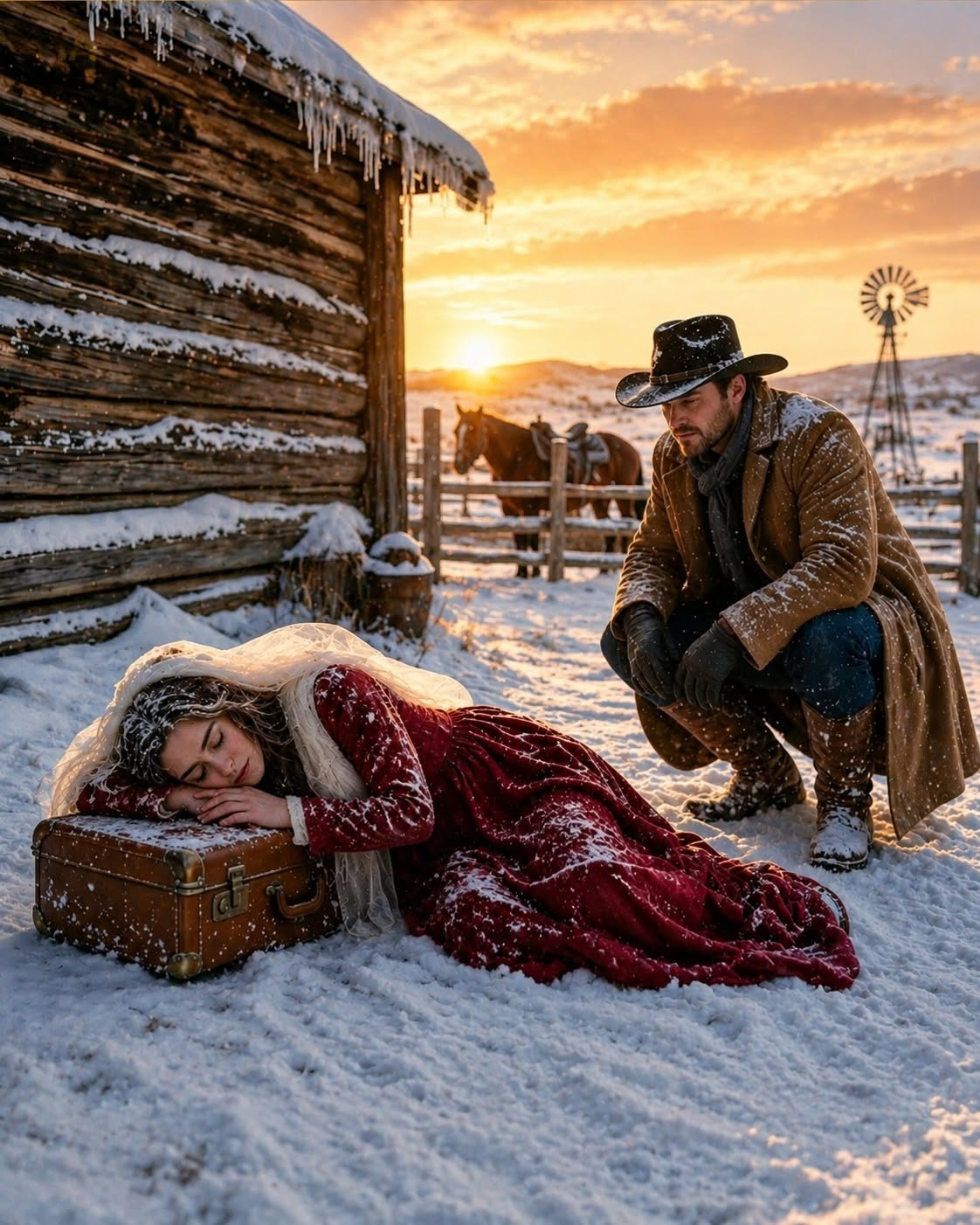
When Wyatt Thorne eventually found me, he carried an old brass lantern that illuminated something strange beside my suitcase.
Three miles had never seemed so far.
"End of the line, miss."
I stared at the driver through the frost-covered window.
For several seconds, I honestly believed I had misunderstood him.
"We're not there yet," I said.
The man sat on the driver's bench with his shoulders hunched against the wind. His face was red from the cold, and his thick wool coat was dusted with snow.
He looked toward the horses.
Then he looked at me.
"Road's near gone. Drifts too deep. Horses won't make the rest."
I tightened my hands around the strap of my traveling bag.
"How far is the ranch?"
"Thorn place is another three miles northeast."
I thought he was joking.
Three miles.
In a Montana blizzard.
I had spent the last several days traveling west, enduring uncomfortable stagecoach seats, terrible food, and nights in unfamiliar boardinghouses. I had crossed more miles than I could remember.
But I had never imagined that the final three would become the most dangerous.
"You can't leave me here," I said.
The driver shrugged.
"Best I can do."
I looked outside.
The world had disappeared.
There was no visible road, no distant town, and no welcoming light from another house. Only white fields and a sky so dark with snow that it seemed impossible the sun was still above the horizon.
"Is there somewhere I can wait?"
"There's fencing not far from here. Follow it. Big ranch house beyond the north pasture."
I swallowed.
"And the rancher?"
"Wyatt Mercer."
Something about the way he said the name made me look at him more carefully.
"Mercer?"
He blinked.
"Wyatt Thorne," he corrected quickly. "Your rancher."
I frowned.
"Which one is it?"
He ignored the question.
Instead, he reached for my suitcase.
I stood immediately.
"Please. At least take me to the ranch gate."
The driver dropped my suitcase into the snow.
It landed on its side.
"Tell Wyatt Mercer I said you should've waited for clear weather."
Before I could ask what he meant, he snapped the reins.
The horses moved.
The stagecoach lurched forward.
I pushed the door open and tried to climb down, but the wind struck me so violently that I nearly fell beneath the wheels.
"Wait!"
The driver did not stop.
I watched the coach disappear into the white distance.
Then even the dark outline of the horses vanished.
I stood alone.
My name was Rosemary Caldwell.
I was twenty-seven years old.
And I had just been abandoned in the Montana wilderness.
I looked down at my suitcase.
Snow was already collecting across its worn brown leather surface.
I bent to pick it up.
My gloves were damp, and the fingers had begun to stiffen. I could barely feel the handle.
Inside that suitcase were two dresses, a hairbrush, a small family photograph, three letters from the man I was supposed to marry, and everything else I had managed to bring from Boston.
Nine dollars were sewn into the lining of my traveling dress.
Nine dollars.
I had counted the money every night since leaving home.
It was all I had left after paying for my passage west.
I could not afford to lose it.
I could not afford to fail.
And I certainly could not afford to return to Boston.
My father had died two years earlier.
He had been a gentle man who worked as a veterinary assistant and spent most of his life caring for animals that belonged to people who could barely afford to feed themselves.
After his death, the small amount of money he had left disappeared into unpaid medical bills and rent.
I had worked in a sewing shop.
Then I had worked in a laundry.
Then I had worked wherever someone was willing to pay me enough to buy bread.
But work had become difficult to find.
My landlord had stopped accepting promises.
The owner of the sewing shop had dismissed three women in one week.
And I had finally understood that staying in Boston without money or family was no longer a choice.
That was why I had answered the advertisement.
A rancher in Montana wanted a wife.
He was described as hardworking, financially independent, and interested in building a family.
His name was Wyatt Thorne.
He had written three letters.
They were not romantic letters.
They were simple, thoughtful, and honest.
He told me about his ranch, the cattle, the winters, and the long distances between neighboring properties.
He said he was not a wealthy man in the way city people understood wealth.
But he had land, a home, and enough work to keep both hands occupied.
In his second letter, he wrote that he believed marriage should begin with honesty rather than promises.
In his third, he asked whether I could imagine making a home in a place where the nearest town was several miles away.
I had answered yes.
Not because I understood Montana.
Because I understood what it meant to have nowhere else to go.
And because something in his letters had made me believe that perhaps a different life was possible.
I lifted my suitcase.
The wind screamed across the open prairie.
I lowered my head and began walking.
At first, I searched for the fence the driver had mentioned.
I could barely see ten feet ahead.
Snow struck my face from the side, slipping beneath my scarf and gathering around the collar of my coat.
My boots sank into the drifts.
Every step required effort.
After several minutes, I found what looked like a dark line beneath the snow.
I followed it.
A fence.
I nearly cried with relief.
I knew that as long as I stayed beside it, I would eventually reach the ranch.
I tightened my grip on the suitcase and continued.
One hundred steps.
One hundred more.
The cold began working its way through my coat.
My toes hurt.
My fingers ached.
I tried to move faster, but the snow made every step difficult.
I remembered something my father had told me when I was a child.
We had been walking through Boston during a particularly brutal January when he noticed a laborer sitting in an alley.
The man had fallen asleep against a brick wall.
My father had rushed toward him.
I remembered the fear in his voice when he discovered how cold the man's hands were.
Later, when we were safely home, Father had held my hands between his palms.
"The cold lies to you first, Rose."
I had laughed because I was young enough to believe the weather could not possibly lie.
He had continued.
"It tells you to rest. It tells you to stop. It tells you that sitting down for a minute won't hurt."
He had looked directly into my eyes.
"Don't listen."
I repeated those words now.
Don't listen.
Keep moving.
I counted my steps.
At one hundred, I allowed myself a breath.
Then I counted again.
The fence disappeared beneath a fresh drift.
I stopped.
For a moment, I could not understand where it had gone.
I turned my head.
Nothing.
Just white.
My heart began beating faster.
I took several steps forward and reached down with my gloved hand.
There.
Wood.
I found the fence again.
I followed it.
The storm grew worse.
My scarf was soaked.
My cheeks burned.
I could no longer feel the tips of my fingers.
At some point, I realized that I was no longer thinking about the wedding.
I was no longer thinking about the house or the letters or whether Wyatt would like me.
I was thinking about the next step.
Only the next step.
That was all I could manage.
Then I saw something ahead.
A dark shape.
At first, I thought it was another section of fence.
But as I approached, it became a large wooden post with a horizontal beam.
A ranch entrance.
Beyond it, I could just make out the shape of a building.
A roof.
A chimney.
A window.
There was a faint orange glow behind the glass.
A light.
A real light.
I tried to walk faster.
My legs did not cooperate.
The suitcase slipped from my hand and disappeared into the snow.
I turned to retrieve it.
The movement made the world spin.
I caught the fence with one hand.
My knees began to buckle.
"No," I whispered.
I had come too far.
I could see the house.
I was almost there.
I forced myself forward.
One step.
Then another.
The snow reached above my ankles.
I could hear the wind, but everything else seemed distant.
My father had once told me that the body knew when it was in danger long before the mind accepted it.
I finally understood what he meant.
My legs felt heavy.
My breathing became shallow.
The ranch house seemed to move farther away each time I looked at it.
I reached for the fence.
My hand missed.
I fell onto my knees.
The snow was cold against my dress.
I tried to stand.
I could not.
I looked toward the house.
A small light moved behind one of the windows.
Someone was inside.
Someone was awake.
I opened my mouth to call for help.
Only a weak sound escaped.
I lowered my head.
For one terrible moment, I thought about the letters in my suitcase.
The first one had arrived in early autumn.
The last had arrived three weeks before I left Boston.
Wyatt had written that he was preparing the guest room.
He had mentioned that the old fireplace needed repairing.
He had also written something that I had read many times.
"I cannot promise you an easy life, Miss Caldwell. But I can promise you that no one in my home will ever have to earn the right to be treated with kindness."
I had kept that sentence folded inside my traveling bag.
I wanted to believe it.
I wanted to believe that somewhere beyond this storm there was a man who meant what he wrote.
I tried to lift my head.
The world became a blur of orange and white.
Then I heard something.
A distant sound.
Hooves.
At first, I thought I had imagined it.
But the sound came again.
Louder.
Someone was approaching.
I tried to turn toward it.
A horse emerged from the storm.
Its dark shape moved through the snow, followed by a man wearing a long navy wool coat and a black cowboy hat.
He pulled the reins.
The horse stopped.
The man looked down.
For several seconds, he did not move.
Then he jumped from the saddle.
"Miss?"
His voice sounded distant.
I tried to answer.
He rushed toward me.
"Miss, can you hear me?"
He dropped to one knee and brushed snow away from my face.
His beard was reddish-brown.
His hair was sandy blond.
His eyes were pale and alert.
He looked like a man who had spent most of his life outdoors.
"Good Lord."
He glanced at my coat, then at the suitcase lying several feet away.
"How long have you been out here?"
I tried to speak.
My lips barely moved.
He leaned closer.
"Look at me. Stay with me."
I wanted to tell him my name.
I wanted to tell him that I had been traveling from Boston.
I wanted to tell him that I was supposed to marry a man named Wyatt Thorne.
But my thoughts were becoming confused.
The stranger carefully removed one glove and touched my cheek.
His expression changed.
"You're freezing."
He looked toward the ranch house.
Then he looked back at me.
"Can you tell me your name?"
I swallowed.
"Rosemary."
His eyes narrowed slightly.
"Rosemary what?"
"Caldwell."
The man went completely still.
I saw something change in his face.
He looked at me more carefully.
Then he glanced toward the suitcase.
"Rosemary Caldwell?"
I tried to nod.
He let out a breath.
For a moment, he seemed unable to believe what he was seeing.
Then he spoke.
"I've been waiting three months for you."
I looked at him.
My vision was fading.
"Wyatt?"
He nodded.
"Wyatt Thorne."
I wanted to smile, but I could not.
I had finally reached him.
I had crossed the wilderness.
I had survived the storm.
And the man who had written those letters was kneeling beside me in the snow.
But something was wrong.
His expression was not simply one of relief.
He looked frightened.
Not frightened for himself.
Frightened by something he had just discovered.
He pulled his coat tighter around me.
"Rose, where's the driver?"
I tried to remember.
"Left."
"Left you here?"
I nodded weakly.
"What did he tell you?"
I struggled to form the words.
"He said... your name was Mercer."
Wyatt's face changed.
The warmth disappeared from his eyes.
He looked toward the road.
Then toward the ranch entrance.
"Mercer?"
I nodded.
"He corrected himself."
Wyatt said nothing.
He slowly turned toward the suitcase.
A gust of wind pushed snow across the ground.
For a moment, neither of us moved.
Then Wyatt carefully lifted me into his arms.
"You're coming inside."
I rested my head against his shoulder.
His coat smelled faintly of leather, wood smoke, and cold air.
He began walking toward the ranch house.
Behind us, my suitcase remained beside the fence.
Wyatt stopped after several steps.
He looked back toward the road.
Then he noticed something.
A set of fresh horse tracks was visible in the snow.
They did not lead toward the ranch.
They led away from it.
And they were not the tracks of the stagecoach.






Comments 0