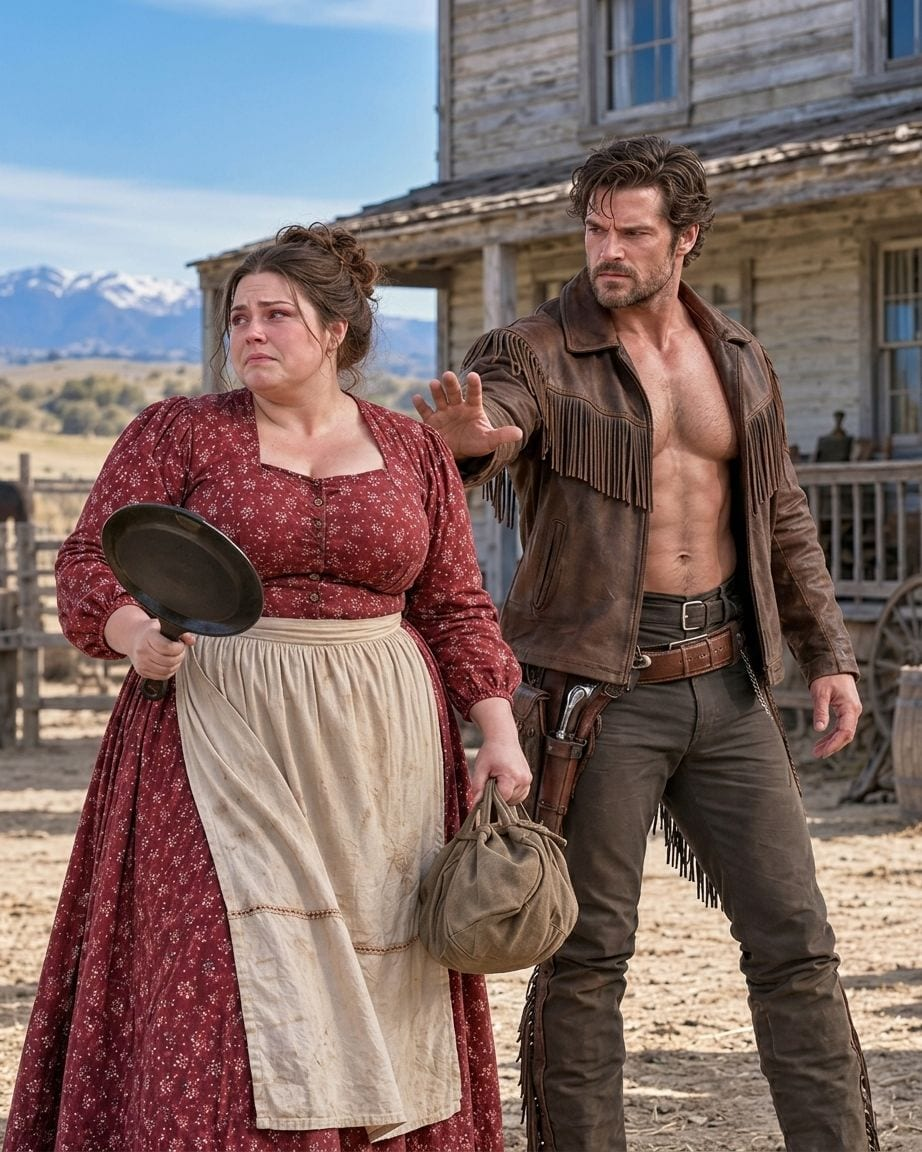
Harrison slammed the study door so hard that the old glass windows rattled.
"Clem! Get away from that window!"
I turned just as a horse galloped past the front gate.
A rider had stopped outside the property.
He wasn't carrying a delivery or looking for work.
He was watching our house.
And when Harrison recognized the man, his expression changed.
"Dalton's sending us a warning," he muttered.
I looked toward the stranger.
"What kind of warning?"
Harrison reached for his gun belt.
"The kind that means somebody knows what we're looking for."
I had been at Ironweed Ranch for barely two days, yet somehow I had already become part of a mystery that had existed long before I arrived.
My mother's name was in Arthur Cole's private ledger.
There was a photograph of her standing outside this very ranch.
And now a powerful banker seemed terrified of an old document.
I wanted answers.
But Harrison wasn't ready to give them to me.
"Stay inside," he ordered.
Then he walked out.
I watched him cross the porch, his long leather jacket moving in the afternoon breeze. The stranger immediately turned his horse toward the road.
Harrison called after him.
The rider didn't stop.
Instead, he raised one hand.
A small gesture.
Almost like a greeting.
Then he disappeared behind the distant hills.
Harrison returned twenty minutes later with a look that made me regret asking questions.
"Who was he?"
"Nobody you need to worry about."
"People don't ride all the way out here to stare at a farmhouse."
He removed his hat and placed it on the table.
"His name is Silas Boone. He used to work for my uncle."
"Why was he watching us?"
"Because he has always been interested in things that don't belong to him."
I studied his face.
"Like the deed?"
Harrison looked at me sharply.
"Especially the deed."
He walked toward the fireplace and stared into the flames.
For a moment, he seemed older than his thirty-five years.
I had begun to notice that about him.
He carried his troubles like a man who had been taught never to put them down.
Even when the ranch hands laughed, even when the kitchen smelled of fresh bread, there was something guarded in his expression.
He never smiled for long.
And he rarely spoke about himself.
I wondered whether he had always been that way.
Or whether Ironweed had made him so.
"Mr. Cole," I said quietly.
He turned.
"If my mother knew your uncle, why didn't she ever tell me?"
"I don't know."
"Do you think Arthur had something to do with her life?"
Harrison looked down at the ledger.
"I think your mother knew something about this property that nobody else wanted discussed."
That answer frightened me more than I expected.
Before I could ask another question, the kitchen bell rang.
One of the ranch hands had pulled the rope.
Harrison sighed.
"That's supper."
I looked at the clock.
He was right.
I returned to the kitchen, but my thoughts remained in the study.
That evening, I prepared roasted chicken, mashed potatoes, green beans, and fresh cornbread.
The men were hungry after spending the afternoon repairing the western fence.
Samuel Price entered first, carrying a bundle of firewood.
"Need any help, Miss Clem?"
I smiled.
"Could you bring that wood closer to the stove?"
He dropped it beside the hearth.
"Sure thing."
Another ranch hand, Thomas Bell, leaned against the doorway.
"Samuel's been volunteering in here every evening."
Samuel turned red.
"I like helping."
Thomas grinned.
"Must be the biscuits."
The men laughed.
Even I couldn't help smiling.
For the first time since arriving, the kitchen felt like a place where I belonged.
Then Jebidiah Rust walked in.
He glanced at the food and immediately frowned.
"What's all this?"
"Dinner," I replied.
He picked up a piece of cornbread.
"Looks expensive."
"It's flour, cornmeal, and butter."
"Boss paying you extra for butter?"
"No."
"Then perhaps you ought to learn how to stretch a dollar."
I wiped my hands on my apron.
"Perhaps you ought to learn how to appreciate a meal someone else prepared."
The room fell quiet.
Jebidiah narrowed his eyes.
Before he could respond, Harrison entered.
"Something wrong?"
Jebidiah immediately changed his expression.
"Just discussing expenses, boss."
Harrison looked at the cornbread in his hand.
Then at the empty plate he had already filled with chicken.
"Funny. I don't remember asking you to manage my kitchen."
Jebidiah placed the bread down.
"No, sir."
"Then eat your supper."
The foreman took his seat.
I turned toward the stove, hiding a smile.
Harrison sat at the far end of the table.
He ate quietly, listening to the men talk about cattle and fence repairs.
Occasionally, he glanced in my direction.
When supper ended, I began collecting plates.
He remained seated.
"That was good," he said.
I raised an eyebrow.
"Just good?"
He looked at his empty plate.
"Excellent."
"That's better."
A faint smile appeared on his face.
It vanished almost immediately.
But I had seen it.
And for reasons I couldn't explain, I wanted to see it again.
The following morning, I discovered that the ranch had more problems than its damaged fences.
The flour supply was almost gone.
The meat cellar needed cleaning.
The kitchen roof had developed another leak.
And the wagon that was supposed to bring fresh supplies from Bitter Creek had not returned.
I found Harrison examining a stack of bills near the dining room.
"Mr. Cole?"
He looked up.
"Yes?"
"We need flour, coffee, salt, and meat."
He rubbed his eyes.
"Put it on the list."
"I did."
"Then give it to me."
I handed him the paper.
He studied the numbers.
His jaw tightened.
"That's more than I expected."
"The prices have increased."
"I know."
He placed the list on the desk.
For the first time, I noticed how thin the stack of banknotes beside him had become.
"Is the ranch having financial trouble?"
He looked at me.
"Every ranch has financial trouble."
"That wasn't what I asked."
He leaned back.
"Arthur left debts. I inherited them. Cattle prices fell, and the last winter killed more animals than I care to remember."
I waited.
He continued.
"I've spent two years trying to keep this place alive. Some days I think the ranch is determined to bury me before I can save it."
I understood that feeling.
After Mother died, I had spent months trying to keep our cottage while working whatever jobs I could find.
There were nights when I went to bed hungry because I had chosen to buy medicine instead of food.
"I know what it's like to lose something you cannot replace," I said.
Harrison looked at me.
"Your mother?"
I nodded.
"She was all I had."
He lowered his gaze.
"I'm sorry."
The words were simple.
But he spoke them with such sincerity that I felt something loosen inside my chest.
"Thank you."
He looked toward the window.
"She must have been a remarkable woman."
"She was."
I thought about the photograph.
About the letter.
About the mysterious connection between Abigail O'Reilly and Arthur Cole.
"She was also very good at keeping secrets."
Harrison looked back at me.
"Then perhaps we have more in common than we thought."
That afternoon, I went into Bitter Creek to purchase supplies.
I wore my burgundy dress, tied my cream apron over it, and carried a basket containing the shopping list and Mother's purse.
The moment I stepped onto the boardwalk, I noticed Martha Higgins standing outside the general store.
She was surrounded by three women.
Her eyes immediately found me.
"Well, if it isn't Ironweed's new housekeeper."
I continued walking.
"Good afternoon, Mrs. Higgins."
She opened her lace fan.
"I heard you've been spending quite a lot of time with Harrison Cole."
I stopped.
"I work for him."
"Of course you do."
One of the women giggled.
Martha leaned closer.
"People are beginning to talk, Clementine."
"People have been talking about me since I was twelve."
Her smile tightened.
"Surely you don't believe a man like Harrison would ever consider marrying someone like you?"
I looked directly at her.
"I haven't asked him to."
Martha's cheeks colored.
"Well, I should hope not."
I turned toward the general store.
Then I heard her next words.
"Some women simply don't know their place."
I stopped again.
For a moment, I considered turning around.
Instead, I remembered my mother's voice.
Don't let cruel people decide how you see yourself.
I opened the store door.
Inside, the owner, Mr. Whitaker, greeted me.
"Morning, Miss O'Reilly."
"Good morning. I need flour, coffee, salt, and several other things."
He began collecting the supplies.
While he worked, I noticed a framed photograph behind the counter.
It showed several men standing outside a large ranch house.
One of them was Arthur Cole.
Another was a younger version of Amos Dalton.
And standing between them was my mother.
I stepped closer.
"Mr. Whitaker?"
He followed my gaze.
"What is it?"
"Do you know this woman?"
He examined the photograph.
His expression changed.
"That's Abigail."
My throat tightened.
"You knew her?"
"Everybody knew Abigail."
"What was she doing with those men?"
He looked toward the store windows.
Then he lowered his voice.
"She wasn't just a cook, Miss O'Reilly."
I stared at him.
"What do you mean?"
He carefully removed the photograph from the wall.
"There are things about Ironweed that most people have forgotten. Your mother was involved in something important."
"Something involving the land?"
He didn't answer.
Instead, he placed the photograph back on its hook.
"You should speak with Harrison."
"I have."
"Then speak with him again."
He finished packing my supplies.
Before I left, he caught my wrist gently.
"Your mother was a good woman, Clementine. Whatever happens, don't let Amos Dalton convince you otherwise."
I walked out of the store feeling as though the ground beneath my feet had shifted.
Martha was still outside.
She watched me leave.
This time, she didn't laugh.
When I returned to Ironweed, Harrison was in the stable.
He was tightening a saddle strap while Samuel repaired a broken gate hinge.
I placed the supplies on the kitchen counter and walked outside.
"Harrison, I need to speak with you."
He looked up.
"Everything all right?"
"I found a photograph in the general store."
I described it.
His expression became serious.
"Arthur and Dalton were standing with your mother?"
"Yes."
"Did Whitaker say anything?"
"He said she was involved in something important."
Harrison stopped working.
Then he placed the saddle aside.
"Come with me."
He led me to the study and opened a drawer beneath his desk.
Inside was a collection of old papers tied with a leather cord.
He removed a folded letter.
"I found this among Arthur's belongings last night."
He handed it to me.
The handwriting was unfamiliar.
But the name at the bottom was unmistakable.
Amos Dalton.
The letter was dated twenty-three years earlier.
It contained only a few paragraphs.
I read them slowly.
Arthur,
You must understand that this arrangement cannot continue. Abigail has no intention of surrendering her claim, and the longer you delay, the greater the risk that the entire agreement will become public.
The property cannot remain in two names indefinitely.
Make her understand that silence is in everyone's best interest.
A.D.
I read the letter again.
My fingers began to tremble.
"What arrangement?"
Harrison shook his head.
"I don't know."
"Why would my mother have a claim to Ironweed?"
"That's what we're trying to find out."
He took the letter back and studied the signature.
"Dalton knew your mother. He knew about the agreement. And he apparently wanted her to remain silent."
"About what?"
Harrison looked at me.
"Perhaps about who really owned this ranch."
The room became very still.
I thought about the photograph.
The ledger.
My mother's letter.
And the strange instruction telling me to come to Ironweed.
"Do you think my mother owned this property?"
Harrison didn't answer immediately.
Then he said something that made my heart stop.
"I think your mother may have been the reason Arthur never sold it."
That night, the wind grew stronger.
I was washing the final dishes when I heard a horse outside.
I dried my hands and looked through the kitchen window.
A rider had arrived.
He wore a dark coat and kept his hat pulled low.
Harrison stepped onto the porch.
The stranger dismounted.
I couldn't hear their conversation, but I saw Harrison's shoulders stiffen.
Then the stranger handed him a folded envelope.
Harrison opened it.
He read the first line.
His face went completely pale.
The stranger mounted his horse and rode away without another word.
I hurried toward the front door.
"What happened?"
Harrison didn't respond.
He stared at the paper as though it contained something he had spent his entire life trying not to believe.
I stepped closer.
"Harrison?"
He finally looked at me.
His eyes were filled with anger.
And fear.
"Clem, there's something you need to know."
He turned the paper toward me.
At the top was my mother's full name.
Below it was a date.
And at the bottom was a sentence written in bold black ink:
ABIGAIL O'REILLY DID NOT DIE OWNING THE LAND SHE HAD BEEN PROMISED.
Harrison reached for the second page.
But before he could unfold it, someone began pounding violently on the front door.
Then a familiar voice shouted from outside.
"Open up, Harrison! It's Sheriff Clemens!"
Harrison looked at me.
The sheriff shouted again.
"There's been a murder in Bitter Creek!"
And then he called out the name of the person they had come to arrest—
"Clementine O'Reilly!"






Comments 0