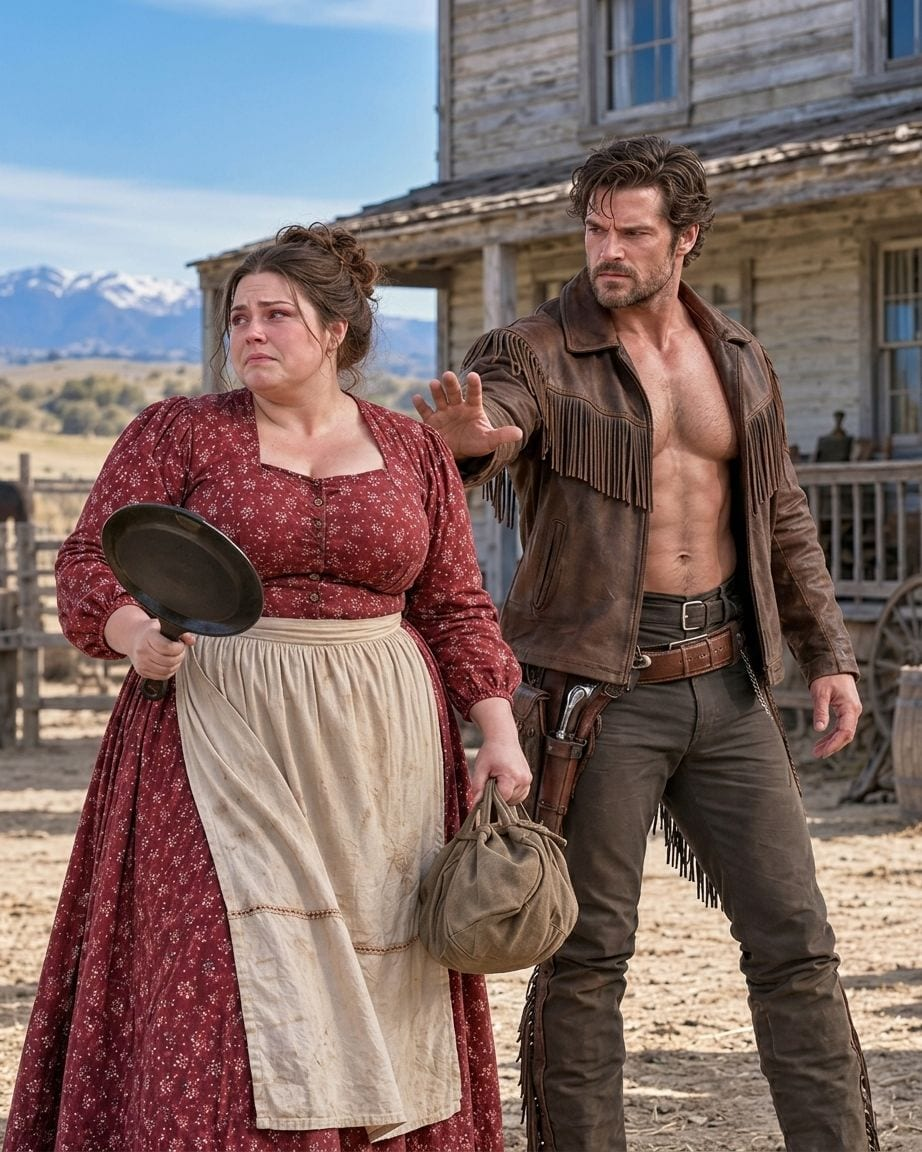
I knocked on the heavy oak door of Ironweed Ranch and held my battered cast-iron skillet against my chest.
"Please, sir. I need work."
Harrison Cole opened the door and stared at the skillet before looking at the woman holding it.
A small crack ran along its wooden handle, the same skillet my mother had used for nearly thirty years.
He had no idea that the woman standing on his porch would change his entire life.
My name was Clementine O'Reilly, although almost everyone who knew me called me Clem.
I was thirty-two years old, heavyset, and accustomed to being noticed for all the wrong reasons. My broad shoulders, thick arms, round face, and full figure had made me an easy target for people who believed a woman's worth could be measured by the size of her waist.
I had learned early that some people would laugh before I even opened my mouth.
In Bitter Creek, Wyoming, that was practically a local tradition.
The women who gathered outside the general store whispered whenever I passed. The younger men snickered behind their hands, and the older ones pretended not to see me while making certain I heard every insult.
Martha Higgins, the mayor's wife, was particularly talented at making cruelty sound like respectable conversation.
"Poor Clementine," she once announced to a group of women outside the church. "At her age, with that figure, she ought to be grateful if somebody offers her a roof over her head."
I had been carrying a basket of potatoes when she said it.
I stopped, looked at her, and continued walking.
There was no point arguing with people who had already decided who you were.
My mother, Abigail O'Reilly, had taught me that dignity was something I could keep even when the whole world tried to take it away.
She had raised me alone in a small rented cottage outside town. We never had much money, but we always had food, and our kitchen was the one place where I never felt unwanted.
Mother had possessed a remarkable talent for turning inexpensive ingredients into meals that could make a hungry man forget his troubles.
Her biscuits were legendary.
Her sausage gravy could bring a grown cowboy to tears.
And her cast-iron skillet had survived more years of cooking than I could count.
When winter fever took her, the cottage became unbearably quiet.
She left me three things: the skillet, a battered recipe book, and a letter written in her careful handwriting.
I kept that letter folded inside my dress pocket for months.
I had read it so many times that I could almost remember every word without opening it.
But one sentence remained especially clear.
"If the wolves ever come to your door, Clementine, go to Ironweed Ranch. Offer your services. Don't ask for charity. Just get your foot in the door."
I never understood why she had chosen that particular ranch.
Ironweed had a reputation for bringing misfortune to everyone who lived there.
Its former owner, Arthur Cole, had died after years of gambling, drinking, and making enemies.
His nephew, Harrison Cole, had inherited the property along with its debts.
People said Harrison was stubborn, difficult, and incapable of keeping anyone around for long.
He had hired ranch hands, lost ranch hands, and hired more.
He had even advertised for a cook three times.
Nobody stayed.
For months, I ignored Mother's advice.
I told myself I could find work in town.
I tried cleaning rooms at the hotel, but the owner decided my appearance would discourage respectable guests.
I applied to help at a boardinghouse, but its manager laughed and asked whether I planned to eat more than I earned.
Then my landlord gave me three days to leave my cottage.
I had fallen behind on the rent after spending my remaining savings on medicine for Mother.
I packed my clothes, folded the recipe book carefully, wrapped the skillet in an old towel, and tied everything into a canvas bag.
The following morning, I walked five dusty miles toward Ironweed Ranch.
By the time I reached the property, my boots hurt, my shoulders ached, and the afternoon sun had turned the back of my neck red.
The ranch looked as though it had survived a war.
Its wooden fences leaned in several directions. The stable roof needed repairs, and the front porch had a loose board that creaked beneath my feet.
I raised my hand and knocked.
That was when Harrison Cole opened the door.
He was taller than I expected, with broad shoulders, dark wavy hair, and a rugged face covered in several days of stubble.
His brown leather jacket hung open over a dark shirt. A gun belt rested around his waist.
He looked tired.
Not ordinary tired, either.
He looked like a man who had spent so many nights fighting problems that he had forgotten what a peaceful morning felt like.
His eyes moved from my face to my canvas bag.
Then they settled on the skillet.
"You lost, Miss?"
"No, sir. I heard you needed a cook."
He rubbed his forehead.
"I need a miracle, Miss. A cook will have to do."
I straightened my back.
"I can cook."
He gave a short, humorless laugh.
"That's what the last three women told me."
"I won't promise you anything I can't deliver."
He leaned against the doorframe.
"Fifteen men. Breakfast before sunrise. Dinner after they return from the fields. The kitchen roof leaks, the stove smokes, and the pay isn't generous."
"I am not afraid of hard work."
"Can you cook for fifteen hungry cowboys?"
"Can you afford to keep fifteen hungry cowboys?"
For the first time, something resembling amusement crossed his face.
He studied me for another moment.
Then he stepped aside.
"Come in, Miss O'Reilly."
I walked through the doorway.
The house smelled of old wood, tobacco, and stale whiskey. A pair of muddy boots sat beside the fireplace. Papers covered a desk in the corner, and an empty bottle rested on the windowsill.
The kitchen was worse.
A blackened stove stood against the far wall. Dirty pans filled the sink, and several empty flour sacks lay beneath the counter.
I looked around without saying anything.
Harrison crossed his arms.
"Still interested?"
I put down my bag.
"Where do you keep the flour?"
He blinked.
"What?"
"The flour, Mr. Cole. And the bacon, if you have any."
He pointed toward a pantry.
I inspected the shelves, lifted a flour sack, and checked the remaining ingredients.
There wasn't much.
But there was enough.
"I'll need fresh eggs, buttermilk, sausage, potatoes, and coffee," I said.
"That's quite a list."
"Fifteen men are quite a responsibility."
He stared at me.
Then he laughed.
It was the first genuine laugh I had heard since arriving.
"All right. You start tomorrow. Four o'clock."
"I'll be here."
"Three-thirty."
I raised an eyebrow.
"Four."
He shook his head.
"You're already negotiating."
"I haven't even started working yet."
He handed me a small advance and showed me a narrow bedroom near the kitchen.
It contained a wooden bed, a washbasin, and a small window overlooking the stable.
It wasn't much.
But it was mine for as long as I could earn my keep.
That evening, I unpacked my belongings.
I placed Mother's recipe book beside the bed and set the skillet on the little wooden table.
Then I unfolded her letter.
The final paragraph had a sentence I had never fully understood.
"Remember, Clem, Ironweed has a history older than the Coles themselves. If anyone tells you that you don't belong there, don't believe them."
I read it twice.
Why would Mother have known so much about Ironweed?
I had asked her once, years earlier, whether she had ever worked there.
She had changed the subject immediately.
I had never pressed her.
Now I wished I had.
A sharp knock interrupted my thoughts.
I opened the door.
A thin, wiry man stood in the hallway wearing a dusty hat and a red bandanna around his neck.
He was perhaps fifty, with narrow eyes and a permanent expression of contempt.
"You're the new cook?"
"Yes."
"Jebidiah Rust. Foreman."
He glanced at my room, then at the skillet on the table.
His mouth twisted.
"Boss must be desperate."
I said nothing.
He stepped closer.
"Listen carefully, lady. The men here work hard. They don't need some oversized woman slowing everybody down."
I held his gaze.
"Then they'll be pleased when breakfast is ready."
He chuckled.
"Don't get too comfortable. The last cook lasted four days."
"Perhaps the last cook wasn't given a fair chance."
His smile disappeared.
"Watch your mouth, Pork Chop."
He walked away before I could answer.
I closed the door quietly.
My hands were shaking, but not because I was frightened.
I was angry.
I had spent too many years allowing strangers to decide how much space I was permitted to occupy.
That night, I slept very little.
At three-thirty in the morning, I lit the kitchen stove.
The first flame struggled beneath the old iron burners. Smoke curled toward the ceiling, and the chimney rattled in the wind.
I tied my apron tightly around my waist and began working.
I fried thick slices of bacon.
I peeled potatoes.
I mixed flour, buttermilk, butter, and baking powder until the dough came together beneath my hands.
I prepared sausage gravy with black pepper and a little sage.
By five o'clock, the kitchen smelled like the home I had shared with Mother.
I was turning the first batch of biscuits when footsteps sounded outside.
The ranch hands were waking.
I heard a man's voice.
"What's that smell?"
Another answered, "Something good. Better be, because I'm starving."
The kitchen door swung open.
Jebidiah entered first.
He looked at the table.
His mouth opened slightly.
Behind him, fourteen hungry cowboys crowded into the doorway.
For several seconds, nobody spoke.
Then one of the men stepped forward, picked up a biscuit, and broke it open.
Steam rose from its golden center.
He looked at me.
"Ma'am, what exactly did you put in these?"
I smiled.
"Breakfast."
The men laughed.
And then they sat down.
I watched them eat, one plate after another disappearing beneath hungry hands.
Jebidiah tried to maintain his contempt, but his third biscuit made that increasingly difficult.
From the doorway, Harrison watched the entire scene.
He had arrived without making a sound.
His gaze moved across the table, then settled on me.
For the first time, I saw the exhaustion leave his face.
He poured himself a cup of coffee.
"Miss O'Reilly."
I turned.
"Yes, Mr. Cole?"
He lifted his cup.
"You may have just saved this ranch."
I returned to the stove.
"I only made breakfast."
But Harrison didn't look away.
And neither did Jebidiah.
Because the foreman had just realized something that would make the coming weeks considerably more difficult.
The woman he had mocked was becoming the most important person in Ironweed Ranch.
And that afternoon, when I carried a basket of clean towels past the old study, I heard Harrison speaking to someone behind its closed door.
Then I heard a name.
My mother's name.
"Abigail O'Reilly..."






Comments 0