My father stared at the photograph as though it had betrayed him.
Grandad held it between his fingers.
Nobody spoke.
Then he turned it around again and read the handwriting.
"Three children sharing until we can find a bigger house. David promised."
The room seemed to shrink.
I looked at Dad.
He was staring at the back of the photograph.
"Who wrote that?" I asked.
Grandad looked at me.
"I did."
Beth immediately shook her head.
"That was years ago. Circumstances changed."
Grandad didn't look at her.
"Your father told me it was temporary. I remember because Daniel was sleeping on a bunk bed, and you girls were sharing the other room."
There was a short silence.
"Jamie," I corrected gently. "Daniel, Jamie, and me."
Grandad nodded.
"That's right. The three of you."
My father rubbed his forehead.
"Can we please stop making everything sound terrible? We had a house full of children. We did the best we could."
Daniel gave a quiet laugh.
It wasn't a happy sound.
"Did you?"
Dad looked at him.
"Don't start."
Daniel folded his arms.
"I'm not starting anything. I'm asking a question."
Beth stepped closer to the coffee table.
"Your grandfather is remembering things incorrectly. The house was perfectly adequate. All five children had somewhere to sleep."
I looked at her.
"That's not the same as having a home."
She gave me a hard stare.
I knew that expression.
It was the one she used when she wanted me to understand that I had crossed some invisible boundary.
For most of my childhood, I had responded to that look by becoming quiet.
I had learned to apologize even when I hadn't done anything wrong.
But standing there as an adult, I found myself wondering why I had ever been so frightened of it.
Grandad placed the photograph on the table.
"Let's look at the rest."
Beth shook her head.
"I really don't think that's necessary."
"Then you won't mind."
He reached into the box.
My aunt stood beside him, watching carefully.
I noticed that she looked uncomfortable too.
Perhaps she had never expected the afternoon to turn into this.
Neither had we.
I sat on the edge of the sofa.
Jamie sat beside me, and Daniel remained standing.
Dad had moved toward the window.
He was still holding himself as though he wanted to leave but didn't want anyone to notice.
I looked down at the photographs.
There were so many.
Some were from Wales.
Some were taken after the wedding.
Others showed birthdays, Christmas gatherings, and ordinary family afternoons.
I found one of Daniel holding Jamie when he was very small.
Another showed me sitting on Mum's lap.
I couldn't remember the day, but I recognized her cardigan.
Yellow.
The same one I had remembered for years.
I touched the edge of the photograph.
"She looks happy," Jamie said.
I nodded.
"She was."
He looked at it for a moment.
Then he gently moved it away from the others, as though it deserved its own space.
Grandad watched us.
"Your mother loved having you all together."
I swallowed.
"I wish I remembered more."
He sat down opposite us.
"You were very young, love."
"I know."
"She used to take you to the park on Sundays. Daniel would run ahead, Jamie would want to be carried, and you would insist on collecting leaves."
I smiled faintly.
"I remember the leaves."
Grandad nodded.
"She kept some of them in a little book."
I looked up.
"Really?"
"Yes. I think your grandmother still has it somewhere."
For a moment, the birthday party disappeared from my thoughts.
I imagined Mum collecting leaves with us.
I imagined her laughing.
I imagined a version of our childhood that had continued with her in it.
Then Beth spoke.
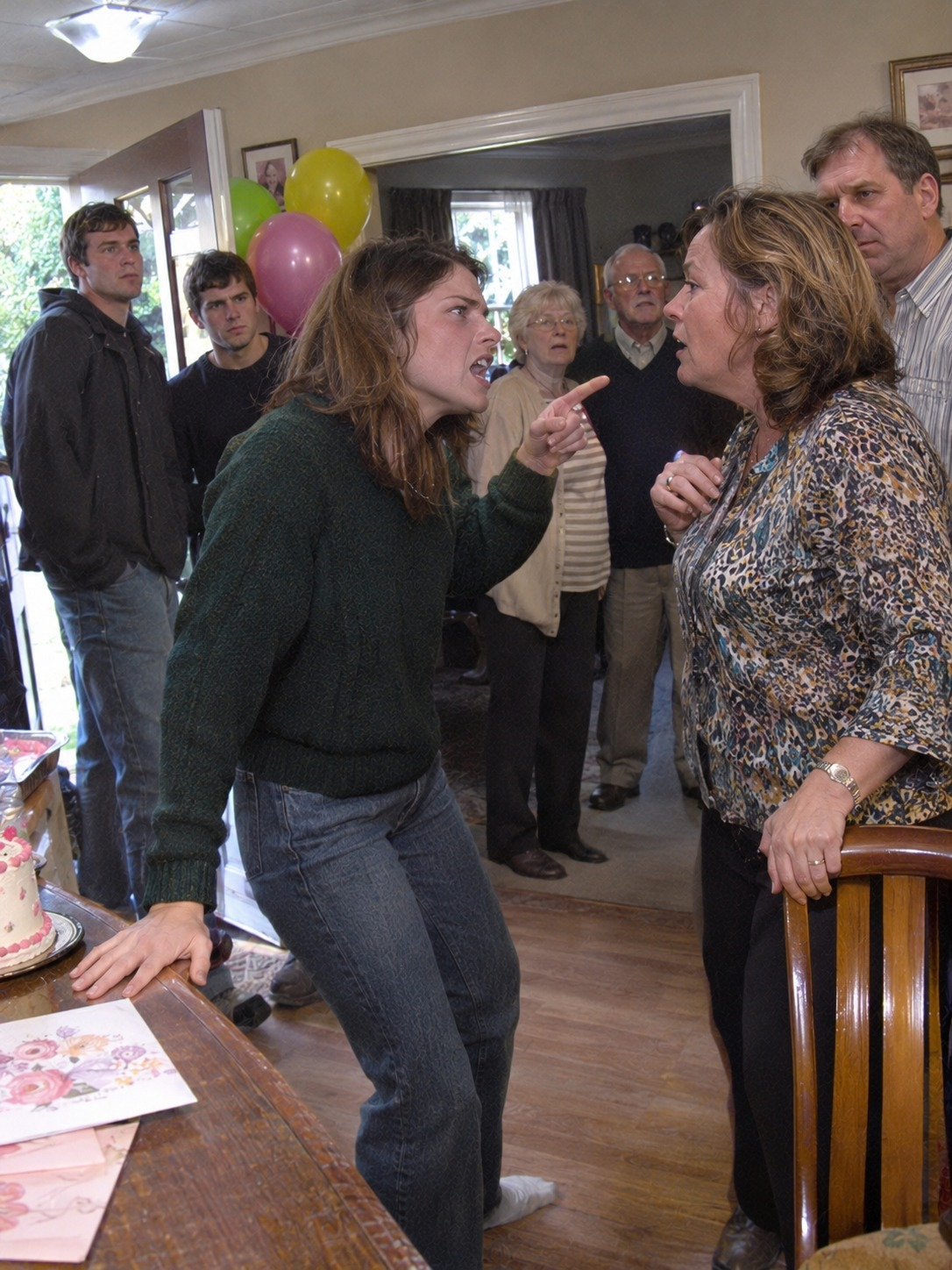
"Can we please get back to the actual issue?"
I looked at her.
"What issue?"
"The accusations. The way you're speaking about your father."
I almost answered.
But Daniel spoke first.
"Maybe we should talk about the way he treated us."
Dad turned.
"I treated you exactly the same as the others."
Jamie looked up.
"No, you didn't."
Dad's expression tightened.
"What makes you say that?"
Jamie didn't hesitate.
"Everything."
The word hung in the air.
I looked at my younger brother.
He rarely spoke about our childhood unless one of us brought it up.
For years, he had preferred to avoid arguments.
But now he was sitting upright, looking directly at Dad.
"You remember when we moved into the house?" he asked.
Dad sighed.
"Yes."
"Do you remember where we slept?"
"Of course I remember."
"Then tell everyone."
Dad didn't answer.
Jamie glanced toward the photograph.
"Beth's children had their own rooms. Daniel and I shared the bunk bed, and she had the single bed."
I looked at him.
He had remembered it incorrectly in one small detail.
I had the single bed.
But I understood what he meant.
He was remembering the room as it had felt to him.
Crowded.
Temporary.
Not ours.
I corrected him gently.
"I had the single bed."
He nodded.
"Right. You did."
Beth gave an impatient sigh.
"Honestly, are we really discussing bedroom arrangements from twenty years ago?"
"Why not?" Daniel asked.
"Because it's ridiculous."
Daniel looked at her.
"It mattered to us."
She rolled her eyes.
I remembered that too.
How often she had dismissed things because they seemed unimportant to her.
The bedroom was one example.
The presents were another.
The television.
The holidays.
The food.
The opportunities.
Each individual incident seemed small when described separately.
But children don't experience their childhood as a collection of isolated events.
They experience it as a pattern.
And our pattern was simple.
Her children belonged.
We were expected to fit around them.
The first bedroom argument I remembered clearly happened during our second year in England.
I was about ten.
Daniel was twelve, and Jamie was nine.
Beth's daughter had been given a new dressing table.
It was white, with a mirror and several little drawers.
She spent an entire afternoon arranging perfume bottles, hairbrushes, and ornaments across its surface.
I thought it was lovely.
That evening, I went into our room and looked at the windowsill.
My belongings were still there.
The little ceramic rabbit.
My hairbrush.
A notebook.
A photograph of Mum, which I had carefully hidden inside the notebook.
I began moving everything into a small box.
Beth appeared at the doorway.
"What are you doing?"
"Making some space."
She looked at the windowsill.
"Good. It looks untidy."
I nodded.
Then I asked whether I could have a small shelf above my bed.
"Why?"
"Just somewhere to put my things."
She looked around the room.
"You already have somewhere to put your things."
I pointed toward the small drawer beside the bed.
It was shared with Jamie.
Beth frowned.
"Well, you'll have to organize yourselves better."
Then she walked away.
I remember sitting on the bed afterward.
It wasn't really about the shelf.
I wanted somewhere that felt like mine.
A little space where I could put something without worrying that somebody would decide it was untidy or unnecessary.
Daniel noticed me looking at the empty windowsill.
"What's wrong?"
"Nothing."
He sat down beside me.
"That's not convincing."
I explained.
He listened without interrupting.
Then he took a small wooden box from beneath his bed.
It had once contained a watch.
He emptied it and handed it to me.
"Here."
I looked inside.
"What for?"
"Your important things."
I smiled.
"Thank you."
He shrugged.
"Just don't fill it with rubbish."
I laughed.
It was a small moment.
But I kept that box for years.
Even after we moved out.
At Grandad's house, Daniel was now looking through the photographs.
He picked up one showing the five children standing outside the old house.
"Do you remember this?" he asked.
I leaned closer.
We were all wearing coats.
Beth's daughter stood beside her brother.
Daniel had one arm around Jamie.
I was holding a small toy.
"Yes," I said.
"That was the day we went to the park."
Jamie looked at the picture.
"I remember the ice cream."
Daniel smiled.
"You dropped yours."
"I was little."
"You cried for twenty minutes."
"I was devastated."
I laughed.
For a moment, it felt almost normal.
Then Daniel turned the photograph over.
There was another handwritten note.
This one was shorter.
It read:
"First family outing after the move."
Grandad looked at it.
"I wrote that too."
Beth shook her head.
"Why are you keeping all these things?"
Grandad finally looked at her.
"Because they matter."
She folded her arms.
"You're making it sound as though the children were deliberately excluded. They weren't."
I looked at her.
"Then why did everything feel different?"
She stared at me.
"You were difficult children."
Daniel's expression changed.
"What?"
Beth seemed surprised that he had spoken.
"You heard me."
Daniel stepped forward.
"What exactly made us difficult?"
"You argued. You questioned everything. You never appreciated what your father did for you."
I felt something tighten in my chest.
I remembered how often we had tried to avoid arguments.
How carefully we had behaved.
How we had learned not to ask for things.
But apparently even that had been too much.
Jamie spoke quietly.
"We were children."
Beth looked at him.
"Exactly. Children need discipline."
"Your children needed discipline too," I said.
Her face tightened.
"Don't bring my children into this."
I almost laughed.
Her children had been part of every comparison for years.
But now that the comparison was uncomfortable, she wanted them removed from the conversation.
I looked toward Dad.
"Did you ever notice how differently we were treated?"
He picked up his glass again.
"I don't remember every little thing."
"Of course you don't."
"You're expecting me to remember something that happened years ago."
I nodded slowly.
"I remember."
He looked at me.
I continued.
"I remember who got their own bedroom. I remember who was allowed to invite friends over. I remember who got new things and who was told to make do. I remember asking for a shelf and being told I already had enough space."
Dad shook his head.
"That's not a fair way to describe things."
"What would be fair?"
He didn't answer.
I looked toward the box.
There were more photographs inside.
One showed us standing beside a Christmas tree.
Another showed Beth's daughter holding a large wrapped present.
Daniel was beside her, holding a small package.
I remembered that Christmas.
I remembered being excited about the decorations.
I remembered Dad telling us that money was tight.
I remembered trying to look pleased with what we received.
I also remembered Beth's children opening expensive presents.
At the time, I hadn't understood why there was such a difference.
I had simply assumed that perhaps we weren't supposed to expect the same things.
Grandad noticed which photograph I was holding.
"That was Christmas at your father's house, wasn't it?"
I nodded.
"Yes."
He looked at the picture.
"I remember asking Daniel whether he had received anything else."
Daniel gave a small smile.
"You asked me whether I was happy."
"And you said you were all right."
Daniel shrugged.
"I was."
Grandad looked at him.
"You didn't have to pretend."
Daniel's smile disappeared.
"I know that now."
The room became quiet.
I thought about all the times Daniel had protected us by pretending not to care.
He had always been the oldest.
He had been expected to understand.
To be sensible.
To make things easier.
But he had been a child too.
He had wanted things.
He had deserved things.
And nobody had asked him whether he was happy.
My aunt finally spoke.
"I remember something about the bedrooms."
Everyone turned toward her.
She looked at Grandad.
"Do you remember when we visited after the move? I asked where the children were sleeping."
Grandad nodded slowly.
"Yes."
My aunt looked toward Dad.
"You told us it was temporary."
Dad sighed.
"It was temporary."
"Then why did nothing change?"
He didn't answer.
Beth stepped in.
"There were financial pressures. We couldn't simply make another bedroom appear."
My aunt looked at her.
"Nobody expected that."
"Then what did you expect?"
"Perhaps that the three children would have a little more space as they got older."
Beth shook her head.
"You weren't living in the house. You don't know what it was like."
My aunt nodded.
"You're right. I wasn't."
She paused.
"But I do remember visiting and finding Daniel sleeping on a mattress on the floor because the bunk bed was broken."
Daniel looked at her.
I turned toward him.
"What?"
He looked uncomfortable.
"It happened once."
"Once?"
"The frame broke. Dad said he'd fix it."
I stared at him.
"When?"
Daniel shrugged.
"I don't remember."
My aunt looked at Dad.
"You told me it had been replaced."
Dad rubbed his forehead.
"It was fixed."
Daniel shook his head.
"No, it wasn't."
Beth became visibly irritated.
"Can we stop exaggerating every minor inconvenience?"
Jamie looked at her.
"Why does everything become an exaggeration when it happens to us?"
Nobody answered.
Grandad slowly closed one of the photograph albums.
He looked tired.
But there was something else in his expression.
He was beginning to understand that what he had believed about our childhood was incomplete.
Perhaps he had known there were differences.
Perhaps he had thought they were ordinary disagreements between children.
Perhaps he had assumed that Dad would tell him if anything serious was happening.
I wondered how many times we had been asked whether we were all right.
And how many times we had said yes.
Because it was easier.
Because we didn't want to cause trouble.
Because we had learned that telling the truth didn't necessarily make anything better.
Grandad looked at me.
"Why didn't you tell us?"
I stared at him.
I wanted to answer honestly.
But there were too many answers.
We had been young.
We had been frightened.
We had thought our father would protect us.
We had been embarrassed.
We had worried that nobody would believe us.
And eventually, we had become so accustomed to the situation that we stopped recognizing how wrong it was.
"I don't know," I said.
Then I corrected myself.
"I think we didn't believe anyone could change it."
Grandad lowered his eyes.
My grandmother had been standing near the dining-room entrance.
She hadn't spoken for several minutes.
Now she approached the table.
"Your grandfather and I should have asked more questions."
I looked at her.
She reached for my hand.
I allowed her to take it.
"I'm sorry, sweetheart."
Her voice trembled.
I didn't know what to say.
I loved my grandparents.
But I was beginning to realize that loving someone didn't automatically mean they had understood what was happening.
Sometimes people missed things because they didn't look closely enough.
Sometimes they accepted explanations because questioning them would have been uncomfortable.
And sometimes children paid the price for adults wanting everything to remain peaceful.
Beth suddenly picked up her handbag.
"This is ridiculous. I'm not staying here while everyone sits around accusing me."
Dad looked at her.
"Beth."
She ignored him.
"Come on. We're leaving."
But Dad didn't move.
He was staring at the photograph Grandad had placed on the table.
The handwritten promise.
Three children sharing until we can find a bigger house.
I watched him.
"Did you forget?" I asked.
He looked up.
"What?"
"That you promised us it was temporary?"
He sighed.
"I didn't forget."
"Then why did you never change it?"
His jaw tightened.
"Because life became complicated."
I nodded.
That was the answer, apparently.
Life became complicated.
Not for Beth's children.
Not for the children who received their own rooms, new belongings, and opportunities.
Only for us.
I felt Jamie move closer.
Daniel stood behind our chairs.
For the first time that afternoon, Dad seemed unable to find an easy answer.
Then Grandad reached deeper into the cardboard box.
He pulled out a thin brown envelope.
It was tucked beneath several birthday cards.
The paper had yellowed with age.
There was writing across the front.
My aunt leaned closer.
"What's that?"
Grandad turned it over.
His expression changed.
I watched him carefully.
"What is it?"
He didn't answer immediately.
Instead, he looked toward my grandmother.
She brought a hand to her mouth.
Beth stepped forward.
"Give me that."
Grandad held the envelope against his chest.
"No."
My father suddenly moved away from the window.
"David, don't."
Grandad looked at him.
"Why not?"
Dad's voice became unusually quiet.
"Because that was a private letter."
My heart began beating faster.
Grandad examined the handwriting.
Then he looked at me.
"This was written shortly after you moved to England."
I stared at the envelope.
"Who sent it?"
Grandad turned it around.
There was a name in the top corner.
A name I hadn't seen written in years.
My mother's sister.
My aunt from Wales.
The same woman I had eventually found again when I was twenty.
I looked at Dad.
His face had gone pale.
"Why was a letter from Mum's family kept in your box?" I asked.
He didn't answer.
Grandad carefully opened the envelope.
Inside was a folded sheet of paper.
He began reading the first few lines silently.
Then his eyes stopped.
He looked at my father.
And before he could read the letter aloud, Beth reached across the table and said:
"David, if you read that letter, everyone will know what really happened when those children were moved to England."
End of Chapter 3.






Comments 0