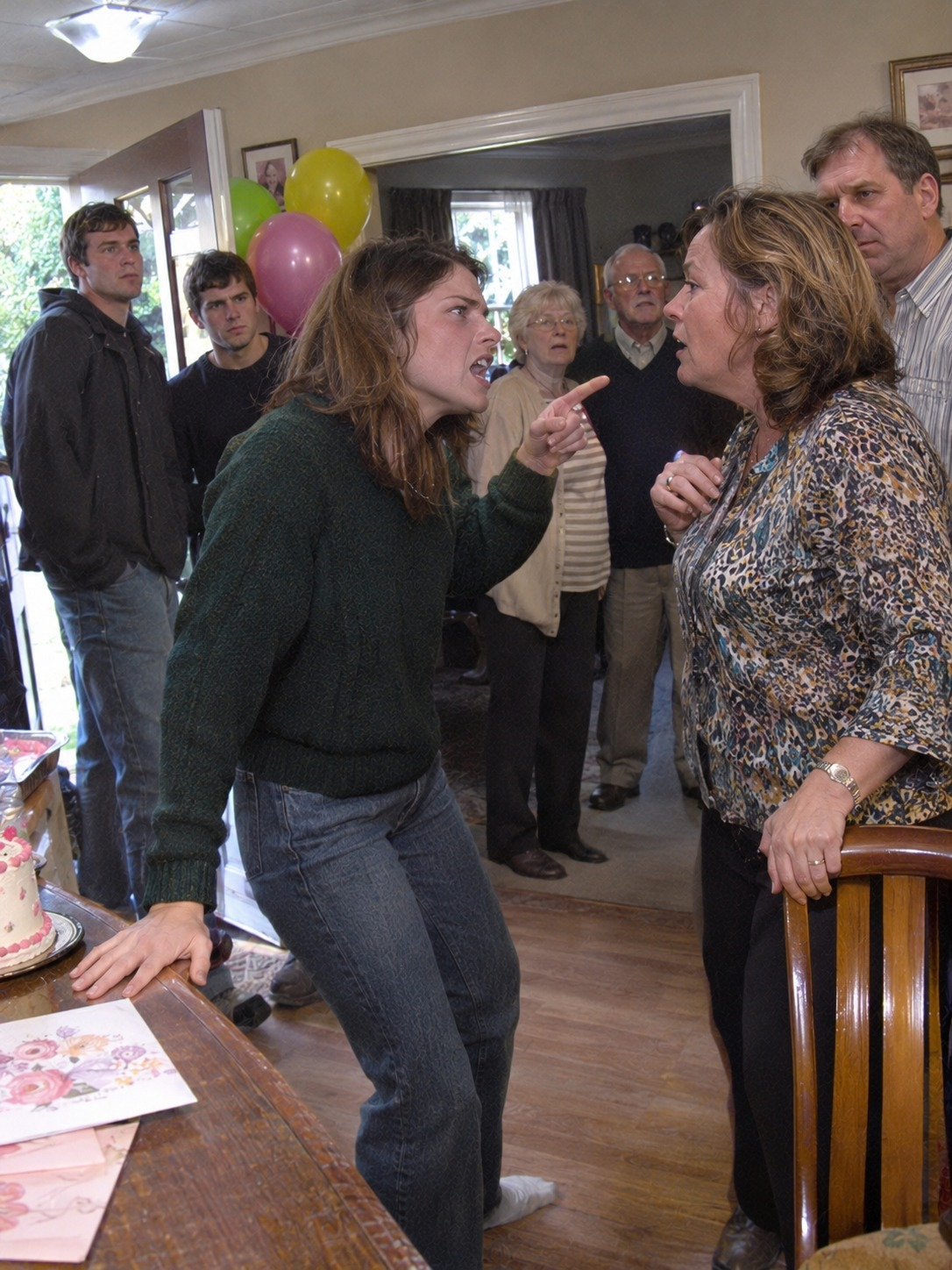
Beth moved before anyone else could speak.
"There's absolutely no reason to bring old photographs into this."
My aunt, who had been standing near the kitchen doorway, stopped.
Grandad looked at her.
"I asked you to get them."
Beth gave a small, uncomfortable laugh.
"Honestly, Dad, this is supposed to be a birthday party. We don't need to turn it into some sort of investigation."
Grandad adjusted his glasses.
"Then it shouldn't be a problem, should it?"
Nobody answered.
I stood beside Daniel, trying to understand why Beth seemed so frightened of a few old photographs.
Jamie leaned closer to me.
"What's going on?"
"I don't know."
But I had a feeling that whatever Grandad wanted to show us had something to do with the years we had spent growing up in Dad's house.
And suddenly, I was thinking about the bedroom again.
The three of us.
One room.
One bunk bed.
One single bed.
And the photograph of Mum that I had hidden because Beth didn't like seeing it.
It was strange how quickly an ordinary afternoon could take you backwards.
Five years of distance disappeared in a matter of seconds.
I was twenty-three, standing in my grandparents' living room, wearing a burgundy dress, with my two adult brothers beside me.
But when I looked at Beth, I could still remember being eight years old and wondering what I had done wrong.
I hadn't always disliked her.
That was something people often misunderstood.
When Dad first introduced us to Beth, I had been excited.
I thought she might become someone I could talk to.
Someone who would help make our family feel complete again.
My mother had died when I was six.
I didn't understand death properly at that age.
I knew she wasn't coming home, but I still expected to find reminders of her everywhere.
Her yellow cardigan had been kept in a wardrobe.
Her hairbrush sat in a drawer.
There were photographs of her smiling at birthdays, holidays, and ordinary afternoons.
Sometimes I would look at those photographs and try to remember the sound of her voice.
Daniel remembered more than I did.
He was nine when she died.
Jamie was seven.
We had all lost the same person, but we remembered her differently.
Daniel remembered the practical things.
How she prepared breakfast.
How she checked our school uniforms.
How she used to tell him that being the oldest didn't mean he had to solve every problem.
Jamie remembered her singing.
He claimed she had been terrible at it.
I remembered her yellow cardigan and the way she tucked my hair behind my ears.
Those memories were precious to us.
After Mum died, Dad changed.
He became quieter.
Sometimes he sat at the dining table long after dinner had finished, staring into his cup.
Daniel started helping with things around the house.
He checked that Jamie had his schoolbooks and reminded me to brush my teeth.
I don't remember Dad being particularly affectionate during those years, but he was there.
He made lunches.
He attended school meetings when he could.
He was our father.
We didn't need him to be perfect.
We needed him to remain our father.
Then he met Beth.
At first, everything seemed ordinary.
He introduced her to us one afternoon, and she arrived with a bright smile and a box of biscuits.
She had two children.
A daughter and a son.
Her daughter was about a year older than me, and her son was three years older.
They seemed confident and comfortable around her.
They spoke without hesitation.
They asked for things without looking at the adults first.
I remember thinking that perhaps they could teach me how to be part of a bigger family.
Beth was polite to us in the beginning.
She asked about school and complimented my hair.
She told Jamie he had lovely eyes.
She even asked Daniel about his football.
I remember going to bed that night thinking things might turn out well.
Dad seemed happier.
He smiled more often.
And I wanted that happiness to last.
Children don't always recognize the difference between being included and being tolerated.
I certainly didn't.
When Dad announced that he was going to marry Beth, I tried to be enthusiastic.
I wanted him to be happy.
I wanted the house to feel like a family again.
After the wedding, we moved from Wales to England.
Dad explained that it would be a fresh start.
There would be a bigger family, new schools, and new opportunities.
I didn't particularly want to leave Wales.
My school friends were there.
My grandparents were there.
And I knew where everything was.
But Dad said it was necessary.
So we packed our belongings.
I remember putting Mum's photograph into a small book and placing it carefully inside my suitcase.
It was one of the first things I made sure to pack.
I didn't know then how important that photograph would become.
When we arrived at the new house, Beth's children already had their rooms.
Her daughter showed me hers.
It was painted a soft pink, with a dressing table near the window and shelves filled with ornaments.
Her son had a larger room with posters, a television, and a desk.
I remember looking around and thinking it was nice.
Then Beth showed us where we would sleep.
It was a smaller bedroom at the end of the hallway.
There were three beds.
A bunk bed and a single bed.
Daniel immediately said he would take the top bunk.
Jamie didn't like sleeping high up.
I took the single bed beside the window.
It seemed like a reasonable arrangement.
At least, that's what I told myself.
Dad stood in the doorway.
"It's temporary," he said.
"We'll sort something out when everyone gets settled."
I nodded.
I didn't want to appear difficult.
Beth smiled.
"Well, you'll have to learn to share. That's what families do."
I remember thinking that she was right.
We were a family now.
The room wasn't particularly large, but the three of us managed.
Daniel arranged his schoolbooks beneath the bunk.
Jamie put his clothes into a small drawer.
I placed my hairbrush, a little notebook, and a ceramic rabbit on the windowsill.
The rabbit had one chipped ear.
Mum had bought it for me before she died.
I liked looking at it when I woke up.
It made the new room feel slightly less unfamiliar.
The first few weeks were difficult because everything was different.
New school.
New uniforms.
New classmates.
Different routines.
Beth seemed to have very particular ideas about how the household should operate.
There were rules about television, food, chores, and bedrooms.
Some rules made sense.
Others depended on which child was involved.
I noticed that gradually.
If Beth's daughter wanted to watch television, she chose the programme.
If Jamie wanted to watch something else, he was told to wait.
If her son left his shoes in the hallway, nobody seemed particularly concerned.
If Daniel did the same thing, Beth reminded him that he needed to learn responsibility.
At first, I thought these differences were accidental.
Perhaps she simply knew her own children better.
Perhaps she was still getting used to us.
I kept making excuses because I wanted the arrangement to work.
One afternoon, Beth's daughter offered to let me play a game on her new phone.
I was delighted.
We sat together on the sofa, and she showed me how to use it.
I had never played that particular game before.
After a few minutes, she asked me to hold the phone while she went to get something.
I did.
When she returned, she suddenly accused me of taking it without permission.
I stared at her.
"You gave it to me."
"No, I didn't."
I looked toward Beth.
She was standing near the kitchen.
Her daughter immediately began explaining that I had taken the phone.
Beth didn't ask what had happened.
She simply looked at me.
"Why would you do that?"
I tried to explain.
But the more I spoke, the more irritated she became.
"Don't argue with me."
I went upstairs feeling confused.
Later, I saw her daughter smiling at me from the doorway.
I never accepted another offer to borrow her things.
It was easier that way.
Daniel noticed the difference too.
He didn't always say anything, but I could tell.
He began reminding Jamie and me to put our belongings away immediately.
He checked that we hadn't accidentally left anything in the sitting room.
He even started asking whether we had eaten before taking food from the kitchen.
It wasn't because he wanted to control us.
He was trying to prevent arguments.
We were learning to anticipate trouble before it arrived.
At dinner, the seating arrangements became another small lesson.
Beth's children usually sat closest to her.
Dad sat at the other end of the table.
Daniel, Jamie, and I occupied the remaining places.
If we asked for another serving, Beth sometimes made comments about how much food we were eating.
Her children could help themselves without explanation.
I began taking smaller portions.
Jamie did the same.
Daniel occasionally told us to eat properly.
"You're allowed to be hungry," he whispered once.
I remember looking at him.
He said it as though he was reminding us of something important.
Maybe he was.
The bedroom situation never changed.
Months passed.
Then another year.
The temporary arrangement became permanent without anybody announcing it.
Beth's daughter had shelves installed.
Her son received a new desk.
Their rooms gradually became more comfortable.
Our bedroom remained the same.
One evening, I asked Dad whether we might eventually have separate rooms.
I wasn't demanding anything.
I simply wanted somewhere to put my belongings.
He was watching television.
"We'll see," he said.
"Beth has a lot to organize at the moment."
I waited.
He didn't say anything else.
When I went upstairs, Daniel was sitting on the bottom bunk, sorting through some university brochures.
"Did you ask him?" he said.
I nodded.
"What did he say?"
"We'll see."
Daniel looked at the brochures.
Then he gave a small, tired smile.
"That's what he always says."
Jamie was lying on the single bed, reading.
He lowered his book.
"Maybe we'll get a bigger room when we're older."
Daniel looked at him.
"Maybe."
Nobody believed it.
But we didn't discuss it further.
There were times when I wondered whether Beth genuinely disliked us or whether she simply didn't think about us very much.
It was difficult to know.
Sometimes she could be perfectly pleasant.
She would ask whether we needed anything from the shops.
She occasionally bought us snacks.
On other days, she acted as though our presence was an inconvenience.
The unpredictability was exhausting.
We never knew which version of her we would encounter.
And Dad rarely helped.
When Beth complained about us, he usually agreed.
If we tried to explain our side, he told us not to argue.
I remember one particular evening when Jamie accidentally knocked over a glass.
It fell onto the kitchen floor and broke.
He immediately apologized.
"I'm sorry. I'll clean it up."
Beth looked at him.
"You're always making a mess."
He froze.
Dad came into the kitchen.
"What happened?"
Beth explained.
Jamie repeated that it had been an accident.
Dad told him to be more careful.
Nobody shouted.
Nobody made a great deal of it.
But later that night, Jamie asked Daniel whether he thought he was clumsy.
Daniel looked up from his homework.
"No."
"I keep doing things wrong."
"Everyone breaks glasses."
Jamie considered that.
Then he asked something that made Daniel put his pen down.
"Why do they get annoyed with us more than they do with them?"
Daniel didn't answer immediately.
I was sitting on my bed, pretending to read.
I wanted to hear what he would say.
Finally, he closed his notebook.
"Because sometimes people aren't fair."
Jamie nodded.
It was a simple answer.
But I remember it clearly.
As we grew older, the differences became harder to ignore.
Beth's children had their own bedrooms, their own belongings, and more freedom.
They could invite friends over.
They could choose what they wanted for Christmas.
They had opportunities that we weren't offered.
When they wanted something, the adults discussed how to arrange it.
When we wanted something, the first question was usually whether we really needed it.
Still, we tried to be good children.
Daniel worked hard at school.
Jamie became increasingly quiet.
I learned to keep my belongings organized and avoid asking for anything unnecessary.
I thought that if we behaved well enough, eventually Beth might see us differently.
Perhaps Dad would notice how hard we were trying.
Perhaps the house would begin to feel like ours too.
But there was one thing Beth never seemed willing to accept.
Our mother.
I had kept her photograph hidden inside a book, but sometimes I took it out when I was alone.
I would study her face.
I wanted to remember the shape of her smile.
I wanted to know whether I had inherited her eyes.
I wanted to ask Dad what she had been like when she was young.
But whenever her name came up, Beth became uncomfortable.
Once, while we were clearing the dinner table, I mentioned that Mum used to sing a particular song.
Beth stopped arranging the plates.
"Do we have to keep bringing her up?"
I looked at her.
"I was only talking about a song."
"She's gone. You need to stop living in the past."
I didn't answer.
Dad was standing nearby.
He heard everything.
He said nothing.
That evening, I put the photograph back inside the book.
I didn't take it out again for several weeks.
Years later, I would understand that the photograph wasn't the problem.
The problem was that we still loved someone who had belonged to us before Beth arrived.
And she seemed determined to make that love feel like a personal insult.
Back in my grandparents' living room, I was pulled out of those memories by the sound of footsteps.
My aunt returned from the hallway.
She was carrying a large cardboard box.
It looked old.
The corners were worn, and a piece of faded tape held one side together.
Grandad moved forward.
"Put it here, love."
She placed it on the coffee table.
Beth immediately looked uncomfortable.
"Surely we don't need to go through all that."
Grandad ignored her.
He opened the box.
Inside were envelopes, loose photographs, birthday cards, and several old family albums.
Jamie leaned closer.
Daniel looked at me.
I felt my heartbeat quicken.
Grandad began sorting through the photographs.
Some showed us as children.
Others showed family gatherings in Wales.
There was one of Mum standing beside a garden fence, laughing at something outside the frame.
I reached toward it.
My fingers stopped just above the photograph.
I hadn't seen that picture in years.
"That's your mother," Grandad said quietly.
I nodded.
"I remember."
He looked at me.
"She was very proud of you three."
My throat tightened.
Beth shifted her weight.
"Can we please not turn this into something it isn't?"
Grandad finally looked up.
"Nobody is turning anything into anything, Beth."
He returned his attention to the box.
Then he lifted an old photograph of the five children.
It had been taken shortly after the wedding.
Daniel stood at the back.
Jamie and I were beside him.
Beth's two children stood in front, smiling.
I remembered that day.
We had been told to stand together for a family photograph.
I had thought it meant we were becoming a family.
Grandad studied the picture.
"Do you remember where this was taken?"
"At the old house," I replied.
He nodded.
Then he turned the photograph over.
There was handwriting on the back.
A date.
And a short sentence.
Grandad read it silently.
His expression changed.
"What does it say?" Daniel asked.
Grandad looked toward Dad.
My father had gone very still.
Beth took one step forward.
"Give me that photograph."
Grandad didn't move.
Instead, he held it closer to the light.
Then he read the words aloud.
And the moment he reached the final line, my father whispered:
"That photograph was never supposed to be in that box."






Comments 0