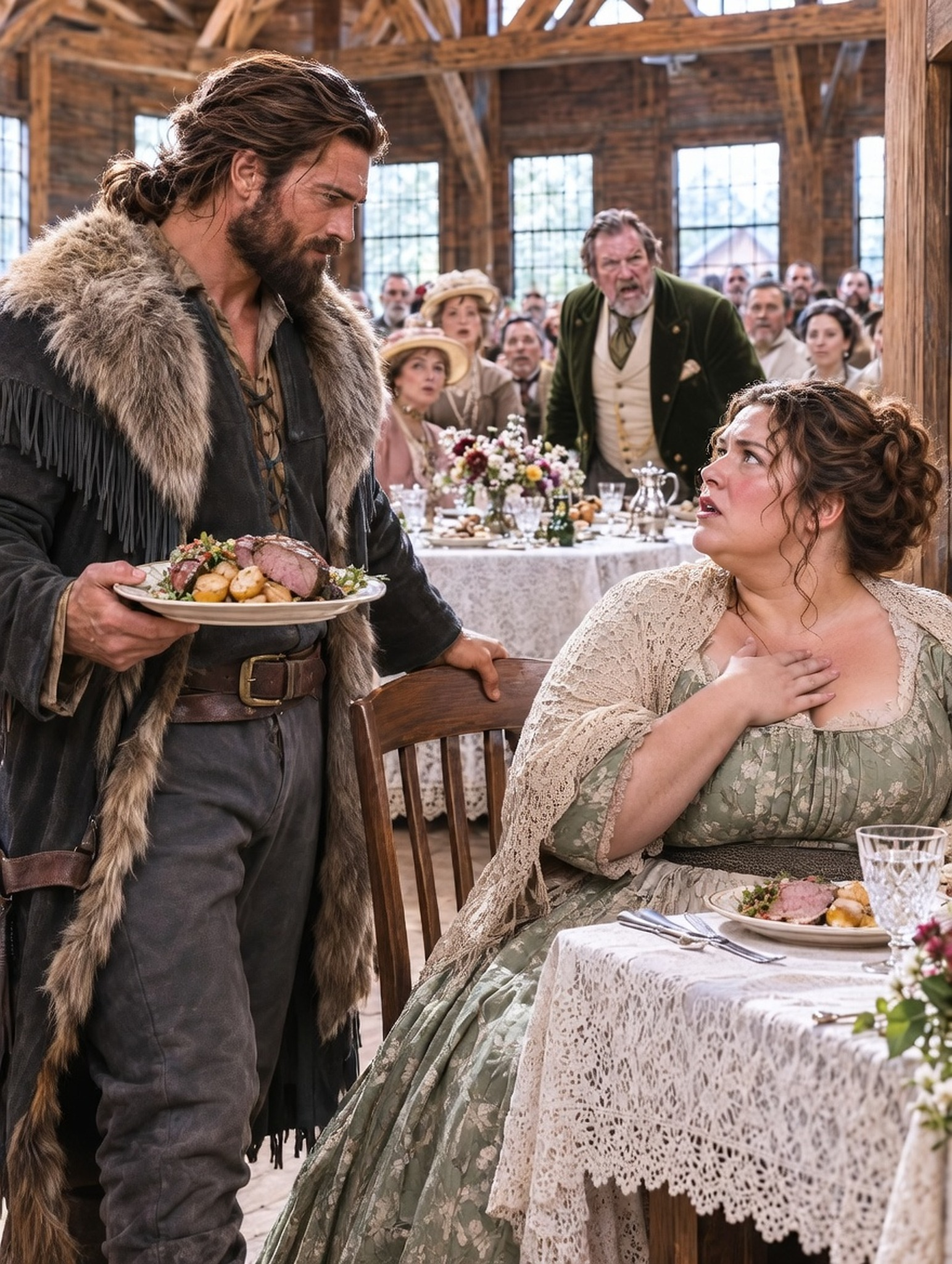
Hallie Nash stopped beside a crooked wooden chair and whispered:
"I suppose this is where they want me."
Across the room, Elliot Gallagher, the banker who had taken her home, raised his glass.
A small card bearing Hallie's name rested beside a bent tin plate.
But the empty seats at the front tables told a different story.
Hallie stood perfectly still.
The card had been written carefully.
That was the part that hurt most.
Someone had taken the time to write her name in neat, deliberate handwriting. Someone had carried it across the community hall, passed dozens of empty chairs, and placed it on the smallest table in the building.
It was not a mistake.
It was a decision.
She looked at the chair again.
One leg was shorter than the others. A small piece of folded wood had been pushed underneath to keep it from rocking too badly. The table itself had scratches deep enough to catch the edge of her fingernail.
Behind her, the swinging kitchen doors opened.
A server stepped through carrying a tray of steaming vegetables. Warm air rushed into the hall, carrying the smell of roasted meat and onions. The young man glanced at Hallie, then quickly looked away.
She knew that expression.
It was the expression people wore when they recognized an injustice but had already decided that acknowledging it would make their evening inconvenient.
Hallie lowered her eyes.
She could leave.
The thought came easily.
She could turn around, walk through the heavy wooden doors, and return to the little line shack near the trees. She could spend the evening beside her iron stove, listening to the wind move through the gaps in the walls.
Nobody would ask why she had gone.
Nobody would notice that she had never eaten the dinner Naomi Warner had promised.
And tomorrow, the women who sent her laundry would still expect their collars and sheets to be washed.
Her life would remain exactly as it had been that morning.
But leaving would mean giving Elliot Gallagher another reason to tell the town that she was difficult, ungrateful, or incapable of accepting kindness.
Hallie had learned that people who possessed money often found generous words for the things they did not have to sacrifice.
She tightened her fingers around the small dinner ticket.
Its corners had softened from the dampness of the November air.
She remembered Naomi Warner pressing it into her palm three days earlier.
"Being seen would do you good, Hallie," the minister's wife had said.
Naomi had smiled as though she were offering a gift.
"People worry when a woman stops making an effort."
Hallie had wanted to ask which people.
She had wanted to ask whether any of them had worried enough to visit the shack where she slept.
She had wanted to ask whether they knew what it felt like to wake before sunrise because the stove had gone cold and there was no money left for another load of firewood.
Instead, she had thanked Naomi.
It was easier.
It was almost always easier.
Now, standing beside the kitchen table, Hallie understood what the invitation had really meant.
They wanted her to attend.
They wanted her dressed as neatly as she could manage.
They wanted to see that she was still surviving.
But they did not want to make room for her.
Across the hall, a burst of laughter rose above the fiddle music.
Hallie recognized the voice before she looked.
Elliot Gallagher.
He sat near the front, where the tables had been arranged beneath the largest windows. His dark suit was freshly pressed, and a gold watch chain stretched across his waistcoat.
A glass of wine stood beside his plate.
He was speaking to two merchants and an older man who served on the town committee.
Elliot leaned back in his chair.
His laughter came easily.
Hallie watched him for only a moment.
Then she looked away.
Eight months earlier, she would never have imagined standing in a public hall and being afraid to pass a man who had once greeted her husband by his first name.
Eight months earlier, she had a home.
A small one, but it was warm.
Jonah had repaired the roof himself every spring. He had built the kitchen shelves from leftover timber and carved a little wooden bird for the windowsill because Hallie once mentioned that she liked watching birds in the morning.
There had been no grand furniture.
No expensive rugs.
But there had been two chairs beside the stove, a table large enough for both of them, and a door that belonged to them.
Then the mine collapsed.
Jonah never came home.
The mine owner had sent a representative to speak with Hallie. The man had removed his hat, offered several uncomfortable words of regret, and left before she could ask what would happen to the wages Jonah had earned.
There was no pension.
No reliable compensation.
Nothing steady enough to carry a household after the money stopped.
Hallie had spent the first month after his death moving through the house like someone who had forgotten what she was supposed to do next.
She still prepared two cups of coffee some mornings.
She still turned toward the door whenever she heard boots outside.
Then Elliot Gallagher had called in the loans.
He had explained the paperwork with the patience of a man discussing an ordinary business arrangement.
The money was due.
The property secured the debt.
The bank had followed the terms.
He had said that grief did not change an agreement.
A month later, Hallie no longer had a key to her own front door.
She could still see the little house from the road.
Sometimes she walked past it after finishing a laundry delivery.
She never stopped.
She could not bear to stand there and look at the windows.
It was easier to keep walking.
The line shack near the trees had one room, a narrow bed, and a stove that smoked when the wind came from the north.
Hallie had learned to stretch flour, repair clothing, and wash other people's linens until her hands grew rough.
Some women paid her fairly.
Others waited until she finished the work before finding a reason to reduce the price.
The same women who once invited her to afternoon tea now discussed payment from their doorways.
She had stopped expecting explanations.
"Hallie?"
The voice brought her back to the hall.
Tessa Callahan stood a few feet away.
She wore a deep plum-colored dress with a high collar, delicate lace at the cuffs, and a small gold brooch pinned near her throat.
Her hair had been arranged beneath a fashionable ribbon.
She held a glass in one hand.
Her smile was polite.
Her eyes were not.
"Well, you found your way here," Tessa said.
Hallie turned toward her.
"Good evening."
"With the weather turning, I thought you might decide against it."
"The walk hasn't gotten longer," Hallie replied. "It's still a mile."
Tessa's smile tightened.
She glanced at Hallie's boots.
Then at the repaired section of her sleeve.
"Well, I suppose that is true."
A pause followed.
Tessa looked toward the tables.
"We're nearly ready to serve. You'd better find your place."
Hallie glanced at the card in her hand.
"I believe I have."
Tessa followed her gaze.
For one brief moment, something passed across the other woman's face.
It might have been embarrassment.
It might have been satisfaction.
Whatever it was, it disappeared quickly.
"Oh," Tessa said. "Yes. That little table."
Hallie waited.
Tessa did not offer another chair.
"There was some confusion with the seating arrangements," Hallie said quietly.
"Was there?"
"Several tables have empty places."
Tessa took a small sip from her glass.
"Those tables have been arranged according to the committee's plans."
Hallie looked at her.
"I see."
"Of course, the kitchen table is perfectly suitable. The hired hands usually eat there."
The words were delivered lightly.
Almost pleasantly.
That made them worse.
Hallie could feel the heat rising in her cheeks.
She wanted to tell Tessa that she had not come to beg for a place among the merchants. She had not come to borrow money or ask anyone to pity her.
She had come because Naomi had insisted that being seen would do her good.
But the explanation would only give Tessa another opportunity to make her sound unreasonable.
So Hallie said nothing.
She moved past her.
As she walked between the dining tables, conversations changed.
Not stopped.
Changed.
A woman who had been laughing turned toward her husband.
Two men moved their chairs inward, leaving a narrow passage.
An older guest lifted his glass and watched her pass over the rim.
Hallie recognized nearly every face.
There was Mrs. Bell, who had once asked Hallie for the recipe for her apple preserves.
There was Samuel Price, who had borrowed Jonah's tools and promised to return them.
There was Clara Whitcomb, who had sat beside Hallie at church for years.
Nobody called her over.
Nobody asked how she was managing.
She continued toward the rear of the hall.
The first tables were decorated with polished silver serving dishes, white cloths, and arrangements of cedar branches tied with red ribbons.
At the center table, Elliot Gallagher was telling a story.
The men around him laughed.
He lifted his glass.
Hallie kept walking.
She did not want him to see her looking.
She did not want him to know how much it cost her to stand in the same room.
Farther along, the tables became smaller.
The merchants' families sat near the windows.
The town committee occupied a long table close to the front.
At the rear, the decorations grew simpler.
The white linen ended.
The cedar arrangements disappeared.
And then Hallie saw it.
A small bare table stood against the swinging kitchen doors.
One crooked chair had been placed beside it.
A bent tin plate waited at one place.
There was no glass of wine.
No silver cutlery.
No small arrangement of winter berries.
Only a folded napkin and a handwritten card.
Hallie approached.
Her steps slowed.
The card read:
Hallie Nash.
She looked at the handwriting.
Every letter had been carefully formed.
The writer had taken time.
That detail stayed with her.
The person who placed the card here had not forgotten her.
They had remembered her.
They had simply decided that this was where she belonged.
Hallie reached for the chair.
Then stopped.
A cold draft moved through the room as the kitchen doors swung open behind her.
She felt the air against the back of her neck.
Across the hall, Tessa Callahan watched over the rim of her glass.
The woman made no move to correct the seating.
Hallie looked down at the chair again.
She could hear the fiddle.
She could hear plates being moved.
She could hear Elliot Gallagher laughing at the front table.
And beneath all of it, she heard the quiet sound of her own breathing.
She placed her dinner ticket beside the name card.
Then she slowly pulled out the chair.
It scraped against the floor.
A few guests glanced toward her.
Hallie sat.
She folded her hands in her lap and waited.
She had survived the mine taking Jonah.
She had survived losing her home.
She had survived months of being treated as though poverty were a character flaw.
She could survive one dinner.
That was what she told herself.
But just as she lowered her eyes toward the bent tin plate, someone behind her stopped walking.
A man's shadow fell across the small table.
Hallie looked up.
The stranger was tall, broad-shouldered, and dressed in a dark green frontier coat. A short sandy-blond haircut framed a weathered face, and a reddish-brown beard covered his jaw.
He held a dinner plate.
He was not looking at the food.
He was looking at her name card.
Then he glanced toward the empty chairs at the front tables.
His eyes returned to Hallie.
He had heard something.
She could tell by the way his expression had changed.
He pulled his chair closer.
And before Hallie could understand what he intended to do, he turned toward the table behind him...
Hallie watched him.
He looked at the chair.
Then he looked directly at her.
"Is anyone sitting here?" he asked.
Hallie glanced at the empty space beside her.
"No."
The man nodded.
He placed his plate on the table and pulled out the crooked chair.
The scrape of wood against the floor sounded strangely loud.
A woman at the nearest table stopped speaking.
Then another.
The man sat down beside Hallie.
He adjusted his coat, picked up his fork, and looked at his dinner as though nothing unusual had happened.
Hallie stared at him.
"Sir..."
He turned slightly.
"Yes?"
"You don't have to sit here."
He looked at the empty seats across the room.
Then back at her.
"I know."
There was no pity in his voice.
No awkward attempt to comfort her.
Just certainty.
Hallie lowered her eyes.
For eight months, people had found countless ways to remind her that she had become someone of little importance.
This stranger had just done something none of them had thought worth doing.
He had chosen her table.
At the front, Elliot Gallagher's laughter faded.
Tessa Callahan lowered her glass.
And somewhere behind them, a chair suddenly scraped backward.
Someone was getting up.
Hallie turned toward the sound.
It was Elliot Gallagher.
And he was walking toward them.
END OF CHAPTER 1
Phần tiếp theo sẽ bắt đầu ngay tại khoảnh khắc Elliot Gallagher tiến đến bàn ăn phía cửa bếp, không lặp lại Chapter 1.






Comments 0