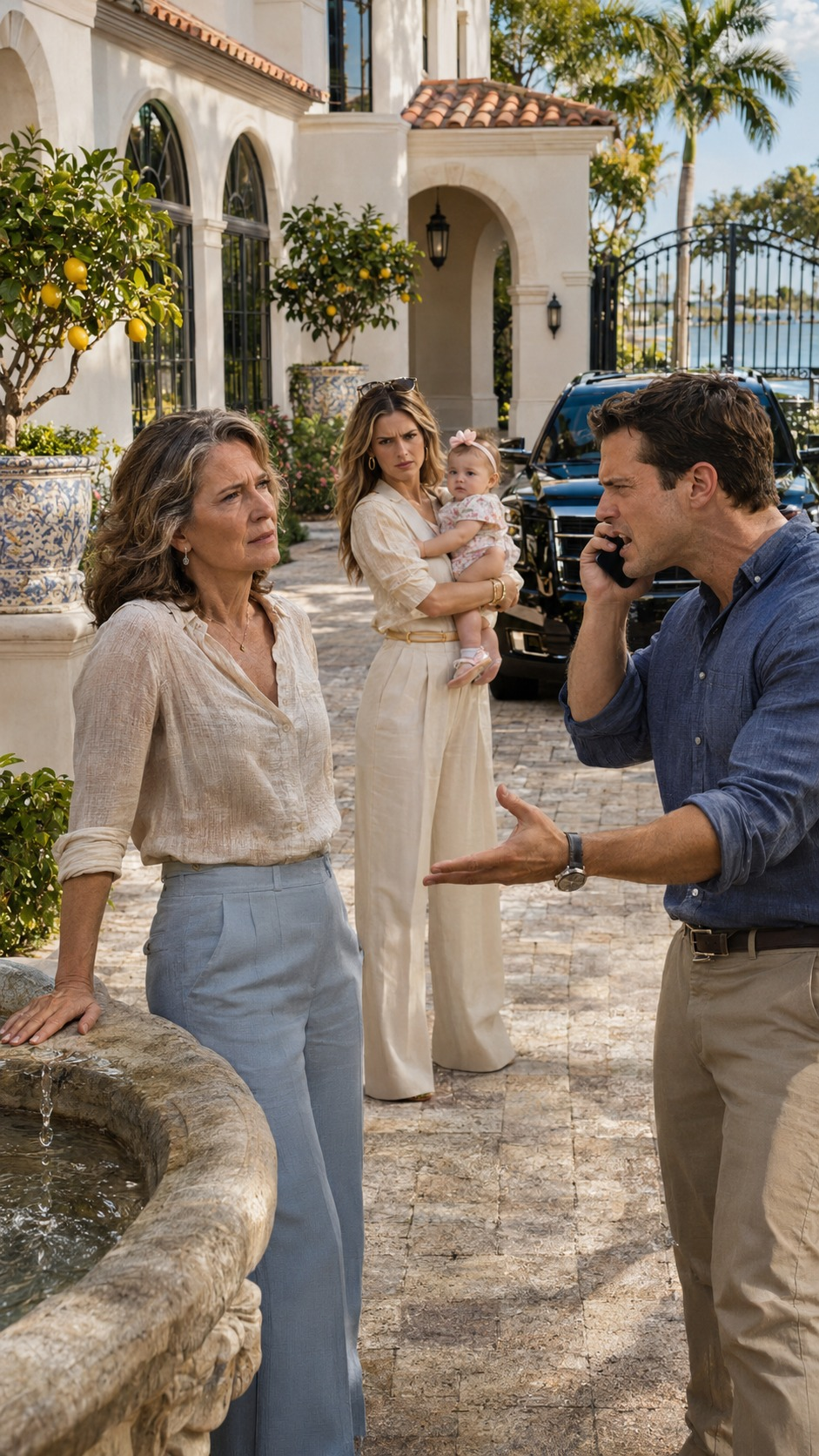
Someone had entered my house.
I stood in the courtyard, staring at the security alert on my phone.
FRONT ENTRANCE — MOTION DETECTED.
The notification had arrived less than ten seconds after Preston told me to check what he had left inside.
My first instinct was to run toward the door.
Instead, I stopped.
At sixty-one, I had learned that panic rarely made a bad situation better. And after everything my son had done that morning, I wasn't about to make another decision based on fear.
I opened the security application.
The live camera showed my front hallway.
Empty.
The marble floor reflected the afternoon sunlight coming through the arched windows. My grandmother's antique console table stood against the wall, exactly where I had placed it three weeks earlier.
Nothing appeared disturbed.
Then I noticed something near the bottom of the screen.
The front door was slightly open.
I knew I had closed it.
I knew because I had checked it myself after the locksmith finished replacing the locks.
"Preston," I said into the phone, "what did you do?"
He didn't answer immediately.
"Mom, don't overreact."
Those three words made my stomach tighten.
"Did you give someone access to my house?"
"No."
"Then why is my front door open?"
Another pause.
"Maybe you forgot to close it."
I looked toward the entrance.
"Don't insult my intelligence."
He sighed.
"See? This is exactly what I'm talking about. Every little thing becomes some huge accusation."
I almost responded.
Then I remembered something my grandmother used to tell me.
When someone is determined to misunderstand you, explaining yourself only gives them more words to twist.
So I ended the call.
For the first time in my life, I hung up on my only child without apologizing.
I stood beside the fountain for several seconds, listening.
Water trickled into the stone basin.
A palm frond moved gently in the breeze.
Somewhere beyond the courtyard wall, a car passed along the road.
Everything looked peaceful.
That was what frightened me.
The house I had purchased to escape thirty-four years of emotional exhaustion suddenly felt like a place where I needed permission to breathe.
I walked toward the entrance.
Halfway there, my phone vibrated again.
Another security notification.
FRONT DOOR — OPEN.
I stopped.
The camera feed refreshed.
The door moved inward another inch.
Then a familiar voice came from the other side.
"Margaret? It's Diane."
I exhaled so sharply that my knees nearly weakened.
"Diane?"
My neighbor stepped into view, holding a small white envelope.
She was sixty-eight, a retired school librarian with silver hair, sensible shoes, and the kind of sharp observational skills that made lying to her almost impossible.
She lived in the villa next door.
During my first week in the neighborhood, she had brought me homemade banana bread and a handwritten list of trustworthy local contractors.
She was also the woman Preston had followed through the gate earlier that morning.
I hurried toward her.
"Diane, what are you doing inside?"
She looked startled.
"Inside? Honey, I'm standing on your front step."
I reached the doorway.
She was right.
The camera angle had made the partially open door look as though someone had entered the hallway.
Diane held up the envelope.
"I found this tucked between your front door and the frame. When I tried to knock, the door moved. I thought you might want to know."
I stared at the envelope.
My name was written across the front.
MARGARET WHITMORE.
The handwriting was unmistakable.
Preston's.
"Where did you find it?" I asked.
"Right here."
She pointed toward the narrow space beside the lock.
"I didn't open it."
"Thank you."
Diane studied my face.
"Are you all right?"
It was such a simple question.
For a moment, I couldn't answer.
I had spent so many years telling people I was fine that I had almost forgotten how to recognize when I wasn't.
"Preston came back," I finally said.
Diane's expression changed.
"The moving truck?"
I nodded.
"He tried to bring his family here."
"Oh, Margaret."
"And he followed you through the gate."
Her eyes widened.
"That was your son?"
"Yes."
"I thought he was visiting. He waved like he belonged here."
I gave a humorless little laugh.
"That's exactly what he wants everyone to believe."
Diane looked toward the guesthouse.
"Did he get inside?"
"I don't think so."
"Have you checked?"
I shook my head.
She lowered her voice.
"Then perhaps we should."
I looked at the envelope again.
Something about it felt deliberate.
Preston had told me to check what he left inside the front door.
Now I had found a letter wedged beside that same door.
I didn't believe in coincidences when my son was involved.
"Would you mind staying with me for a few minutes?" I asked.
"Of course."
We stepped into the foyer.
I closed the door firmly and checked the new deadbolt.
It turned smoothly.
Then I opened the envelope.
Inside were three folded sheets of paper.
The first page was titled:
FAMILY RESIDENCE AGREEMENT.
I stared at the words.
Diane leaned slightly closer.
"What is that?"
"I have no idea."
But I was beginning to understand.
The document described an arrangement in which Preston, Kendra, and Lila would occupy the main residence of my villa.
I would occupy the detached guesthouse.
The language was formal enough to look important, but not formal enough to disguise what it was.
A demand.
The second paragraph described Preston and Kendra as the "primary residential family unit."
The third paragraph referred to me as the "senior family member."
I read that phrase twice.
Senior family member.
Not owner.
Not homeowner.
Not the woman who had paid for every square foot of the property.
Just the senior family member.
As though my age had somehow transformed me from a person into a dependent.
Then I reached the section titled:
PROPERTY MANAGEMENT RESPONSIBILITIES.
Preston had listed himself as the person responsible for decisions concerning household access, maintenance, and long-term occupancy.
He had even included a provision stating that major property decisions should be discussed with him before implementation.
I felt heat rise behind my eyes.
For decades, I had helped this man.
I had taught him to ride a bicycle.
I had sat beside his hospital bed when he broke his arm at twelve.
I had worked extra hours when he needed braces.
I had paid apartment deposits, covered overdue utility bills, and helped him recover from financial mistakes he promised never to repeat.
And now he had prepared a document that attempted to reduce me to a guest on my own property.
Diane read the title again.
"Did you agree to this?"
"No."
"Did you sign anything?"
"Absolutely not."
She pointed toward the bottom of the page.
"Then why is your name there?"
I looked down.
A signature line appeared beneath the words:
Margaret Whitmore — Property Owner.
Above it, someone had typed:
ACKNOWLEDGED VERBALLY.
My mouth went dry.
Diane stared at the page.
"What does that mean?"
"It means Preston wants someone to believe I agreed."
"Did you?"
"No."
"Not even in conversation?"
I shook my head.
"I told him no. Repeatedly."
Diane looked toward the front door.
"Then keep that paper."
I folded it carefully.
"I intend to."
But the third sheet was worse.
It was a printed email.
The sender's address belonged to Preston.
The recipient was a property management company I had never heard of.
The subject line read:
URGENT FAMILY OCCUPANCY TRANSITION.
I began reading.
Preston had contacted the company several days earlier, explaining that his mother had recently divorced and was struggling with decisions regarding a large residential property.
He claimed that his family would soon assume responsibility for the main residence.
He asked about changing access codes, managing contractors, and arranging household services under his name.
Then came the sentence that made me sit down on the small bench beside the staircase.
"My mother has already agreed in principle, but she sometimes becomes confused about details."
I read it again.
Then again.
Diane sat beside me.
"Margaret?"
I handed her the page.
She read silently.
When she finished, she looked genuinely angry.
"Your son wrote this?"
"Yes."
"While you were telling him he couldn't move in?"
"Apparently."
She shook her head.
"That's not a misunderstanding."
"No," I whispered.
"It certainly isn't."
For several minutes, neither of us spoke.
I thought about the little apartment behind the laundromat.
I thought about Preston looking around my kitchen with embarrassment.
I thought about Kendra saying renting was fine for some people.
And I finally understood something I had been resisting.
They hadn't been concerned about my future.
They had been concerned about what they might get from it.
When they thought I had nothing, I was an inconvenience.
When they discovered I owned something valuable, I became an opportunity.
The realization was painful enough that I had to close my eyes.
Diane placed her hand over mine.
"You don't have to solve everything this afternoon."
I nodded.
But I knew I couldn't ignore it.
Not anymore.
"There's something else," I said.
I reached into my pocket and removed the silver key.
The black letter G was still visible.
Diane frowned.
"Guesthouse?"
"That's what I think."
"Where did you find it?"
"Beside the guesthouse door."
She looked toward the garden.
"Did Preston have permission to make a copy?"
"No."
"Then how did he get one?"
"That's what I need to find out."
Diane was quiet for a moment.
Then she asked, "Have you checked whether it works?"
I hadn't.
And suddenly, I wasn't sure I wanted to.
The guesthouse had been the most personal part of my new home.
The main villa was beautiful, but the guesthouse represented something different.
It was where I intended to become myself again.
I had already placed my sewing machine beneath the largest window.
Fabric samples were arranged in labeled boxes.
My grandmother's old measuring tape hung from a hook beside the worktable.
I had even bought a small blue chair where I could sit and read when my hands grew tired.
The thought of Preston entering that space without permission made me feel exposed.
Still, I stood.
"Let's check."
We walked through the courtyard and around the side of the villa.
The guesthouse stood beyond the garden, partly shaded by two lemon trees.
Its white stucco walls matched the main residence.
A narrow stone path led to the door.
As we approached, I noticed something I hadn't seen earlier.
A faint scrape beside the lock.
I leaned closer.
The mark was fresh.
Diane saw it too.
"That wasn't there before?"
"I don't remember seeing it."
I took out the silver key.
For a moment, my hand trembled.
Then I inserted it into the lock.
It slid in perfectly.
I turned it.
The deadbolt moved.
Diane inhaled.
"Oh, Margaret."
I removed the key.
There was no longer any doubt.
Preston had possessed a working key to my guesthouse.
Without my permission.
Without my knowledge.
And he had been confident enough to leave it behind.
I opened the door.
Inside, everything appeared normal.
My sewing machine sat beneath the window.
The fabric boxes remained stacked against the wall.
My grandmother's measuring tape hung exactly where I had left it.
But as I walked farther into the room, I noticed that one of the boxes had been moved.
It was a large plastic container labeled:
FAMILY PHOTOGRAPHS.
I remembered placing it beneath the worktable.
Now it stood beside the door.
I crouched.
The lid wasn't fully closed.
Inside were photographs from Preston's childhood, old Christmas cards, and several albums I had saved from my marriage.
Nothing seemed missing.
Then I found a folded sheet of paper between two albums.
It was a printed checklist.
At the top, in Preston's handwriting, were three words.
MOVE-IN PREPARATION LIST.
Below that, he had written:
Guesthouse cleared for Mom.
Main bedroom for Preston and Kendra.
Nursery upstairs.
Storage bins relocated.
Locks and access updated.
I stared at the page.
This wasn't a spontaneous argument.
This wasn't a desperate father who had made a poor decision because his family needed somewhere to live.
Preston had been planning.
He had inspected my rooms, assigned bedrooms, contacted a property management company, and prepared to move my belongings.
He had even decided where I would sleep.
All without asking me.
Diane stood beside the doorway.
"Margaret, I think you should photograph everything."
I nodded.
I took pictures of the key, the lock, the checklist, and the moved storage box.
Then I photographed the documents from the envelope.
I saved copies in a separate folder on my phone.
I also emailed them to myself.
Years of managing financial records had taught me one important lesson.
Memories could be challenged.
Documents were harder to dismiss.
When we returned to the main house, Diane suggested that I call my real estate attorney.
I agreed.
His name was Daniel Mercer.
He had handled the closing on the villa and had impressed me with his careful attention to detail.
I found his number and called.
He answered on the fourth ring.
"Margaret. Is everything all right with the house?"
"I'm afraid not."
I explained what had happened.
I told him about the moving truck, the unauthorized guesthouse key, the documents, and the email.
He listened without interrupting.
When I finished, he asked a question that surprised me.
"Margaret, have you signed any power of attorney naming your son?"
"No."
"Any property management authorization?"
"No."
"Any lease or occupancy agreement?"
"Absolutely not."
"Good."
His tone was calm, but serious.
"Do not sign anything he brings you. Do not give him access to your original property documents. And preserve every message he's sent."
"I already have."
"Excellent."
I looked at Diane.
She nodded approvingly.
"Daniel, can he actually do anything with these papers?"
"Not simply because he wrote them," he said. "But false claims can create problems if they reach the wrong people. We need to understand exactly what he's been telling others."
I thought about the email.
"He contacted a property management company."
"Send me that immediately."
"I will."
"And Margaret?"
"Yes?"
"Did your son ever have access to the documents from your closing?"
I hesitated.
"Not that I know of."
"Think carefully."
I closed my eyes.
On the day Preston first visited, he had wandered through the house while I prepared lunch.
He had opened cabinets.
He had inspected rooms.
He had asked questions about the purchase.
At one point, he had been alone in my home office.
My closing folder was in the bottom drawer of the desk.
I remembered seeing him standing near it.
I had assumed he was looking at the framed photograph on top.
Now I wasn't so sure.
"Possibly," I admitted.
Daniel was silent for a moment.
"Then I want you to check that folder."
After ending the call, I went directly to my office.
The room overlooked the courtyard.
A mahogany desk stood beneath the window, and a tall bookcase held my financial records.
I opened the bottom drawer.
The blue closing folder was there.
I took it out.
The deed was inside.
So were the title insurance documents, settlement statement, and copies of the identification I had provided during closing.
Everything appeared to be in order.
Then I noticed the paper clip.
I always kept the closing statement and deed together.
Now they were separated.
A small detail.
Perhaps meaningless.
But after finding Preston's checklist, I no longer trusted meaningless details.
I checked the contents again.
Nothing obvious was missing.
Still, I photographed the folder and sent Daniel copies of the documents.
He replied a few minutes later.
"I'll review these. Meanwhile, please send the original emails and messages from Preston if possible."
I began forwarding them.
The message announcing the move.
My refusal.
His insistence that the conversation wasn't over.
The text he sent that morning demanding access.
Each one felt worse when I read it in sequence.
For weeks, I had been treating Preston's behavior as separate incidents.
A rude comment.
An unreasonable suggestion.
An unwanted visit.
A moving truck.
A copied key.
But arranged together, they told a different story.
A story of escalation.
He hadn't accepted my first no.
Or my second.
Or my third.
Each refusal had simply made him search for another way around me.
Diane watched me organize the messages.
"Can I ask you something personal?" she said.
"Of course."
"Has he always behaved this way?"
I opened my mouth.
Then closed it.
The answer wasn't simple.
Preston had been a sweet little boy.
At six, he used to bring me dandelions from the yard and tell me they were flowers for the prettiest mother in the world.
At ten, he cried when our family dog died and insisted we bury her beneath the oak tree.
At sixteen, he stayed up all night helping me clean the basement after a pipe burst.
Those memories were real.
So were the later ones.
The college tuition he promised to repay.
The car payment he missed.
The credit card bills I quietly covered.
The apartment deposit I paid after he and Kendra argued with their landlord.
Every time, I told myself he was struggling.
Every time, I helped.
And every time, the next request came a little sooner.
"I think," I finally said, "I've spent so long protecting him from consequences that he started believing consequences were something that happened to other people."
Diane didn't answer immediately.
Then she said, "You can love your son without letting him take your home."
I looked down at my phone.
A photograph of Lila filled the screen.
She was smiling in a little yellow sweater.
I had taken the picture during a visit two months earlier.
The thought of losing contact with her made my chest ache.
Preston knew that.
He had already used her once that morning.
And I was terrified he would do it again.
"I don't want to lose my granddaughter," I whispered.
Diane's expression softened.
"I know."
"What if he keeps her away from me?"
"Then that will be another choice he makes. It won't mean you were wrong to protect yourself."
I wanted to believe her.
But being a mother is complicated.
You can know your child is behaving terribly and still remember the weight of his sleeping head against your shoulder.
You can recognize manipulation and still feel responsible for the person doing it.
You can be furious and heartbroken at the same time.
That afternoon, after Diane left, I sat alone in my living room.
The house was quiet.
I could hear the faint hum of the air conditioner and the soft ticking of the antique clock above the fireplace.
I thought about calling Preston.
Part of me wanted to demand an explanation.
Another part wanted to ask whether he was truly willing to destroy our relationship over a house.
But I didn't call.
Instead, I opened the security application and reviewed the footage from the morning.
At 7:43, Preston's SUV arrived.
At 7:45, the moving truck stopped behind it.
At 7:48, Preston walked toward the gate.
At 7:52, he held up Lila's car seat.
At 8:17, the moving truck departed.
Later, at 10:36, Diane's car approached the gate.
Preston followed closely behind.
I watched him enter the property.
Then I switched to the guesthouse camera.
He carried two suitcases toward the door.
Kendra followed with a diaper bag.
Lila remained in her mother's arms.
Preston reached into his pocket.
He removed something small and silver.
The key.
He inserted it into the guesthouse lock.
Then he opened the door.
I felt sick.
He hadn't merely possessed a copied key.
He had used it.
The footage continued.
Preston stepped inside.
Kendra followed.
For several minutes, they disappeared from view.
Then Preston came back outside carrying one of my storage bins.
He placed it beside the path.
He returned for another.
I watched him move my belongings as casually as though he were rearranging furniture in his own house.
At 10:49, I appeared in the footage.
I remembered the confrontation.
I had demanded that he leave.
He had accused me of being selfish.
Kendra had stood beside the guesthouse, holding Lila and looking offended.
Now I could see something I hadn't noticed at the time.
When I turned away to call the locksmith, Preston leaned toward Kendra.
He said something.
She nodded.
Then she looked directly at the camera.
I paused the footage.
Her expression was strange.
Not frightened.
Not embarrassed.
Almost calculating.
I replayed the moment.
Again.
And again.
I couldn't hear their words because the camera didn't record clear audio at that distance.
But I could see Preston point toward the main house.
Then Kendra reached into her purse.
She handed him a folded piece of paper.
He slipped it into his pocket.
My heart began beating faster.
I checked the timestamp.
10:51 a.m.
That was before the locksmith arrived.
Before I found the key.
Before Preston told me there was something inside the front door.
I sat back.
The envelope hadn't been an afterthought.
He had brought it with him.
He had intended to leave it.
I looked toward the hallway.
The white envelope lay on the console table.
Suddenly, it felt less like a letter and more like a warning.
At 4:26 that afternoon, Daniel called.
"Margaret, I've reviewed what you sent."
I sat straighter.
"And?"
"The deed and closing documents appear consistent with the purchase records. Nothing you've shown me gives your son ownership or a right to occupy the property."
Relief washed through me.
But Daniel wasn't finished.
"However, there's something in that email to the property management company that concerns me."
"What?"
"He refers to an upcoming assessment of your ability to manage the residence."
I frowned.
"An assessment?"
"Yes."
"What kind of assessment?"
"That's what I want to know."
I remembered Preston's words during the 911 call.
Unstable.
Recently divorced.
Unable to make reasonable decisions.
A cold feeling spread through my stomach.
"Daniel, do you think he's trying to make people believe I can't manage my own affairs?"
"I can't tell you what his intentions are," he said carefully. "But I don't like the pattern."
Neither did I.
"There's one more thing," he continued.
I waited.
"Did your son ever ask you to sign a document related to emergency contacts, medical decisions, or family assistance?"
I thought back over the previous months.
After my divorce, Preston had called several times offering to help me "get organized."
He had asked whether I needed someone to handle bills.
He had suggested adding him to my bank accounts for convenience.
I had refused.
Then I remembered a conversation from the previous winter.
He had visited while I was recovering from a minor outpatient procedure.
He brought groceries and a folder of papers.
"Just some family emergency forms," he had said.
I hadn't signed them.
At least, I didn't think I had.
I remembered putting the folder aside because I was tired.
Later, I couldn't recall what happened to it.
"Margaret?" Daniel asked.
I swallowed.
"He brought me some papers once."
"What papers?"
"I don't know."
"Did you sign them?"
"I don't remember signing anything."
His voice became firmer.
"Please don't panic. Not remembering the details of an old conversation doesn't mean you signed anything. But we should find out what those documents were."
I looked toward the office.
"I'll check my records."
"Good. And Margaret, if your son returns, don't argue with him. Keep yourself safe. Let the authorities handle any trespassing or threats."
I thanked him.
After we ended the call, I went back to the office.
I searched the filing cabinet.
Medical records.
Insurance policies.
Tax returns.
Divorce documents.
Nothing resembling the folder Preston had brought.
I checked the desk drawers.
Then the bookshelf.
Finally, I opened the small wooden chest where I kept personal papers.
Inside were old birthday cards, family photographs, and letters from my grandmother.
At the bottom lay a thin manila folder.
I recognized it immediately.
Preston had brought it during my recovery.
My hands felt strangely cold as I lifted it out.
Across the front, in his handwriting, were the words:
FAMILY EMERGENCY PLANNING.
I sat at the desk.
For several seconds, I simply looked at the folder.
Then I opened it.
The first page was a list of emergency contacts.
The second was a blank medical information sheet.
The third was a document titled:
DURABLE POWER OF ATTORNEY.
My breath caught.
I turned the page.
My name appeared at the top.
Preston's name appeared beneath it.
I scanned the document, trying to understand what I was seeing.
It purported to authorize him to make certain financial and property-related decisions on my behalf.
I had never knowingly granted him that authority.
I reached the final page.
There was a signature.
My signature.
Or something that looked disturbingly like it.
I stared at the familiar loops and curves of my name.
Margaret Whitmore.
My hand began to shake.
I knew how I signed my name.
I had signed thousands of checks, contracts, and financial documents over the years.
This signature resembled mine.
But something about the final letter was wrong.
I leaned closer.
Then I noticed the date.
It was dated during the week of my outpatient procedure.
The same week Preston had visited.
The same week I had been tired, uncomfortable, and taking prescribed pain medication.
I hadn't remembered signing anything.
And now I was looking at a document that claimed I had given my son authority over parts of my financial life.
I immediately photographed every page.
Then I called Daniel.
He answered quickly.
"Margaret?"
"I found something."
"What is it?"
"A power of attorney."
There was silence.
"Whose?"
"Mine."
"Who is named as agent?"
"Preston."
Daniel took a slow breath.
"Is it signed?"
"There's a signature."
"Is it yours?"
I looked at the page again.
"I don't know."
"Are there witnesses or a notary acknowledgment?"
I examined the bottom section.
There were printed names.
A notary stamp.
A commission number.
I read the information aloud.
Daniel asked me to send photographs immediately.
I did.
For several minutes, we remained on the phone while he reviewed them.
Finally, he spoke.
"Margaret, I need to verify this carefully. A document's appearance doesn't establish that it's valid, and we don't yet know whether anyone has attempted to use it."
"Could Preston use it to take my house?"
"Not automatically. There are legal requirements, and the scope of any valid authority matters. But if you didn't knowingly execute this, we need to address it promptly."
I looked at the signature again.
"Daniel, I never wanted him controlling my finances."
"I understand."
"I never agreed to give him my house."
"I know."
"And I certainly never agreed to let him move me into the guesthouse."
His voice softened.
"Margaret, listen to me. You're doing the right thing by bringing this forward. We'll verify the document and take appropriate steps to protect your interests."
For the first time that day, I felt a small measure of steadiness return.
Not because the problem was solved.
Because someone was finally treating me like the competent adult I was.
After the call, I placed the original folder in a locked drawer.
Then I sat quietly at my desk.
Outside, the afternoon sunlight had begun to fade.
The courtyard fountain continued running.
My lemon trees swayed gently in the breeze.
And somewhere in Sarasota, my son was probably telling Kendra that I would eventually give in.
He had always believed I would.
For most of his life, he had been right.
But this was different.
This wasn't about paying a bill.
It wasn't about lending him money.
It wasn't even about letting him stay for a few nights.
This was about my right to decide how I lived.
And whether my son believed that right still belonged to me.
At 6:12 p.m., my phone rang.
Preston.
I let it go to voicemail.
He called again.
Then a third time.
Finally, a text appeared.
"Mom, we need to talk before this gets any worse."
I didn't answer.
Another message arrived.
"I know you found the papers."
I stared at the screen.
Then came a third.
"Don't let some lawyer convince you to turn against your own family."
I felt my jaw tighten.
I typed a response.
"Preston, I am preserving all documents and messages. Any further discussion about the property should go through my attorney."
I read it twice.
Then I sent it.
For nearly a minute, nothing happened.
Then the typing indicator appeared.
Disappeared.
Appeared again.
Finally, his reply arrived.
"You have no idea what you've started."
I set the phone down.
I refused to let his threats control the rest of my evening.
I made tea.
I ate a small dinner.
I checked the locks.
Then I sat in the living room with a book I couldn't concentrate on.
At 8:47 p.m., my security system chimed.
GATE CAMERA — MOTION DETECTED.
My heart jumped.
I opened the live feed.
A dark sedan had stopped outside my gate.
It wasn't Preston's SUV.
A man in a gray jacket stepped out.
He carried a leather briefcase.
For a moment, I thought he might be a delivery driver.
Then he walked directly toward the intercom.
The bell rang.
I didn't answer immediately.
Instead, I enlarged the camera image.
The man looked to be in his late fifties.
He wore glasses and had neatly combed gray hair.
He checked something on his phone.
Then he pressed the intercom again.
"Mrs. Whitmore?" he called.
I activated the speaker.
"Who is this?"
"My name is Thomas Reed."
I didn't recognize it.
"What do you want?"
"I'm here regarding a document bearing your signature."
Every muscle in my body tightened.
"What document?"
He glanced toward his briefcase.
"A power of attorney."
I gripped the edge of the desk.
"Who sent you?"
There was a pause.
Then he answered.
"Your son contacted my office."
I looked toward the locked drawer containing the manila folder.
"Are you an attorney?"
"No, ma'am."
"Then what is your business here?"
He adjusted his glasses.
"I'm a commissioned notary public."
The words landed heavily.
I thought about the stamp on the document.
The unfamiliar name.
The signature I didn't remember making.
"Mr. Reed," I said slowly, "why are you at my house?"
He looked directly into the camera.
"Because I received a request to certify a statement about a document I supposedly notarized."
I stopped breathing.
"Supposedly?"
His expression changed.
"Mrs. Whitmore, I need to ask you something."
"What?"
"Have you ever met me before?"
I stared at his face.
"No."
He nodded once.
"That's what I was afraid of."
A cold sensation moved through my chest.
"What are you saying?"
He looked over his shoulder toward the dark sedan.
Then back at the camera.
"I'm saying someone used my name on a document, and I need to know who."
Before I could respond, headlights appeared at the far end of the driveway.
Another vehicle was approaching.
The camera adjusted to the glare.
A black SUV slowed behind the sedan.
I recognized it immediately.
Preston.
The driver's door opened.
My son stepped out.
He wasn't alone.
Kendra emerged from the passenger side.
And then Preston opened the rear door.
For a moment, I thought he was reaching for Lila.
Instead, he helped an older man climb out.
The man wore a dark suit.
He carried a thick folder beneath one arm.
Preston looked toward the gate camera and smiled.
It wasn't a friendly smile.
It was the expression he wore when he believed he had already won.
Then the older man stepped into the light.
I recognized him.
My hand flew to my mouth.
It was Richard.
My ex-husband.
The man I had divorced only months earlier.
The man who had kept our lake house, our boat, and most of the life we had built together.
He stood beside Preston as though they had arrived for a meeting.
Thomas Reed turned toward them.
His expression sharpened.
Then my phone rang.
It was Daniel.
I answered immediately.
"Margaret," he said, his voice urgent, "do not open that gate."
I stared at the security screen.
"Daniel, Richard is here."
"I know."
My heart began pounding.
"How could you know?"
"Because I just received a copy of something involving your son and your ex-husband."
I looked at the folder beneath Richard's arm.
"What something?"
Daniel was silent for a second.
Then he said, "Margaret, I need you to listen very carefully. There's a document you haven't seen yet."
Outside, Preston pressed the intercom.
"Mom, open up. Dad's here to help us settle this."
I didn't move.
Daniel continued speaking.
"The document claims you signed away something much more important than permission to use the guesthouse."
My mouth went dry.
"What did I supposedly sign away?"
Outside, Richard opened his folder.
He removed a single sheet of paper.
He held it up toward the security camera.
And across the top, in large capital letters, were four words I had never expected to see.
TRANSFER OF REAL PROPERTY.
Then Daniel said my name.
"Margaret, there's another signature on that document."
I gripped the phone.
"Whose?"
He took a breath.
"Your grandmother's."






Comments 0