"Your grandmother's."
For several seconds, I couldn't speak.
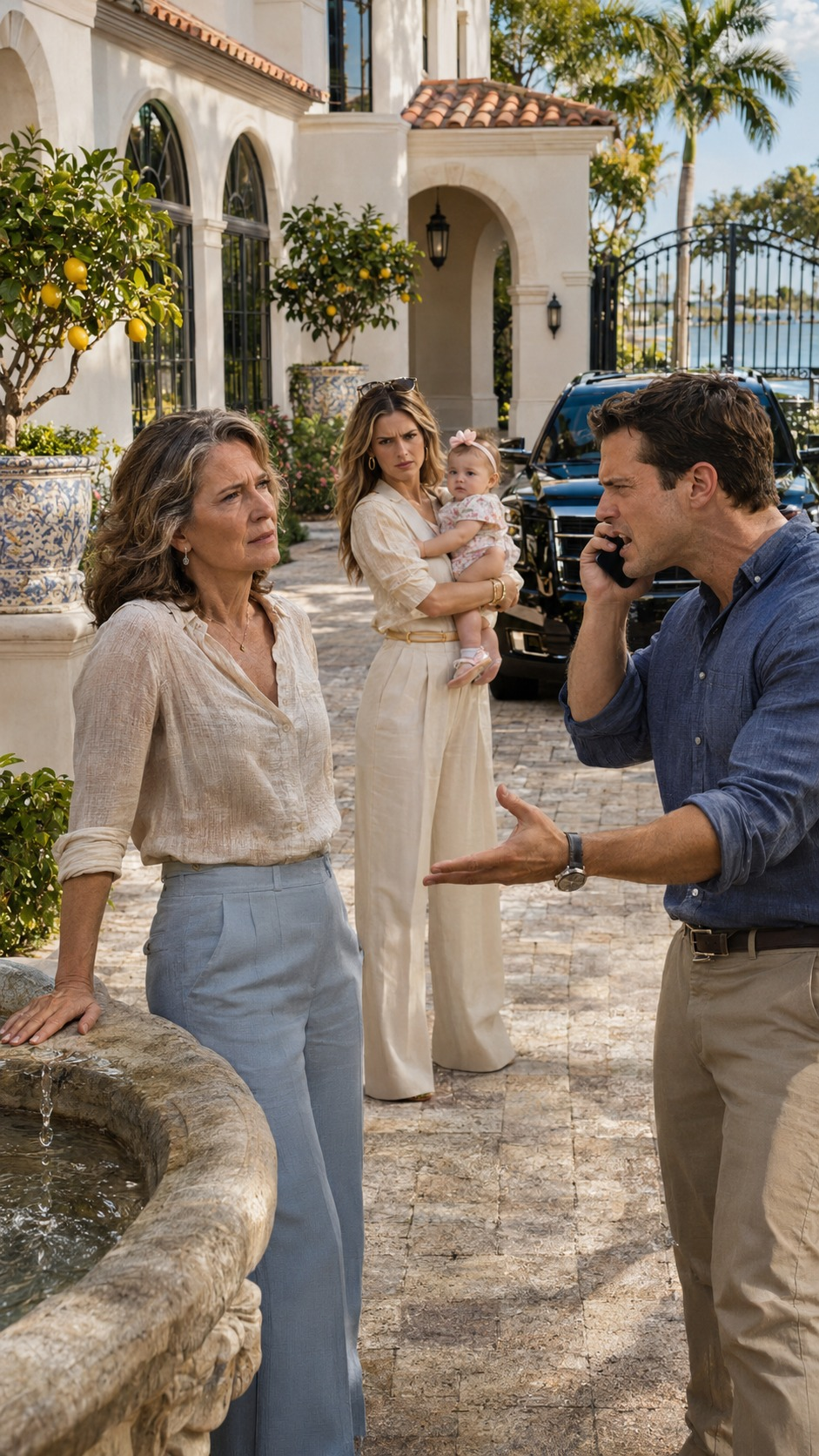
I stood in my home office, gripping my phone while the security monitor showed my ex-husband standing outside my gate beside our son.
Richard held a document toward the camera.
Preston stood beside him, smiling as though they had just delivered the final piece of a carefully planned surprise.
But all I could think about was my grandmother.
Eleanor Bennett had been dead for fourteen years.
She had taught me to sew, helped me open my first savings account, and left me the inheritance that eventually made my beautiful Florida villa possible.
And now her signature had somehow appeared on a document involving a house purchased long after her death.
"Daniel," I whispered, "that's impossible."
"I know, Margaret."
"She died fourteen years ago."
"I'm aware."
"Then how could her signature be on a property transfer?"
"That's exactly what we need to establish."
Outside, Preston pressed the intercom again.
"Mom! We know you're watching. Open the gate."
I looked at the screen.
Kendra stood beside the SUV, holding Lila against her shoulder. My granddaughter had fallen asleep, her little cheek resting against her mother's navy dress.
The sight made my chest ache.
Preston had brought his wife and baby to another confrontation, apparently believing their presence would make it harder for me to refuse him.
But Richard's arrival frightened me in a different way.
My ex-husband was not an impulsive man.
He could be selfish, dismissive, and painfully indifferent to my feelings, but he rarely acted without calculating what he expected to gain.
If Richard had joined Preston, something more serious was happening.
"Do not open the gate," Daniel repeated.
"I won't."
"Is the notary still there?"
"Yes."
"Can you ask him to remain?"
I glanced at Thomas Reed on the security monitor.
He stood several feet away from Preston and Richard, watching them with an expression I couldn't quite read.
"I can try."
"Good. I'm going to contact a colleague who handles disputed property instruments. In the meantime, don't sign anything, don't hand over original documents, and don't let anyone inside."
"Daniel, what does the paper actually say?"
He hesitated.
"The copy I received appears to be an attempted assignment of interests connected to your grandmother's estate."
I sat down.
"My grandmother's estate was settled years ago."
"That's my understanding."
"Then why would anyone bring it into this?"
"I don't know yet."
I looked toward the locked drawer containing the power of attorney.
My grandmother had been the one person in my childhood who never made love feel conditional.
When my parents argued, she took me into her sewing room and taught me how to make straight seams.
When I failed a mathematics test, she told me that one bad grade couldn't measure a person's intelligence.
And when I married Richard, she gave me a small gold bracelet and whispered, "Always keep something that belongs only to you."
I hadn't understood the importance of those words at twenty-seven.
At sixty-one, I understood them perfectly.
"Margaret?" Daniel said.
"I'm here."
"Whatever they're claiming, remember that a document isn't automatically valid because someone prints it and puts signatures on it."
I nodded, although he couldn't see me.
"I understand."
"Call me immediately if anything changes."
After we ended the call, I returned to the security application.
Preston was speaking to Richard.
I couldn't hear them through the camera, but I could see the tension in their movements.
Richard pointed toward the house.
Preston shook his head.
Then Kendra said something that made both men turn toward her.
I pressed the intercom button.
"Preston."
All three adults looked toward the camera.
"Finally," my son said. "Open the gate."
"No."
His expression hardened.
"Mom, Dad came all the way over here."
"I can see that."
"We need to settle this."
"Then you can speak to my attorney."
Richard stepped forward.
"Margaret, don't make this more difficult than necessary."
Hearing his voice brought back thirty-four years of memories I had spent months trying to put behind me.
Richard had a particular way of speaking when he wanted me to stop arguing.
Quiet.
Controlled.
Almost patient.
He used to call it being reasonable.
I had eventually learned that his definition of reasonableness usually meant accepting whatever he had already decided.
"Hello, Richard," I said.
He looked directly into the camera.
"We need to discuss your financial situation."
I nearly laughed.
"My financial situation?"
"Yes."
"You're standing outside a house I bought after our divorce, holding papers I haven't seen, and you want to discuss my finances?"
His jaw tightened.
"Margaret, this attitude isn't helping."
There it was.
The familiar correction.
Not an answer.
Not an explanation.
Just a reminder that my tone was somehow more important than his behavior.
"What exactly do you want?" I asked.
Preston stepped forward.
"We want what's fair."
"Fair to whom?"
"To the family."
I looked at the villa reflected on the monitor.
"Preston, you and Kendra have never lived here."
"That's not the point."
"Then what is?"
Richard interrupted.
"Margaret, your grandmother's estate involved certain financial arrangements that were never properly explained to you."
I went still.
"Excuse me?"
He lifted the document.
"This concerns those arrangements."
"How convenient that you're explaining them fourteen years after her death."
His expression changed.
"There's no need for sarcasm."
"Then explain why her signature appears on a document about my house."
For the first time, Richard looked uncomfortable.
Only briefly.
But I saw it.
He lowered the paper.
"That isn't something we should discuss over an intercom."
"Then send it to Daniel."
Preston threw up his hands.
"Unbelievable."
I ignored him.
"Richard, send the document to my attorney."
He stared at the camera.
"You're making a mistake."
"Possibly," I said. "But it'll be my mistake."
I released the intercom button.
My hands were trembling.
I hated that.
I hated how easily Richard's voice could still reach into parts of me I thought I'd repaired.
But I was beginning to understand something.
Being afraid didn't mean I had to obey.
I could feel frightened and still keep the gate closed.
I could feel heartbroken and still protect my home.
I could love Preston and still refuse to let him take what belonged to me.
Outside, Thomas Reed approached the intercom.
He pressed the button.
"Mrs. Whitmore?"
I answered.
"Yes?"
"I don't want to interfere in a family disagreement, but I believe you should know something."
Richard turned sharply toward him.
"Mr. Reed, this is a private matter."
Thomas didn't move.
"Someone used my notarial information on a document I have no record of notarizing."
Preston's smile vanished.
Richard took a step toward Thomas.
"That's a serious allegation."
"Which is why I'm being careful about what I say."
I leaned toward the monitor.
"Mr. Reed, did you notarize a power of attorney for me?"
"Not according to my records, ma'am."
My stomach tightened.
"Have we ever met?"
"No."
"Then why does the document bear your name?"
"That's what I'm trying to determine."
Richard spoke sharply.
"You shouldn't be discussing this without reviewing the complete file."
Thomas looked at him.
"I have reviewed the information sent to me."
Preston stepped between them.
"Okay, everybody needs to calm down."
I stared at the screen.
The man who had called 911 claiming I was unstable was now telling everyone else to calm down.
For a moment, the absurdity almost overwhelmed me.
Then Thomas spoke again.
"Mrs. Whitmore, I received a request this afternoon to confirm the authenticity of a notarization. When I examined the copy, I noticed an inconsistency."
"What inconsistency?"
He glanced at Richard.
"The commission number printed on the document doesn't match the one I held on the date shown."
Silence.
Even Preston stopped moving.
I gripped the edge of my desk.
"Are you certain?"
"I'm certain about my commission records. I can't tell you who prepared that document, but the discrepancy needs investigation."
Richard folded the paper in his hand.
"That can be addressed through the appropriate channels."
"Agreed," Thomas replied.
I watched Preston turn toward his father.
Their eyes met.
Something passed between them.
Not panic exactly.
Recognition.
As though a conversation they'd expected to control had suddenly moved in an unexpected direction.
I pressed the intercom.
"Mr. Reed, please give your contact information to my attorney."
"I'd be happy to."
"Thank you."
Then I addressed Richard.
"Leave my property."
He looked up.
"Margaret—"
"Please leave."
Preston stepped toward the gate.
"Mom, you can't just shut us out."
"I can refuse to let you into my home."
"We're your family!"
I looked at Lila, still sleeping in Kendra's arms.
"I know exactly who you are."
The words came out more sadly than I intended.
Preston stared at the camera.
Then Richard touched his shoulder.
They exchanged a few quiet words.
A minute later, Thomas returned to his sedan.
Richard and Preston walked toward the SUV.
Kendra climbed into the back seat with Lila.
I watched until both vehicles disappeared down the road.
Only then did I realize how tightly I'd been holding my phone.
My fingers ached.
I set it on the desk and pressed my palms against my eyes.
I wanted to cry.
Not because I believed Preston would succeed.
Not because Richard had frightened me.
Because I had spent my entire adult life trying to build a family where everyone felt safe.
And now the people I'd loved most were standing outside my gate with documents designed to make me feel powerless.
I stayed in the office until the antique clock in the hallway struck ten.
Then I called Diane.
She answered immediately.
"Margaret? Is everything okay?"
"No," I admitted. "But I'm safe."
"Do you need me to come over?"
I almost said no.
Then I remembered how much loneliness had cost me during my marriage.
"Would you mind?"
"I'll be there in five minutes."
Diane arrived carrying a thermos of chamomile tea and a container of homemade cookies.
She didn't ask whether I wanted them.
She simply set everything on the kitchen counter and said, "Sit down."
I obeyed.
For the next twenty minutes, I told her what had happened.
Richard's arrival.
The disputed power of attorney.
Thomas Reed.
My grandmother's signature.
Diane listened carefully.
When I finished, she asked, "Did your grandmother leave you those commercial properties directly?"
"She left me an inheritance. I used part of it to acquire interests in the properties."
"And you kept records?"
"Every single one."
"Good."
I looked at her.
"Why?"
"Because people who rely on confusion don't like organized paperwork."
I smiled faintly.
"You're beginning to sound like my grandmother."
"Then she must have been a sensible woman."
"She was."
I stood and walked toward the living room cabinet.
Inside, beneath a stack of old family photographs, was a small wooden box.
I carried it to the kitchen table.
"This was hers."
Diane leaned forward.
The box was made of dark walnut, with a brass clasp and a tiny carved rose on the lid.
My grandmother had kept sewing needles, buttons, and handwritten patterns inside it.
After her death, I had used it to store letters and keepsakes.
I opened the clasp.
The familiar scent of old paper rose from the box.
Inside were birthday cards, a photograph of my grandmother standing beside her first sewing machine, and several envelopes tied with faded blue ribbon.
I lifted the ribbon carefully.
The top envelope was addressed to me in her handwriting.
Margaret, my darling girl.
I had read that letter dozens of times.
It was written shortly before she died.
She told me she was proud of the woman I'd become.
She reminded me not to spend my whole life apologizing for wanting happiness.
And she ended with a sentence I could still recite from memory.
"Never confuse being needed with being loved."
I read it aloud.
Diane was quiet.
Then she said, "She understood more than most people."
I nodded.
For years, I had thought the sentence referred to my marriage.
Now I wondered whether it also applied to Preston.
I put the letter aside and examined the remaining papers.
There were old bank statements.
A copy of her will.
Several handwritten notes about investments.
And a yellowed envelope from the attorney who had administered her estate.
I opened it.
Inside was a summary of distributions made after her death.
My name appeared beside the amount I'd inherited.
Everything matched my records.
I felt a small measure of relief.
Then Diane pointed toward the bottom of the page.
"Who's that?"
I followed her finger.
A name appeared in the correspondence section.
Richard Whitmore.
My ex-husband.
I frowned.
"Richard helped me organize some of the estate paperwork."
"Was he involved in the inheritance?"
"Not as a beneficiary."
"But he corresponded with the attorney?"
"Apparently."
I remembered that period of my life.
My grandmother had died after a long illness.
I was devastated.
Preston was twenty-six and struggling to keep his first steady job.
Richard had offered to handle phone calls and paperwork while I dealt with the funeral.
At the time, I'd been grateful.
Now I wondered what conversations had taken place without me.
I reached for another document.
It was a letter dated fourteen years earlier.
The attorney had written to Richard regarding a proposed investment structure.
I read the first paragraph.
Then the second.
Nothing appeared obviously improper.
But one sentence caught my attention.
"Please confirm that Margaret has reviewed and approved the proposed handling of her separate inheritance funds."
I stared at the words.
Had Richard confirmed?
I couldn't remember.
I had been grieving.
I had trusted him.
Those two facts suddenly felt dangerous.
Diane watched my expression.
"What is it?"
"I don't know yet."
I photographed the letter.
Then I sent it to Daniel.
A few minutes later, he replied.
"Received. We should review the historical estate records before drawing conclusions."
I appreciated his caution.
He wasn't telling me what I wanted to hear.
He was telling me what could actually be established.
That mattered.
Because by then, I had heard enough confident lies to last a lifetime.
Diane stayed until nearly midnight.
Before leaving, she squeezed my shoulder.
"Lock your doors. Get some sleep. And remember, you don't have to answer every call."
I thanked her.
After she left, I checked the security cameras one final time.
The courtyard was empty.
The fountain glowed beneath the garden lights.
The black wrought-iron gate was closed.
For the first time all evening, I felt able to breathe.
I went upstairs.
But sleep wouldn't come.
I lay in bed thinking about Preston.
I remembered the day he was born.
Richard had stood beside my hospital bed, holding our son with an expression of wonder I'd never forgotten.
Preston had been so small.
His fingers curled around mine.
I had promised him, silently, that I would always protect him.
And I had kept that promise.
Perhaps too well.
When Preston failed a college course, I paid for him to retake it.
When he lost his first job, I covered his rent.
When he bought a car he couldn't afford, I helped him refinance the loan.
When he and Kendra overspent on their wedding, I contributed more than I'd originally promised.
Every rescue had seemed like an act of love.
But somewhere along the way, Preston had stopped seeing my help as a gift.
He had begun seeing it as an obligation.
And when I finally refused him something, he reacted as though I had stolen it.
At 1:18 a.m., my phone vibrated.
A text from Kendra.
I sat up.
It was the first message she'd sent me directly since the moving truck arrived.
"Margaret, I know things are tense, but please remember Lila is innocent."
I stared at the screen.
Of course Lila was innocent.
My granddaughter had nothing to do with the adults' decisions.
I typed carefully.
"I know that, Kendra. I love Lila very much."
Her reply came almost immediately.
"Then please don't make us homeless."
I closed my eyes.
There it was again.
The same argument.
The same emotional pressure.
I wanted to ask why they had given notice on their rental without securing another place to live.
I wanted to ask why they believed my home was theirs to claim.
Instead, I wrote:
"You and Preston need to make appropriate housing arrangements. My home is not available for you to occupy."
A minute passed.
Then another message arrived.
"Preston said you promised him this house would eventually be his."
I sat very still.
I had never promised Preston the villa.
I hadn't even owned it until recently.
I typed:
"That is not true."
Kendra replied:
"He said your grandmother's money was always meant to stay in the family."
I looked toward the bedroom window.
Outside, the palm trees moved in the darkness.
"My grandmother left her inheritance to me," I wrote. "I used it to purchase investments. Those investments helped me buy this house."
Kendra didn't respond.
I thought the conversation was over.
Then, at 1:31 a.m., another message appeared.
"Did Richard ever tell you what he promised Preston?"
I read it twice.
My heart began beating faster.
"What promise?"
The typing indicator appeared.
Disappeared.
Appeared again.
Finally, Kendra wrote:
"You should ask them."
Then she stopped responding.
I called her.
No answer.
I sent another message.
Nothing.
For nearly an hour, I lay awake wondering what Richard could have promised our son.
Money?
Property?
A future inheritance?
Something connected to my grandmother's estate?
The possibilities made me feel physically ill.
At 7:06 the next morning, I called Daniel.
He answered with the tired voice of a man who had already been working.
"Margaret, good morning."
"Did I wake you?"
"No. I've been reviewing the documents."
I told him about Kendra's messages.
He listened carefully.
"Save those," he said.
"I already have."
"Good."
"Daniel, what could Richard have promised Preston?"
"I don't know. But we should distinguish between a promise and a legal right."
"I understand."
"Someone can promise another person property they don't own. That doesn't make the promise enforceable against the actual owner."
I let out a breath.
"That helps."
"However, I want to investigate why your grandmother's estate is being invoked."
I looked at the wooden box on my bedside table.
"I found some old correspondence."
"I saw what you sent."
"Does it mean anything?"
"Not conclusively. But it gives us a starting point."
He paused.
"Margaret, I also spoke briefly with Thomas Reed."
I sat straighter.
"What did he say?"
"He confirmed that the commission information on the power of attorney doesn't match his records for the date shown. He's preparing a written statement about what he can verify."
"Does that prove the document is forged?"
"Not by itself. But it's a significant concern, and it warrants further examination."
I nodded.
"What happens next?"
"We'll review the available records, consider whether any formal revocation or protective filing is appropriate, and determine whether the document has been presented to anyone."
"Can we find that out?"
"We can begin asking the right questions."
I looked toward the window.
The morning sun was rising over the courtyard.
For the first time since Preston arrived with the moving truck, I felt something besides fear.
Resolve.
"Daniel," I said, "I want to know everything."
"Then we'll proceed carefully."
After the call, I went downstairs and made coffee.
I carried my cup into the courtyard.
The lemon trees were bright beneath the morning sun.
The fountain continued its gentle rhythm.
I sat on the stone bench and opened my phone.
There were six missed calls from Preston.
Two from Richard.
And one voicemail from a number I didn't recognize.
I played the voicemail.
A woman's voice filled the quiet courtyard.
"Good morning, Mrs. Whitmore. My name is Rebecca Sloan. I'm calling from Gulf Coast Residential Services regarding a request to update the authorized contact information for your property."
I stopped the recording.
My stomach tightened.
The property management company.
The one Preston had contacted.
I played the message again.
"Before we process any changes, we need to confirm certain information directly with the property owner. Please return my call at your earliest convenience."
I immediately called Daniel.
He told me to speak with the company only to establish what had been submitted, without agreeing to any changes.
Then I returned Rebecca Sloan's call.
She answered politely.
"Gulf Coast Residential Services. This is Rebecca."
"Hello. My name is Margaret Whitmore. You left me a voicemail."
"Oh, yes, Mrs. Whitmore. Thank you for calling."
"Can you tell me why your company has been contacted about my property?"
There was a brief pause.
"We received an inquiry from a Mr. Preston Whitmore."
"My son."
"Yes, ma'am. He indicated that he would be coordinating residential arrangements for your family."
"I have not authorized him to do that."
Another pause.
"I see."
"Did he send you documents?"
"He provided a proposed occupancy agreement and a copy of what he described as a family authorization."
My fingers tightened around the phone.
"What family authorization?"
"I'd prefer to send you the materials so you can review exactly what we received."
"Please do."
"Of course."
I gave her my email address.
Then I asked, "Has your company made any changes to my property records?"
"No, ma'am. We haven't accepted any management arrangement or changed any access information. That's why we contacted you directly."
Relief washed through me.
"Thank you for verifying."
"You're welcome. And Mrs. Whitmore?"
"Yes?"
"Your son seemed quite insistent that the matter was urgent."
I looked toward the front gate.
"I'm sure he did."
After ending the call, I waited for the email.
It arrived four minutes later.
I opened the attachments.
The first was the same proposed occupancy agreement I'd found in the envelope.
The second was a copy of the disputed power of attorney.
The third was a letter written by Preston.
I read it slowly.
He claimed that I had become overwhelmed after my divorce.
He described my decision to purchase the villa as impulsive.
He suggested that I was struggling to understand the responsibilities of property ownership.
Then he wrote:
"My father and I are working together to ensure that my mother's assets remain protected and that appropriate family supervision is established."
I stared at the words.
Family supervision.
At sixty-one.
After managing our household finances for decades.
After protecting my inheritance.
After buying a home with my own money.
My son and ex-husband were telling strangers that I needed supervision.
I forwarded the email to Daniel.
Then I walked into the living room and stood before my grandmother's china cabinet.
Inside were six delicate plates decorated with blue flowers.
They were among the few possessions I had taken when I left Richard.
I remembered my grandmother using those plates for Sunday dinners.
She never served expensive food.
Usually roast chicken, potatoes, and whatever vegetables were fresh.
But she always made the table look beautiful.
"People deserve beauty even on ordinary days," she used to say.
I touched the cabinet glass.
For years, I had believed that being a good mother meant keeping the family together at any cost.
Now I was beginning to see the danger in that belief.
A family held together by one person's surrender wasn't truly together.
It was simply arranged around the person making the demands.
My phone rang.
Richard.
I almost ignored it.
Then I decided I wanted to hear what he had to say.
I answered.
"Hello, Richard."
"Margaret."
His voice was smooth.
Too smooth.
"We need to talk."
"You can contact Daniel."
"This isn't something we should involve attorneys in."
I looked toward the window.
"You arrived at my house with legal documents last night."
"Because you're refusing to listen."
"No. I'm refusing to give Preston my house."
Richard sighed.
"You're being emotional."
I closed my eyes briefly.
There it was again.
The same accusation he had used throughout our marriage whenever I disagreed with him.
"Richard, I have a question."
"What?"
"What did you promise Preston?"
Silence.
Then he said, "Who told you that?"
My heart gave a hard thump.
"So there was a promise."
"Margaret, don't twist my words."
"What did you promise him?"
He exhaled sharply.
"I told him the family would always have a place to live."
"Which family?"
"Our family."
"We're divorced, Richard."
"That doesn't erase thirty-four years."
"No," I said quietly. "It doesn't."
For a moment, neither of us spoke.
Then he said something that changed the conversation.
"Your grandmother never intended for that money to be used this way."
I stared at the wall.
"My grandmother left that money to me."
"She wanted it to benefit the family."
"She wanted me to have security."
"That's your interpretation."
I felt my voice become very calm.
"Richard, are you claiming to know my grandmother's wishes better than I do?"
"I'm saying there were conversations you weren't part of."
I went still.
"What conversations?"
He hesitated.
"Things were discussed before she died."
"Between whom?"
"Margaret—"
"Between whom, Richard?"
His voice hardened.
"You're not going to like everything you discover."
I looked toward the wooden box on the coffee table.
"Then perhaps you should start telling the truth."
He didn't answer.
Instead, he said, "Preston is under a great deal of pressure."
"What kind of pressure?"
"Financial."
I felt a familiar sinking sensation.
"How much does he owe?"
"That's not the point."
"It sounds exactly like the point."
Richard sighed.
"He's made some mistakes."
"Again?"
"He's trying to provide for his family."
"By taking my home?"
"By finding a solution."
I sat down.
For years, I had heard that word used to justify decisions that benefited everyone except me.
A solution.
I paid the bill.
I covered the debt.
I postponed my plans.
I gave up something I wanted.
And the problem disappeared.
Until the next one.
"Richard," I said, "I will not surrender my house to solve Preston's financial problems."
His voice changed.
Became colder.
"Then you may force us to take a different approach."
I felt a chill.
"Is that a threat?"
"It's a warning."
I looked at the phone.
Then I ended the call.
My hands were steady.
That surprised me.
For thirty-four years, Richard had known how to make me doubt myself.
But his words no longer had the same power.
He could accuse me of being emotional.
He could tell me I was making mistakes.
He could claim to know what my grandmother wanted.
None of it changed the deed.
None of it changed the truth.
At 11:42 a.m., Daniel called.
"Margaret, I found something in the historical records."
I sat down immediately.
"What?"
"Your grandmother's estate file includes a reference to an investment proposal Richard submitted shortly before her death."
I gripped the phone.
"What kind of proposal?"
"It involved transferring certain assets into a family-controlled arrangement."
My stomach tightened.
"Did she agree?"
"That's what we're trying to establish. The records I've seen don't show a completed transfer."
"Then why is Richard bringing it up now?"
"I suspect he's relying on an old proposal to support a claim that never became effective."
I thought about the paper Richard had held outside my gate.
"And her signature?"
"Margaret, I want you to understand something. A signature can appear on a document for many reasons. It might be copied from another record. It might be attached to an unrelated acknowledgment. We need to examine the original before making conclusions."
I nodded.
"Okay."
"There's also something else."
I closed my eyes.
"What now?"
"The attorney who handled your grandmother's estate retired years ago. But his former assistant still lives in Florida."
"Does she remember the case?"
"Apparently, she remembers your grandmother very well."
My heart began beating faster.
"Why?"
Daniel hesitated.
"Because there was a disagreement about the proposed transfer."
I sat perfectly still.
"Between my grandmother and Richard?"
"That's what she indicated."
I looked at the photograph of my grandmother on the mantel.
She stood beside her sewing machine, smiling at the camera.
I remembered how much she had loved me.
How carefully she had protected her savings.
How often she had warned me not to let other people make my decisions.
"Daniel," I whispered, "what happened?"
"She wouldn't discuss the details over the phone. But she's agreed to meet us tomorrow."
"Where?"
"At my office."
I looked toward the window.
"What's her name?"
"Carolyn Hayes."
The name meant nothing to me.
But Daniel's next words made my pulse quicken.
"Margaret, she said your grandmother left something behind specifically for you."
I stopped breathing.
"What?"
"She wouldn't say."
I looked down at my hands.
For fourteen years, I had believed I knew everything my grandmother wanted me to have.
Her letters.
Her sewing supplies.
Her inheritance.
Her love.
Now there was something else.
Something connected to a disagreement with Richard.
Something the former legal assistant had apparently kept all these years.
"Daniel, why didn't she give it to me before?"
"I don't know."
"Did she explain?"
"Only that she had been waiting for the right circumstances."
I felt a strange mixture of fear and hope.
"What circumstances?"
Daniel paused.
Then he said, "She told me she would explain when she saw you."
That evening, I prepared for the meeting.
I organized the documents into folders.
One contained my property records.
Another held Preston's messages.
A third contained the disputed power of attorney.
I placed the old estate correspondence in a separate envelope.
Then I printed the photographs from my security cameras.
I wanted everything ready.
I wanted no confusion.
No missing dates.
No opportunity for Richard or Preston to claim I had misunderstood what happened.
At 9:16 p.m., I received another text from Preston.
"Mom, Dad says you're meeting with a lawyer tomorrow."
I stared at the screen.
How did he know?
I hadn't told him.
Another message arrived.
"Don't go digging into Grandma Eleanor's old business. You won't like what you find."
I felt my stomach tighten.
Then came a third.
"Some things were kept from you for a reason."
I didn't respond.
I took screenshots and forwarded them to Daniel.
Then I locked my phone and sat quietly.
For the first time, I wondered whether my grandmother's inheritance had been the source of conflict long before my divorce.
Had Richard tried to control it?
Had my grandmother refused?
Had Preston been told a version of events that made him believe he was entitled to money that had never belonged to him?
The questions kept coming.
But I had learned enough to stop guessing.
Tomorrow, I would meet Carolyn Hayes.
Tomorrow, I would hear what she knew.
And perhaps, for the first time, I would understand why my son and ex-husband were so determined to take control of my home.
The following morning, I arrived at Daniel's office ten minutes early.
His building stood near downtown Sarasota, a modern structure with glass doors and a quiet reception area.
I wore a cream blouse, navy trousers, and comfortable shoes.
My grandmother's gold bracelet rested against my wrist.
I had worn it deliberately.
It reminded me that I was still the woman she had believed in.
Daniel greeted me personally.
"Margaret, come in."
He led me into a conference room.
A pitcher of water stood on the table.
Several folders were arranged neatly beside a legal pad.
I sat down.
"Is Carolyn here?"
"Not yet."
I glanced at the clock.
9:52.
Our meeting was scheduled for ten.
Daniel sat across from me.
"Before she arrives, there's something I want you to understand."
I looked at him.
"What?"
"Whatever Carolyn tells us, we need to separate what she personally witnessed from what she heard from others."
I nodded.
"Of course."
"And we should be prepared for the possibility that some of the information is upsetting."
I looked down at my bracelet.
"I think I've already passed that point."
He gave me a sympathetic smile.
Then the receptionist knocked.
"Mr. Mercer?"
"Yes?"
"Your ten o'clock appointment is here."
Daniel stood.
"Please send her in."
The door opened.
A woman in her late seventies entered, carrying a brown leather handbag.
Her silver hair was neatly pinned back.
She wore a pale blue cardigan and sensible black shoes.
She looked at me for a long moment.
Then her eyes filled with tears.
"Margaret Bennett," she whispered.
I stood slowly.
"Yes?"
She pressed a hand to her chest.
"Oh, my goodness. You look so much like Eleanor."
Something tightened in my throat.
"Did you know my grandmother well?"
Carolyn nodded.
"Very well."
She stepped closer.
"She was a remarkable woman."
I smiled sadly.
"She was."
Carolyn reached into her handbag.
"I promised her something a long time ago."
She removed a small sealed envelope.
The paper was yellowed with age.
Across the front, in my grandmother's handwriting, were five words.
FOR MARGARET, WHEN SHE NEEDS IT.
My eyes filled.
I reached toward the envelope.
But Carolyn didn't hand it over.
Not yet.
Instead, she looked at Daniel.
"Before she opens this, there's something she needs to know."
Daniel nodded.
"Go ahead."
Carolyn turned toward me.
"Margaret, your grandmother discovered something about Richard shortly before she died."
I felt the room grow very still.
"What did she discover?"
Carolyn's expression became grave.
"She found out he had been trying to use her estate to secure money for himself."
I stared at her.
"How?"
She lowered her eyes toward the envelope.
"She confronted him. And after that conversation, she became very concerned about what might happen to you."
My hands began trembling.
"Why?"
Carolyn looked directly into my eyes.
"Because Richard wasn't the only person involved."
I felt a cold sensation move through my chest.
"Who else?"
Carolyn hesitated.
Then she reached into her handbag again.
She removed a photograph.
It showed Richard standing outside an office building fourteen years earlier.
Beside him stood a much younger Preston.
And between them was a third person.
Someone I recognized immediately.
Someone I had trusted.
Someone who had been inside my villa only days earlier.
I leaned closer.
My heart seemed to stop.
Carolyn placed the photograph on the table.
Then she said, "Margaret, before I tell you what happened, you need to understand who took this picture."
I looked up.
"Who?"
She opened her mouth.
At that exact moment, Daniel's office phone rang.
He glanced at the display.
His expression changed.
"Margaret," he said quietly, "it's the county records office."
I stared at him.
He answered.
For several seconds, he listened without speaking.
Then he stood abruptly.
"Are you certain?"
My stomach dropped.
Daniel looked directly at me.
"Margaret, someone filed a new document against your property this morning."
I gripped the edge of the table.
"What document?"
He listened to the person on the phone.
Then his face went pale.
"It's not just a transfer request," he said.
I stopped breathing.
"Then what is it?"
Daniel slowly lowered the phone.
"Someone has submitted paperwork claiming that your house was sold yesterday."
And the buyer's name was about to appear on his screen.






Comments 0