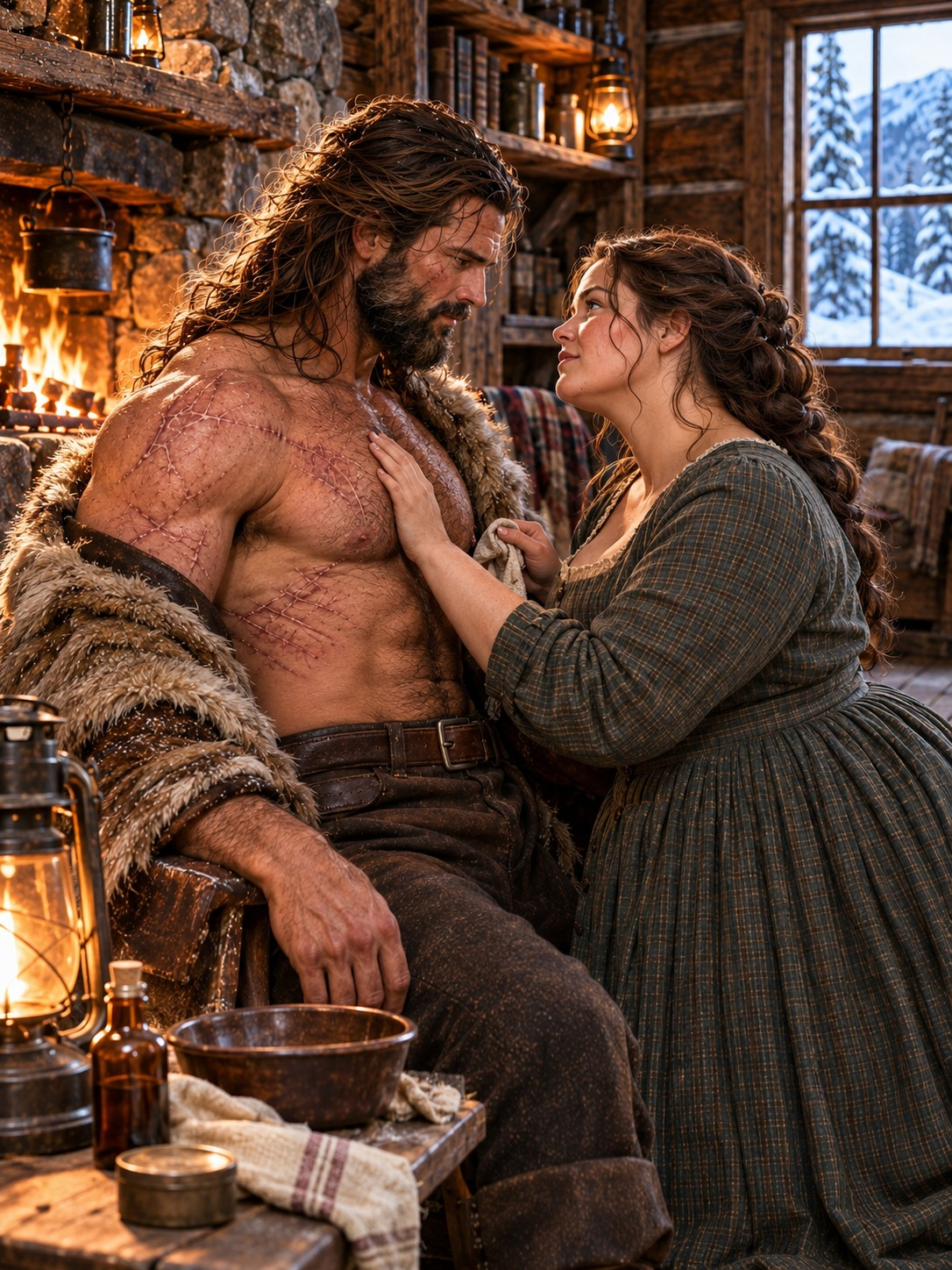
Boone Harlan reached for his rifle.
Lydia stood beside the wooden table, staring at the envelope in his hands.
Neither moved.
The name written across its front seemed to have changed the air inside the cabin.
REVEREND SAMUEL HARLAN.
Beneath it, in smaller handwriting, were six words.
For the truth about the Tanner fire.
Boone read the words again.
His father had been dead for nearly twenty years.
At least, that was what Boone had believed.
He placed the envelope on the table but kept one hand near his rifle.
Lydia watched him carefully.
She pointed toward the name.
Then toward the small wooden cross above the fireplace.
Samuel Harlan.
She understood now.
The man whose name appeared on the envelope was Boone's father.
But she did not understand why her mother had been connected to him.
Boone looked at her.
"Where did your father get this?"
Lydia shook her head.
She had never seen the envelope before.
He studied her expression, searching for any sign that she might be hiding something.
There was none.
He slowly pulled out the chair opposite her.
"Sit down."
She understood from his gesture.
Lydia sat.
Boone remained standing.
He examined the red wax seal. It was old and cracked, but it had not been broken.
Someone had deliberately preserved the envelope.
He turned it over.
On the back was another inscription.
This time, the handwriting was different.
If Lydia ever learns what happened that night, tell her to find the preacher's son.
Boone stopped breathing for a moment.
The preacher's son.
Him.
He looked toward the window.
Then at the door.
For years, he had believed his father's past was buried beneath the ruins of an old church in the eastern territory.
Now someone had placed a piece of that past inside Elias Tanner's satchel.
And they had sent it directly to his cabin.
Boone finally sat down.
He took a small knife from his belt and carefully cut through the edge of the envelope.
Inside was a folded letter.
The paper had yellowed with age. Several creases ran across its surface, and the ink had faded in places.
Boone unfolded it.
The first line was written in a woman's hand.
Samuel,
If this letter reaches you, it means I have failed to keep my promise.
Boone stopped.
He looked at Lydia.
She leaned forward.
He continued reading.
You told me that the truth would eventually find its way into the light. I want to believe you. But Elias has become frightened, and the men who came to the boarding house have threatened us again.
I cannot stay in Hollow Rock.
I cannot allow them to take my daughter.
Boone lowered the paper.
Lydia's hands rose immediately.
My mother?
He nodded.
She reached across the table.
He allowed her to take the letter.
Lydia read the lines slowly.
Her fingers began trembling.
She recognized the handwriting.
Not from a letter she had seen before.
From an old recipe card that had once belonged to her mother.
The same curved letters.
The same way the capital letters leaned slightly to the right.
She touched the paper.
A memory surfaced.
She was very young.
Her mother was sitting beside a window, writing something while Lydia played with wooden blocks on the floor.
When Lydia had approached, her mother had smiled and folded the paper.
She had placed it inside a small leather bag.
Then she had kissed Lydia's forehead.
Lydia had never seen that letter again.
She turned the page.
At the bottom was a signature.
Mary Tanner.
Her mother.
Lydia pressed the letter against her chest.
Boone watched her.
He had seen people grieve before.
But there was something particularly painful about watching someone discover that a person they had mourned might have left behind an explanation.
Lydia looked up.
She raised her hands.
Where is she?
Boone did not answer.
He had no idea.
But the letter contained something else.
A date.
December 14, 1862.
Nearly eighteen years earlier.
And beneath the date was a place.
The old mission church outside Hollow Rock.
Boone looked toward the fireplace.
His father's cross hung above it.
He slowly stood.
For several minutes, Boone said nothing.
He walked to the shelf and removed the wooden cross.
Its edges were worn smooth.
Samuel had carved it himself, using a piece of walnut from an old church pew.
Boone remembered watching him work.
He had been twelve years old.
His father had sat near a window, carefully shaping the wood with a small knife.
Boone had asked why he needed another cross when the church already had one.
Samuel had smiled.
He had explained that faith was not something that belonged only inside a building.
It was something a person carried.
Boone had believed him.
Then came the fire.
He remembered smoke.
Shouting.
A collapsing roof.
His father's hands pushing him through a narrow doorway.
He remembered being told to run.
He remembered turning around and seeing flames climbing the church walls.
He had waited for his father.
But Samuel had never returned.
The authorities searched the ruins.
They found several bodies, but the damage was too severe for reliable identification.
A body believed to belong to Samuel was buried beneath a wooden marker.
Boone had attended the funeral.
He had watched the earth cover the grave.
He had never questioned it.
Until now.
He looked at the letter again.
"Why did my father know your mother?"
Lydia looked at him.
She raised her hands slowly.
I don't know.
Boone returned the cross to the shelf.
Then he reached for the letter.
There was more writing on the second page.
He read it aloud, although Lydia could not hear him.
"Samuel, Elias has made another agreement with Ambrose. He believes he can repay the money by giving the mining company access to the land near the old church."
He paused.
The next sentence was underlined.
But the land is not empty.
Boone leaned closer.
There is something buried beneath the church.
He read the final paragraph.
Please do not let Ambrose find it. Your father promised me that it would remain hidden until Lydia was old enough to understand.
Boone lowered the letter.
The cabin seemed suddenly colder.
He looked toward Lydia.
She was staring at him.
He turned the paper around and showed her the final lines.
She read them twice.
Then she shook her head.
She had never known about any buried object.
She had never heard her mother mention an old church.
And she had certainly never known that Ambrose Culpepper might have been searching for something connected to her family.
Boone folded the letter.
"Your father knows more than he admitted."
Lydia's expression changed.
She pointed toward the southern mountains.
Then toward the road.
She wanted to return to Hollow Rock.
Boone shook his head.
Not yet.
He pointed at the letter.
Then at the window.
Someone had already followed them to the cabin.
They needed to understand what Ambrose wanted before walking into his hands.
That afternoon, Boone began preparing for a journey.
He checked the ammunition in his rifle and loaded several cartridges into a leather pouch.
He examined the straps on Deacon's harness.
Then he packed flour, dried meat, coffee, and a small medical kit.
Lydia watched him.
She wanted to help.
Boone pointed toward the table and showed her where to place the supplies.
She followed his instructions carefully.
While packing, she found a small cloth bundle beneath a folded blanket.
She lifted it.
Inside was a collection of old photographs.
Most showed mountains, horses, and men standing outside wooden buildings.
One photograph caught her attention.
It showed a group of people standing in front of a church.
A tall, bearded man stood near the center.
His face was younger, but the resemblance was unmistakable.
Samuel Harlan.
Beside him stood a woman with dark hair.
Lydia brought the photograph closer.
She recognized her mother.
Mary Tanner.
She had seen that face in an old family photograph many times.
Her mother looked younger than Lydia remembered.
She wore a pale dress and held a small book against her chest.
Beside her was a little boy.
Boone.
Lydia turned the photograph over.
There was writing on the back.
Samuel, Mary, and the children of the mission school.
A date followed.
December 1862.
Lydia stared at the photograph.
Then she looked toward Boone.
He approached.
She held it out.
He examined it.
His face changed when he recognized the people.
He pointed toward the little boy.
Then toward himself.
Lydia nodded.
She pointed toward the woman.
Then toward herself.
Boone understood.
For several seconds, neither moved.
Their families had known each other.
Not merely as strangers.
They had stood together in front of the same church.
Boone examined the photograph again.
He turned it over.
At the bottom, beneath the date, someone had written another sentence in faded ink.
The night everything changed.
He looked at Lydia.
She was already watching him.
Boone remembered something else.
A conversation.
He had been thirteen when his father began spending long evenings at the mission church.
Sometimes Samuel returned home with mud on his boots and a troubled expression.
Once, Boone had asked whether something was wrong.
His father had placed a hand on his shoulder.
"Some people spend their whole lives protecting things that don't belong to them," Samuel had said.
Boone had not understood.
"Why would they do that?"
Samuel had smiled sadly.
"Because sometimes the truth is worth more than gold."
A week later, the church burned.
Boone had never heard the sentence again.
Now it returned with a clarity that frightened him.
He looked at the photograph.
The old mission church had stood on land that later became part of Ambrose Culpepper's mining claims.
If something valuable had been buried there, Ambrose might have spent years searching for it.
But why would Mary Tanner have been involved?
And why had Elias hidden the letter?
Boone approached the table and unfolded the original document.
He examined the handwriting more carefully.
The debt agreement was dated the day after Elias supposedly signed it.
But there was another detail.
A small mark appeared beside his signature.
Three short lines forming a triangle.
Boone recognized it.
He had seen the same mark on several mining documents in Hollow Rock.
It belonged to Ambrose's private accounting system.
The debt agreement was not simply a personal arrangement.
It had been entered into the mining company's records.
Someone had intended to make the transaction look legitimate.
Boone looked at Lydia.
He pointed toward her father's signature.
Then toward the paper.
He shook his head.
He did not believe Elias had acted alone.
As the afternoon light faded, Lydia began preparing a meal.
She sliced potatoes and placed them in the cooking pot.
Boone stood near the window, watching the clearing.
Every few minutes, he checked the tree line.
Lydia noticed.
She understood that he expected someone to return.
She approached him and touched his sleeve.
He turned.
She raised her hands.
Are you afraid?
Boone studied her face.
He considered giving her the answer she might have wanted.
Instead, he shook his head.
Then he pointed toward the mountains.
He had lived through worse things than a man carrying a revolver.
But Lydia was not convinced.
She pointed toward his chest.
Then toward the rifle.
She wanted to know why he was preparing for a fight.
Boone looked down.
He slowly removed his gloves.
His hands were rough and heavily scarred.
He placed them on the table.
Then he pointed toward the letter.
Toward the photograph.
And finally toward Lydia.
She understood part of his meaning.
He was not protecting the cabin.
He was protecting her.
Lydia lowered her hands.
Then she did something Boone did not expect.
She reached for his right hand.
She held it gently.
He stiffened.
Her fingers moved across his palm.
She traced the old scars.
Then she looked directly into his eyes.
There was no fear in her expression.
Boone slowly pulled his hand away.
Not because he disliked her touch.
Because he had spent too many years believing he did not deserve it.
He turned toward the fireplace.
Lydia returned to the cooking pot.
Neither spoke.
But something between them had changed.
That evening, Boone finally told Lydia about the old church.
He took a piece of paper and began drawing.
First, he sketched a simple building.
Then he drew a mountain road and a small stream.
He marked the church with a cross.
Lydia leaned closer.
He pointed toward the cross.
Then he drew a second line beneath the building.
He tapped the paper.
Buried.
Lydia understood.
She pointed toward the photograph.
Then toward the drawing.
Boone nodded.
He wrote two words.
Tomorrow. Church.
Lydia looked at him.
She pointed toward herself.
He nodded again.
She would come with him.
Then Boone wrote another sentence.
We find out what your mother left behind.
Lydia held the paper for a long time.
Her mother had disappeared when she was too young to remember the circumstances clearly.
For years, Elias had told her that Mary had died during an illness while they were traveling west.
He had never shown her a grave.
He had never spoken about the church.
He had never explained why he kept her mother's belongings locked away.
Now Lydia began wondering whether her entire childhood had been built around a lie.
She looked toward the photograph again.
The little boy beside her mother was Boone.
Perhaps her mother had trusted his father.
Perhaps Samuel had known what happened to her.
And perhaps Boone was the only person left who could help uncover the truth.
Night came quickly.
Boone secured the door and placed the rifle beside his chair.
Lydia folded the old photograph and placed it beneath her pillow.
She wanted to keep it close.
For the first time in years, she had something that connected her to her mother beyond fading memories.
Boone sat near the fire.
He was not reading.
He was staring at the wooden cross.
The letter remained on the table.
He had read it so many times that he could almost remember every sentence.
The name of his father.
The old church.
The buried secret.
And the warning that Ambrose must never find it.
A thought suddenly occurred to him.
If Samuel had written to Mary in December 1862, then someone had preserved the correspondence for years.
Someone had known the secret.
Someone had kept it hidden.
Someone had placed the envelope inside Elias Tanner's satchel.
Boone stood and approached the table.
He examined the envelope again.
The wax seal was old.
But the handwriting on the back looked much newer.
He lifted the paper toward the lantern.
There was a faint impression beneath the writing.
Another message.
He turned the envelope sideways and studied the paper.
Then he took a pencil and gently rubbed its side across the surface.
Gradually, several hidden letters appeared.
Lydia sat up.
She watched him.
The first line became readable.
SAMUEL DID NOT DIE THAT NIGHT.
Boone stopped.
The pencil fell from his hand.
He stared at the words.
His father had survived the church fire.
The grave.
The funeral.
The years of mourning.
Everything he had believed might have been a lie.
Then another line appeared beneath the first.
HE WAS TAKEN ALIVE BY THE MEN WHO WANTED WHAT WAS BURIED.
Boone looked toward Lydia.
Her face had gone pale.
She slowly raised her hands.
Where is he?
Before Boone could answer, three hard knocks struck the cabin door.
He grabbed his rifle.
The knocks came again.
Then a man's voice called from outside.
"Boone Harlan!"
Boone froze.
He knew that voice.
He had not heard it in nearly twenty years.
The man outside spoke again.
"Open the door, son."
And then he called Boone by the childhood name only one person in the world had ever used.






Comments 0