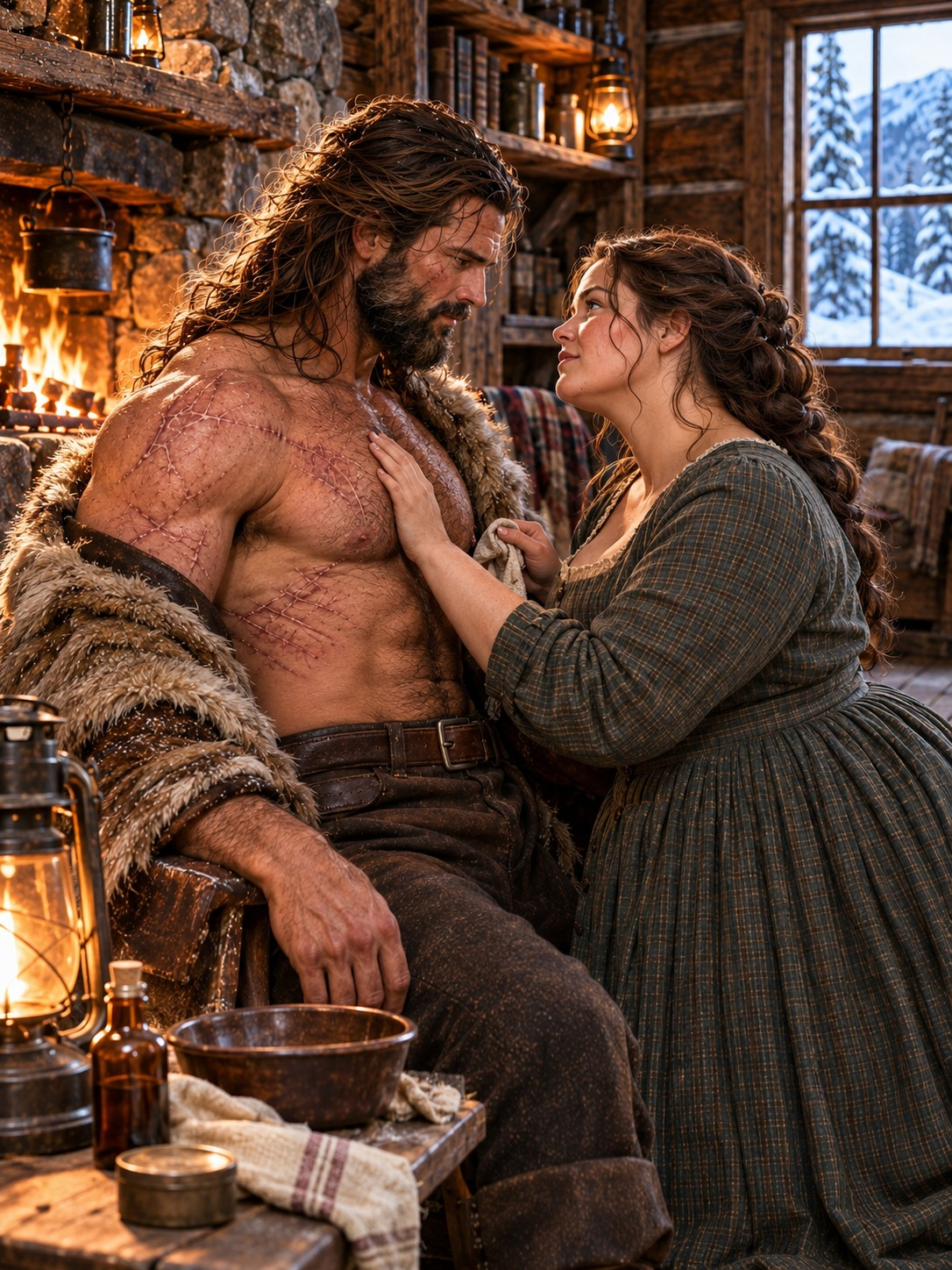
Lydia Tanner dropped the water bucket and ran toward her father.
"Let go of that girl!" someone shouted.
When Boone Harlan saw Ambrose Culpepper holding a torn debt note marked with Elias Tanner's signature, he stopped his white mule.
But something on the back of that paper caught his attention.
The date was tomorrow.
And Elias had already promised something he did not own.
Across the muddy street, Lydia fought against the man gripping her wrist.
Her strawberry-blonde hair had escaped its loose bun, and several strands clung to her cheeks. Her deep burgundy wool dress was soaked at the hem from the freezing mud. She had been carrying water from the public pump when she noticed the crowd gathering outside the saloon.
She could not hear the shouting.
She never could.
But she understood anger.
She recognized it in the way men's shoulders stiffened, in the way their mouths twisted, and in the way people suddenly found reasons to look somewhere else.
Her father was standing beside the saloon steps.
Elias Tanner's hat had fallen into the mud. His old brown coat hung loosely from his narrow shoulders, and his face had the defeated look Lydia had grown accustomed to seeing.
Two armed men stood behind Ambrose Culpepper.
Ambrose was a wealthy claim owner who controlled several mining operations outside Hollow Rock. He owned land, equipment, a saloon, and enough men with guns to make most disagreements disappear before they reached the sheriff.
He also owned the largest gambling debt in town.
And Elias Tanner owed him nearly two hundred dollars.
"Where is my money, Tanner?" Ambrose demanded.
Elias moved his lips.
Lydia could not hear the answer, but she knew her father's excuses. He had used them for years.
A failed mining claim.
A broken wagon.
A sick horse.
A business opportunity that had never existed.
Ambrose grabbed the front of Elias's coat and pulled him forward.
"You have had three weeks."
Elias raised both hands.
Ambrose shoved him against the wooden post beside the saloon.
Lydia dropped her bucket.
Water splashed across the frozen ground.
She ran toward them.
Her father saw her coming, but instead of relief, his face filled with something that made her stomach tighten.
Fear.
She pushed between the two men and raised her hands.
Her fingers moved quickly.
Leave him alone. I will help him.
Ambrose stared at her hands.
He had seen Lydia signing before. He knew she was deaf, but he had never bothered to learn what her gestures meant.
"What is she saying?"
Elias swallowed.
"Nothing important."
Lydia turned toward her father.
She signed again.
Papa, come with me.
Her father looked away.
Ambrose smiled.
It was not a pleasant expression.
"Perhaps your daughter can be useful after all."
He released Elias and seized Lydia's wrist.
His fingers closed painfully around her arm.
She tried to pull away.
He tightened his grip.
"Your debt can disappear today, Tanner."
Elias looked up.
For the first time, his expression changed.
Hope.
Ambrose leaned closer.
"Give me the girl, and we are finished."
Lydia stopped moving.
She looked at her father.
Surely he would refuse.
Surely the man who had carried her across the plains when she was a child would not agree to such a thing.
Her father had once promised her that nobody would ever take her somewhere she did not want to go.
She remembered that promise.
She remembered it so clearly that she almost reached for his hand.
Then Elias nodded.
Just once.
Ambrose released a satisfied breath.
"Good. We understand each other."
Lydia stared at her father.
His eyes never met hers.
She began struggling again.
She twisted her wrist, kicked at Ambrose's shin, and tried to pull herself free.
One of his men caught her other arm.
The crowd grew larger.
Miners stood outside the saloon. A blacksmith watched from across the street. Two men carrying sacks of flour stopped beside the mercantile.
Nobody moved.
Nobody wanted trouble with Ambrose Culpepper.
On the porch of the Latimer boarding house, Ruth Latimer watched with her arms crossed.
She had given Lydia a room in exchange for domestic work, although the arrangement had become increasingly cruel over the past several months.
Ruth was a sharp-faced widow who considered kindness an unnecessary expense.
She looked at Lydia.
Then she looked at Ambrose.
She said nothing.
Lydia's eyes filled with tears, but she refused to let them fall.
She looked at her father one final time.
Elias adjusted his hat.
He still did not look at her.
That was when Boone Harlan noticed the girl's face.
He had been standing near the mercantile, checking the ropes on his mule.
He was a large man, well over six feet tall, with broad shoulders and a thick reddish-brown beard. His short, slightly wavy hair was the same color, although a few gray strands had begun appearing near his temples.
A dark charcoal buffalo hide coat covered nearly every part of his upper body.
Beneath it, he wore a faded navy wool shirt and rugged brown trousers.
The coat was heavy enough to make him look even larger than he was.
Most people in Hollow Rock knew him by sight.
Few knew anything about him.
He lived high in the Wind River Range, far from the mining camps and the crowded settlements. He came down from the mountains when he needed flour, coffee, ammunition, salt, or other winter supplies.
He never stayed longer than necessary.
He never joined a card game.
He never drank with the miners.
And he never invited anyone to his cabin.
Some said he had once been a preacher.
Others claimed he had killed a man.
One old prospector insisted Boone had survived a grizzly attack that should have left him dead.
Nobody knew which stories were true.
Boone preferred it that way.
He had come into town that morning with his stubborn white mule, Deacon, carrying two empty canvas sacks.
By noon, the mule was loaded with fifty pounds of flour, coffee, salt, and two boxes of Winchester cartridges.
The supplies had cost him more than he liked.
The prices in Hollow Rock were robbery, but the snow would soon make the mountain passes impassable.
He needed to leave.
He had no intention of becoming involved in anyone else's troubles.
Then he saw Lydia.
He noticed the way she struggled against Ambrose's grip.
He noticed the way her eyes searched the crowd.
Most of all, he noticed the way she looked at her father.
Boone knew that expression.
It was the expression of someone discovering that the person who should protect them had already abandoned them.
He looked away.
For several seconds, he considered continuing toward the northern road.
Deacon snorted and shifted beneath his heavy load.
Boone tightened the lead rope.
He had spent years learning to avoid people.
People had brought him disappointment, violence, and memories he did not wish to revisit.
He had no desire to become a hero.
He was not one.
But Lydia twisted her wrist again, and Ambrose struck her hand away.
The movement was small.
Almost casual.
That was what made it worse.
Boone looked back.
Ambrose was already pulling Lydia toward the saloon.
The girl planted her boots in the mud.
Her face was pale.
Her fingers moved desperately, searching for a way to communicate with someone.
Nobody understood.
Nobody cared.
Something inside Boone shifted.
He thought of the old church where he had once stood beside his father.
He remembered a passage about the responsibility of the strong toward the helpless.
For years, he had convinced himself that those words belonged to another man.
A younger man.
A man who still believed the world could be made better.
But he was still standing there.
And the girl was still fighting.
Boone handed Deacon's lead rope to no one.
He simply stepped off the boardwalk.
His heavy boots sank into the mud.
The crowd began turning toward him.
Ambrose noticed the movement.
"Keep walking, mountain man."
Boone did not answer.
He continued forward.
His massive figure moved between the saloon and the mercantile.
The two armed men looked at each other.
One of them recognized him.
"That's Harlan."
Ambrose's expression hardened.
"I know who he is."
Boone stopped beside Deacon.
The mule stood quietly, its ears pointed toward the commotion.
Boone looked at Lydia's wrist.
Then he looked at Ambrose.
"Release her."
His voice was low.
It carried no anger.
That somehow made the words more threatening.
Ambrose laughed.
"You have business here, Harlan?"
"No."
"Then keep out of mine."
Boone looked toward Elias.
The older man was staring at the ground.
"Is she your daughter?"
Elias nodded.
"Then why is another man holding her like a prisoner?"
Elias said nothing.
Ambrose stepped closer.
"Her father owes me money. This is a private arrangement."
Boone glanced at the paper in Ambrose's hand.
"Two hundred dollars?"
"None of your concern."
Boone studied the torn document.
The amount was written in large black numbers.
Below it was Elias's signature.
But the date at the top made Boone pause.
Tomorrow.
The agreement had been dated for the following day, even though Ambrose claimed the debt was already overdue.
Boone had spent enough years around dishonest men to recognize a convenient lie.
He looked back at Ambrose.
"That paper says tomorrow."
Ambrose folded it.
"Do you have trouble understanding business?"
"No."
"Then move."
Boone remained where he was.
The crowd had become completely still.
Lydia looked between the two men.
She did not know Boone's name.
She did not know whether he intended to help her.
But she recognized something in his face that she had not seen in anyone else's that afternoon.
He was looking at her.
Not at her disability.
Not at her usefulness.
Not at the debt attached to her father's name.
At her.
Boone turned slightly toward her.
He raised one open hand, palm outward.
He did not know sign language.
But he understood that she needed a moment to breathe.
Then he looked at Ambrose again.
"Let her go."
Ambrose's jaw tightened.
"You think your size makes you untouchable?"
"No."
"Then perhaps you should remember that I have men who can put a bullet through you."
Boone glanced at the two armed men.
Neither looked particularly eager to test that promise.
Ambrose noticed.
His face darkened.
He released Lydia's wrist with a sudden shove.
She stumbled backward.
Boone moved one step, positioning himself between her and the men.
He did not touch her.
He simply made it impossible for Ambrose to reach her without going through him.
"She is coming with me," Boone said.
Ambrose laughed again, but this time there was less confidence in it.
"Where?"
"Somewhere you cannot reach her."
"She belongs to her father."
Boone looked at Elias.
"Does she?"
The question hung in the cold air.
Elias opened his mouth.
No words came.
Lydia stood behind Boone, rubbing her injured wrist.
She looked toward her father.
For a moment, she seemed to be waiting for him to change his mind.
He did not.
Ambrose straightened his coat.
"This isn't finished, Harlan."
Boone nodded.
"I didn't think it was."
He turned toward Lydia.
Slowly, he lifted his right hand and pointed toward Deacon.
Then he pointed toward the road leading north.
He made no attempt to grab her.
He waited.
Lydia looked at the mule.
Then at the mountain man.
She glanced once more at her father.
Elias was already walking away.
That was the moment she understood that she had nowhere left to go.
She stepped toward Boone.
He offered his hand.
After a brief hesitation, she accepted it.
Behind them, Ambrose watched.
His expression had changed.
The debt had not disappeared.
The girl had not become his property.
And Boone Harlan had just made himself an enemy of the most powerful man in Hollow Rock.
But Ambrose was not thinking about the money anymore.
He was staring at the enormous buffalo coat.
And he remembered something about the mountain man's past that nobody in town dared mention.
That evening, before Boone and Lydia reached the mountain road, Ambrose quietly summoned his two armed men.
He gave them an order.
They were to follow the white mule.
And they were not to return without the girl.
Part 1 of 15 — Chapter 1 completed. The remaining chapters will follow the outline above, preserving the original storyline, character relationships, historical setting, and eventual happy ending. Each installment will continue directly from the previous chapter without restarting or summarizing the story.






Comments 0