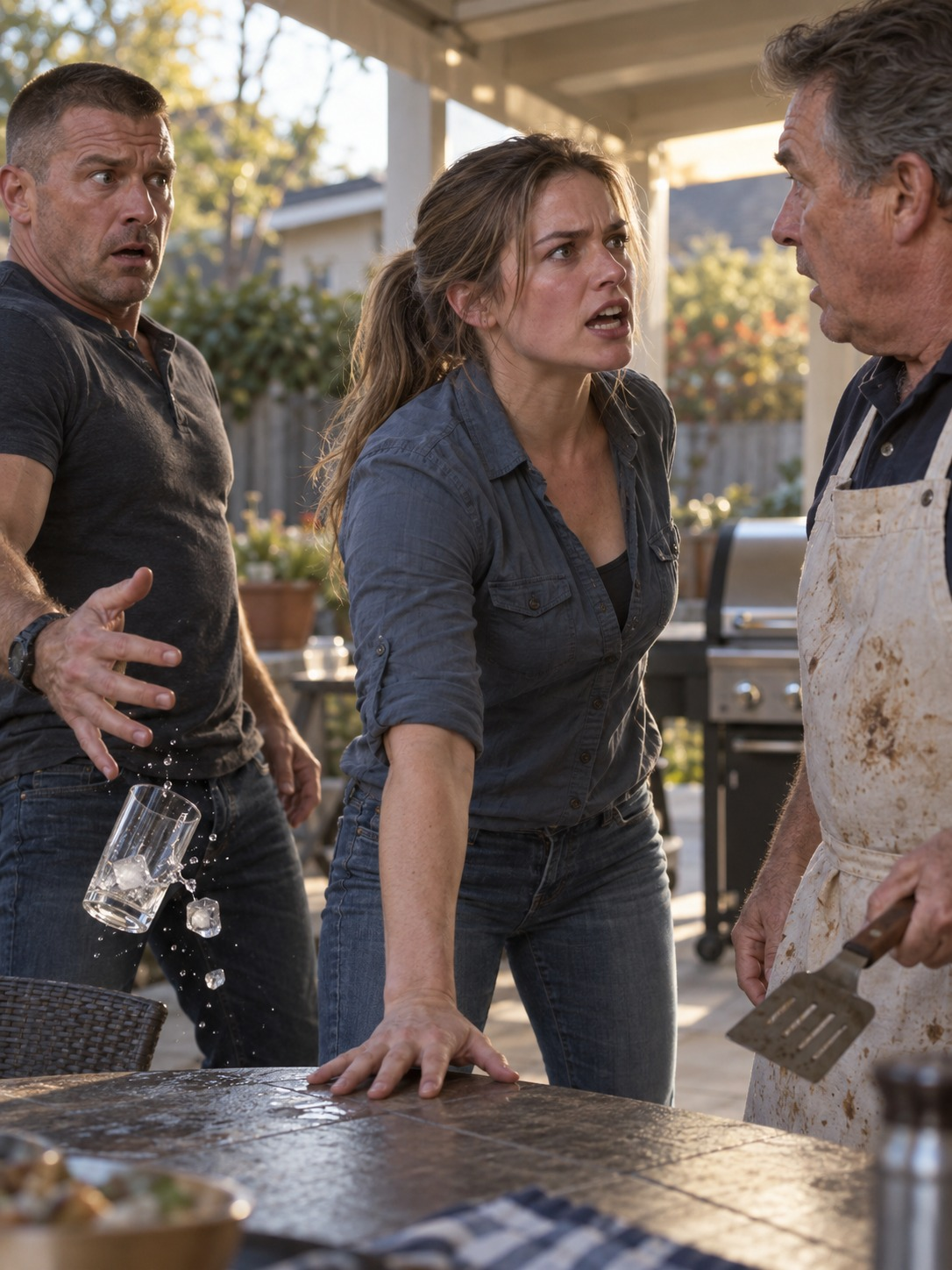
"Captain Hayes, there's something about that night that Colonel Voss doesn't want you to remember."
Lieutenant Colonel Evelyn Parker stood beside the locked conference room door, holding a printed access report against her chest.
Marcus Reed remained beside me.
Neither of us moved.
I looked at Parker's face, searching for some indication that she was joking.
She wasn't.
"Ma'am," I said carefully, "you just showed me an access record with your name on it."
"I know."
"Are you telling me you accessed my operational file?"
"Yes."
Marcus immediately straightened.
"Why?"
Parker glanced toward the glass panel beside the door.
"Because I was trying to find something before Voss destroyed it."
The room suddenly felt much smaller.
I looked down at the document.
"Destroyed what?"
"The original mission record."
I exchanged a glance with Marcus.
He stepped closer to the table.
"Colonel, you need to explain exactly what you're talking about."
Parker placed the access report down.
"Six months ago, shortly after Commander Reed's team returned, I received a request to review an operational discrepancy. The report concerned the withdrawal of aerial support during the extraction window."
My stomach tightened.
"Who requested the review?"
"An officer from the operational oversight division."
"Colonel Voss?"
She nodded.
"Initially, I believed it was a routine compliance review. But when I examined the supporting documents, I noticed that the withdrawal authorization appeared in two different versions."
Marcus leaned forward.
"Exactly what Daniel found."
"Yes."
"Why didn't you report it?"
Parker looked at him.
"Because I couldn't establish which version was authentic."
I folded my arms.
"Then why did you access my file?"
"Because both versions referred to your call sign."
I felt my breathing become slower.
Not because I was calm.
Because I was trying to understand how far this situation extended.
"Explain."
Parker opened her tablet.
"Your aircraft was providing support to Commander Reed's team. The original request to withdraw aerial support was submitted while the team was still in a vulnerable position."
"Because of the weather," I said.
"That's what the first report claimed."
"And the second?"
She hesitated.
"The second version contained an additional operational justification."
Marcus looked at her.
"What justification?"
Parker turned the tablet toward us.
A paragraph appeared on the screen.
Several lines had been redacted, but one sentence remained visible.
Continued aerial presence may compromise the integrity of the wider operation.
I read it twice.
"What does that mean?"
Parker shook her head.
"That's what I have been trying to establish."
Marcus's expression hardened.
"Your report says withdrawing the aircraft would have been safer for the mission?"
"According to the revised document."
"Safer for whom?"
Parker didn't answer.
I stared at the paragraph.
Something about the wording bothered me.
The operation had been classified as a support mission. Our primary responsibility was to maintain surveillance and provide assistance within the approved operational boundaries.
There had been no indication that the aircraft's presence was compromising anything.
In fact, the aircraft had been the only reliable source of continuous situational awareness during the most difficult portion of the operation.
"Did you compare the two versions?" I asked.
"Yes."
"And?"
"The timestamps don't match."
I leaned closer.
"How far apart?"
"Eleven minutes."
Marcus looked confused.
"Why does that matter?"
"Because the first version was entered before the weather warning," Parker explained. "The second was modified after the team requested additional support."
I looked at her.
"Someone changed the reason for withdrawing the aircraft after we had already received the request."
She nodded.
"That's my concern."
For several seconds, nobody spoke.
Then Marcus asked the question I had been avoiding.
"Did Colonel Voss know?"
Parker looked toward the door.
"Yes."
"How do you know?"
"Because he personally instructed me to close the review."
Marcus's expression became cold.
"And you refused?"
"I requested additional documentation."
"That isn't an answer."
Parker looked directly at him.
"He told me to stop asking questions."
I sat back.
The situation was becoming more complicated with every passing minute.
"Why are you telling us now?"
Parker looked at me.
"Because last night, someone accessed the original archive and requested the deletion of the first authorization record."
My stomach dropped.
"Was it approved?"
"No. The system flagged the request."
"Who submitted it?"
She turned the tablet again.
The authorization number was visible.
The name was not.
But the account designation matched Colonel Voss's administrative office.
Marcus stood.
"This is beyond an ordinary personnel review."
"I know."
"Then why are we sitting here instead of reporting it?"
Parker took a breath.
"Because I have already reported it."
She opened another file.
"This is the response I received."
The screen displayed an official notice.
It stated that the discrepancy had been reviewed and that no further action was required.
The document had been approved the previous evening.
I looked at the signature.
Colonel Richard Voss.
He had approved the closure of an investigation into a record he had personally requested to be altered.
I slowly lowered my eyes.
"That's why my credentials were suspended."
Parker nodded.
"Your file contains the original mission timeline. It also contains the communication logs that would allow an independent reviewer to compare the two authorization versions."
Marcus looked at me.
"Can you access those logs?"
"Not anymore."
Parker's expression tightened.
"That's the problem."
I studied her.
"Did you know my credentials would be suspended?"
"No."
"Then why did you access my file last night?"
She hesitated.
"Because I found another reference to Shadow Watch."
"What reference?"
Parker opened a separate document.
It was an internal personnel note dated three years earlier.
My name appeared at the top.
Lauren Hayes.
Underneath it was a short description of my professional qualifications and previous assignments.
I recognized the document.
It had been created when I was being considered for a specialized aerial support position.
But there was another section.
A paragraph I had never seen before.
Operator demonstrates exceptional decision-making under pressure. Recommended for high-priority assignments requiring sustained independent judgment.
I looked up.
"What's wrong with that?"
Parker pointed to the bottom.
"Look at the approval."
I moved closer.
There was a signature.
Richard Voss.
I felt a strange chill.
"Why would he approve my original assignment?"
Parker closed the document.
"Because he had been following your career for years."
Marcus looked at me.
"Did you know him before the mission?"
"No."
I searched my memory.
I remembered the selection process. I remembered interviews, technical evaluations, and a series of demanding training exercises.
But I had never spoken to Voss.
"Did he personally select me?" I asked.
"Not exactly," Parker replied. "But he recommended that you be assigned to the unit responsible for the operation."
I stared at her.
"Why?"
"That is what I don't know."
Marcus rubbed his forehead.
"You're telling us the same colonel who requested the withdrawal of our support also helped place Lauren in the position?"
Parker nodded.
"According to the personnel records, yes."
I looked at the document again.
Something didn't fit.
If Voss had wanted to remove the aircraft, why had he recommended me for the assignment in the first place?
Unless his original intentions had been different.
Unless he had expected something to happen during the operation.
I pushed that thought away.
There wasn't enough evidence.
I had learned long ago that assumptions could be dangerous.
"Ma'am," I said, "I need to know whether the original recording still exists."
Parker nodded.
"The mission communications archive should contain it."
"Should?"
"The archive was recently moved to a restricted storage system."
"Who authorized the transfer?"
She looked at the screen.
"Colonel Voss."
Marcus let out a quiet breath.
"Of course he did."
I stood and walked toward the window.
The parking lot outside was almost empty.
A few personnel were crossing between buildings, carrying folders and coffee cups.
Everything looked normal.
That was the strangest part.
Somewhere inside the installation, a record connected to a mission involving eleven men had apparently been altered.
And the people responsible for reviewing it were being told to stop.
I turned back.
"Can we retrieve the original recording through another channel?"
Parker considered the question.
"There may be a backup."
"Where?"
"An archived communications server."
"Who controls it?"
She hesitated.
"Technical operations."
I knew that department.
It maintained several independent storage systems used for continuity and security.
If the original communication record had been preserved, there was a chance the backup would contain information missing from the revised report.
Marcus looked at me.
"Could the recording identify who issued the withdrawal order?"
"Possibly."
Parker nodded.
"That's why I wanted to find it."
I approached the table.
"Then we need to request access through the appropriate authority."
Parker gave a small, humorless smile.
"I tried."
"And?"
"Denied."
Marcus shook his head.
"By Voss?"
"Yes."
I closed my eyes briefly.
This was no longer simply about proving that I had followed orders.
Someone appeared determined to control which version of the mission became part of the official record.
And if the original communications archive disappeared, the truth might become much harder to establish.
Parker picked up her tablet.
"There's one more thing."
I looked at her.
"What?"
She opened a photograph.
It showed a handwritten note attached to a printed operational document.
The handwriting was unfamiliar.
But the sentence was clear.
Do not allow Shadow Watch to testify about the final transmission.
I felt the muscles in my shoulders tighten.
Marcus stepped closer.
"What final transmission?"
I looked at him.
"Do you remember anything unusual before your team was extracted?"
He shook his head.
"Not that I can recall."
I thought carefully.
There had been dozens of transmissions that night.
Most were routine.
Some concerned weather updates, aircraft positioning, and confirmation of the extraction route.
But one moment stood out.
After the team had reached the designated extraction area, I had received an unexpected communication from a different command channel.
It hadn't come from Marcus.
It hadn't come from my normal supervisor.
It was a brief instruction concerning the aircraft's departure.
At the time, I had followed the authorized procedure and requested confirmation.
The response had been unusual.
It had come from someone who identified themselves only by position.
I remembered the words.
Confirm the team is no longer your responsibility.
I had answered that the team remained within the support window.
Then the channel had gone silent.
I looked at Parker.
"Where did you get this note?"
"From the original review folder."
"Who wrote it?"
"We don't know."
Marcus stared at the photograph.
"Someone was specifically concerned about her final transmission."
Parker nodded.
"Yes."
I slowly sat down.
For the first time that morning, I wondered whether the most important part of the mission hadn't been the withdrawal request at all.
It might have been what I had said immediately before the aircraft left the area.
I looked at Marcus.
"Do you remember what happened after your team boarded the transport?"
He frowned.
"We reported all personnel accounted for."
"Then?"
"The aircraft departed."
"Did anyone contact you afterward?"
He thought for several seconds.
"Not immediately."
"Are you sure?"
Marcus closed his eyes.
Then he opened them.
"Wait."
He reached for his phone.
"There was something."
"What?"
He scrolled through his old messages.
"I received a transmission summary after we returned. I never paid much attention to it because I was focused on the casualty reports."
He found an archived message.
His expression changed.
"Lauren..."
"What?"
He turned the screen toward me.
It was a short operational communication summary.
Most of the text was routine.
But one line had been highlighted.
FINAL AIR SUPPORT TRANSMISSION RECEIVED AFTER EXTRACTION CONFIRMATION — ORIGINATING COMMAND CHANNEL UNIDENTIFIED.
I stared at it.
"That isn't possible."
Marcus looked at me.
"Why?"
"Because I never received confirmation that the channel had been closed."
Parker moved closer.
"Are you saying someone continued transmitting after the operation ended?"
I nodded slowly.
"I don't know who."
Marcus scrolled farther down.
There was another entry.
A recording reference number.
The same number appeared in the archived document Parker had shown us.
I read it twice.
Then I looked at her.
"Can you access this recording?"
She hesitated.
"I can try."
She entered the reference number into her tablet.
A loading symbol appeared.
Then the screen changed.
ARCHIVED AUDIO RECORD — RESTRICTED
Parker attempted to open the file.
ACCESS DENIED.
She tried again.
The same message appeared.
Then a new notification appeared beneath it.
THIS RECORDING HAS BEEN PLACED UNDER PERSONAL AUTHORIZATION OF COLONEL RICHARD VOSS.
Marcus stood abruptly.
"He's protecting the recording."
Parker looked pale.
I couldn't take my eyes off the screen.
Then a second notification appeared.
This one contained a timestamp.
The recording had been accessed seven minutes earlier.
I looked at the time.
It was still within the installation.
Someone was listening to it.
Someone who knew exactly what was inside.
And just as Parker began to close the tablet, a new line appeared on the screen.
PLAYBACK SESSION ACTIVE — EXTERNAL LISTENER CONNECTED.
Marcus leaned toward the display.
"Who is listening?"
Parker stared at the authorization field.
Her lips parted.
Then she whispered the name.
"It isn't Voss."
She turned the screen toward us.
The active listener was identified as—
GENERAL JAMES WHITMORE.






Comments 0