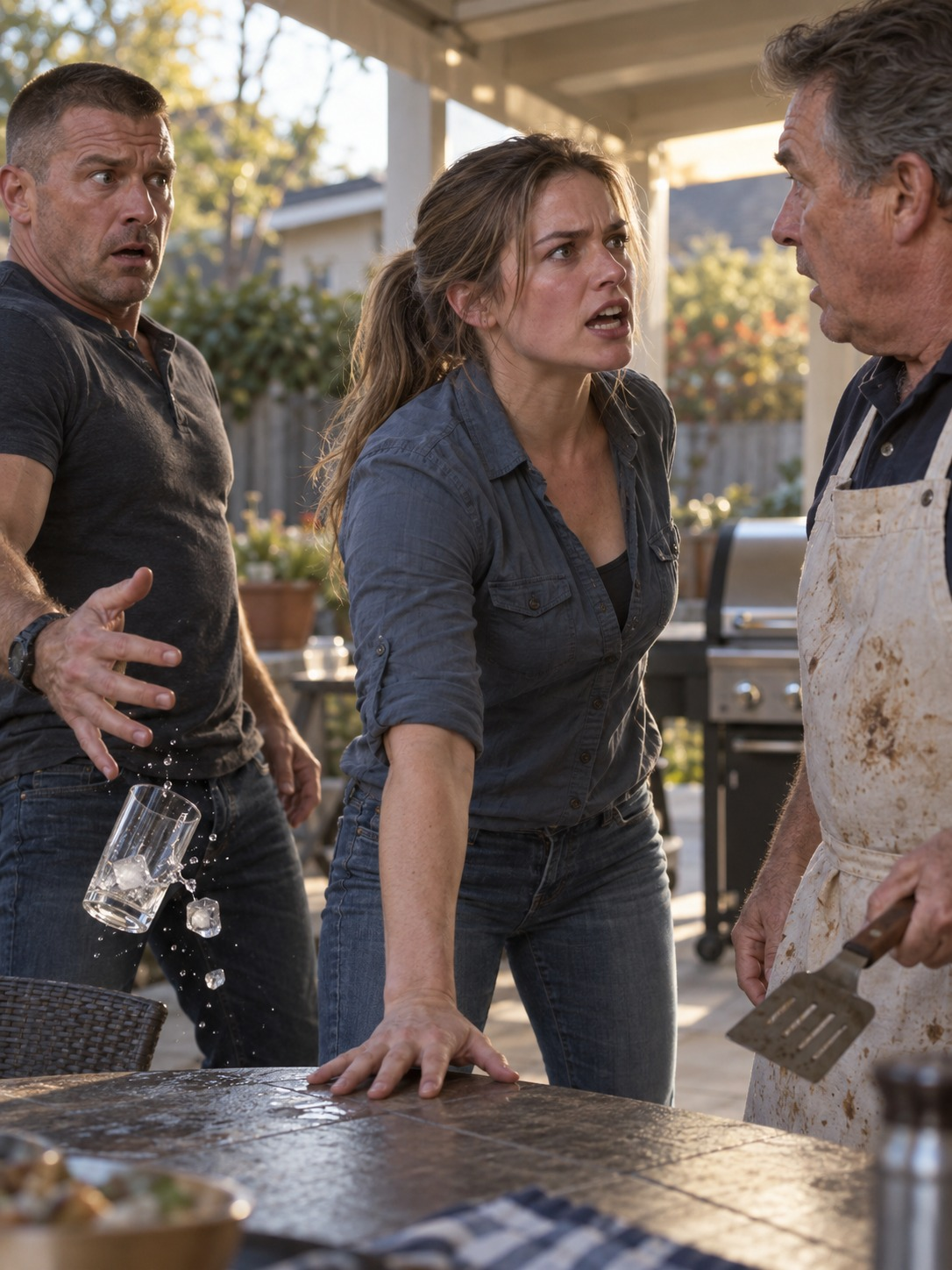
My father dropped his barbecue spatula when Marcus's glass shattered.
"She's the one."
The Navy SEAL commander stood frozen beside the grill, staring at me.
On the concrete, ice cubes rolled beneath the patio table.
And my father suddenly stopped laughing.
I had imagined plenty of ways that afternoon might end. An argument about my career. Another lecture about how I needed to spend less time behind a computer. Perhaps an awkward apology after my father realized he had gone too far.
I had not imagined this.
Six years of military service had taught me that the most important moments rarely announced themselves. Sometimes they arrived quietly, disguised as an ordinary conversation, and changed everything before anyone understood what was happening.
My name is Lauren Hayes. I was twenty-eight years old, and until that afternoon, my father had never understood what I actually did for a living.
To him, I was the daughter who worked with computers.
To Marcus, I was something else entirely.
But I was getting ahead of myself.
Three hours earlier, I had pulled into my childhood driveway in Sacramento, California, carrying a container of homemade potato salad and hoping to enjoy a peaceful Saturday afternoon.
My father, Tom Hayes, was already outside.
At sixty-three, he still carried himself like the Marine sergeant he had been for most of his adult life. He had broad shoulders, weathered hands, and short silver hair that he refused to let anyone describe as gray.
He was standing beside his barbecue grill, wearing a dark green apron over a rust-colored polo shirt.
The moment he spotted my car, he raised his spatula.
"Look who finally left her computer screen!"
I closed my car door.
"Good to see you too, Dad."
He laughed.
"Come on. Don't give me that attitude. I've been standing out here cooking for two hours."
I walked toward him and kissed his cheek.
"Then you deserve a medal."
"That's right. Unlike some people, I actually do something with my Saturdays."
I smiled politely.
It was an old routine.
My father made a joke. I pretended it didn't bother me. He interpreted my silence as agreement.
Then we moved on.
I had learned that arguing rarely changed his mind. He respected experience, physical endurance, and accomplishments he could understand.
Unfortunately, my job rarely offered stories I could share.
For six years, I had worked at a secure military installation supporting advanced aerial operations.
My specialty involved operating high-altitude stealth unmanned aircraft and coordinating surveillance and support for military personnel operating in dangerous environments.
It wasn't a desk job in the ordinary sense.
There were nights when a single mistake could compromise an entire mission. There were moments when weather, communications failures, and rapidly changing battlefield conditions demanded decisions within seconds.
I couldn't explain those situations to my father.
I couldn't tell him where our aircraft operated, who depended on them, or what happened during certain missions.
The restrictions weren't suggestions.
They were part of my responsibility.
But Dad had never understood that.
He thought my inability to tell him stories meant I didn't have any.
I placed the potato salad on the patio table.
"Where's Mom?"
"Inside. Preparing enough food for an entire Marine battalion."
"Sounds like her."
He turned a piece of meat on the grill.
"How's that computer job?"
"Good."
"Still playing those airplane games?"
I looked at him.
"They're not games."
He laughed without looking up.
"Sure, Lauren."
I reached for a glass of water.
I had promised myself I wouldn't let the conversation ruin the afternoon.
My father had spent years serving his country. I respected that service. I knew what sacrifice meant, even if my experience looked different from his.
I also knew he loved me.
But love didn't always prevent people from underestimating those closest to them.
Sometimes it made them believe they already knew everything worth knowing.
A few minutes later, tires crunched against the gravel driveway.
A black pickup truck appeared between the houses.
My father's face immediately brightened.
"Now there's a man who knows what real service looks like."
I turned.
Marcus Reed stepped out of the driver's seat.
He was forty-two, tall, athletic, and carried himself with the quiet alertness I had learned to associate with experienced operators.
His short dark brown hair was beginning to gray at the temples.
He wore a light-colored button-up shirt with the sleeves rolled to his elbows.
Marcus had been my father's best friend for almost fifteen years.
He was an active-duty Navy SEAL commander, and Dad admired him enormously.
They had met through a military veterans' charity event years earlier. Their friendship had survived deployments, family difficulties, and countless weekends spent discussing military history.
Marcus was one of the few people whose opinion could make my father reconsider something.
Unfortunately, I had a feeling he wouldn't get that opportunity today.
"Marcus!" Dad shouted.
The two men embraced.
"Tom," Marcus said, laughing. "Still burning everything you put on that grill?"
"Only the food that deserves it."
They exchanged the usual jokes.
Dad offered him a drink, then introduced the barbecue spread as though he were presenting a military operation.
Marcus glanced toward me.
"Lauren. Good to see you."
"You too, Marcus."
He gave me a friendly nod.
Unlike my father, he didn't immediately ask about my computer.
Instead, he asked how I had been doing.
"Busy," I answered.
"Work?"
I nodded.
"Mostly."
He didn't press.
I appreciated that.
Dad, however, was already preparing to turn the conversation toward his favorite subject.
"Lauren's been telling me about her exciting life behind a monitor."
I looked at him.
"I haven't actually told you much."
"Exactly."
Marcus gave a small smile.
Dad continued.
"She's got some technical assignment. Flight simulation, computers, all that stuff."
He waved his spatula.
"Air-conditioned office. Comfortable chair. Probably gets to drink coffee whenever she wants."
I took a sip of water.
Marcus looked at me again.
Something about his expression suggested he was listening more carefully than my father realized.
"That's not exactly how it works," I said.
Dad laughed.
"Come on, sweetheart. I'm only teasing."
I nodded.
He turned toward Marcus.
"Tell her about a real deployment. Maybe she'll understand what military service actually means."
Marcus took a drink.
"Every job has its own challenges, Tom."
Dad shrugged.
"Sure. But there's a difference between sitting in a simulator room and being shot at."
The words landed harder than I expected.
Not because I needed Marcus to defend me.
Not because I wanted my father to compare our careers.
It was the casual certainty in his voice.
He had decided my work was insignificant without ever making an effort to understand it.
I placed my glass on the table.
"Dad, I don't sit in a simulator teaching people how to fly."
He turned toward me.
"Then what exactly do you do?"
"I operate aerial systems that support military teams."
He raised his eyebrows.
"Support?"
"Surveillance. Tactical coordination. Situational awareness. Sometimes direct support when authorized."
He gave a short laugh.
"So you're watching them on a screen."
"Yes."
"Exactly."
I stared at him.
He seemed delighted that I had confirmed his point.
"See? Video games. Except the real pilots are the ones putting their lives on the line."
Marcus stopped drinking.
For the first time that afternoon, his expression changed slightly.
Dad didn't notice.
He was too busy enjoying his joke.
I considered ending the conversation.
I could have taken my glass inside, helped Mom, and allowed the afternoon to continue.
But something inside me had grown tired of pretending that the distinction didn't matter.
The people on the ground didn't care whether the information they received came from someone sitting in an operations center.
They cared whether it was accurate.
They cared whether the aircraft remained available.
They cared whether someone was watching when they needed help.
Six months earlier, eleven men had been depending on that work.
I knew their names.
I remembered their positions.
I remembered the weather, the damaged communications equipment, and the moment their situation had become dangerously complicated.
I also remembered the voice of their commander.
I just hadn't known that commander was standing beside my father's barbecue grill.
Dad leaned against the counter.
"Well, if you're such an important military operator, what do they call you?"
I didn't answer immediately.
He grinned.
"Come on. Every real pilot has a call sign."
Marcus looked at him.
"Tom—"
"No, no. Let her answer."
Dad pointed the spatula toward me.
"What's yours? Or do you just use your employee number?"
Marcus's expression became more serious.
I noticed it.
So did he.
For a second, the backyard seemed unusually quiet.
I thought about the people who had trusted my voice during difficult moments.
I thought about the responsibility that came with knowing what they were facing without being physically beside them.
Then I looked directly at my father.
"Shadow Watch."
Two words.
Nothing more.
Marcus's hand went completely still.
His glass slipped.
It struck the concrete and shattered.
Dad turned toward him.
"Hey! You all right?"
Marcus didn't respond.
He was staring at me.
His face had lost its color.
His fingers trembled slightly as he looked down at the broken glass, then back at my eyes.
"Where did you hear that?" he whispered.
I frowned.
"Hear what?"
"That call sign."
I remained still.
"It's mine."
Marcus took one slow step toward me.
"No."
He shook his head.
"That can't be right."
Dad looked increasingly uncomfortable.
"Marcus, what's going on?"
The commander ignored him.
His eyes remained fixed on me.
"Six months ago," he whispered, "there were eleven of us in a valley outside Jalalabad."
My stomach tightened.
I recognized the location immediately.
I remembered the mission.
I remembered the weather.
I remembered the damaged radio.
But I said nothing.
Marcus swallowed.
"We were surrounded. Communications were failing. We had two casualties, and our ammunition was almost gone."
Dad slowly lowered his spatula.
Marcus continued.
"Then a woman came over our emergency channel."
He looked directly into my eyes.
"She told us to stay where we were. She knew exactly where we were. She knew what we were facing."
My heart began beating faster.
I hadn't expected to hear that story here.
Not in front of my father.
Not while the barbecue was still cooking.
Marcus took another breath.
"We never saw her. We never knew her real name. We only knew the call sign."
His voice dropped.
"Shadow Watch."
Dad stared at me.
I could see the questions forming behind his eyes.
Marcus opened his mouth again.
And then he said something that made my father take one unsteady step backward—
"Lauren, I need to ask you something about that night..."
PART 1/15 — Chapter 1 completed. The story will continue in chronological order, with the same characters, original military incident, emotional progression, and cliffhanger structure.






Comments 0