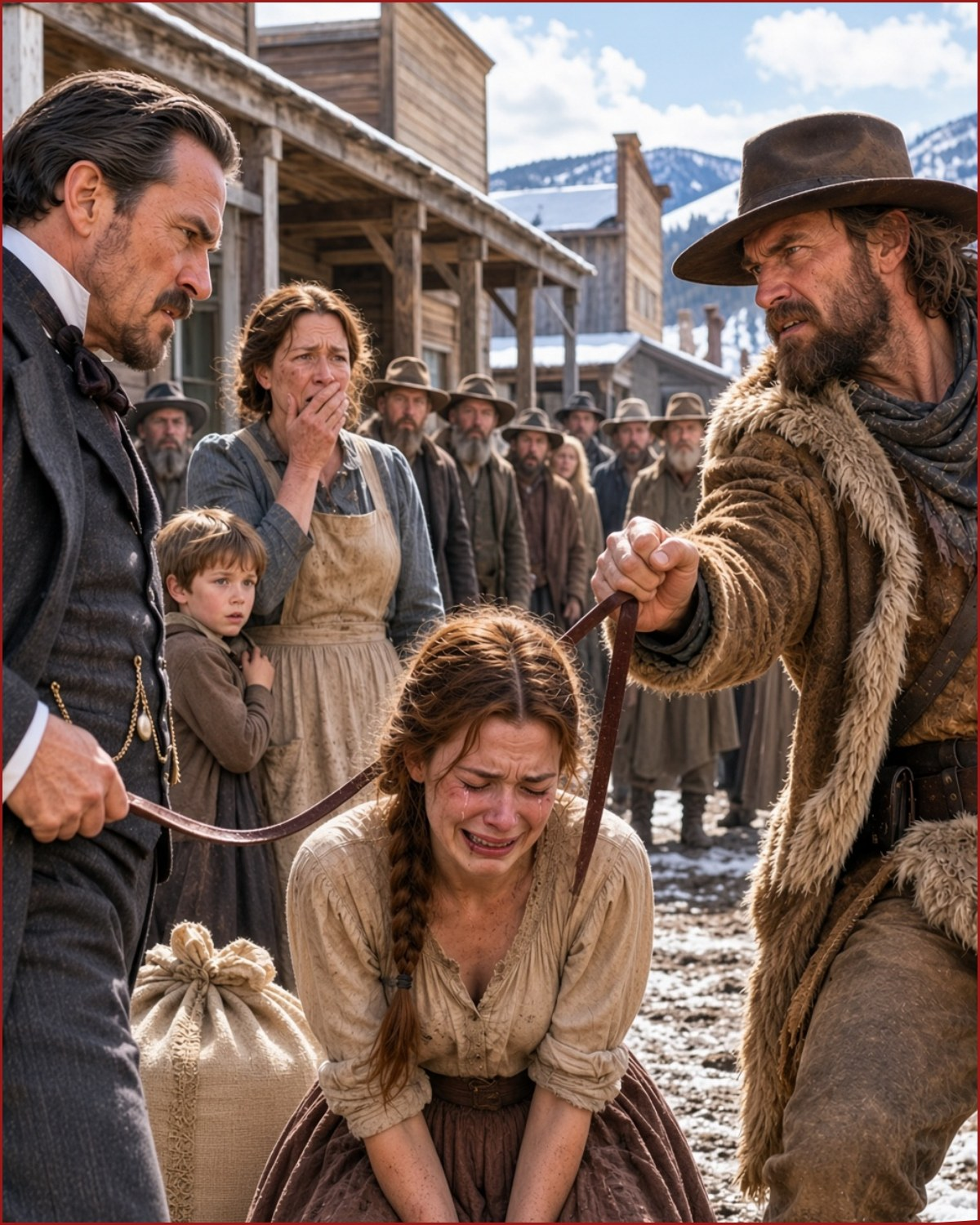
Willa stared at the envelope attached to the horse's saddle.
Her father's name was written across the front.
Elias Prather.
The handwriting was unmistakable. The same narrow letters, the same slight downward slant, the same unusual way he crossed the letter T.
But there was something impossible about it.
Her father had been dead for four years.
"Don't touch it," Caleb said.
Willa looked at him.
"That's my father's handwriting."
"I know."
"How?"
Caleb stepped closer to the window, studying the horse and the empty street.
"Because I've seen it before."
He reached for his coat.
"Stay inside. Lock the door."
Willa caught his sleeve.
"You're not going out there alone."
"Willa—"
"Someone threatened my brother. Someone is leaving messages using my dead father's name. And you keep telling me to stay behind while everyone else decides what happens to my family."
Caleb looked down at her hand.
She released his sleeve but did not step back.
For several seconds, he studied her expression.
Then he nodded.
"Stay close. And don't touch anything until I've examined it."
They stepped onto the porch together.
The horse shifted its weight, sending a small cloud of breath into the cold air. It was a dark bay gelding with a white mark above its left eye. Its saddle was old but carefully maintained.
Caleb approached from the side.
He examined the brass emblem first.
A triangle.
Three short lines.
The same symbol Elias had used in his records.
Then he examined the envelope.
A thin strip of red wax sealed the flap.
Willa recognized the color.
Her father had used red sealing wax whenever he wanted to make certain a document remained unopened.
"That's his," she whispered.
Caleb removed the envelope carefully.
He turned it over.
There was no return address.
Only a small inscription beneath the seal.
Not until the six-pound theft is proven.
Willa felt her stomach tighten.
"Whoever left this knows about the flour."
"Yes."
"And they know about Father's records."
"Yes."
"Then why leave it here?"
Caleb looked toward the street.
"Perhaps they want us to open it."
He examined the horse again.
There was a small leather pouch tied beneath the saddle. Inside lay a folded piece of paper.
Caleb opened it.
The message contained seven words.
The second scale is beneath the old mill.
Willa read it twice.
Her father had owned a small mill on the outskirts of Ransom Gulch before the accident that eventually destroyed his business.
The building had been abandoned after his death.
Nobody had worked there in years.
"That's impossible," she whispered.
Caleb looked at her.
"What?"
"My father sold the mill equipment before he died. There shouldn't be another scale."
"Did you see him sell it?"
Willa hesitated.
"No."
"Then we should look."
They left the horse tied outside the laundry and returned indoors.
Dorcas was waiting beside Wes.
When Willa explained the message, her mother's expression changed immediately.
"No."
"Mother—"
"Absolutely not."
Dorcas stood and placed herself between Willa and the door.
"Your father spent years trying to keep that place out of trouble. I won't let you go looking for it."
Willa took a breath.
"Someone threatened Wes."
"I know!"
Dorcas's voice broke.
"I heard you reading the note. I know exactly what they threatened."
She looked toward her son.
Wes was sitting quietly, pretending not to listen.
Dorcas lowered her voice.
"Your father came home one night with blood on his shirt. He told me that if anything happened to him, I must never let you return to the mill."
Willa stared at her.
"You never told me that."
"Because I thought I could keep you safe by keeping you away from it."
"Did he say why?"
Dorcas shook her head.
"He said the mill held something that could ruin powerful men."
Caleb moved toward the table.
"Did Elias ever mention a second weighing station?"
Dorcas looked at him.
"Not to me."
"What about a hidden room?"
She hesitated.
Then she nodded.
"He once asked me to sew a small leather pouch into the lining of his winter coat. He said it contained something important. After he died, I searched his clothes, but I never found it."
Willa felt a sudden chill.
"Which coat?"
"The brown one. The coat he wore to the mill."
"Where is it?"
Dorcas looked toward the bedroom.
"I kept it."
Willa followed her mother.
The coat was hanging inside a narrow wardrobe, protected by an old linen sheet.
It was made of heavy brown wool, with worn leather patches at the elbows and a dark stain near the lower hem.
Willa remembered it.
Her father had worn it every winter.
She remembered him returning from the mill, stamping snow from his boots and hanging that coat beside the kitchen stove.
Dorcas carefully lifted it from the hanger.
"Your father loved this coat," she whispered.
Willa examined the lining.
At first, she saw nothing unusual.
Then she noticed a small section near the inside pocket where the stitches were slightly different.
She ran her fingers across the seam.
"Mother, there's something here."
Caleb brought a small knife from his belt.
He opened the seam carefully.
A narrow leather pouch slid out.
Dorcas covered her mouth.
Inside were three folded sheets and a small brass token.
Willa unfolded the first sheet.
It contained a list of names.
Samuel Mercer.
Elias Prather.
Amos Pike.
And several others.
Beside each name was a date and a number.
Caleb studied the list.
His expression grew serious.
"My father."
Willa looked at him.
"Samuel Mercer?"
He nodded.
"He wasn't just helping your father investigate the shortages. He was keeping records of the people involved."
The second sheet contained a list of shipments.
Flour.
Salt.
Coal.
Mining equipment.
The third contained a short handwritten statement.
Willa recognized her father's signature at the bottom.
She read it aloud.
"Every sack marked fifty pounds must be weighed twice. The first weighing confirms the merchant's claim. The second confirms what the people actually receive. Never trust a single scale when two men control the same warehouse."
She stopped.
Below the statement was another sentence.
The missing weight is only the beginning.
Caleb took the page from her.
He studied the final line.
"What does that mean?" Willa asked.
He looked at the brass token.
"I think your father discovered that the flour shortage was connected to something much larger."
That afternoon, Willa and Caleb visited Amos Pike again.
The blacksmith was surprised to see them.
He was even more surprised when Caleb placed the list of names on his workbench.
Amos read it slowly.
When he reached Samuel Mercer's name, he stopped.
"Where did you get this?"
"From Elias's coat," Willa answered.
Amos looked at her.
"Then he kept it."
"Kept what?"
"The original list."
Amos closed the paper.
"Your father and Samuel came to me four years ago. They wanted me to make something."
Caleb leaned forward.
"What?"
"A second balance scale."
Willa's heart began beating faster.
"Where is it?"
Amos rubbed his forehead.
"I don't know."
"You made it."
"I made the parts. Elias assembled it himself."
"Why?"
Amos looked toward the open workshop door.
"Because he believed the merchants were changing the weights on the official scales."
Willa frowned.
"How could they do that?"
Amos explained that the large platform scales used at the warehouses could be adjusted. A dishonest operator could alter the balance or place hidden weights beneath the platform.
The merchants would record a shipment as fifty pounds even if the actual quantity was considerably less.
The buyers had no way of knowing.
Unless they possessed an independent scale.
"Your father wanted something portable," Amos continued. "Something that couldn't be altered without leaving evidence."
Caleb looked at the brass token.
"Was this part of it?"
Amos examined the small object.
His eyes widened.
"Where did you get that?"
"Inside the coat."
Amos turned it over.
There was a tiny number stamped on the reverse.
Twenty-seven.
"That's a storage marker," he whispered.
Willa leaned closer.
"Storage for what?"
Amos looked at Caleb.
"Your father and Elias rented a private compartment at the old freight depot."
Caleb straightened.
"Which depot?"
"The one that burned."
The workshop fell silent.
Willa looked between them.
"What burned?"
Amos placed the token on the bench.
"Three weeks after Elias died, the depot caught fire. The official report said it was an accident."
Caleb's jaw tightened.
"My father disappeared before that."
Amos nodded.
"And nobody ever found the records they kept there."
Willa stared at the number twenty-seven.
"Then why would Father leave this token?"
Amos looked at her.
"Because he probably knew the compartment survived."
They returned to the laundry before sunset.
Caleb wanted to visit the freight depot immediately, but Willa insisted they first examine the old mill.
They agreed to leave at dawn.
Dorcas prepared supper, although nobody ate much.
Wes was sleeping when Willa entered his room.
She sat beside him and brushed his hair away from his forehead.
"Are you feeling better?"
He nodded.
"Are you going to the mountain tomorrow?"
"Not the mountain. The old mill."
"Can I come?"
"No."
"Why not?"
"Because it's cold, and you need to rest."
Wes looked disappointed.
Then he reached beneath his pillow and pulled out a small folded paper.
"I found this."
Willa took it.
"What is it?"
"It was inside Father's old Bible."
She unfolded the paper.
There were only a few lines written on it.
The handwriting belonged to Elias.
When the weight is wrong, look beneath the stone. When the stone is moved, count the shadows.
Willa read it again.
"Where did you find this?"
"In the Bible. I was looking for the picture of Father."
She kissed his forehead.
"Thank you."
Wes looked at her seriously.
"Will we lose the house?"
Willa forced herself to smile.
"Not if I can help it."
He closed his eyes.
Within minutes, his breathing became steady.
Willa returned to the kitchen.
Caleb was standing near the stove, examining the note.
"Your father liked riddles," he said.
"He liked hiding things where people wouldn't think to look."
Caleb folded the paper.
"Then tomorrow we find out what he left beneath the stone."
Before dawn, they set out for the abandoned mill.
The path crossed a frozen creek and climbed a low ridge beyond the mining settlement.
Willa carried a lantern and her father's daybook. Caleb carried a small shovel, a rope and his revolver.
The mill appeared through the trees just as the sky began turning pale.
Its roof was partly collapsed.
One of the wooden doors hung from a single hinge.
Snow covered the old grinding stones.
Willa stopped at the entrance.
She had not been there since her father's funeral.
She remembered running through the building as a child, following him between the sacks of grain. She remembered the smell of fresh flour and the steady rhythm of the millstone.
Now everything was silent.
Caleb pushed the door open.
The hinges groaned.
Inside, dust covered the machinery.
Willa moved toward the large stone platform near the back wall.
"That was where Father weighed the grain."
Caleb examined the floor.
"Look for anything unusual."
They searched for nearly twenty minutes.
Then Willa noticed a narrow line in the stone floor.
It formed a rectangle around one of the old weighing platforms.
She knelt.
"Caleb."
He came over.
Together they cleared away the dust.
The stone platform was not fixed to the floor.
It could move.
Caleb placed his fingers beneath the edge and lifted.
A hollow space appeared underneath.
Inside was a small iron compartment.
Willa's breath caught.
Caleb removed the lid.
There lay a second brass scale.
Its balance arm was polished.
Its markings were clear.
And beside it sat a leather-bound notebook.
Willa reached for the notebook.
But Caleb stopped her.
Something was carved into the underside of the iron lid.
A sentence.
If Barlow finds this, Elias is already dead.
Willa felt her blood run cold.
Caleb lifted the notebook.
The first page contained a date.
October 24, 1865.
The day Willa had first discovered the shortage.
Below it, her father's handwriting continued.
The six pounds were never the real theft.
Caleb turned the page.
His face changed.
Willa leaned closer.
There were names, payments and a detailed record of shipments that had never appeared in the town's official accounts.
At the bottom of the page was a final entry.
November 4. The marriage bond will be used to obtain the last key. If Quint succeeds, the evidence will disappear forever.
Willa stepped backward.
Her father's warning had been written before Barlow proposed marriage.
Before Dorcas signed.
Before the public humiliation.
Her father had somehow known what the merchant intended.
Caleb slowly turned another page.
A small folded photograph slipped from the notebook.
Willa picked it up.
It showed three men standing outside a warehouse.
Her father was on the left.
Samuel Mercer stood beside him.
The third man wore a dark merchant's coat.
Willa recognized him immediately.
Barlow Quint.
But it was the handwritten name on the back that made Caleb's expression collapse.
He read it aloud.
"October 24, 1865. The day the real shipment arrived."
Willa looked at the photograph again.
Then Caleb turned the page to reveal a list of names.
One of them belonged to a man who was supposed to have been dead for four years.
And beside that name, someone had written: STILL WORKING FOR QUINT.
Comments 0