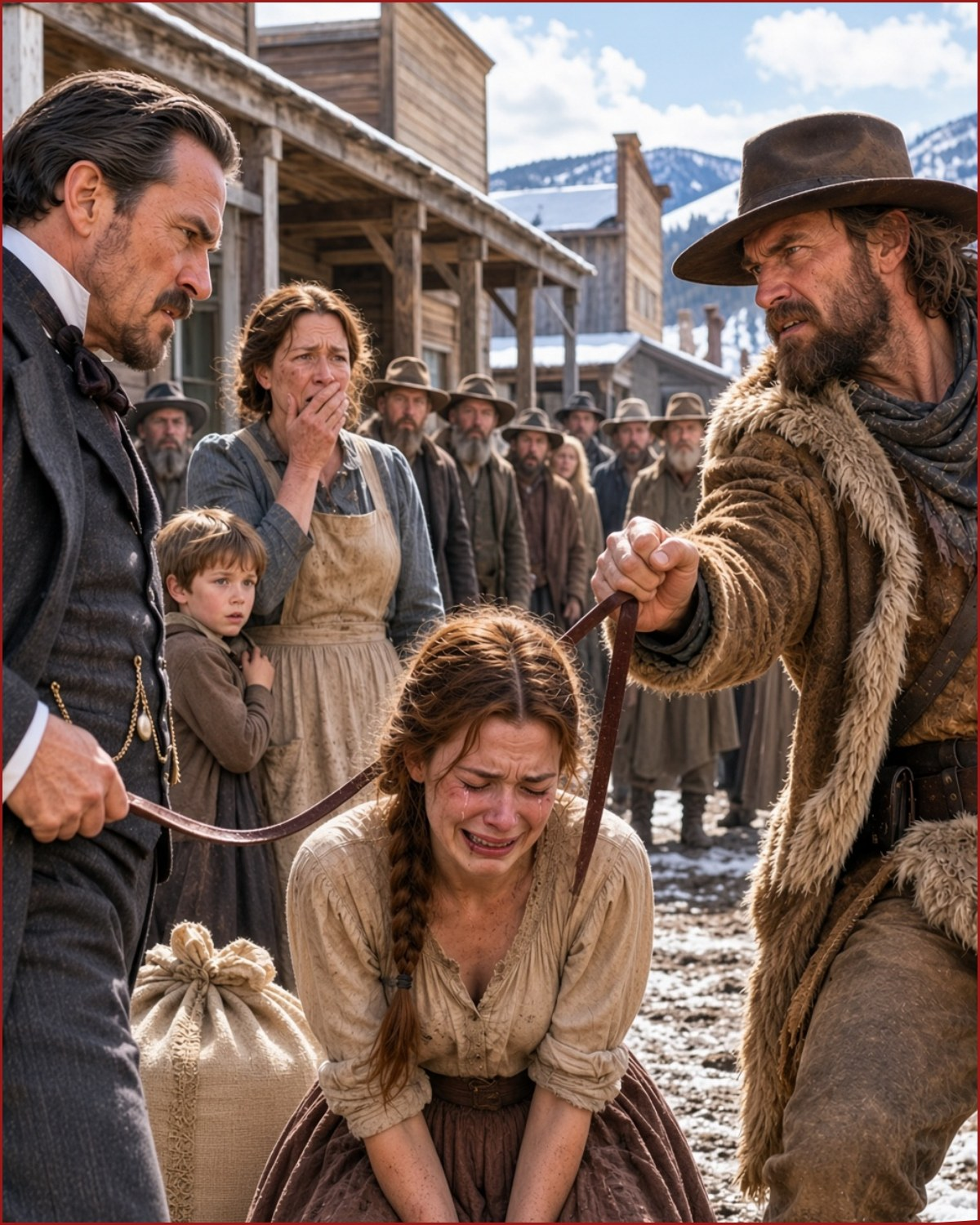
Willa Prather dropped to her knees in the frozen mud as the teamster raised his leather strap.
"Please! Leave her alone!"
A mountain man stepped out of the crowd and caught the strap before it could fall.
Barlow Quint stared at the stranger's damaged hand.
Then he recognized the man.
And for the first time that afternoon, the merchant looked afraid.
The leather strap hung between them, stretched tight like a rope in a storm. The teamster, a thick-necked fellow named Harlan, still held one end. The stranger held the other with a grip that made the man's knuckles turn white.
Nobody spoke.
Willa remained on her knees, her palms pressed into the frozen earth. Her chest rose and fell rapidly. One cheek burned where the earlier blows had landed, and tears blurred the faces surrounding her.
She could hear her mother crying.
She could hear Wes coughing.
And she could hear the wind rattling the wooden signs above the storefronts.
But most of all, she could hear the silence of forty people who had watched her suffer without moving.
The stranger did not look at her immediately.
His attention remained fixed on Harlan.
"Let go," he said.
Harlan attempted a nervous laugh.
"You don't want trouble with Mr. Quint."
"I wasn't speaking to Mr. Quint."
The stranger's voice was quiet, almost conversational. Somehow, that made it more frightening.
Harlan loosened his fingers.
The stranger released the strap.
It dropped into the mud between them.
Only then did he turn toward Willa.
He was taller than anyone standing nearby, broad across the shoulders, with a thick brown beard and a weather-beaten face. His elk-hide coat was worn along the sleeves, and snow clung to the edges of his dark hat.
Two fingers were missing from his right hand.
Willa stared at them.
She had seen injured miners, men with broken arms and workers whose fingers had been crushed beneath machinery. But she had never seen a man carry such an injury without appearing to notice it.
"Can you stand?" he asked.
Willa tried.
Her knees shook.
Before she could fall again, he offered his left hand.
She hesitated.
She had learned that accepting help from powerful men could sometimes cost more than refusing it.
"He's not going to touch you again," the stranger said.
Something in his voice made her believe him.
She took his hand.
He helped her rise slowly, careful not to pull her injured arms.
Behind them, Barlow Quint adjusted his expensive black waistcoat.
"This is a private matter," the merchant announced. "You have no business interfering."
The stranger finally looked at him.
"Private?"
He glanced at Willa's mother, then at the frightened boy standing beside her.
"Forty people watching a woman get beaten in the street doesn't make this private."
A few townspeople lowered their eyes.
Others shifted uncomfortably.
Barlow's expression hardened.
"Do you know who I am?"
The stranger studied him for a moment.
"Yes."
"Then you understand that I control most of the supplies in this settlement."
"I understand that you talk too much."
A murmur passed through the crowd.
Nobody had spoken to Barlow Quint that way in years.
He owned the largest general store in Ransom Gulch. He controlled the flour shipments, the coal deliveries and much of the equipment used by the miners. Families owed him money. Businessmen feared him. Even the local constable had once admitted that confronting Quint was likely to cost him his position.
The merchant had built his influence one debt at a time.
And now a stranger in a dirty elk-hide coat was standing in front of him.
Barlow took a measured breath.
"Miss Prather has obligations."
Willa lifted her chin.
"I have never agreed to marry you."
"Your mother signed the marriage bond."
"My mother signed a debt agreement because you threatened to take our home."
Dorcas made a small, wounded sound.
"Willa, please."
Willa turned toward her.
Her mother's face was pale, her eyes swollen from crying. The woman had worked fourteen hours a day washing clothes for miners and their families. Her fingers were permanently rough from soap and boiling water.
Willa knew why she had signed.
She knew about the $214 note.
She knew about the approaching March deadline.
She also knew that her mother had not slept properly in weeks.
But understanding desperation did not mean accepting a lifetime of imprisonment.
"Mother," Willa whispered, "you cannot give away my life to pay a debt."
Dorcas covered her mouth.
Barlow stepped forward.
"Enough of this foolishness. The arrangement was made. I offered your family a respectable future. A fine house. Medical care for your brother. A comfortable life."
Willa looked at him.
"You offered to buy me."
His cheeks colored.
"I offered security."
"You offered fifty pounds of flour."
"And I kept my word."
"You sent flour that was short."
For one brief moment, the merchant's expression changed.
It was almost invisible.
A tightening around the eyes. A slight movement of his jaw.
But Willa saw it.
She had spent two days studying his face while presenting her father's calculations. She knew how he looked when a number troubled him.
The stranger noticed the exchange.
"What flour?" he asked.
Willa swallowed.
"My father's old scale. Every sack marked fifty pounds weighs less than it should."
Barlow gave a dismissive laugh.
"An accusation from a desperate girl."
"Six and a half pounds short," Willa replied. "Every sack I've tested."
"Your father's equipment was old."
"It was calibrated every month."
"You have no proof."
"I have his records."
The crowd began whispering.
A miner near the back stepped forward.
"My last sack was light too," he said.
Barlow turned sharply.
"Then you should learn how to store flour properly."
Another man spoke.
"Mine was short."
Then another.
The merchant's composure began to fracture.
Willa watched the faces around her. These were families who had been stretching their flour for weeks. Mothers who had watered down porridge. Men who had gone to work hungry because they could not afford another sack.
She had thought she was the only person willing to challenge him.
She was beginning to understand that she was not.
The mountain man looked at her.
"Where is this scale?"
"At our laundry."
"Your father's?"
She nodded.
"His name was Elias Prather. He owned a small mill before the accident."
The stranger's expression shifted.
"Prather?"
Willa noticed the change.
"Did you know him?"
He looked toward the snowy mountains beyond the rooftops.
"I knew a man who used to talk about a miller in Montana who could tell a dishonest merchant's weight by listening to the chain."
Willa felt her heart beat faster.
"That was my father."
The stranger said nothing.
Barlow interrupted.
"This conversation is over. Miss Prather is coming with me."
He reached toward Willa's arm.
The mountain man moved between them.
It happened so quickly that Barlow barely had time to withdraw his hand.
"Don't."
One word.
No shouting.
No threat.
Just a warning.
Barlow looked at the stranger's missing fingers.
"You're making a mistake."
"Maybe."
"You don't know what you're getting involved in."
"Then explain it."
The merchant glanced toward Harlan.
The teamster bent to retrieve the strap.
The stranger saw him move.
"Leave it."
Harlan froze.
A long moment passed before the merchant finally turned away.
"Come along," he ordered his men.
Then he looked at Willa.
"You have until tomorrow morning to reconsider. After that, I will collect what is owed."
Willa's stomach tightened.
"What do you mean?"
Barlow smiled without warmth.
"The laundry. The building. Everything secured by the note."
He stepped onto the boardwalk.
"And don't mistake today's interruption for a victory."
His boots disappeared around the corner.
The crowd slowly began to disperse.
Some people offered Willa sympathetic looks. A few nodded toward the stranger. Nobody apologized for standing still while she had been beaten.
Willa did not ask them to.
She was too tired.
The mountain man turned toward Dorcas.
"Take the boy inside."
Dorcas nodded and hurried Wes toward the laundry.
Wes looked back once.
"Are you going to help my sister?"
The stranger crouched slightly so he could meet the boy's eyes.
"That's what I'm trying to do."
Wes disappeared through the door.
Willa remained on the boardwalk, holding her injured arm.
"What's your name?" she asked.
"Caleb Mercer."
"Why did you help me?"
Caleb looked toward the street where Barlow had vanished.
"Because I don't like watching men use money to make themselves powerful."
"That's not the whole reason."
His eyes returned to hers.
"No," he admitted. "It isn't."
Willa waited.
But Caleb did not explain.
Instead, he glanced at the snow-covered mountains and then at the laundry entrance.
"Your father kept his records there?"
"Yes."
"Then I'd like to see them."
Willa frowned.
"Why?"
"Because I believe your numbers."
She studied his face.
Most men who heard her accusations either laughed or demanded proof. Caleb had not done either.
He had simply believed her.
That frightened her almost as much as Barlow's threats.
"People who challenge Mr. Quint usually regret it," she said.
Caleb gave a faint, humorless smile.
"People who steal from hungry families should regret it more."
He followed her toward the laundry.
Inside, the smell of soap, wet wool and wood smoke filled the small room.
A cast-iron stove stood near the back wall. Bundles of washed clothing hung from wooden racks. An old table occupied the corner, its surface covered with folded linens and account books.
Dorcas was helping Wes onto a chair.
The boy coughed into his sleeve.
Willa immediately went to him.
"How are you feeling?"
"Fine."
His voice was weak.
She touched his forehead.
He was warm.
Caleb noticed.
"Has he seen a doctor?"
Willa looked away.
"We cannot afford one."
"I asked whether he's seen a doctor."
"Not since the cough started."
Caleb removed his hat.
"That needs to change."
Willa almost laughed.
"Everybody says that when they have money."
He looked at her.
"I didn't say I had money."
For the first time that afternoon, she almost smiled.
Then she remembered the merchant's warning.
The laundry.
The note.
March first.
Her family's home was already in danger.
Caleb walked toward the old brass steelyard hanging beside the kitchen shelves.
He examined its hook, the balance arm and the worn markings along its length.
"Your father's?"
"Yes."
"How long have you used it?"
"Since I was a child."
Caleb ran his thumb over the brass.
"Then he trusted you with something important."
Willa opened a wooden drawer and removed the daybook.
Its leather cover was cracked, and several pages had dark stains from years of handling.
She placed it on the table.
Inside were columns of figures written in her father's precise handwriting. Flour deliveries, grain purchases, payments and measurements.
Near the back, Willa had added her own calculations.
Fifty pounds promised.
Forty-three and a half delivered.
The same shortage repeated across eleven separate sacks.
Caleb studied the figures.
"Who else has seen this?"
"Nobody."
"Not your mother?"
"She knows about the shortage. She doesn't know everything I've written."
He turned several pages.
Then he stopped.
His eyes fixed on an entry dated six months before Elias Prather died.
Willa leaned closer.
"What is it?"
Caleb did not answer immediately.
He looked at the handwriting again.
Then he examined the small mark beside the number.
A little triangle.
Three short lines beneath it.
Willa recognized it.
Her father used that mark whenever he recorded a shipment that had been inspected twice.
"What does that mean?" Caleb asked.
"It means he weighed the delivery again."
"Why?"
"He suspected someone was cheating the miners."
Caleb slowly closed the book.
"How long ago did your father die?"
"Four years."
"Was he ever threatened?"
Willa hesitated.
She remembered her father's last winter. The strange men who had visited the mill. The arguments behind the locked office door. The day he returned home with a split lip and refused to explain it.
She had been nineteen.
Her father had told her that some men would rather destroy a scale than accept what it revealed.
At the time, she thought he was speaking about business.
Now she wasn't so certain.
"Yes," she finally whispered. "But he never told us why."
Caleb's face became unreadable.
He looked toward the window.
Outside, a horse stood tied to a post across the street.
Its rider was not visible.
But somebody was watching the laundry.
Caleb noticed the movement in the reflection.
He quietly moved the daybook away from the window.
"Willa," he said, "does anyone besides your family know where this book is kept?"
She shook her head.
"Why?"
Caleb reached for his hat.
"Because somebody just rode past this building twice."
He moved toward the door.
Willa followed him with her eyes.
Then came a sharp knock.
Three times.
Dorcas stopped folding the laundry.
Wes began coughing again.
Caleb placed one hand against the door but did not open it.
A man's voice came from outside.
"Miss Prather?"
Willa recognized it immediately.
It was the local constable.
But when he spoke again, she realized he was not alone.
"We have an order from Mr. Quint."
Caleb slowly turned toward her.
"What kind of order?"
The constable unfolded a paper.
And read the first sentence aloud.
"By authority of the outstanding debt, the Prather property is to be seized immediately..."
Comments 0