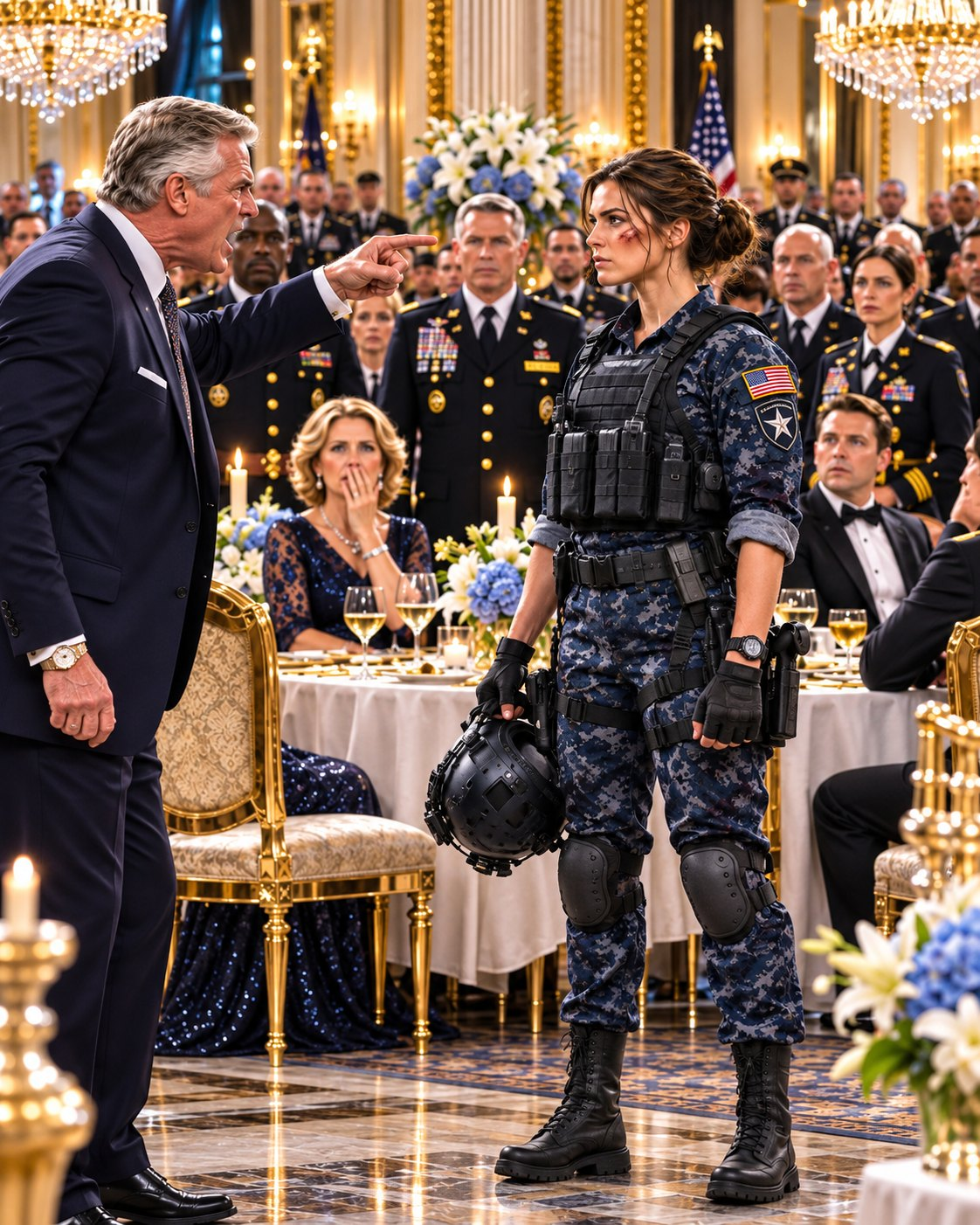
"Mr. Carter, have you ever heard the name Daniel Carter?"
My father's expression changed instantly.
The bourbon glass in his hand stopped halfway to his mouth.
For a moment, he looked as though he hadn't heard correctly.
"What did you just say?"
General Thomas Whitmore repeated the name.
"Daniel Carter."
My brother Daniel slowly turned toward our father.
"That's my name."
The general nodded.
"I understand. But I'm referring to another Daniel Carter. A man who served in the United States Army several decades ago."
My father placed his glass on the table.
"I don't know what this has to do with my daughter."
The general opened the black folder.
"Perhaps you should allow me to explain."
I stood beside Amanda, trying to understand why my father's face had suddenly lost its color.
I had never seen him react that way.
Charles Carter was a man who could negotiate multimillion-dollar contracts without changing his expression. He had once dismissed an entire boardroom of executives with three sentences.
But now, hearing one name, he looked genuinely frightened.
"Who was Daniel Carter?" I asked.
The general glanced at me.
"Captain, Daniel Carter was a decorated military medic who served during an overseas humanitarian operation many years ago."
My father looked down.
General Whitmore continued.
"He was involved in an evacuation mission in which several American service members and dozens of civilians were rescued under extremely dangerous conditions."
Amanda frowned.
"Was he related to us?"
The general closed the folder halfway.
"That's what I was hoping your father would explain."
Everyone turned toward Charles.
He remained silent.
Finally, he spoke.
"He was my older brother."
The words seemed to change the atmosphere of the entire ballroom.
Daniel stared at him.
"You had an older brother?"
My father didn't look at him.
"Yes."
"Why have we never heard about him?"
Charles rubbed his forehead.
"Because he died before you were born."
I looked at General Whitmore.
"Sir, why is my uncle connected to tonight's announcement?"
The general opened the folder again.
"Because your uncle's service is part of the history behind the recognition being presented to you tonight."
I felt my stomach tighten.
I had never known I had an uncle who served in the military.
Not once had my father mentioned him.
And suddenly, the name seemed to carry a weight that nobody in the room understood.
General Whitmore removed an old photograph from the folder.
It showed a young man standing beside a military medical vehicle.
He wore a faded combat uniform and had a serious expression.
The photograph was slightly damaged along one edge.
"Is this him?" I asked.
My father looked at it.
His face tightened.
"Yes."
The general placed the photograph on the table.
"Daniel Carter served as a combat medic. During one operation, he helped evacuate civilians from a damaged medical facility while enemy forces were approaching."
My father stared at the picture.
"He was always stubborn."
His voice was barely audible.
The general continued.
"He refused to abandon wounded civilians. According to the official account, he remained behind to assist the final evacuation group."
I looked at my father.
"Was he killed during that mission?"
Charles nodded.
"Yes."
Amanda moved closer.
"Why didn't you ever tell us about him?"
My father didn't answer.
The general looked toward him.
"Mr. Carter, your brother's actions were formally recognized. His name was entered into the military service records, and his family was contacted."
My father's eyes remained fixed on the photograph.
"I know."
"Then you understand why we contacted you."
He nodded slowly.
I stepped forward.
"Sir, I still don't understand."
General Whitmore turned toward me.
"Your uncle's final written testimony became part of the military historical record. Several years later, the military established a humanitarian rescue recognition program in his honor."
I stared at him.
"Named after my uncle?"
"Yes."
The general opened another document.
"The Daniel Carter Humanitarian Service Citation recognizes exceptional acts of courage involving the protection and evacuation of civilians during dangerous military operations."
I looked at the old photograph again.
My father had never told me.
Not when I enlisted.
Not when I received my first assignment.
Not when I became an officer.
I had spent sixteen years in the military without knowing that someone in my own family had once worn the same uniform.
I turned toward Charles.
"Why didn't you tell me?"
He looked away.
"I didn't think it mattered."
The answer hurt more than I expected.
General Whitmore continued.
"Captain Carter's recent mission has been reviewed against the criteria established for this recognition."
He removed a second document.
"Her actions demonstrated exceptional commitment to civilian protection, particularly her decision to continue the search after the primary evacuation had been completed."
I listened carefully.
The general spoke with measured precision.
"Her rescue team located and evacuated additional survivors, including Sarah Mitchell and her daughter Lily. Her leadership, despite sustaining injuries, was documented by multiple witnesses."
He paused.
"The review committee unanimously recommended her for the Daniel Carter Humanitarian Service Citation."
A quiet murmur moved through the ballroom.
I looked at the document.
My uncle's name.
My name.
A connection I had never known existed.
I felt strangely overwhelmed.
"Sir, I appreciate the recognition, but I don't know enough about my uncle to understand what this means."
The general nodded.
"That's understandable."
He looked toward Charles.
"Perhaps your father can tell you."
My father stared at the photograph.
For several seconds, he didn't move.
Then he spoke.
"Daniel was twelve years older than me."
His voice sounded different.
Less commanding.
More tired.
"He was the one everyone admired. He was brave, generous, and always getting involved in other people's problems."
A faint, almost reluctant smile crossed his face.
"When I was a child, I thought he was invincible."
I listened.
Charles continued.
"He used to take me fishing. He taught me how to ride a bicycle. When I got into trouble at school, he was the one who came to get me."
He stopped.
I had never heard my father talk about his childhood like this.
"He enlisted when I was still young. My parents didn't want him to go, but he insisted."
Amanda sat down slowly.
Daniel stood beside her.
My father looked at the photograph.
"He sent letters home. Always talking about the people he had met. The children. The families. He said that sometimes the smallest things mattered most."
I felt something move inside me.
I thought about Lily.
About Sarah.
About Marcus.
My father continued.
"When he died, my parents never recovered. My mother kept his uniform in a closet until the day she passed away."
He swallowed.
"I couldn't look at it."
The room remained silent.
"After that, I decided I wanted nothing to do with the military."
I stared at him.
"Nothing?"
He shook his head.
"I wanted a different life. I wanted security. Money. Something I could control."
He looked toward me.
"And when you joined the military, I thought you were making the same mistake he had made."
The words struck me.
I had spent years wondering why my father reacted so strongly to my career.
Now I was beginning to understand.
But understanding did not erase the hurt.
"Did you think I would die?" I asked.
He looked at me.
"I thought you would lose everything."
I shook my head.
"You never asked."
He lowered his eyes.
"No."
Amanda moved toward the table.
"Then why didn't you tell us about him?"
My father looked at her.
"Because I didn't want his story repeated."
"That doesn't make sense."
"I know."
Amanda folded her arms.
"You made Evelyn feel like her military career was something shameful. Did you ever consider that she might have been following the example of someone you loved?"
Charles looked toward me.
For the first time, I saw genuine regret in his expression.
"I didn't think about it that way."
I took a breath.
"Maybe that's the problem, Dad."
He stared at me.
I continued.
"You decided what my life meant without ever asking me what it meant to me."
He didn't answer.
General Whitmore stepped forward.
"Mr. Carter, I understand this is difficult. But there is another part of your brother's story that may help explain why we wanted you present tonight."
My father looked up.
"What else?"
The general removed a small envelope from the folder.
It was old.
The edges had yellowed.
A handwritten name appeared across the front.
CHARLES.
My father's face went completely white.
"Where did you get that?"
General Whitmore held it carefully.
"It was preserved in your brother's personal military records."
My father took one step forward.
"That's impossible."
"Why?"
Charles stared at the handwriting.
"Because I thought it had been destroyed."
I looked between them.
"What is it?"
The general answered.
"A personal letter written by your uncle shortly before his final operation."
My father reached toward it.
His fingers trembled.
"Can I see it?"
"Of course."
General Whitmore handed him the envelope.
Charles held it as though it were something fragile.
For several seconds, he simply stared at his brother's handwriting.
Then he carefully opened it.
Inside was a single folded page.
He began reading silently.
His eyes moved across the lines.
Then stopped.
His breathing changed.
Amanda noticed.
"Dad?"
He didn't respond.
I stepped closer.
"What's wrong?"
My father looked at me.
His eyes were suddenly wet.
"There's something here."
He lowered the letter.
Then he read the final paragraph aloud.
"Charles, if one day you have children, teach them that a person's worth isn't measured by what they own, but by what they're willing to do for someone who has nothing..."
My father's voice broke.
Nobody spoke.
He continued reading.
"Don't let fear make their world smaller than it needs to be. And if one of them ever chooses to serve, don't make them feel ashamed of the courage it takes."
He stopped.
I looked down.
Those words sounded like something my father had spent forty years trying to forget.
He turned the page.
There was a handwritten signature.
Daniel Carter.
And beneath it, another sentence.
My father stared at it for a long time.
Then he looked at me.
"Evelyn..."
I waited.
He held out the letter.
"There is something your uncle wrote specifically about the child he hoped I would have one day."
My heart began beating faster.
I reached for the page.
But before my fingers touched it, General Whitmore quietly interrupted.
"Mr. Carter, there's one more document that must be read before that letter is handed to Evelyn."
He opened the folder and removed a sealed military record.
The name printed across the top was not Daniel Carter.
It was Charles Carter.
And my father suddenly stepped backward...






Comments 0