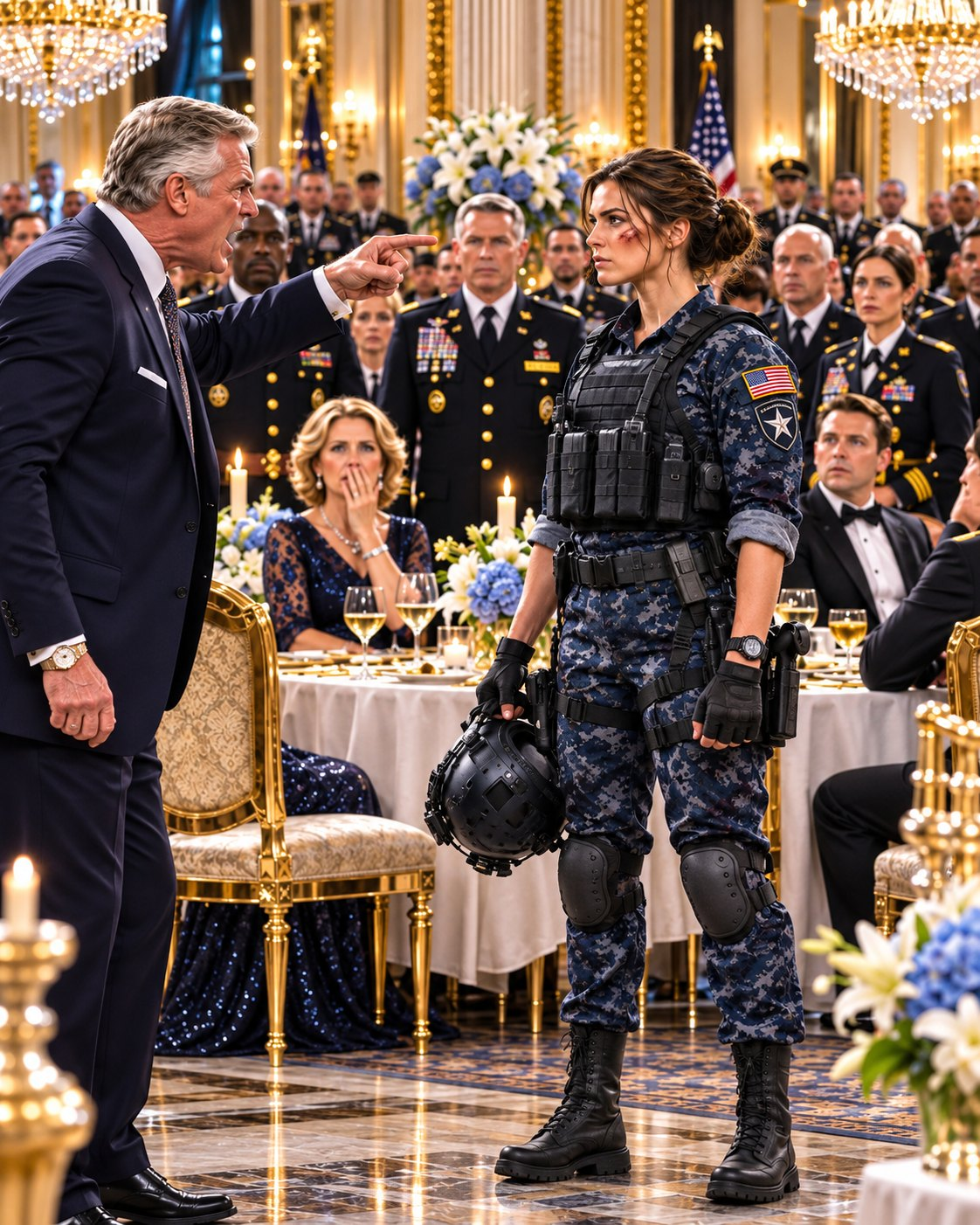
My father stepped backward.
For the first time in my life, I saw Charles Carter genuinely afraid of something he couldn't control.
The sealed military record rested in General Whitmore's hands.
His name was printed across the front.
CHARLES CARTER.
My brother Daniel stared at our father.
"What's that?"
Charles didn't answer.
Amanda moved closer.
"Dad, what is going on?"
He shook his head.
"I don't want to discuss this."
General Whitmore remained calm.
"Mr. Carter, I understand this is difficult. But the document is part of your brother's historical military record. It was preserved because of the circumstances surrounding his final operation."
My father looked at him.
"I thought those records were closed."
"They were restricted for many years. The review has now been completed, and the family has been notified."
"Why tonight?"
"Because tonight is when the military is formally recognizing your daughter's actions under the humanitarian citation established in your brother's memory."
My father closed his eyes.
I looked at General Whitmore.
"Sir, what does my father have to do with this?"
The general glanced at Charles.
"That question is best answered by him."
My father looked at the floor.
For several seconds, nobody spoke.
Then he reached for the document.
His fingers trembled as he accepted it.
I watched him turn the envelope over.
There was an old reference number beneath the military seal.
He recognized it immediately.
"Where did you find this?"
"In the archived correspondence associated with Daniel Carter's final operation."
My father swallowed.
"Who else has seen it?"
"Only the authorized review committee."
He looked at me.
Then at Amanda.
Then at Daniel.
"I never wanted any of you to know."
Amanda's expression hardened.
"Know what?"
Charles didn't answer.
Instead, he slowly opened the envelope.
Forty years earlier, my father had been twenty-seven.
He was already ambitious, already determined to become wealthy, and already convinced that the world rewarded people who made practical decisions.
His older brother Daniel had been different.
Daniel had spent his youth helping people.
He had volunteered at community clinics, assisted injured workers, and eventually joined the military as a medical specialist.
My father had admired him.
But he had also resented him.
Daniel was the person their parents trusted.
The person neighbors called when they needed help.
The person who could walk into a room and make everyone feel welcome.
Charles had never been able to compete with that kind of attention.
When Daniel died during an overseas humanitarian operation, the family received an official notification.
There was a military ceremony.
There were letters.
There were people who came to the house to express their condolences.
And there was a sealed collection of Daniel's personal belongings.
My father had told us almost nothing about that period.
He had simply said his brother died while serving overseas.
Now, standing beneath the golden chandelier, I began to understand that there was much more to the story.
Charles opened the document.
The first page contained a formal military statement.
He read the heading silently.
Then his face tightened.
"What's it say?" Daniel asked.
My father looked at him.
"It's an old statement."
"About Uncle Daniel?"
He nodded.
General Whitmore stepped forward.
"Mr. Carter, would you like me to read the relevant passage?"
Charles hesitated.
Then he handed him the document.
"Go ahead."
The general adjusted his glasses.
"According to the archived family correspondence, Charles Carter was contacted following the death of his brother, Daniel Carter, and was offered the opportunity to participate in the formal acceptance of his brother's posthumous recognition."
My father stared at the floor.
The general continued.
"However, the original correspondence indicates that Mr. Carter requested that the family not participate in the public ceremony."
Amanda looked shocked.
"You refused?"
My father didn't respond.
The general read the next passage.
"His stated reason was that he wished to protect the family from further emotional distress and believed that continued public attention would make the grieving process more difficult."
I looked at my father.
"Is that true?"
He nodded slowly.
"I thought it was better that way."
Daniel frowned.
"But why?"
Charles looked at him.
"Because I couldn't bear seeing his name everywhere."
His voice cracked.
"Every newspaper. Every military announcement. Every ceremony. Everywhere I went, someone wanted to talk about my brother."
He paused.
"I couldn't handle it."
I understood something then.
My father had not simply forgotten his brother.
He had spent forty years trying to escape the memory of him.
But that still didn't explain why he had hidden everything from us.
General Whitmore turned to the second page.
"There's another part of the record."
My father immediately looked up.
"Do we need to read that?"
"Yes, sir. It concerns the original establishment of the humanitarian citation."
The general continued.
"Following Daniel Carter's death, the military received a recommendation to establish a recognition program in his honor. The proposal was supported by several officers who had served with him."
He paused.
"However, the family was invited to provide a personal statement explaining what his service had meant to them."
My father looked uncomfortable.
The general turned another page.
"Mr. Carter submitted a statement."
I looked at him.
"You wrote something about Uncle Daniel?"
He nodded.
"Yes."
"What did you say?"
My father didn't answer.
The general looked down.
"May I?"
Charles slowly nodded.
The general began reading.
"Daniel Carter was the kind of man who believed every life had value. He never understood why people waited for someone else to help. If he saw a person in trouble, he went toward them."
The general paused.
I felt something tighten in my throat.
He continued.
"His death has left our family with a loss that cannot be measured. However, I hope his actions will be remembered not for the way he died, but for the people who survived because he refused to abandon them."
Nobody moved.
Then the general read the final paragraph.
"I do not believe I possess his courage. I only hope that the people who remember him will understand why he chose the life he did."
My father turned away.
I stared at him.
Those words didn't sound like the man who had called my military career a disgrace.
They sounded like someone who had once loved a soldier.
Someone who understood exactly what service meant.
And someone who had spent decades burying that understanding.
Amanda approached our father.
"Why didn't you tell us?"
He rubbed his eyes.
"I didn't know how."
"You could have told us his name."
"I know."
"You could have shown us his photograph."
"I know."
"You could have told Evelyn that someone in this family served before her."
He looked at me.
"I was afraid."
"Of what?"
He took a long breath.
"That you would choose the same life."
I stared at him.
He continued.
"When you told me you wanted to enlist, I remembered Daniel. I remembered the telegram. I remembered my mother crying in the kitchen."
His voice weakened.
"I remembered standing in that house and realizing that he wasn't coming back."
I felt my anger shifting.
Not disappearing.
Shifting.
My father looked toward the old photograph on the table.
"I thought if I made you hate the military, perhaps you would choose something safer."
I shook my head.
"You could have told me you were scared."
He looked at me.
"What?"
"You could have said you were afraid of losing me."
My voice was quiet.
"Instead, you made me feel like I wasn't good enough."
He lowered his head.
"I know."
"No, Dad. I don't think you do."
I looked at Amanda.
Then Daniel.
"Do you know how many times I wanted to call home after a difficult mission?"
Neither answered.
"Sometimes I wanted to hear someone's voice. Sometimes I wanted to tell you that I had been scared. Sometimes I wanted to talk about the people I had lost."
My eyes returned to Charles.
"But I stopped calling because I knew what the conversation would become."
He looked devastated.
I continued.
"You would tell me I had chosen this life. You would tell me I needed to think about my future. You would ask when I planned to stop risking everything."
I swallowed.
"I didn't need you to understand every operation. I just needed you to be my father."
His eyes filled with tears.
For the first time, he didn't try to interrupt.
Daniel approached the table.
He picked up the old photograph of our uncle.
"Why did you never tell me his name?"
My father looked at him.
"You were young."
"I'm thirty-seven."
"I know."
"You could have told me when I was older."
Charles nodded.
Daniel looked at the photograph.
"He looks like you."
My father gave a faint, painful smile.
"People used to say that."
Daniel turned the photograph around.
There was handwriting on the back.
He read it aloud.
"To Charles. Keep looking after the family. Love, Daniel."
My father covered his mouth.
Daniel stared at him.
"Was this always here?"
"Yes."
"Why didn't you show us?"
Charles couldn't answer.
Amanda moved toward him.
"Dad, we deserved to know."
He nodded.
"I know."
Then she added something that made him look directly at her.
"And Evelyn deserved to know that the uniform she wore wasn't something you needed to be ashamed of."
My father looked at me.
I didn't know what to say.
I had imagined countless versions of this moment.
In some, he apologized.
In others, he finally admitted that I had been right all along.
But I had never imagined discovering that his cruelty had grown from an old grief he had never learned to face.
It explained something.
It didn't excuse everything.
And I wasn't ready to pretend otherwise.
General Whitmore waited until the family conversation had settled.
"Mr. Carter, there is one final item in the record."
My father looked up.
"Another one?"
"Yes."
The general removed a smaller folded document.
"This was attached to your brother's original personal correspondence. It was not included in the public historical record because it contained private family information."
My father went completely still.
"That's the one."
I turned toward him.
"What is it?"
He stared at the paper.
"Daniel wrote something for the family."
The general nodded.
"It was preserved with the original letter."
He carefully unfolded it.
The handwriting was unmistakably different from the typed military documents.
It was Daniel's.
My father stepped closer.
"May I read it?"
The general handed him the page.
Charles took a long breath.
Then he began.
"If you're reading this, Charles, I hope you've finally stopped blaming yourself for the things you couldn't control."
My father stopped.
His eyes filled.
He continued.
"I know you think I chose a dangerous life because I didn't understand what mattered. But I want you to know something. I never wanted you to become like me. I only wanted you to become the kind of man who would never turn away when someone needed help."
My father lowered the letter.
Amanda was crying.
Daniel looked toward the photograph.
I stood completely still.
My uncle's words seemed to reach across forty years and enter the room.
Charles continued reading.
"One day, you may have a child who chooses a difficult path. If that happens, don't make them carry the weight of your fear. Let them know you love them. Let them know that whatever happens, they will always have a place to come home."
My father couldn't continue.
He pressed the letter against his chest.
For several seconds, the entire ballroom was silent.
Then he looked at me.
"Evelyn..."
I waited.
He took a step toward me.
"I think I owe you an apology."
I felt Amanda's hand touch my back.
But before my father could say another word, General Whitmore raised his hand.
"Mr. Carter, I'm afraid there's something else you should see first."
He removed a final page from the sealed record.
It contained a handwritten signature.
Not Daniel's.
Not my father's.
Someone else's.
The general looked at the document, then directly at Charles.
"Your brother's final request was never officially delivered to you. And according to this record, the person responsible for withholding it was..."
My father suddenly reached for the page.
"Don't read that name."
The general stopped.
And every guest in the ballroom turned toward him.
Because my father had just recognized the signature...






Comments 0