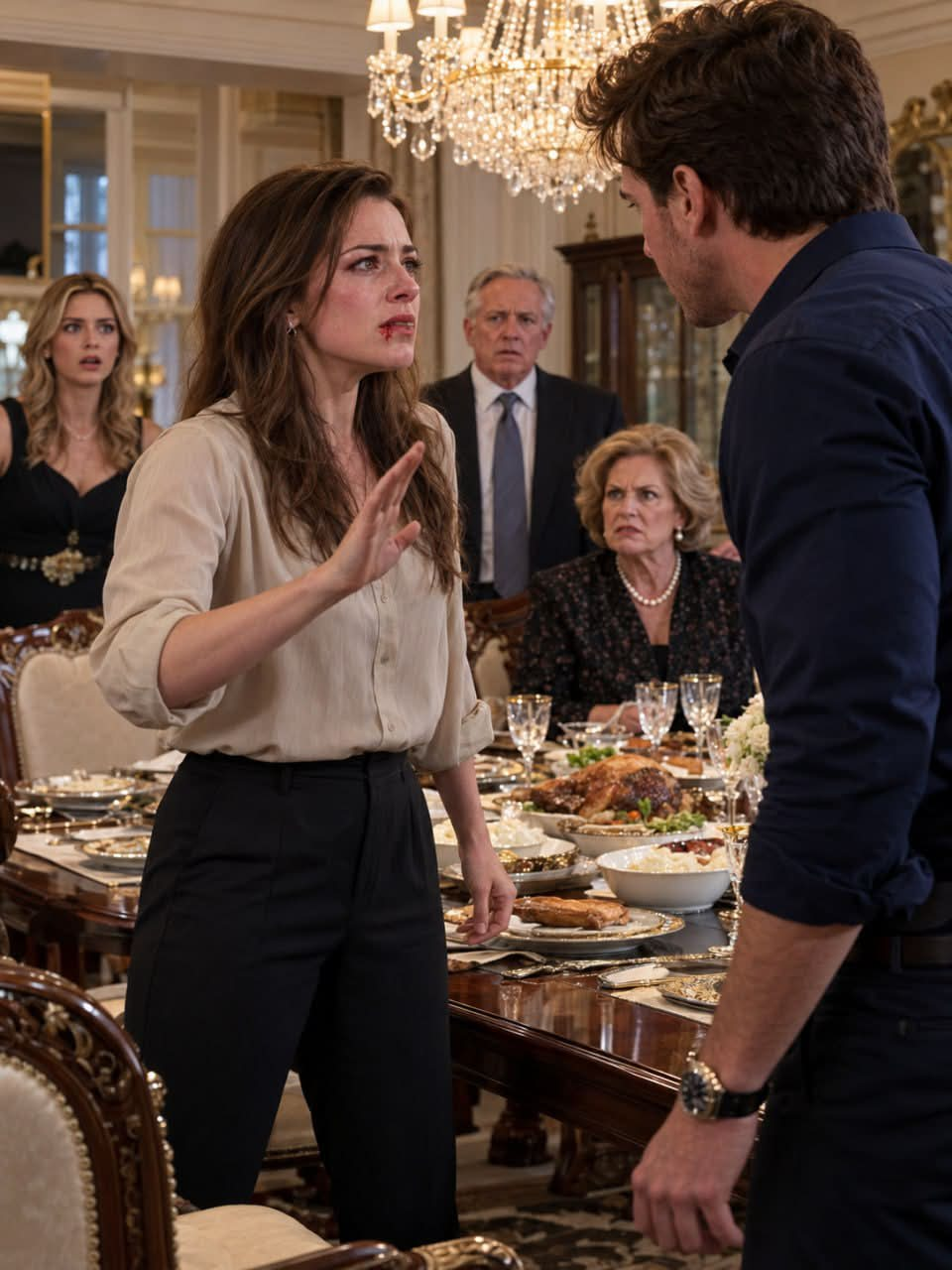
Brad grabbed my wrist beside the dinner table and shouted, "Apologize to my mother!"
His father stood behind him, clutching a folded document that had fallen from Brad's jacket.
Three words were written across the top.
CARTER ASSET TRANSFER.
That was the moment I realized the argument wasn't just about respect.
But I didn't understand what those words meant until much later.
My name is Megan Carter. I was twenty-nine years old when my husband slapped me across the face three days after our wedding.
Three days.
Seventy-two hours after he promised to love me, honor me, and protect me for the rest of our lives.
And he did it in front of his entire family.
The worst part wasn't the slap.
It wasn't even the blood running down my chin.
It was the expression on his mother's face.
She smiled.
Not nervously. Not because she didn't know what else to do.
She smiled like she'd been waiting for that moment.
Like something she'd spent months planning had finally happened.
And when I slapped her precious son right back, that smile disappeared so quickly I almost wished I could have taken a picture.
But I'm getting ahead of myself.
To understand why I was standing in that dining room, bleeding in front of four people who considered themselves better than me, you need to understand the kind of woman I had been before I met Brad.
I grew up on a small farm outside a rural Iowa town where everyone knew everyone else's business.
My father, Daniel Carter, worked from sunrise until his back couldn't take another hour. My mother, Linda, kept our home running, helped with the chickens, and somehow always found time to make sure my brother and I never felt poor.
We were poor, of course.
At least by the standards of people like Brad's family.
Our farmhouse needed a new roof. My father's truck had more rust than paint. We bought our clothes during clearance sales, and vacations usually meant driving to visit relatives.
But we had something I didn't appreciate until I was older.
We had peace.
Nobody screamed at the dinner table.
Nobody measured another person's worth by the size of their paycheck.
And nobody ever raised a hand against someone they claimed to love.
When I was twenty, I moved to Des Moines with two suitcases, a secondhand laptop, and $430 in my checking account.
I found a job at a department store.
I worked weekends.
I took evening classes whenever I could afford them.
I ate cheap groceries, shared an apartment, and saved every dollar that didn't have a job to do.
Seven years later, I'd managed to put away twelve thousand dollars.
That money wasn't a fortune.
But it represented years of saying no to things I wanted because I had something bigger in mind.
I wanted to finish my accounting degree.
Eventually, I wanted to start my own bookkeeping and accounting business.
Nothing enormous.
Just something that belonged to me.
Something nobody could take away because they thought I wasn't good enough.
Then I met Brad Whitmore.
He was thirty-four, handsome, well dressed, and employed by the city government in Cedar Falls.
His family owned two large commercial properties downtown.
He drove a beautiful car, wore expensive watches, and seemed to know everyone worth knowing.
But none of that was what attracted me.
It was the way he listened.
At least, I thought he listened.
We met when he came into the department store looking for a birthday gift for his mother.
He couldn't decide between two expensive scarves.
I helped him choose one.
He asked whether I thought his mother would like it.
I told him that depended on whether she liked the color.
He laughed.
Then he asked me out for coffee.
I said no.
He came back the following week.
This time, I said yes.
For the first six months, Brad seemed almost impossibly considerate.
He brought me flowers when I worked late.
He remembered the names of my parents.
He asked questions about my classes.
When I told him about my dream of starting a business, he said, "I love a woman who knows what she wants."
I remember those words.
I remember them because, after our wedding, he seemed determined to make sure I never got what I wanted again.
The first warning came when he introduced me to his mother.
Patricia Whitmore was sixty-three and carried herself like the entire world had been created to inconvenience her.
She wore expensive jewelry even when she was sitting at home.
She corrected the household staff over tiny mistakes.
And when Brad introduced me, her eyes traveled from my inexpensive shoes to my simple handbag before settling on my face.
"So," she said, "you're the girl from the farm."
I smiled.
"Yes, ma'am."
"How charming."
There was nothing charming about the way she said it.
At dinner that evening, she asked what my parents did.
I told her they farmed corn and raised chickens.
She tilted her head.
"How unfortunate."
Brad laughed awkwardly.
"Mom."
"What? I'm only making conversation."
Then she asked whether my parents owned their land or rented it.
I answered politely.
She asked whether I'd ever traveled outside Iowa.
I told her I had.
She looked surprised.
By dessert, I felt as if I'd attended a job interview for a position nobody wanted to give me.
On the drive home, I told Brad his mother didn't seem to like me.
He reached across the console and squeezed my hand.
"Don't take it personally, babe. Mom has a strong personality."
"She asked whether my parents could afford indoor plumbing."
"She was joking."
"Brad, she wasn't joking."
He sighed.
"You're being a little sensitive."
I should have paid attention to that sentence.
Instead, I convinced myself that families were complicated.
That love required patience.
That Patricia would eventually understand I wasn't interested in her money.
And that Brad would defend me if things ever became truly serious.
I was wrong about every single one of those things.
Our wedding was beautiful.
Or at least the photographs made it look beautiful.
We married in a small chapel decorated with white roses.
My mother cried during the ceremony.
My father wore the suit he'd bought for my college graduation, even though I hadn't finished my degree yet.
He whispered, "I'll wear it again when you get that diploma."
Brad smiled when he said his vows.
He held my hands.
He promised to stand beside me through every hardship.
And when the minister pronounced us husband and wife, he kissed me like I was the only person in the world.
I believed him.
Three days later, I would learn how easily a man could make promises he had no intention of keeping.
After the wedding, I moved into the Whitmore mansion.
Brad said it was temporary.
His parents had a large house with more bedrooms than they needed, and he wanted us to save money before buying our own place.
That sounded reasonable.
I had twelve thousand dollars in savings.
Brad had a good job.
We could save for a down payment.
Maybe in six months, we'd have a place of our own.
That was the plan.
At least, that was the plan he told me.
The mansion was beautiful in the way expensive things sometimes are.
Crystal chandeliers.
Tall windows.
Polished wooden floors.
Antique furniture that looked too valuable to touch.
A formal dining room large enough to host twenty people.
But the house never felt welcoming.
It felt like a museum where I was constantly being watched to make sure I didn't damage anything.
Patricia made that clear almost immediately.
On our first morning, she found me making coffee in the kitchen.
"Brad likes his breakfast at seven," she said.
I glanced at the clock.
It was six thirty.
"Okay."
"And his father prefers fresh fruit."
"All right."
"And I don't tolerate people sleeping until noon."
I looked at her.
"I've been awake since five forty-five."
She smiled without warmth.
"Good. Then we understand each other."
I wanted to tell Brad.
But he had already left for work.
When I mentioned it that evening, he kissed my forehead.
"She's just trying to help you settle in."
I told myself he was right.
The next day, Patricia criticized the way I folded towels.
Then the way I arranged the breakfast dishes.
Then the way I spoke to the housekeeper.
By the third day, I was exhausted.
And that was before she announced that I would be preparing dinner.
"You're part of this family now," she said. "It would be nice if you contributed something."
I looked at her.
"I'd be happy to help."
"Wonderful. Dinner is at six thirty."
She handed me a handwritten menu.
Chicken noodle soup.
Rice.
Slow-cooked beans.
Pork roast in green chile sauce.
Fresh vegetables.
Bread.
Dessert.
I stared at the list.
"All of this?"
"Is that a problem?"
"No, ma'am."
"Good. I would hate to think my son married someone who couldn't manage a simple family meal."
So I cooked.
For nearly five hours.
I chopped vegetables.
I seasoned meat.
I watched the soup.
I stirred the beans.
I checked the roast.
I cleaned as I worked.
And every time Patricia walked through the kitchen, she found something wrong.
"Too much salt."
"Not enough seasoning."
"That knife isn't for vegetables."
"Are you sure your mother taught you to cook?"
By five thirty, my feet hurt.
By six, my back ached.
By six fifteen, I realized I hadn't eaten anything since breakfast.
Still, I kept working.
I wanted dinner to be good.
Not because I needed Patricia's approval.
Because cooking for people had always been an expression of love in my family.
My mother could make a meal from almost nothing.
My father always thanked her, even if it was just scrambled eggs.
I thought perhaps a good dinner might soften something in Patricia.
It didn't.
At six thirty, everyone gathered around the dining table.
Brad wore a burgundy shirt with the sleeves rolled up.
His father, Richard Whitmore, stood near the head of the table in a dark suit.
His sister, Kelsey, wore a pale gold dress and looked uncomfortable before anyone had even spoken.
Patricia sat in her usual chair.
I carried out the final serving dishes.
The chandelier reflected in the crystal glasses.
The table looked beautiful.
For one brief moment, I felt proud.
Then Patricia tasted the soup.
She placed her spoon down.
"Interesting."
My stomach tightened.
"Is something wrong?"
"It's a little rustic."
Brad laughed.
"Mom, it's soup."
"Of course it is, darling."
I kept my mouth shut.
I served Richard first.
Then Patricia.
Then Brad.
Kelsey quietly took her own plate and whispered, "Thank you, Megan."
I smiled at her.
It was the first kind thing anyone had said to me all afternoon.
Finally, I reached for my own plate.
I spooned a little rice onto it.
Patricia slammed her spoon against the table.
The sound cracked through the room.
"Excuse me?"
I stopped.
She stared at my plate.
"You're seriously going to eat already?"
I blinked.
"Everyone else has been served."
"And?"
I looked around the table.
Nobody spoke.
Patricia leaned back.
"Where on earth were your manners raised?"
I felt my face warming.
"I'm sorry, ma'am. I just assumed—"
"That's your problem, Megan. You assume."
Brad stared at his plate.
Richard adjusted his tie.
Kelsey looked down.
Patricia continued.
"Honestly, this is what happens when you bring home someone from a farm. No understanding of proper behavior."
I swallowed.
"I didn't mean to offend anyone."
"Oh, I'm sure you didn't. People from your background rarely understand when they're being offensive."
My fingers tightened around the serving spoon.
"Patricia—"
"Mrs. Whitmore would be more appropriate when you're speaking to me like that."
I stared at her.
She smiled.
Then she said the words that changed everything.
"Your parents were probably desperate to marry you off to someone with real money."
The room went quiet.
I felt something inside me go still.
Not angry.
Not yet.
Just still.
Because my parents had given everything they could to help me become independent.
My father had worked through injuries.
My mother had skipped things she needed so I could have school supplies.
They had never asked Brad for anything.
They had never asked his family for anything.
And now this woman was sitting at a table I'd spent five hours preparing, insulting the two people who had loved me most.
I set down the serving spoon.
"My parents might not have money," I said, "but they're honest, good people."
Patricia's eyes narrowed.
I continued.
"And they've never asked you for a single dime."
Brad's chair scraped backward.
"Megan."
I turned toward him.
"What?"
"That's enough."
I stared at my husband.
"She insulted my parents."
"Apologize."
For a moment, I thought I'd misunderstood.
"Excuse me?"
Brad stepped away from his chair.
"I said apologize to my mother."
I looked at Patricia.
She was watching me with obvious satisfaction.
I turned back to Brad.
"I'm not apologizing for defending my family."
His face changed.
It happened so quickly that I barely recognized him.
The attentive man who brought me flowers disappeared.
His jaw tightened.
His eyes hardened.
And before I could take a step backward, he lunged toward me.
His open hand struck the left side of my face.
Hard.
The sound was so sharp that Kelsey gasped.
My head snapped sideways.
I stumbled against the edge of a dining chair.
For one second, everything seemed distant.
The chandelier.
The table.
The people.
I tasted blood.
When I touched my mouth, my fingers came away red.
Brad stood in front of me, breathing heavily.
"Don't you ever talk back to my mother!"
Nobody moved.
Nobody helped me.
Richard looked horrified, but he stayed where he was.
Kelsey covered her mouth.
And Patricia—
Patricia smiled.
A small, satisfied smile.
As though she'd finally received exactly what she wanted.
Something changed inside me.
I remembered my father teaching me to stand up for myself.
I remembered my mother telling me that kindness did not mean accepting cruelty.
I remembered every hour I'd spent working toward a future that belonged to me.
And I understood, with sudden clarity, that I had made a terrible mistake marrying Brad Whitmore.
But I was not going to make the mistake of surrendering to him.
I slowly straightened.
I wiped the blood from my lip.
Brad stared at me.
"Well?"
I looked him directly in the eyes.
Then I slapped him.
Once.
Hard enough to turn his face.
The room fell silent.
Brad staggered half a step backward.
He touched his cheek.
For the first time since I'd met him, he looked completely unsure of what to do.
Patricia shot to her feet.
"You insolent little nobody!"
I didn't look at her.
I kept my eyes on Brad.
"If you ever lay a hand on me again," I said quietly, "I'll break your arm."
Brad's mouth opened.
I stepped closer.
"I'm not your maid."
He said nothing.
"And I'm damn sure not your punching bag."
Kelsey whispered my name.
I ignored her.
Brad finally found his voice.
"You have no idea what you've just done."
I looked at him.
"Actually, Brad, I think I do."
His face darkened.
"This is my family's house."
"Then your family can enjoy dinner without me."
I turned toward the staircase.
Patricia shouted something behind me.
I didn't stop.
Brad called my name.
I kept walking.
Every step hurt.
My cheek throbbed.
My lip stung.
But I refused to give them the satisfaction of seeing me cry.
When I reached the bedroom, I closed the door.
Locked it.
Then I stood in front of the mirror.
My lower lip was split.
My cheek was already swelling.
I barely recognized the woman staring back at me.
Three days earlier, I'd been a bride.
Now I was standing in my husband's childhood bedroom, wondering how quickly I could escape his family.
I took out my phone.
My mother's name appeared on the screen.
I almost called.
But I couldn't bear the thought of telling her what had happened.
Not yet.
Instead, I took photographs of my face.
I photographed my lip.
My cheek.
The blood on my blouse.
Then I sent the pictures to my personal email account.
I didn't know whether I'd need them.
I only knew I wanted a record of what Brad had done.
After that, I pulled my suitcase from the closet.
I began packing.
I folded my clothes.
Collected my toiletries.
Found my wallet.
Checked my bank app.
My twelve thousand dollars was still there.
I felt a small wave of relief.
Whatever happened next, I had enough money to leave.
Then I noticed something strange.
Brad's desk drawer was slightly open.
I'd never paid much attention to the desk before.
It was an expensive dark wooden piece with brass handles.
Usually, Brad kept the drawers locked.
But tonight, the top drawer hadn't closed completely.
A corner of white paper protruded from beneath a leather folder.
I hesitated.
I knew I shouldn't go through another person's belongings without a reason.
But something about that paper caught my attention.
My name was printed across the top.
Not Whitmore.
Carter.
MEGAN CARTER.
I moved closer.
The paper was attached to a folder.
On its cover were three words.
CARTER ASSET TRANSFER.
I stared at them.
My parents didn't have significant assets.
They had their farm.
Their old truck.
A small savings account.
And a mortgage they were still paying.
Why would Brad have a folder about my family's assets?
I opened it.
The first page contained my full legal name.
My date of birth.
My previous address in Des Moines.
My parents' names.
And the name of the bank where I kept my savings.
My hands went cold.
I turned the page.
There was a photocopy of my driver's license.
Another page listed my employment history.
Then my college enrollment information.
And beneath that—
a handwritten note.
Subject has approximately $12,000 in liquid savings.
Subject.
Not wife.
Not Megan.
Subject.
I stared at the words.
The handwriting wasn't Brad's.
It was too precise.
Too carefully formed.
I turned another page.
There was a photograph of me standing outside the department store.
I remembered that day.
I'd been wearing a blue coat.
It had been almost six months before Brad asked me to marry him.
I had never seen the photograph before.
Someone had taken it without my knowledge.
My heart began pounding.
I flipped through the remaining papers.
A property description.
A map.
A list of dates.
And a document bearing the name of a company I didn't recognize.
Whitmore Holdings LLC.
Near the bottom was a sentence that made my stomach twist.
Marriage must be completed before execution of the transfer agreement.
I read it again.
Marriage must be completed.
Before execution.
What transfer?
What agreement?
Why was my marriage being discussed in a business document?
I reached for my phone.
Then I heard footsteps outside the bedroom.
I froze.
The footsteps stopped.
Someone tried the door handle.
It didn't move.
A moment later, Brad spoke.
"Megan."
I said nothing.
His voice was different now.
Quiet.
Controlled.
Almost pleasant.
"Open the door, sweetheart."
I looked at the folder in my hands.
Then at the locked door.
Brad tried the handle again.
"We need to talk."
I backed away.
"No."
A pause.
Then he said something that made every hair on my arms stand up.
"Did you touch my desk?"
I stared at the door.
How could he know?
I hadn't made any noise.
I hadn't moved anything except the folder.
"Megan," he said, his voice suddenly sharper. "Answer me."
I slipped the document beneath my blouse.
My phone vibrated.
A text message appeared from an unknown number.
DO NOT GIVE HIM THE FOLDER.
I stopped breathing.
Another message arrived.
YOUR MARRIAGE WAS ARRANGED LONG BEFORE BRAD MET YOU.
I stared at the screen.
Then a third message appeared.
IF YOU WANT TO KNOW WHAT HAPPENED TO THE FIRST WOMAN, CHECK THE BOTTOM DRAWER.
My blood turned cold.
The first woman?
What first woman?
Outside, Brad stopped speaking.
For several seconds, there was complete silence.
Then I heard another voice.
A woman's voice.
Patricia.
"Brad, move away from the door."
My stomach tightened.
I heard the soft metallic sound of keys.
Patricia spoke again.
"She wasn't supposed to find those papers until after the transfer."
Then the key turned in the lock.
And I realized the bedroom door could be opened from the outside.
"Brad," Patricia whispered, "if she found the photograph of your first wife, we have a much bigger problem."






Comments 0