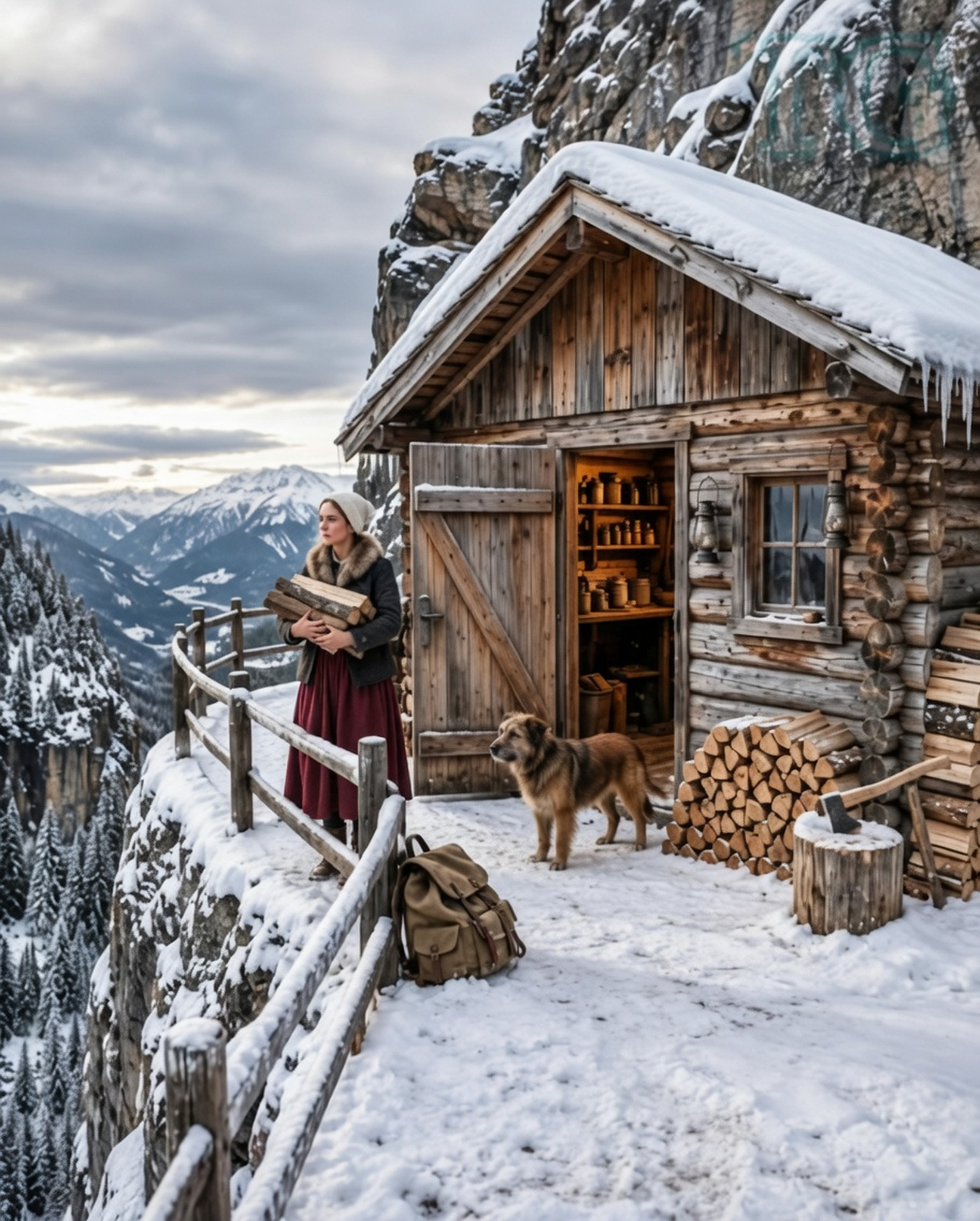
Audrey Everett tightened her grip around the pocketknife.
"Don't come any closer," she whispered.
Outside, a man's shadow stretched across the cabin floor.
On the table, her grandfather's red-backed ledger lay open beside a handwritten letter.
The stranger knew her name.
Three weeks earlier, Audrey had been scrubbing the boardinghouse floor in Marietta, Ohio, when Gemma Prescott called her upstairs.
"Audrey! Stop what you're doing and come here."
Audrey dipped the rag into the bucket and wrung it out with both hands. Her knees ached from spending the morning on the floor, and the sleeves of her faded blouse were wet almost to the elbows.
"Yes, ma'am."
Gemma stood near the staircase, holding a cream-colored envelope.
She was a broad-shouldered woman in her fifties who wore her hair pinned tightly at the back of her head. Her dresses were always clean, her shoes polished, and her expressions suggested that every inconvenience in the world had been caused by someone else.
Audrey had learned not to argue with her.
For five years, the boardinghouse had been Audrey's workplace, shelter, and occasional source of humiliation.
She washed sheets, carried coal, scrubbed floors, cleaned rooms, and served meals to travelers who rarely remembered her name.
In return, Gemma allowed her to sleep in a narrow attic room and paid her a small amount of money.
It wasn't generous.
But it had kept Audrey alive.
"Apparently," Gemma said, turning the envelope between her fingers, "an attorney thinks you're worth finding."
Audrey looked up.
"An attorney?"
"That's what the envelope says. Unless you've suddenly become involved in some expensive legal business without telling me."
Audrey wiped her hands against her apron.
"Are you certain it's addressed to me?"
Gemma turned the envelope outward.
Audrey Everett.
The handwriting was unfamiliar.
The address was correct.
She stared at her name for several seconds before accepting it.
Nobody had sent her personal mail in a very long time.
"Well?" Gemma asked. "Aren't you going to open it?"
Audrey carefully broke the seal.
Inside was a formal letter from a law office in Arkansas.
She read the first paragraph.
Then she read it again.
Her grandfather, Alden Archer, had died seven weeks earlier.
He had been eighty-one years old.
And he had left her his property in the Ozark Mountains of northern Arkansas.
Forty-three acres.
A log cabin.
And everything remaining inside it.
Audrey's knees weakened.
She gripped the edge of the staircase railing.
"What does it say?" Gemma asked.
Audrey swallowed.
"It says my grandfather left me a property."
Gemma stopped smiling.
"Your grandfather?"
"My mother's father."
"I thought he was dead."
"He is."
"Then why would he leave anything to you?"
Audrey looked down at the letter.
"I don't know."
Gemma reached for it.
Audrey instinctively pulled it closer to her chest.
The movement surprised them both.
Gemma narrowed her eyes.
"Don't get clever. I've given you a roof over your head for five years."
"I know. I'm grateful."
"Then don't forget it."
Audrey lowered her gaze.
But something had changed.
For the first time in years, she had received news that belonged entirely to her.
It wasn't another task.
It wasn't another complaint.
It wasn't another demand.
It was an opportunity.
And she was terrified of how much she wanted it.
Alden Archer had never been an easy man for Audrey to remember.
She had met him only four times.
The earliest memory was of a little girl standing beside her mother in front of an old wooden porch.
Alden had come down the steps slowly.
He was tall, with a silver beard, broad hands, and deep lines around his eyes.
He had lifted Audrey into his arms and held her for a long moment.
She remembered the smell of wood smoke on his coat.
She remembered his rough fingers brushing her hair away from her forehead.
Most of all, she remembered how he looked at her mother.
There was affection in his eyes.
But there was sorrow, too.
Audrey had been too young to understand it.
Once, during a visit, she had asked her mother why they never stayed longer.
Her mother had continued folding laundry.
"Your grandfather has had chances to let people close," she had answered. "He doesn't take them."
"Doesn't he like us?"
Her mother had stopped folding.
For a moment, she looked toward the window.
Then she placed another shirt on the pile.
"Some people carry regrets for so long that they forget how to put them down."
Audrey never asked again.
Years later, her father died in a railroad accident.
The news arrived on a gray afternoon.
Her mother received a small package containing his personal belongings and a letter explaining what had happened.
Audrey remembered the way her mother sat at the kitchen table afterward.
She did not scream.
She did not throw anything.
She simply held her husband's pocket watch and stared at it until the light disappeared from the window.
After that, life became harder.
Her mother worked whenever she could find employment.
Audrey helped by carrying water, washing clothes, and collecting whatever food they could afford.
But poverty had already taken hold of them.
Then came the cough.
At first, her mother dismissed it as a winter illness.
By spring, she could barely climb the stairs without stopping.
The doctor called it tuberculosis.
Audrey was thirteen when her mother died.
There had been no grandfather waiting at the funeral.
No father.
No relatives offering to take her home.
Only a few neighbors and a minister who struggled to remember the words of the service.
Audrey learned quickly that grief did not excuse anyone from working.
She eventually found employment at Gemma Prescott's boardinghouse in Marietta.
Five years passed.
She grew taller.
Her hands became rough.
Her childhood disappeared beneath endless hours of labor.
Now, at eighteen, she was being told that a man she barely knew had left her a home.
She looked again at the lawyer's letter.
The property was nearly thirty miles from the closest town.
There were no detailed descriptions of nearby neighbors.
No explanation of why Alden had chosen her.
Only a request that she travel to Arkansas and take possession of the estate.
At the bottom was a small brass key.
Audrey held it in her palm.
It was heavier than she expected.
For the first time in five years, she allowed herself to imagine a life beyond the boardinghouse.
A room with a door she could lock.
A bed that belonged to her.
A kitchen where nobody could order her away from the stove.
A place where she could wake up without wondering whether someone would decide she was no longer useful.
She folded the letter carefully.
"I need to go," she said.
Gemma gave a short laugh.
"Go where?"
"Arkansas."
"With what money?"
Audrey did not answer immediately.
She had saved three dollars and twenty cents.
It represented hundreds of hours of work.
Every coin had been earned by carrying coal, cleaning rooms, and accepting less than she deserved.
"I'll find a way."
Gemma studied her.
"You've been eating under my roof for five years."
"I know."
"And sleeping in my attic."
"I know."
"Don't tell me you're planning to walk away without settling what you owe."
Audrey's stomach tightened.
She had expected resistance.
But she had not expected Gemma to turn the inheritance into another debt.
"How much do you say I owe?"
Gemma named a sum Audrey could never have paid.
Audrey stared at her.
"That isn't what we agreed."
"Agreements change."
Audrey folded the lawyer's letter again.
For once, she did not apologize.
She simply said, "I need to leave."
Gemma's expression hardened.
"Then don't expect to come back."
Audrey nodded.
She had no intention of returning.
The journey south consumed almost everything she owned.
She sold a spare shawl, purchased the cheapest food she could find, and used her savings to reach Arkansas.
She traveled by train for part of the distance, then relied on a wagon driver heading toward the mountains.
The farther south she went, the less familiar the landscape became.
The towns grew smaller.
The roads became rougher.
Eventually, the driver could take her no farther.
He pointed toward a narrow trail.
"That should lead you toward the Archer property."
"How far?"
"Several miles."
"Is there anyone living nearby?"
The driver shook his head.
"Not close enough to matter."
Audrey thanked him and climbed down.
She adjusted the strap of her small leather pouch and checked the brass key inside her coat.
She had two dresses.
A spare blouse.
A pocketknife.
Three dollars and twenty cents.
And a worn flour sack containing her remaining belongings.
It was not much.
But it was hers.
She started walking.
Now, seven weeks after Alden Archer's death, Audrey stood in a clearing surrounded by dark pine trees.
The cabin appeared exactly as she had imagined it from the lawyer's description.
Its logs were dark with age.
The cedar-shingle roof looked intact.
A stone chimney rose above one side, and a narrow porch stretched across the front.
The mountain stood behind it like a wall.
Farther down the slope, the forest disappeared into a valley.
Audrey stopped when she saw the smoke.
It was thin at first.
A gray ribbon rising from the chimney.
She blinked.
Then she looked again.
Smoke.
Someone had lit a fire.
Her heart began beating faster.
The cabin was supposed to be deserted.
She tightened her grip on the flour sack.
"Can anyone hear me?"
Her voice traveled across the clearing.
Nobody answered.
She waited.
The silence seemed to grow heavier.
She tried again.
"Hello?"
A branch snapped behind her.
Audrey spun around.
The trail was empty.
Only the trees moved slightly in the wind.
She stared downhill for several seconds before turning back toward the cabin.
The smoke had become thinner.
Perhaps a traveler had stopped to warm himself.
Perhaps another family had settled here.
Perhaps the lawyer had made a mistake.
A mistake she could not afford.
She approached the porch slowly.
Then she noticed something in the mud.
A fresh bootprint.
It was much larger than hers.
The impression was deep, with a clearly defined heel and a pattern still visible in the wet earth.
Audrey crouched.
She touched the edge of the print.
The mud was still soft.
Someone had been here recently.
Very recently.
She stood and looked toward the door.
The brass key felt cold against her fingers.
She reached for the latch.
Before she could use the key, the door shifted inward.
It was unlocked.
Audrey hesitated.
For several seconds, she considered turning around.
She could return to the trail.
Find a town.
Ask someone for help.
But she had already spent nearly everything getting here.
She had nowhere else to go.
She pushed the door open.
Warmth reached her first.
A fire glowed inside a cast-iron stove.
A kettle rested above the flames.
Two wooden chairs faced a square table.
A blanket lay neatly folded on a narrow bed.
The shelves were lined with glass jars.
The floor had been swept.
Fresh firewood was stacked beside the stove.
Someone had taken care of the cabin.
Audrey stepped inside.
"Anybody here?"
Nothing.
She waited.
The only sound was the faint crackling of the fire.
Her eyes moved toward the table.
A loaf of bread sat beneath a white cloth.
It was fresh.
The crust was still firm, and a faint smell of warm flour filled the room.
Audrey approached it.
Her stomach tightened painfully.
She had eaten very little during the journey.
She lifted one corner of the cloth and touched the bread.
Then she withdrew her hand.
She would not take food that belonged to someone else.
Not without knowing whose it was.
That was when she noticed the letter.
It lay beside an old red-backed ledger.
The note was addressed:
For whoever inherits this place.
Audrey stared at the handwriting.
She knew it.
Even after all those years, she knew the slanted letters and the oversized capital A.
Her grandfather had written her birthday cards when she was little.
She remembered the way he always began her name.
Audrey.
Her fingers trembled as she unfolded the paper.
The first sentence made her throat tighten.
Audrey,
You came here, and that took a courage I spent too many years avoiding.
She read the sentence twice.
Then she continued.
The cabin belongs to you now. Before you choose a life here, though, learn what you can about this mountain.
Read the ledger first.
Whatever anyone tells you, make your own judgment about the value of this ground.
Alden Archer.
Audrey lowered the letter.
She looked around the cabin.
Forty-three acres had sounded like a lifetime of security.
But her grandfather had written as though the land itself carried a danger.
Why would she need to defend her judgment?
What did he know that she did not?
She pulled out the wooden chair and sat down.
The red-backed ledger was thick, its edges worn from years of handling.
She opened the cover.
The first entry was dated May 1847.
Alden had been nineteen when he arrived in the mountains.
Only a year older than Audrey was now.
The handwriting was neat and deliberate.
He recorded clearing the first patch of land, repairing the chimney, finding fresh water, and building the first section of the cabin.
Audrey turned another page.
There were observations about the weather.
Descriptions of the safest places to collect firewood.
Notes about the creek crossing where deer frequently gathered.
There were sketches of trees, paths, and sections of the property.
This was not simply a diary.
It was a guide.
A record of everything her grandfather had learned about surviving in the mountains.
She turned another page.
And another.
The longer she read, the more she understood how much knowledge had been left behind.
Her grandfather had known this mountain intimately.
He had spent decades studying it.
And now he had placed that knowledge in her hands.
Audrey swallowed.
"You could have let me know you," she whispered.
A footstep sounded outside.
She froze.
Another step followed.
Then another.
Slow.
Unhurried.
Someone was walking across the porch.
Audrey closed the ledger.
A shadow moved across the window.
Her eyes widened.
She looked toward the door.
"Miss Everett?"
The voice belonged to a man.
He knew her name.
Audrey slowly reached beneath her coat.
Her fingers closed around the pocketknife.
Then the man spoke again.
And this time, he sounded as though he had been waiting for her for a very long time...






Comments 0