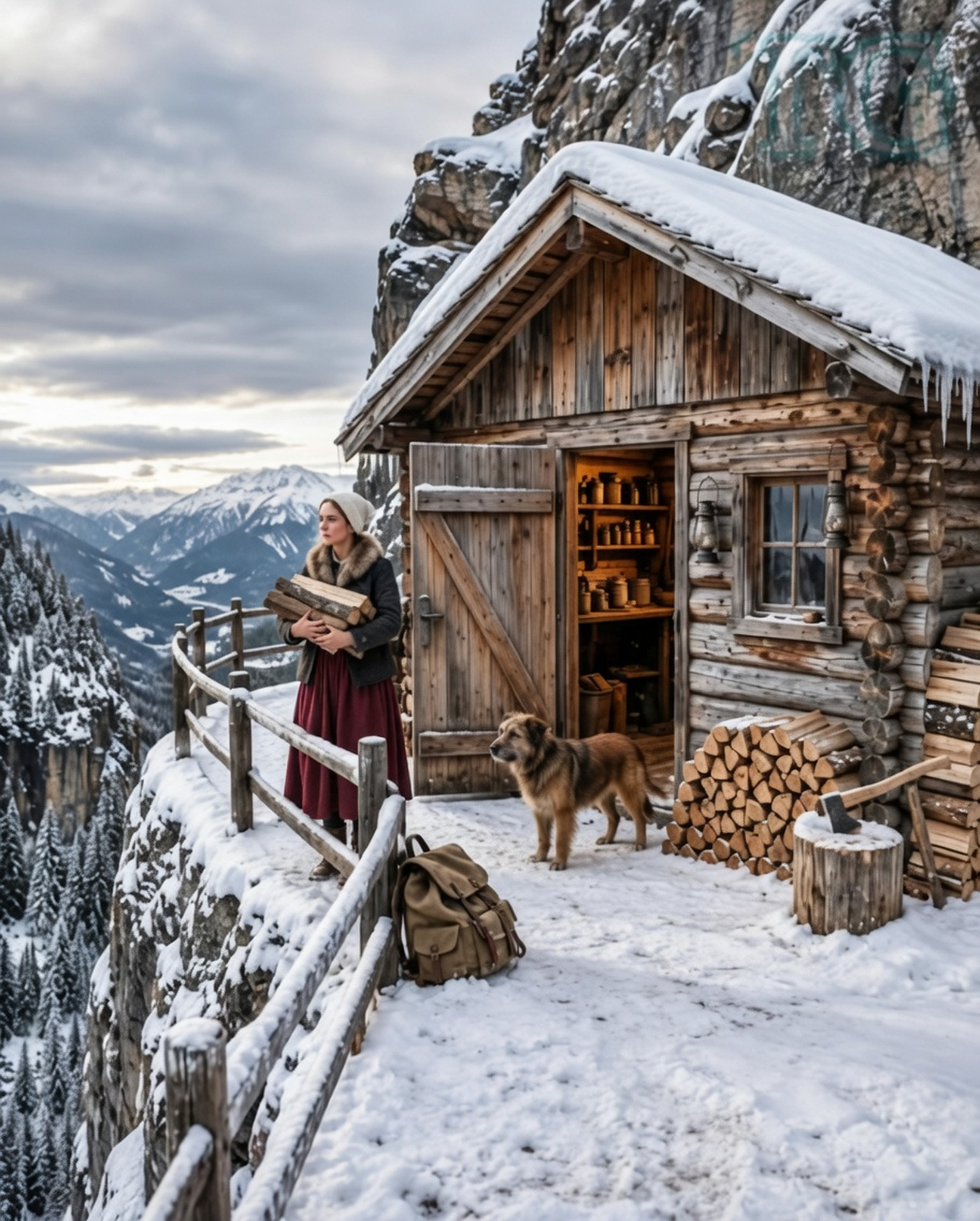
"Audrey Everett? My name is Margaret Whitmore. I believe we need to talk about your mother's death."
Audrey stood beside the kitchen table, unable to move.
The letter in Thomas Reed's hand suddenly seemed heavier than the paper from which it had been made.
Her mother.
For five years, Audrey had carried the memory of her mother's final days like a stone inside her chest. She remembered the coughing, the fever, the doctor's visits, and the terrible afternoon when the woman who had raised her could no longer open her eyes.
Nobody had ever suggested there was anything unusual about her death.
Nobody had ever suggested there was anything left to investigate.
Yet now a stranger stood outside her grandfather's cabin claiming to know something about it.
Thomas folded Alden's letter and slipped it into his coat.
"Don't open the door yet," he said.
Audrey turned toward him.
"Why?"
"Because I want to know why she's here."
"She just told us."
"She told us she wants to discuss your mother. That isn't the same thing."
Another knock sounded.
"Miss Everett?" the woman called. "I know you're inside."
Audrey approached the door.
Thomas moved in front of her.
"Let me speak first."
"No."
He looked back.
"Audrey—"
"This is my house. If someone comes here asking about my mother, I won't hide behind you."
She reached for the bolt.
Thomas hesitated, then stepped aside.
Audrey opened the door.
A woman stood on the porch.
She appeared to be in her late forties, perhaps a little older. Her dark brown hair was streaked with silver and gathered into a loose bun. She wore a charcoal traveling coat, a cream-colored scarf, and practical leather boots.
Her face was pale from the cold.
She carried a small leather handbag.
Unlike Caleb Whitmore, she did not look particularly threatening.
But Audrey had learned that appearances were not reliable measures of a person's intentions.
"Miss Everett," the woman said.
"Yes."
"I'm Margaret Whitmore."
"I heard you."
Margaret glanced at Thomas.
"Thomas."
"Margaret."
There was something uncomfortable in the way they exchanged greetings.
They knew each other.
And neither seemed pleased to meet the other.
Audrey stepped back slightly.
"Why do you want to talk about my mother?"
Margaret looked at her for a long moment.
Then she said, "Because I knew her."
Audrey felt her fingers tighten around the edge of the door.
"How?"
"I knew Eleanor Archer, too. Your grandmother."
Audrey looked toward Thomas.
He had gone very still.
Margaret continued.
"I knew your grandfather for nearly twenty years. I was here when your mother was young. I remember the day she left this mountain."
Audrey swallowed.
"My mother never told me much about her childhood."
"I know."
"Why?"
Margaret lowered her eyes.
"Because there were things she didn't want you to carry."
Audrey stepped aside.
"Come in."
Thomas immediately spoke.
"Audrey, wait."
She looked at him.
"She knows my mother. I want to hear what she has to say."
Margaret entered the cabin.
She removed her gloves and placed them on the table.
Her eyes moved around the room.
The cast-iron stove.
The wooden chairs.
The old shelves.
Finally, she looked at the red-backed ledger.
"Alden kept it," she whispered.
Audrey frowned.
"You know about the ledger?"
Margaret nodded.
"Of course."
Thomas closed the door.
"Why are you here, Margaret?"
She looked at him.
"Because Caleb has started asking questions again."
Thomas's jaw tightened.
"About the land?"
"About the spring. About the old survey. And about the girl who inherited everything."
Audrey pulled out a chair.
"Please sit down."
Margaret did.
Audrey remained standing.
"Tell me about my mother."
For a moment, Margaret seemed unsure where to begin.
Then she opened her handbag.
She removed a small folded photograph.
It was old, with faded edges.
She placed it on the table.
Audrey leaned closer.
The photograph showed three people standing outside the cabin.
Alden was on the left.
A younger woman stood beside him, her long hair falling over her shoulders.
Audrey recognized her immediately.
Her mother.
The third person was Margaret.
She looked much younger, perhaps twenty-five.
Audrey picked up the photograph.
"When was this taken?"
"Almost thirty years ago."
"Why do you have it?"
"Because your mother gave it to me."
Audrey looked at the image again.
Her mother was smiling.
Not the tired, restrained smile Audrey remembered from her childhood.
This was different.
Her mother's face looked peaceful.
Almost happy.
"She looks so young."
"She was."
Margaret paused.
"She was also very stubborn."
Audrey gave a faint, unexpected smile.
"That sounds familiar."
Margaret returned the smile, but it faded quickly.
"Your mother loved this place. She knew every path, every tree, and every bend in the creek. Alden taught her how to read the weather and find water. Eleanor taught her how to garden."
"Then why did she leave?"
Margaret looked at Thomas.
Thomas shook his head slightly.
But Audrey saw it.
She had already had enough of people deciding what she was allowed to know.
"Please," she said. "I have spent my whole life knowing almost nothing about my family. Don't make me ask twice."
Margaret took a slow breath.
"Your mother left because she and Alden had a terrible disagreement."
"About what?"
"The land."
Audrey frowned.
"What does that have to do with her?"
"Your mother believed your grandfather was making a mistake by refusing to sell part of the property."
Thomas leaned against the wall.
"That's not the whole story."
Margaret looked at him.
"No. It isn't."
Audrey placed the photograph down.
"What was the rest?"
Margaret folded her hands.
"Your mother had discovered that someone was trying to change the northern boundary of Alden's property. There were old documents involved. Survey records. Deeds. Information that could have affected ownership of several adjoining parcels."
"The original survey?"
Margaret nodded.
"Your grandfather believed the original record proved that the property was larger than the county maps showed."
Audrey remembered the hidden message.
The northern boundary is not what the county map claims.
"Did my mother find it?"
"No."
"Did she know where it was?"
Margaret hesitated.
"She knew your grandfather had hidden something."
"Then why didn't she tell me?"
"Because she left before she understood what he had done."
Audrey looked down at the photograph.
Her mother had been here.
She had stood on this porch.
She had known the land that Audrey had inherited.
Yet the stories had never reached her.
"Did my grandfather and mother ever make peace?"
Margaret's expression softened.
"Not completely."
Audrey felt a familiar ache.
"Why?"
"Because both of them were too proud to admit they had been hurt."
Thomas looked toward the stove.
Margaret continued.
"Your grandfather loved your mother. But he was a difficult man. He believed protecting people meant making decisions for them. Your mother believed love meant being trusted enough to make her own decisions."
Audrey understood that conflict more than she wanted to.
She had spent five years working for Gemma Prescott, who had called every demand kindness and every insult discipline.
She knew how easily care could become control.
"Did my mother ever want to come back?"
Margaret looked directly at her.
"Yes."
The answer came so quickly that Audrey almost missed it.
"She did?"
"Many times."
"Why didn't she?"
Margaret looked at the photograph.
"Because pride can become a prison."
Audrey lowered herself into the chair.
For a moment, she could not speak.
She had always imagined that her mother had chosen to stay away from the family.
Now she was hearing that the choice might not have been so simple.
"Did my grandfather know she was ill?"
Margaret's eyes shifted.
"Yes."
Audrey looked up sharply.
"How?"
"He received word."
"When?"
"Before she died."
"Did he visit her?"
Margaret said nothing.
"Did he?"
"No."
Audrey stood.
"Why not?"
Margaret looked distressed.
"He was afraid she would refuse to see him."
"That was his reason?"
"He was ashamed."
Audrey shook her head.
"She was dying."
"I know."
"He could have come."
"I know."
Audrey turned away.
Her hands trembled.
She remembered the last weeks of her mother's life.
The cold room.
The empty medicine bottle.
The way her mother had struggled to breathe.
She remembered sitting beside her bed, promising that everything would be all right.
She had been thirteen.
A child.
And her grandfather had been alive somewhere in the world, knowing his daughter was dying.
But he had stayed away.
Audrey pressed her lips together.
"Did my mother ask for him?"
Margaret's eyes filled.
"Yes."
Audrey turned.
"What?"
"She asked about him near the end."
The room became very quiet.
"She asked whether he knew she was sick. She asked whether he had written."
Audrey stared at Margaret.
"And what did you tell her?"
"I told her I didn't know."
Thomas closed his eyes.
Audrey noticed.
"Thomas?"
He looked at her.
"Did you know my mother was dying?"
"Yes."
"Did you know she asked about him?"
Thomas looked down.
"I heard about it."
Audrey felt something inside her break.
"All these years, I thought he had forgotten us."
Thomas stepped forward.
"Audrey, he didn't forget you."
"Then why wasn't he there?"
"Because he made a terrible mistake."
She laughed once, without humor.
"That's what everyone keeps saying. My mother was dead. My father was dead. I was left alone. And everyone keeps telling me that people made mistakes."
Nobody answered.
Audrey returned to the table.
She picked up the photograph and looked at her mother's face.
"I wish someone had told me."
Margaret reached across the table.
"I wish I had."
Audrey withdrew slightly.
"Why didn't you?"
Margaret's hand stopped.
"Because I was afraid."
"Of what?"
"Of making things worse."
Audrey stared at her.
"How could it have been worse?"
Margaret looked away.
For several minutes, nobody spoke.
Then Thomas pulled the hidden letter from his coat.
He placed it beside the photograph.
Margaret immediately recognized the handwriting.
"Oh, Alden."
Audrey looked at her.
"You've seen this before?"
"No."
"Then how do you know?"
"Because I recognize the way he wrote the capital letters."
Thomas unfolded the page.
"Read it."
Margaret did.
Her expression changed as she reached the final lines.
"Where did you find this?"
"Under the floorboard in the storage room," Audrey answered.
Margaret looked toward the rear door.
"He kept it here?"
"Apparently."
She read the letter again.
Then she sat back.
"Did he tell you what happened to your mother?" she asked Audrey.
"No. That's what I'm trying to understand."
Margaret pressed her fingers together.
"Then there is something you need to know about the last time I saw her."
Audrey waited.
"Your mother came to this cabin about six months before she died. She had already been coughing. She looked exhausted, but she insisted she was fine."
"Why did she come?"
"She wanted to see Alden."
"Did she?"
Margaret nodded.
"They argued."
"About the land?"
"Yes. But not only that."
Margaret looked toward the window.
"Your mother believed someone was following her. She said strange men had been asking questions about Alden's property. They wanted to know whether he had shown her the old survey."
"Who were they?"
"She didn't say."
"Did she mention Caleb?"
Margaret hesitated.
"She mentioned the Whitmore name."
Thomas pushed away from the wall.
"That's enough."
Margaret looked at him.
"No. It isn't."
Thomas's expression hardened.
"Be careful."
Audrey looked between them.
"What aren't you telling me?"
Margaret turned back to Audrey.
"Your grandfather believed Caleb's family was involved in the attempts to acquire the property. But there was another person helping them."
"Who?"
"I never learned his full name."
"What did he look like?"
"Older than Caleb. Thin. Gray hair. He carried a walking stick, even when he didn't need one."
Thomas looked toward the door.
Margaret continued.
"Your mother told me that man had offered her money to convince Alden to sell."
Audrey's fingers tightened around the photograph.
"Did she accept?"
"No."
"Then what happened?"
"She became frightened. She told Alden she wanted to leave the mountain."
"And he let her?"
"After another argument."
Audrey looked at Thomas.
"Did you see her leave?"
Thomas nodded.
"I walked her to the trail."
"Was she alone?"
"Yes."
"Did anyone follow her?"
Thomas hesitated.
"I didn't see anyone."
Margaret lowered her eyes.
"That doesn't mean nobody did."
Audrey returned to the letter.
The greatest danger isn't Caleb.
It's the person who knows what happened to her mother.
She read the sentence aloud.
"Who knows what happened to my mother?"
Margaret looked toward Thomas.
He did not move.
"Do you know?" Audrey asked.
Thomas remained silent.
"Thomas."
He took a slow breath.
"Your mother was not alone when she left the mountain."
Audrey felt her stomach tighten.
"You just said you walked her to the trail."
"I did."
"Then who was with her?"
Thomas looked at Margaret.
Margaret shook her head.
"Don't."
Audrey stood.
"Who was with her?"
Thomas looked at the floor.
"Someone was waiting farther down the road."
"Who?"
"I couldn't see his face."
"Did my mother know him?"
"I believe she did."
"Why?"
"Because she didn't seem surprised."
Audrey gripped the edge of the table.
"Why didn't you tell me this before?"
"Because I didn't know whether it was connected to what happened later."
"How could it not be?"
Thomas looked at her.
"I don't know."
Audrey turned toward Margaret.
"Did you know?"
Margaret shook her head.
"No."
"Are you certain?"
Margaret looked hurt.
"Audrey, I have no reason to lie to you."
"Everyone seems to have a reason."
The words came out sharper than she intended.
Margaret accepted them without protest.
Then she reached into her handbag again.
This time, she removed a small envelope.
It was yellowed and folded along the edges.
"I brought this because I thought you might need it."
Audrey stared at it.
"What is it?"
"A letter."
"From whom?"
"Your mother."
Audrey's heart began to race.
"To whom?"
Margaret placed it on the table.
"To your grandfather."
Audrey picked it up.
The envelope had never been sealed.
There was no address.
Only one name written across the front.
Alden.
Her mother's handwriting.
Audrey carefully unfolded the paper.
The first line made her eyes sting.
Father,
I know you may never forgive me for leaving, but I need you to understand that I did not leave because I stopped loving you.
Audrey stopped.
She could not continue immediately.
She swallowed and read the next paragraph.
There are things happening that I cannot explain in a letter. The men who came asking about the land are not interested in ordinary business. They know about the spring. They know about the old records. And they believe you have something that belongs to them.
Audrey looked up.
Margaret nodded.
"Keep reading."
Audrey continued.
I am frightened, Father. Not for myself, but for the little girl I am raising.
Her fingers trembled.
If anything happens to me, please don't let her grow up believing that she was unwanted.
Audrey pressed the letter against her chest.
For a moment, the room disappeared.
She could almost hear her mother's voice.
She could almost see her sitting at the kitchen table in Ohio, folding laundry while Audrey asked questions about her family.
Her mother had loved her.
That had never been in doubt.
But now Audrey understood that there had been something else.
Fear.
A secret her mother had carried even while trying to give her daughter an ordinary childhood.
She continued reading.
I want to come home. I want you to meet your granddaughter properly. But I cannot bring her here while those men are still searching.
The final paragraph was shorter.
If you ever receive this letter, please look beneath the old marker near the water. I believe they have already found the first clue.
Audrey lowered the paper.
"Why didn't my grandfather show me this?"
Margaret looked devastated.
"Perhaps he never received it."
Audrey looked at the envelope.
There was no date.
No indication that it had ever been mailed.
"How did you get this?"
Margaret folded her hands.
"Your mother gave it to me before she left."
"Why?"
"She asked me to keep it safe."
"Why didn't you give it to my grandfather?"
Margaret looked down.
"Because she asked me not to."
Audrey's voice became quiet.
"She wanted him to know she wasn't abandoning him."
"Yes."
"And you kept it all these years?"
"Yes."
Audrey stared at her.
"Why bring it now?"
Margaret looked directly at her.
"Because I believe the men who frightened your mother are searching for the same thing again."
Thomas walked to the window.
"Caleb?"
"Not just Caleb," Margaret answered.
Thomas turned.
"Do you know something?"
Margaret reached into her handbag and removed a second item.
A small folded map.
She spread it across the table.
It showed the mountain property, the creek, and the northern boundary.
Audrey recognized the shape from her grandfather's ledger.
But this map contained something different.
A red line crossed the property.
It began near the spring and continued toward the eastern woods.
At the end was a handwritten name.
Elias Voss.
Audrey looked at Margaret.
"Who is Elias Voss?"
Margaret's face became pale.
"That is the man your mother was afraid of."
Thomas stepped closer.
"Where did you get this map?"
"From Caleb."
Thomas stared at her.
"What?"
Margaret looked between them.
"He came to my house two nights ago. He wanted to know whether I still had anything belonging to Eleanor Archer."
Audrey felt a cold pressure in her chest.
"Why would he ask you?"
"Because he believes I know where the original survey is hidden."
"And do you?"
Margaret shook her head.
"No. But I know who might."
Thomas looked at the map again.
"Who?"
Margaret slowly reached into her handbag for a final folded piece of paper.
Before she could unfold it, a sudden crash sounded outside.
The horse tied near the porch gave a violent cry.
Thomas rushed to the window.
"Get away from the table!"
Audrey turned.
A figure was running through the trees.
Someone had been listening.
Thomas pulled the door open and stepped onto the porch.
"Hey!"
The figure disappeared behind the pines.
Audrey moved toward the doorway.
Margaret grabbed her arm.
"Don't go outside."
"Who was that?"
"I don't know."
Thomas returned a moment later, breathing hard.
He had found something on the porch.
A small wooden box.
It was old, dark, and badly scratched.
He placed it on the table.
Audrey looked at it.
"Where did you find that?"
"Beside the steps."
"Was it there before?"
"No."
Thomas opened the lid.
Inside lay a photograph.
Audrey picked it up.
The image showed her mother standing beside a man near the creek.
The man was older, thin, and dressed in a dark suit.
He carried a walking stick.
Audrey looked at Margaret.
"Is this him?"
Margaret's lips parted.
"Yes."
"Who is he?"
Margaret stared at the photograph.
Then she whispered a name.
"Elias Voss."
Audrey turned the photograph over.
Something had been written on the back.
The handwriting was unfamiliar.
But the message was clear.
She was never supposed to leave that mountain.
Audrey felt her blood turn cold.
Thomas took the photograph from her.
Margaret covered her mouth.
Then another knock sounded against the door.
This time, nobody spoke.
Thomas slowly reached for the latch.
Audrey looked through the window.
A second envelope had been slipped beneath the door.
It was addressed to her.
And beneath her name were six words:
YOUR MOTHER DID NOT DIE ALONE.






Comments 0