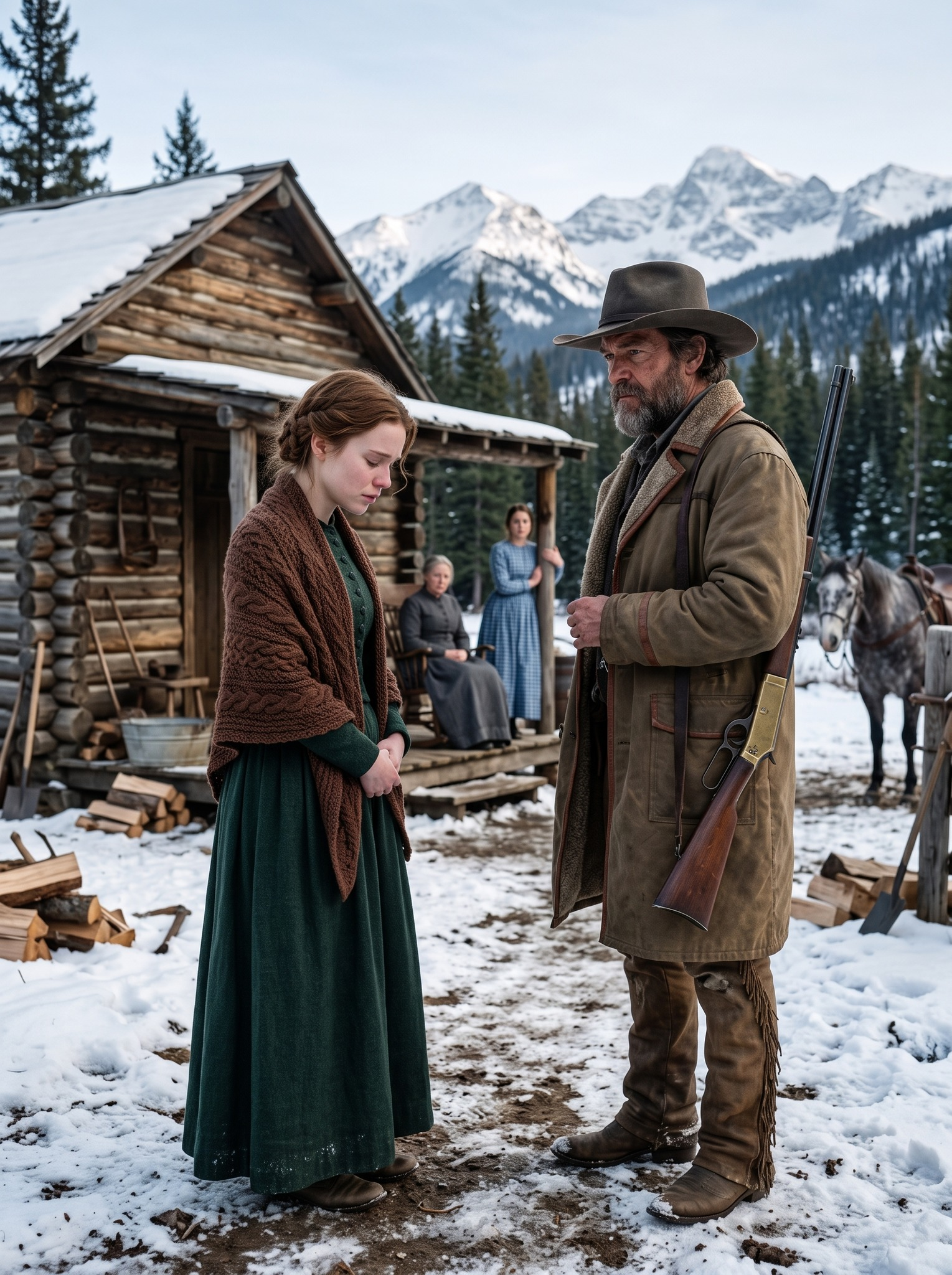
The rider didn't dismount.
He sat on his horse in the middle of the clearing, one gloved hand resting on the reins and the other holding an envelope that had no business being in his possession.
My father's name was written across it.
I knew that handwriting.
I had spent three years trying not to forget it.
"Croft!" the stranger called again. "You planning to keep me standing out here all afternoon?"
Hollis remained on the porch.
His rifle was pointed toward the ground, but his right hand rested firmly around its wooden stock.
"You're a long way from the valley, Mercer."
The rider laughed.
"Not as far as you think."
I stood behind the window, trying to hear every word.
The stranger was perhaps fifty years old, with a narrow face, a pointed nose, and a neatly trimmed mustache. His dark coat looked expensive, much too expensive for someone traveling through the mountain snow.
He carried himself like a man who expected doors to open before he reached them.
His eyes moved from Hollis to the cabin.
Then they stopped at the window.
At me.
He smiled.
It was not a friendly smile.
"Well," he said, "there she is."
My stomach tightened.
Hollis stepped slightly to his left, blocking the rider's view of the window.
"Say what you came to say."
Mercer lifted the envelope.
"I have something that belongs to the girl."
"Then leave it."
"Not so fast."
The stranger looked around the clearing.
His gaze passed over the woodpile, the wagon, the old plow, and the small stable.
Then he returned his attention to Hollis.
"Three years, Croft. Three years you've kept quiet about that little piece of property."
Hollis said nothing.
Mercer shook the envelope.
"People are beginning to wonder whether the old Whitmore claim actually exists."
I stepped away from the window.
The Whitmore claim.
My father's land.
The land Hollis had told me was supposed to be mine.
I wanted to run outside and demand the envelope.
But something about the stranger frightened me more than his appearance.
It was the way he spoke.
He didn't sound like a man delivering a message.
He sounded like someone collecting a debt.
"Who are you?" I called through the window.
Both men looked toward the cabin.
Mercer smiled again.
"Your father's old friend, sweetheart."
Hollis's expression hardened.
"Don't call her that."
The stranger raised his eyebrows.
"Protective, aren't we?"
"Leave."
"After I deliver the message?"
"You can deliver it from there."
Mercer considered him for a moment.
Then he reached inside his coat and removed another piece of paper.
"This concerns the land your father left behind. There's a problem with the original deed."
My heart began beating faster.
"What problem?"
Mercer ignored me.
Instead, he looked directly at Hollis.
"Your old friend signed something before he died. Something that changes everything."
Hollis didn't move.
"You're lying."
"Am I?"
Mercer opened the envelope.
I could see the edge of an official document.
"Perhaps you should let the girl read it."
Hollis raised the rifle slightly.
"Put it away."
For the first time, the stranger's smile disappeared.
He looked at the weapon.
Then he looked at Hollis's injured leg.
"You're not in much condition to threaten anyone, Croft."
The words struck harder than I expected.
Hollis's face remained still.
But his fingers tightened around the rifle.
I opened the cabin door.
"Let me see the paper."
Hollis turned sharply.
"Sarah. Inside."
"No."
His eyes met mine.
I had never spoken to him that way before.
For a moment, neither of us moved.
Then Mercer laughed.
"Well, she's got some spirit. John would have liked that."
He pulled a folded sheet from the envelope.
"Come closer, girl. I don't bite."
I stepped onto the porch.
The cold immediately touched my face.
Hollis moved between us again.
"Hand it over."
Mercer looked almost disappointed.
"Very well."
He tossed the paper.
It landed in the snow between the porch and his horse.
Hollis didn't move.
I looked down.
The paper had landed face upward.
There was a signature at the bottom.
JOHN WHITMORE.
My father's name.
I bent to pick it up.
"Sarah, don't."
I ignored him.
The paper was old, but the ink remained visible.
At the top was a date.
October 14, 1878.
The same year my father had written in the note.
Below it were several paragraphs describing a property agreement between John Whitmore and Hollis Croft.
I recognized the names.
I recognized the language.
But I didn't understand the final sentence.
It stated that the property would remain under joint protection until Sarah Whitmore reached the age of nineteen.
My hands went cold.
I read the sentence again.
Until Sarah Whitmore reached the age of nineteen.
I looked up.
"I turned nineteen three months ago."
Mercer nodded.
"Exactly."
"Why does that matter?"
"Because the agreement has expired."
Hollis stepped down from the porch.
"That's not what it says."
Mercer smiled.
"Perhaps you should read the whole document."
He turned his horse slightly.
"I'll be back in seven days. By then, I expect the original deed to be ready."
"And if it isn't?"
The stranger looked at me.
"Then someone else will take possession of the property."
He touched the brim of his hat.
"Enjoy your new home, Miss Whitmore."
Then he rode away.
I watched him disappear between the trees.
Only when the sound of his horse faded did I realize how tightly I had been holding the document.
My fingers hurt.
Hollis took the rifle inside.
I followed him.
He placed it against the wall and began removing his gloves.
"Who was that man?"
"Silas Mercer."
"What does he want?"
"Your father's land."
"Why?"
"Because he believes it contains something valuable."
I looked at the document.
"What is it?"
Hollis didn't answer.
I stepped closer.
"Why does everyone know something about my father except me?"
He lowered his head slightly.
"Because your father made me promise not to tell you until you were old enough to understand."
"Understand what?"
He walked toward the stove.
"That the land wasn't the only thing he left you."
I felt my patience breaking.
"Then tell me."
Hollis added another piece of wood to the fire.
He remained silent for so long that I thought he intended to ignore me.
Finally, he spoke.
"Your father and I discovered a vein of silver on the northern side of the ridge."
I stared at him.
"Silver?"
"More than one vein. There was also copper."
I looked down at the document.
The mountain land.
The old claim.
The papers.
Suddenly, everything made a little more sense.
"That's why Mercer wants it."
"That's part of the reason."
"How much is it worth?"
"Enough to make men forget their manners."
I sat down.
My mind was racing.
Ruth had sold me for three sacks of flour.
She had given away my future without knowing that the land my father had left me might be worth more than everything she owned.
The thought made me feel sick.
Not because I wanted the money.
Because I remembered every winter morning I had spent washing clothes in freezing water.
Every time Ruth told me we couldn't afford new shoes.
Every time I had asked for something small and been reminded that my father had left nothing.
And now I was learning that she might have lied about all of it.
"Did Ruth know about the silver?"
"No."
"Are you certain?"
"Your father was careful."
I looked at him.
"Then why did Mercer have that document?"
"Because he was involved in the original survey."
"Was he your friend?"
Hollis gave a humorless laugh.
"No."
The answer came too quickly.
I waited.
He finally sat opposite me.
"Mercer worked for a company that wanted to purchase the northern ridge. Your father refused to sell."
"Why?"
"He believed the company intended to force local families off their land."
I thought of the families in the valley.
The farmers.
The old men who lived near the river.
The women who traded eggs for flour.
"Did they try to take it?"
"Not at first."
"What changed?"
Hollis looked toward the window.
"Your father found something."
"What?"
He didn't answer.
Instead, he stood and walked toward the back of the cabin.
I followed him.
He stopped beside a narrow wooden door I hadn't noticed before.
It was hidden behind a tall cupboard.
A heavy iron lock secured it.
Hollis took a key from a chain beneath his shirt.
I stared.
"What's in there?"
"Things your father left."
I looked at the lock.
"Why is it hidden?"
"Because I don't trust anyone who knows about it."
He inserted the key.
The lock turned with a heavy click.
The door opened.
A cold smell of old wood, metal, and dust drifted out.
Inside was a small storage room.
Shelves lined the walls.
There were several wooden boxes, a leather saddle, rolled maps, old mining tools, and a large metal trunk.
I stepped inside.
My eyes immediately went to a photograph sitting on the shelf.
It showed my father standing beside a younger Hollis.
Both men were smiling.
I had never seen Hollis smile before.
In the photograph, he looked almost unrecognizable.
His beard was shorter, his face fuller, and both legs appeared perfectly healthy.
I picked up the photograph.
"Is this from before your accident?"
He nodded.
"Three years before."
I studied the image.
Father stood with one hand resting on Hollis's shoulder.
They looked like brothers.
I had never known my father had a friendship like that.
"Why didn't you come to his funeral?"
Hollis looked away.
"I couldn't."
"Why?"
He didn't answer.
I placed the photograph back.
Then I noticed something else.
A small wooden horse.
It was carved from dark walnut, with a tiny white mark along its neck.
I knew that mark.
My father had made it for me when I was six.
I remembered sitting on his knee while he carved the legs.
I remembered how he had told me that a horse should always have four strong legs, even if the world tried to knock one of them down.
I picked it up carefully.
"How did this get here?"
"Your father gave it to me."
"Why?"
"He said you would recognize it."
I turned it over.
There were letters carved into the underside.
S.W.
My initials.
Beneath them was a small number.
1878.
I looked at Hollis.
"What does this mean?"
He seemed surprised.
"I don't know."
"You're telling me my father left you something with my initials, and you don't know what it means?"
"I never examined it."
I turned the horse again.
There was a tiny seam along its belly.
I pressed gently.
Nothing happened.
Then I noticed a small metal pin beneath the left front leg.
I pushed it.
A tiny compartment opened.
Inside was a folded strip of paper.
My breath caught.
I removed it.
The paper was yellowed and extremely thin.
There were only a few lines written on it.
Sarah,
If you are reading this, the mountain has finally brought you where you need to be.
Trust the man who walks with a broken leg, but do not trust the man who arrives with a clean coat.
The truth is buried where the old pine fell.
Your father.
I read the words twice.
Then I looked at Hollis.
He was staring at the note.
For the first time since I had met him, he looked genuinely shaken.
"Where the old pine fell," I whispered.
His jaw tightened.
"Your father shouldn't have written that."
"Why?"
Hollis took the paper from me.
He read it once.
Then he folded it carefully and returned it to my hand.
"Because that place was supposed to stay buried."
I stepped backward.
"What happened there?"
He closed the storage-room door.
"Not everything your father discovered was valuable."
I followed him into the main room.
"Then what was it?"
Hollis looked toward the fire.
"Evidence."
"Evidence of what?"
He didn't answer.
Instead, he removed his coat and hung it beside the door.
I was beginning to understand something about him.
He had a habit of stopping conversations just before they reached the truth.
It was infuriating.
But I was no longer willing to accept silence as an answer.
I placed the little wooden horse on the table.
"I want to see where the pine fell."
Hollis turned.
"No."
"Why?"
"Because the ground is unstable."
"I can walk carefully."
"It's not the ground I'm worried about."
I stared at him.
"Then what are you worried about?"
He looked directly at me.
"Someone has been watching that place."
A chill passed through me.
"Who?"
"I don't know."
"Mercer?"
"Possibly."
"Then we should find out what my father left there before he does."
Hollis studied my face.
For a long moment, I thought he would refuse.
Then he looked down at his injured leg.
"Tomorrow, if the weather holds."
I nodded.
That evening, he prepared supper while I sat at the table reading through the documents.
The papers contained names, dates, measurements, and references to mining rights.
Some were signed by my father.
Others carried Hollis's signature.
One document mentioned a third man.
Elias Bell.
I had never heard the name.
I asked Hollis about him.
He stopped cutting the bread.
"Where did you see that?"
I pointed to the paper.
He came over and examined it.
"Bell was the surveyor."
"Was he part of the company?"
"No. He worked for your father."
"Where is he now?"
Hollis's expression changed.
"Dead."
"When?"
"Winter of 1878."
I looked at the date.
The same year my father had written in his letter.
"How did he die?"
"His cabin burned."
I remembered what Hollis had said about evidence.
I looked at him.
"Was it an accident?"
He didn't answer.
I leaned forward.
"Was it?"
Hollis placed the paper on the table.
"Your father believed it wasn't."
The room went quiet.
Outside, the horses moved inside the stable.
A branch scraped against the roof.
I looked again at the documents.
Three names.
John Whitmore.
Hollis Croft.
Elias Bell.
One dead surveyor.
One dead father.
And a stranger who had just ridden up the mountain demanding land that had supposedly been mine since childhood.
I suddenly felt very small.
Not because I was afraid of the mountain.
Because I was beginning to understand how much had happened without my knowledge.
Hollis noticed my expression.
"Sarah."
I looked up.
"You don't have to involve yourself in this."
I almost laughed.
"Someone sold me to you this morning, a stranger arrived with my father's papers, and now you're telling me there may be something buried on this mountain connected to his death."
I held his gaze.
"I think I've been involved for a long time."
For the first time, he didn't argue.
He simply nodded.
Later that night, I couldn't sleep.
I kept thinking about the note inside the wooden horse.
Trust the man who walks with a broken leg.
It sounded like something my father would write.
He had always believed that a person's character was revealed by what they did when life became difficult.
I wondered whether he had been speaking about Hollis.
I wondered whether the note had been intended to protect me.
And I wondered what exactly had happened in 1878.
Around midnight, I heard a noise outside.
A sharp metallic sound.
Then silence.
I sat up.
The cabin was dark except for the faint orange glow coming from the stove.
I slipped out of bed and pulled my shawl around my shoulders.
The main room was empty.
Hollis's bedroom door was closed.
I approached the window.
At first, I saw nothing.
Then I noticed a small light near the woodpile.
Someone was standing there.
A dark figure.
I stepped closer.
The figure moved.
It disappeared behind the stable.
I turned toward Hollis's room.
"Hollis?"
No answer.
I knocked.
"Hollis, wake up."
The door opened almost immediately.
He was already dressed.
His rifle was in his hand.
"What did you see?"
"Someone outside."
He moved past me.
"Stay here."
I followed him to the porch.
The night air was bitter.
Snow covered the ground, but there were fresh marks near the woodpile.
Boot prints.
Not ours.
Hollis crouched carefully.
He examined the tracks.
Then he looked toward the stable.
"Go inside."
I swallowed.
"What is it?"
He didn't answer.
Instead, he moved toward the stable.
I stood in the doorway, watching him.
A moment later, I heard a horse snort.
Then a low voice.
Hollis raised his rifle.
"Come out."
Silence.
He took another step.
Then a man emerged from behind the stable.
He was young, perhaps thirty, with a torn coat and a bloodied sleeve.
He held both hands in the air.
"Don't shoot."
Hollis stared at him.
I watched the man's face.
Something about him looked familiar, although I couldn't understand why.
He looked directly at me.
Then his expression changed.
"You're John Whitmore's daughter."
I stepped forward.
"Who are you?"
The stranger swallowed.
"My name is Thomas Bell."
Hollis's rifle rose slightly.
The man's eyes moved between us.
Then he spoke the words that made my blood turn cold.
"My father was Elias Bell. And I know who killed yours."
He reached inside his coat.
Hollis shouted.
"Don't!"
But Thomas had already pulled out a folded photograph.
He held it toward me.
There were three men standing beside a burning cabin.
My father was one of them.
Hollis was another.
And the third man was the stranger who had ridden to our cabin that afternoon.
Silas Mercer.
But it wasn't Mercer's face that made my hands begin to shake.
It was the fourth figure in the background.
A woman standing beside the doorway.
A woman wearing Ruth's plum-colored dress.
And beneath the photograph, in my father's handwriting, were five words:
SHE KNEW BEFORE I DIED.






Comments 0