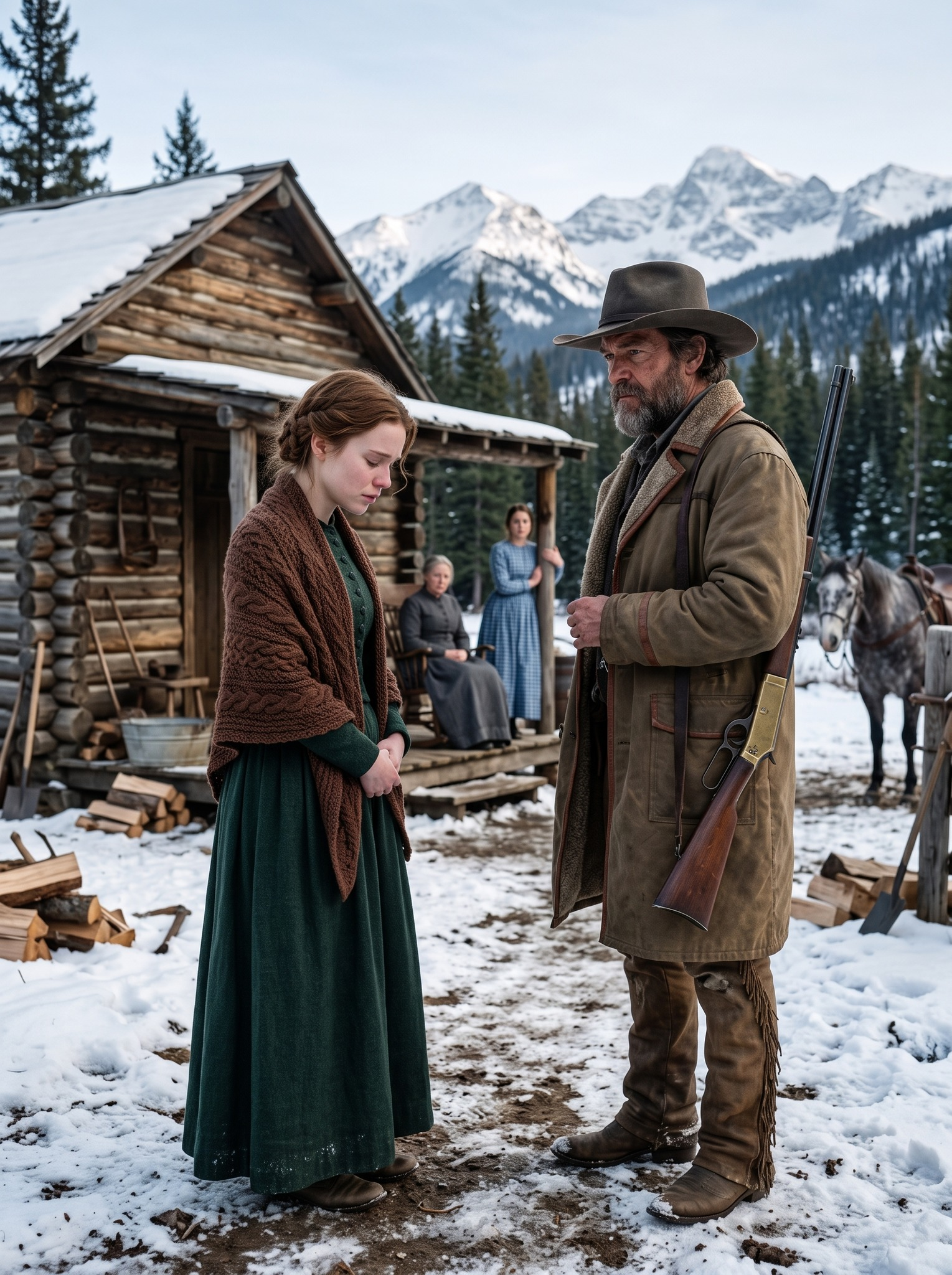
I grabbed the canvas bag before Ruth could change her mind.
"You're going with him, Sarah. Don't make this harder than it needs to be."
Hollis Croft stepped down from his wagon, his injured leg dragging behind him.
A rusted plow lay beside three sacks of flour.
And suddenly, I understood that my family had already forgotten I was their daughter.
My name was Sarah Whitmore. I was nineteen years old, and that morning, my stepmother had decided I was worth exactly three sacks of flour, an old plow, and the promise that her own daughter would never have to endure a mountain winter.
I had imagined leaving home many times.
I had imagined marrying someone kind, finding work in a town where nobody knew my family, perhaps saving enough money to buy a little house with a garden.
I had never imagined being exchanged like a piece of livestock.
Ruth stood beside the wagon, brushing flour dust from her palms. She was a woman who had learned to make practical decisions without allowing inconvenient feelings to interfere. Her silver-blond hair was pulled into a tight bun, and her plum-colored dress was buttoned all the way to her throat.
She had dressed carefully that morning.
Apparently, selling her husband's daughter required looking respectable.
"Those sacks are good quality," she told Hollis. "The miller promised they'd last through the winter."
Hollis didn't answer.
He was a large man with a thick reddish-brown beard, pale gray eyes, and a dark hat pulled low over his forehead. His navy wool coat was worn at the elbows, and a heavy fur collar surrounded his neck.
He looked older than the forty-six years I later learned he had lived.
Not because he was weak.
Because something had happened to him, something that had left its mark on every part of his body.
His right leg barely bent.
When he moved, his boot struck the ground before the rest of his body followed.
Thump-drag.
Thump-drag.
I had heard stories about him since childhood.
People in the valley called him the crippled mountain man. Some said he was dangerous. Others claimed he had once been a successful trapper before a falling pine crushed his leg.
Nobody seemed to know why he preferred living alone.
Nobody seemed interested in finding out.
I looked at him now, wondering what kind of man traveled six hours down a mountain road to purchase a young woman from her own family.
He glanced at my canvas bag.
"Everything?"
"Everything I own," I replied.
My voice sounded unfamiliar.
Hollis studied me for a moment.
Then he looked toward Ruth.
"Where's the plow?"
Ruth pointed.
"Right there. Just as we agreed."
He walked toward it.
His injured leg dragged through the muddy ground while his strong arms reached beneath the rusted metal frame.
I watched him lift it.
He made no complaint.
He simply loaded the plow onto the wagon and secured it with a length of rope.
Behind me, a curtain moved.
I didn't need to turn around to know who was watching.
Emiline.
My stepsister was twenty-three and had spent most of her life receiving the things I was expected to do without.
When Father was alive, he sometimes defended me.
He wasn't perfect, but he never allowed Ruth to forget that I was his daughter.
After he died, everything changed.
Ruth began calling the house hers.
My father's tools became hers.
His savings disappeared into expenses I was never allowed to question.
And eventually, the little room that had once belonged to me became a storage room for Emiline's dresses.
Now even my future belonged to someone else.
"Sarah."
Ruth's voice pulled me back.
I looked at her.
She was still studying the flour sacks.
"It's for the best," she said.
"Whose best?"
She finally looked at me.
For one brief moment, I thought I saw something resembling discomfort in her expression.
Then it disappeared.
"Emiline has been coughing. The doctor said the mountain air would be dangerous for her."
I almost laughed.
Emiline had been coughing every winter since she was old enough to discover that illness could excuse her from washing dishes.
But I said nothing.
Ruth lowered her voice.
"You should be grateful. Hollis is a respected man in these parts."
"Then why does nobody visit him?"
Her expression hardened.
"Don't start."
I looked toward the wagon.
Hollis had finished tying down the plow.
He was waiting.
Not impatiently.
Not kindly.
Simply waiting.
I turned back to Ruth.
"Did you even ask me?"
She tightened her lips.
"There wasn't time for foolishness."
That was when I understood.
She hadn't made a mistake.
She hadn't been forced.
She had considered the options, weighed the flour against my existence, and decided the flour was more valuable.
I picked up my bag.
It contained two dresses, one spare blouse, a pair of worn boots, a small comb, and my father's bone-handled skinning knife.
I had wrapped the knife in an old piece of cloth.
It was the only thing I owned that had belonged to him.
Ruth watched me walk toward the wagon.
"Sarah."
I stopped.
She hesitated.
For a moment, I wondered whether she might apologize.
Instead, she said, "Don't embarrass us up there."
I climbed onto the wooden bench.
Hollis moved to the other side and took the reins.
He didn't offer me his hand.
He didn't ask whether I was ready.
He simply clicked his tongue.
The horses began walking.
I looked back once.
Ruth was standing beside the flour.
Emiline's pale face remained behind the curtains.
Nobody waved.
Nobody called my name.
The cabin disappeared behind a bend in the road.
I faced forward.
The first hour passed without conversation.
The road climbed steadily, leaving the valley behind. Mud gave way to frozen earth, and the trees gradually became taller and darker.
Hollis controlled the horses with small movements of his hands.
He seemed to know every turn, every loose stone, every place where the wheels might sink.
I tried not to stare at his leg.
But the uneven rhythm made it difficult.
Thump-drag.
Thump-drag.
After a while, my fingers became numb.
I pulled my thin shawl closer around my shoulders.
Hollis noticed.
Without looking at me, he reached behind the seat and retrieved a bundled wool blanket.
He dropped it into my lap.
"Use it."
I looked down.
The blanket smelled of woodsmoke, leather, and horses.
"Thank you."
He gave no answer.
I wrapped it around myself.
Another hour passed.
Then another.
Eventually, I asked the question that had been sitting in my throat since morning.
"Why did you want a wife?"
His hands tightened slightly around the reins.
"I didn't say I wanted one."
I turned toward him.
"But you paid for me."
"I made an arrangement with Ruth."
"That isn't an answer."
He looked at me briefly.
His pale eyes were difficult to read.
"No," he said. "It isn't."
Then he faced the road again.
I decided I would not ask him anything else.
By late afternoon, the mountains had swallowed the sunlight.
A cabin appeared beyond a bend, built against the mountainside beneath a line of towering pines.
Smoke rose from its chimney.
There were no neighboring houses.
No fences.
No familiar roads.
Just trees, snow, and a narrow path leading toward the cabin.
Hollis brought the horses to a stop.
I climbed down carefully, my legs stiff from sitting.
He descended more slowly, bracing himself against the wagon.
For the first time, I noticed how much effort each movement required.
He took the rusted plow from the wagon and carried it toward the cabin.
I followed with my bag.
The wooden door was heavy.
Hollis opened it and stepped aside.
"Inside."
I hesitated.
He noticed.
"There's a fire."
I crossed the threshold.
Warm air touched my face.
A small iron stove stood near the wall. A wooden table occupied the center of the room, and several shelves held jars, folded cloth, and cooking utensils.
There was a narrow bed near the back.
Another door stood beside the fireplace.
The cabin was modest, but it was clean.
Hollis placed the plow outside and returned.
He removed his hat.
"Your room is through there."
I stared at him.
"My room?"
He pointed toward the second door.
I opened it.
There was a small bedroom with a wooden bed, a quilt, a washbasin, and a window overlooking the dark pine forest.
I stood there without moving.
I had expected a locked door.
Perhaps a narrow corner beside the stove.
Instead, there was a room.
A room that appeared to have been prepared before I arrived.
I turned around.
"How long have you known I was coming?"
Hollis stood in the doorway.
"Long enough."
He walked away before I could ask what that meant.
I placed my bag beside the bed.
Then I noticed something on the small table.
A folded piece of paper.
My father's name was written across it.
JOHN WHITMORE.
I stopped breathing.
My father had been dead for almost three years.
And I knew his handwriting.






Comments 0