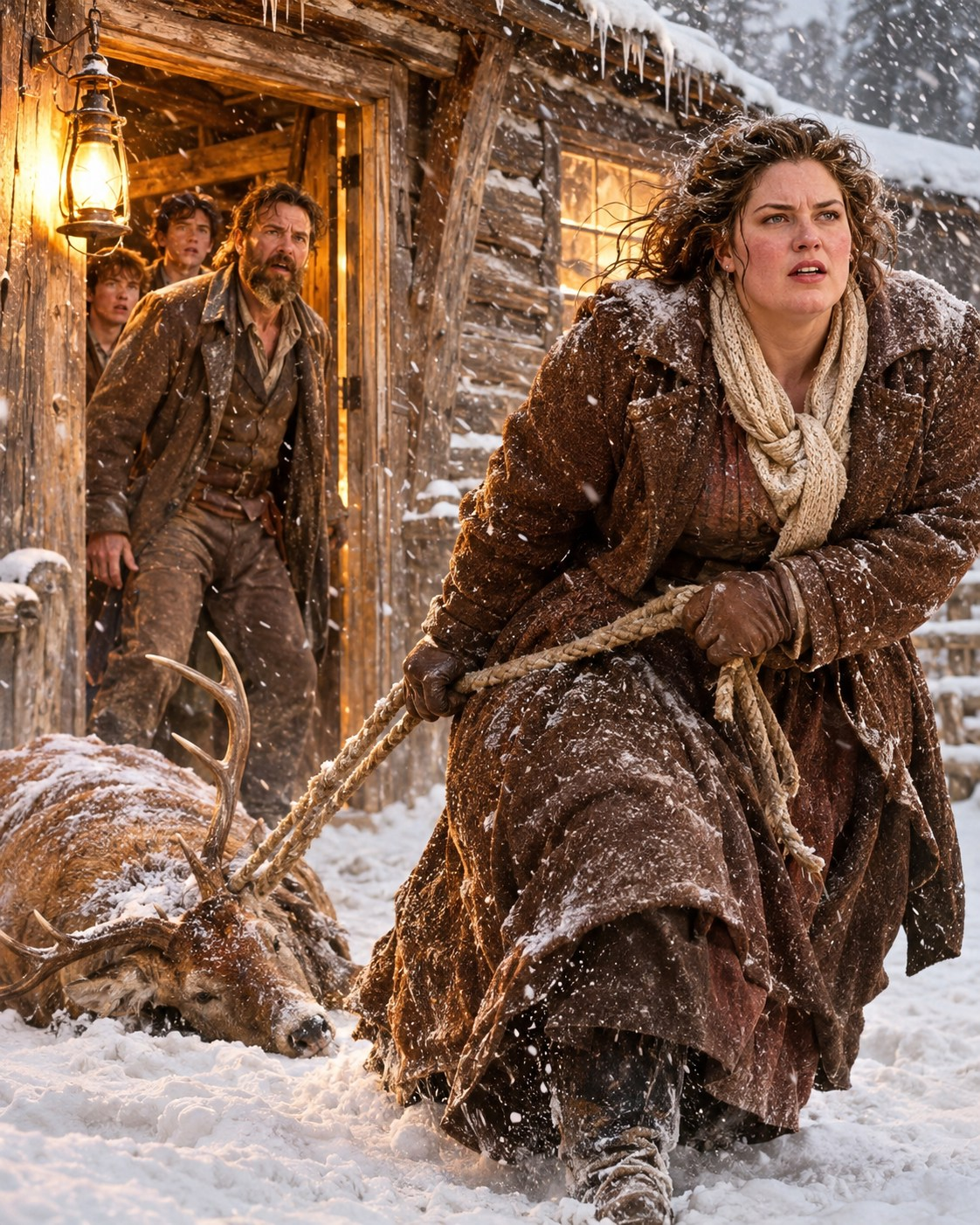
A teenage cowboy grabbed Abigail's sleeve as she entered the frozen ranch house.
"Please, ma'am. Don't leave us here!"
Behind him, Caleb Thornton struggled to lift a wooden cup from the floor.
Abigail noticed something carved into the empty pantry door.
Twenty names.
And every single one had a line scratched through it.
She suddenly understood how close these men had come to giving up.
My name is Abigail Prescott, and I was thirty-eight years old when I discovered that a person could travel nearly a thousand miles to begin a new life and still arrive somewhere that seemed determined to bury her.
I had left Chicago with two heavy suitcases, a sack of cast-iron skillets, and enough money to survive several weeks if my new employment failed.
I had also brought something else.
A lifetime of being told that I was too large, too broad, too stubborn, and too difficult for anyone to love.
In Chicago, women like me were expected to apologize for occupying space.
I had grown accustomed to hearing whispers whenever I entered a respectable dining room.
Some women examined my hips before looking at my face. Others pretended not to notice me while making certain their friends heard their remarks.
One gentleman had once told his companion that I would make an excellent cook but a terrible wife.
I had heard him.
I had also remembered his face.
But I had never allowed those opinions to determine what I could accomplish.
I wasn't traveling west to find a husband.
I was traveling west because I wanted a business of my own.
The advertisement had appeared in a newspaper several weeks earlier.
WHISPERING PINES RANCH.
HEAD COOK REQUIRED.
EXCELLENT WAGES.
POSSIBILITY OF BUSINESS PARTNERSHIP AFTER SUCCESSFUL CATTLE DRIVE.
The owner, Caleb Thornton, had personally signed the advertisement.
His offer was unusually generous. A successful cattle drive would bring substantial money, and he promised to give the cook a share of the business if the arrangement worked.
I had written to him immediately.
His reply arrived ten days later.
He needed someone dependable. Someone who could manage a kitchen for twenty or more working cowboys.
I had spent most of my adult life preparing meals for large households.
Twenty hungry men didn't frighten me.
At least, they hadn't frightened me when I accepted the position.
The journey to Dakota Territory was exhausting.
By the time I reached the nearest settlement, my shoulders ached from carrying my belongings, and the cold had begun creeping through my traveling clothes.
I hired a wagon driver to take me as far as he could.
But the weather worsened.
The driver refused to continue beyond a certain point.
He told me the ranch was approximately two miles farther north.
I could wait for the weather to improve, he explained, but he couldn't promise when that would happen.
I looked toward the darkening sky.
Then I looked at my luggage.
Waiting would cost money I couldn't afford to waste.
So I paid him, secured my belongings as best I could, and continued on foot.
The snow reached my knees in several places.
My heavy boots sank with every step.
I had to stop frequently to catch my breath.
More than once, I wondered whether accepting the position had been a terrible mistake.
But I kept walking.
When I finally saw the ranch, I almost failed to recognize it.
The chimneys were smokeless.
The corrals stood empty.
A broken barn door swung back and forth in the wind.
There were no horses in sight.
No men working outside.
No smoke rising from the kitchen.
The entire property looked abandoned.
I tightened my scarf and approached the main house.
The front door wasn't completely closed.
I knocked.
Nobody answered.
I knocked again.
A weak voice came from somewhere inside.
"Come in."
I pushed the door open.
The smell hit me first.
Cold ashes.
Damp wool.
Unwashed clothing.
And the unmistakable odor of a place where too many people had been living without proper food or water.
I stepped inside.
For several seconds, I couldn't move.
Men were lying everywhere.
Some occupied the old wooden chairs.
Others lay beneath filthy blankets on the floor.
A few had gathered near the fireplace, although the fire had almost completely died.
There were twenty of them.
Twenty cowboys.
Twenty grown men who looked as though they hadn't eaten a proper meal in months.
Their cheeks were hollow.
Their eyes were sunken.
Their clothing hung loosely from bodies that had once been strong.
One man was coughing beneath a blanket.
Another stared at the ceiling without moving.
Near the fireplace, a young cowboy tried to sit up.
His arms trembled so badly that he fell backward.
I lowered my suitcases.
A bearded man near the center of the room slowly raised his head.
He appeared to be in his early fifties.
His face was gaunt, his beard untrimmed, and his eyes carried the exhausted expression of someone who had spent too many nights expecting disaster.
"Who are you?"
I straightened my coat.
"Abigail Prescott. I'm here about the cooking position."
For a moment, he simply stared.
Then he laughed.
It was a bitter, humorless sound.
"Caleb Thornton," he said. "The owner of this place."
I nodded.
"Mr. Thornton."
He attempted to stand.
His legs immediately buckled.
He caught the edge of a chair before falling.
"You're too late, ma'am."
I looked around the room.
"What do you mean?"
He gestured weakly toward the starving men.
"There's no food left. We're waiting to die."
The words settled over the room.
Nobody contradicted him.
Nobody even seemed surprised.
A young cowboy beneath a gray blanket closed his eyes.
I had expected a difficult kitchen.
Perhaps an unorganized ranch.
Perhaps an owner who had underestimated the work involved in feeding twenty men.
I had not expected to walk into a room full of people who believed their lives were already over.
I looked at Caleb.
"What happened?"
He lowered himself into the chair.
For several moments, he didn't answer.
Then he began explaining.
His voice was weak, but his words were clear enough.
Three weeks earlier, the ranch had still been functioning.
The men had been preparing for the winter cattle drive.
The supply wagons were expected to arrive with flour, beans, dried meat, salt, coffee, and other provisions.
But the wagons never came.
At first, Caleb believed the delay was caused by the weather.
Then he received word that several suppliers had canceled their deliveries.
Others stopped answering his letters.
Before he could investigate, an early blizzard swept across the territory.
The men became trapped.
They rationed what little food remained.
Days passed.
Then more days.
When their provisions were nearly exhausted, Caleb discovered that the ranch's winter stores had also been destroyed in a fire.
The barn and storage area had suffered serious damage.
Their remaining supplies were scattered, spoiled, or inaccessible.
Caleb believed the fire had been deliberate.
He suspected Josiah Caldwell.
Caldwell was a wealthy landowner whose property bordered the ranch.
For years, he had wanted control of the valuable water rights belonging to Whispering Pines.
Caleb believed Caldwell had bribed their suppliers and arranged for the winter provisions to be burned.
Without food, without reliable suppliers, and with the blizzard blocking the roads, the ranch had become a prison.
Three weeks had passed.
The men were now too weak to travel.
I listened without interrupting.
When Caleb finished, I looked toward the fireplace.
The remaining embers barely produced any heat.
"Where is your kitchen?"
He stared at me.
I repeated the question.
"Where is the kitchen, Mr. Thornton?"
"Didn't you hear me? There's nothing to cook."
"I heard you perfectly."
I picked up one of my smaller bags.
"I asked where the kitchen was."
A teenage cowboy lying near the wall slowly raised his hand.
He looked no older than seventeen.
His sandy-blond hair was tangled, and his face was pale beneath several days of dirt.
"Down the rear hallway," he whispered.
I turned toward him.
"Thank you."
The boy gave me a faint nod.
Caleb watched as I walked away.
"Miss Prescott."
I stopped.
"Yes?"
"There's no point."
I looked back at him.
"That's for me to decide."
Then I continued down the hallway.
The kitchen was colder than the main room.
A layer of frost covered part of the window.
Several pots sat abandoned on the counter.
The stove was cold.
The shelves were empty.
I opened the pantry.
Nothing.
I checked the lower cupboards.
A few broken containers.
An empty flour sack.
A jar with a spoonful of something hardened at the bottom.
I examined the shelves again.
There was no flour.
No beans.
No dried meat.
Not even a little coffee.
I stood silently for a moment.
Then I noticed a wooden hatch near the back wall.
The root cellar.
I lifted it.
A wave of cold air rose from below.
I found an old lantern, lit it, and descended the narrow steps.
The cellar was in terrible condition.
Several shelves had collapsed.
Dirt and broken boards covered part of the floor.
But beneath an overturned wooden crate, I discovered a sack.
I dragged it into the lantern light.
Potatoes.
Shriveled, dirty, and beginning to soften, but still usable.
I searched farther.
Behind a broken storage box, I found a dirty block of salted pork fat.
I examined it carefully.
It wasn't fresh.
But the interior remained usable if properly trimmed and heated.
I looked at the potatoes.
Then at the pork fat.
It wasn't enough for twenty hungry men.
Not even close.
But it was something.
And something was better than nothing.
I carried the sack upstairs.
When I returned to the kitchen, I noticed that my hands were shaking.
The cold had reached my fingers.
My legs ached.
I had walked two miles through deep snow after a long journey.
I hadn't eaten a proper meal since the previous day.
For a moment, I considered sitting down.
Just for a minute.
Then I remembered the faces in the other room.
Twenty men.
Twenty people who were depending on a stove that had gone cold.
I put the potatoes on the counter.
Then I examined the stove.
The chimney appeared clear, but the firebox was nearly filled with ash.
I found a small pile of dry wood beneath a workbench.
Not much.
Enough to begin.
I cleaned the stove, arranged the wood, and struck a match.
The first attempt failed.
The second produced only a thin thread of smoke.
On the third attempt, a small flame caught.
I fed it carefully.
A few minutes later, the stove began producing heat.
I placed my largest cast-iron skillet on top.
Then I trimmed the pork fat and cut it into smaller pieces.
The first pieces began to render.
A faint smell drifted through the kitchen.
It wasn't the smell of a feast.
It wasn't even the smell of a proper dinner.
But it was the smell of food.
And after three weeks of hunger, that smell was enough to make the impossible feel possible.
I washed the potatoes as carefully as I could.
Then I cut them into small pieces.
I had barely begun preparing them when I heard footsteps behind me.
The teenage cowboy stood in the doorway.
He held the frame with one hand.
"Ma'am?"
I turned.
"What's your name?"
"Wyatt."
"Well, Wyatt, you should be resting."
He looked at the skillet.
His eyes followed the thin stream of steam rising from it.
"Is that food?"
"Yes."
He swallowed.
"Real food?"
I looked at him.
"As real as I can make it."
He remained in the doorway.
I could see how badly he wanted to come closer.
"Go tell Mr. Thornton that the kitchen is working again."
Wyatt blinked.
Then he turned and hurried down the hallway.
I heard his weak voice calling Caleb's name.
A few moments later, the ranch owner appeared.
He leaned against the doorway.
His eyes moved from the stove to the potatoes.
Then to the skillet.
"What are you doing?"
"Preparing what we have."
He looked at the small amount of food.
"That's not enough."
"No."
He seemed surprised by my answer.
I continued cutting the potatoes.
"It's not enough to sustain twenty men."
"Then what are you going to do?"
I put down the knife.
For the first time since entering the ranch, I looked directly into Caleb's eyes.
"First, we're going to get something into their stomachs. Then we're going to find more food."
He shook his head.
"There's nothing out there."
"Did anyone hunt before the storm?"
The question seemed to catch him off guard.
He stared at me for several seconds.
Then Wyatt, who had returned to the hallway, slowly raised his trembling hand.
"I did."
I turned toward him.
"What did you hunt?"
"A deer."
Caleb looked at the boy.
"Wyatt..."
"I shot it four days ago," Wyatt continued. "It ran toward the ravine. I couldn't bring it back."
My attention sharpened.
"Where exactly?"
Wyatt described the location beyond the northern treeline.
He explained that the deer had disappeared into a ravine buried beneath several feet of snow.
Caleb immediately shook his head.
"Forget it."
I looked at him.
"What?"
"Nobody goes there."
"Why?"
"That ravine is dangerous even in good weather. The snow is deep, the ground is uneven, and wolves move through that area."
He struggled to straighten.
"Besides, the carcass has probably been found by now."
I glanced toward the window.
The blizzard was still growing stronger.
The light outside was fading.
I understood the danger.
I also understood that twenty men couldn't survive indefinitely on a few potatoes and a little rendered fat.
I walked toward my luggage.
Caleb watched me.
"What are you doing?"
I opened one of the suitcases.
Inside were my spare clothes, personal belongings, and several practical items I had packed for the journey.
I removed a coil of rope.
Then I found my hunting knife.
I took the lantern from the kitchen shelf.
Caleb's expression changed.
"Miss Prescott."
I tightened my wool coat.
"Keep the stove burning."
"You're not going out there."
I picked up the rope.
"Someone has to."
He tried to move toward me, but his weakened legs failed.
Wyatt stepped forward.
"Ma'am, please don't."
I looked at the boy.
For the first time, I noticed how young he really was.
Seventeen.
He should have been thinking about horses, cattle, and the future.
Instead, he was waiting to see whether he would live long enough to reach another spring.
I looked around the room.
Then I remembered something.
For years, people had treated my body as if it were an obstacle.
They had judged my strength by the shape of my figure.
They had mistaken my quietness for weakness.
Now, standing in that freezing kitchen, I understood something I had never fully appreciated before.
The very body they had mocked had carried me through two miles of snow.
It had carried my luggage.
It had brought me to this ranch.
And it was going to carry me farther if necessary.
I secured the rope over my shoulder.
Then I picked up the lantern.
Caleb's voice broke behind me.
"Miss Prescott, please. You'll die out there!"
I paused at the kitchen doorway.
I looked at the twenty men scattered through the adjoining room.
Some were watching me.
Others were too weak to lift their heads.
I spoke quietly.
"Nobody is dying in this house tonight if I can help it."
Then I stepped toward the front door.
The wind struck me as soon as I opened it.
Snow swept across the porch.
I pulled my scarf higher and secured the lantern.
Behind me, I heard Caleb calling my name.
I didn't turn around.
I stepped into the blizzard.
Within seconds, the ranch disappeared behind a wall of swirling snow.
And somewhere beyond the northern treeline, an enormous deer carcass waited in a ravine that might already be crawling with wolves.
But I had no intention of returning empty-handed.






Comments 0