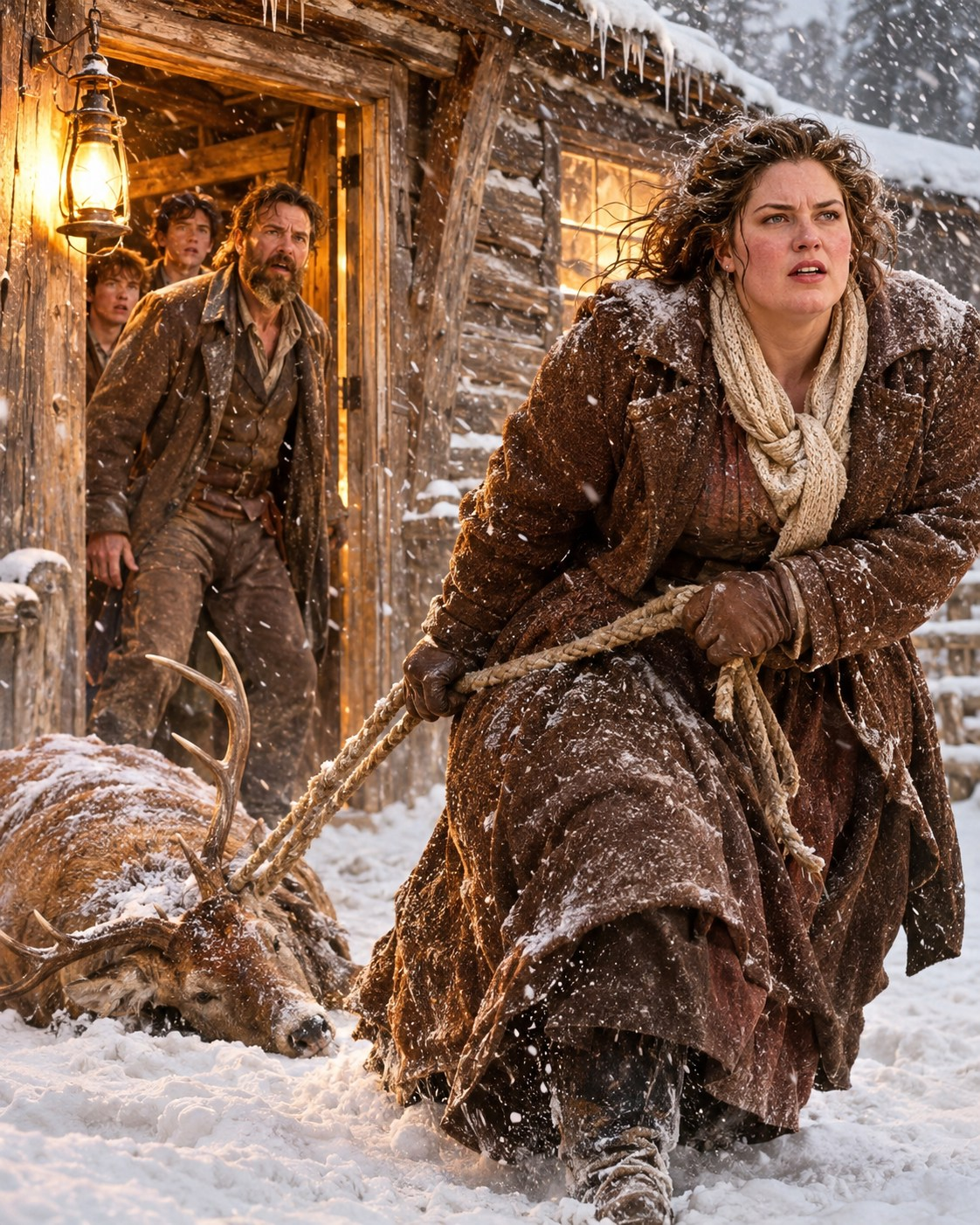
"Your father sent me to find you."
The stranger collapsed against the doorway.
I rushed forward and caught his arm before he struck the floor.
"Who are you?" I asked.
He struggled to breathe.
"My name is Samuel Reed."
Caleb immediately stepped closer.
"Samuel Reed? The delivery agent?"
The stranger shook his head weakly.
"No. The other Samuel."
He reached inside his torn coat and removed a small leather envelope.
"Daniel Prescott told me to give you this."
My hands began trembling.
I recognized the handwriting on the envelope.
It was the same handwriting I had seen on the little wooden horse.
My father's handwriting.
For twenty years, I had imagined what I would say if I ever saw him again.
I had imagined anger.
Questions.
Perhaps tears.
But I had never imagined that the first thing I would receive from him would be another letter.
I opened the envelope.
Inside was a photograph.
A middle-aged man stood beside a wooden cabin, wearing a dark coat and holding a walking stick.
His hair had turned gray.
His face was thinner than I remembered.
But I knew him.
My father.
On the back of the photograph were six words.
I am waiting at Blackwater Crossing.
I looked up.
"He's alive?"
Samuel Reed nodded.
"Yes, ma'am."
Caleb stepped forward.
"How long have you known?"
"Several months."
"Why didn't you bring him here?"
Samuel looked toward the window.
"Because Caldwell had men watching every road leading to the ranch. Daniel believed bringing him here would put everyone in danger."
I gripped the photograph.
"Where is he now?"
"At Blackwater Crossing. He's been waiting for a safe opportunity to return."
I looked toward Caleb.
Then toward Elizabeth.
Neither spoke.
I had spent twenty years believing my father was buried somewhere beneath a wooden memorial marker.
Now he was waiting less than a day's journey away.
I took a breath.
"Then we're going to him."
Caleb nodded.
"Not until we make certain the ranch is safe."
For the first time, I didn't argue.
There was too much at stake.
And I had learned that courage without preparation could become another form of recklessness.
The stranger was carried to the fireplace.
Wyatt brought water.
Elizabeth examined his injuries while I prepared a warm meal.
He had suffered a deep cut along his forehead and bruising around his ribs.
He was exhausted, but his injuries did not appear life-threatening.
After he had eaten, Caleb questioned him.
Samuel explained that he had once worked for several merchants who supplied the ranches around Blackwater Crossing.
He had known Daniel Prescott before the accident.
When Daniel disappeared, Samuel had believed the official story.
But several years later, he discovered that Daniel was still alive.
He had been living under another name.
At first, Samuel thought Daniel was hiding from creditors.
Then he learned about Caldwell.
Daniel had been collecting evidence against the man for years.
Samuel eventually became one of his trusted messengers.
He had been responsible for delivering information between Daniel, Margaret, and Caleb's father.
But when Caldwell discovered the arrangement, Samuel had been forced to disappear.
"Why did you come here now?" Caleb asked.
Samuel looked at the leather envelope.
"Because Daniel learned that Caldwell was preparing to make another attempt on Whispering Pines."
Caleb's expression hardened.
"When?"
"Within days."
Elizabeth sat down.
"Does he know we found the original documents?"
Samuel nodded.
"He knows."
"How?"
"Because the man who was supposed to retrieve them has already reported back."
I looked at Caleb.
"Then we need to act before Caldwell has another opportunity."
Caleb agreed.
He placed the original survey, the property transfer, and the payment records on the table.
For the first time, we had enough evidence to establish the full arrangement.
The altered water boundaries.
The stolen supplies.
The forged invoices.
The false debts.
The attempted destruction of the original documents.
And the transfer of Blackwater Crossing to Margaret Monroe.
But there was still one problem.
The records needed to be presented to someone with the authority to investigate them.
Caleb knew an attorney in the nearest settlement.
His name was Henry Whitcomb.
He had handled legal matters for several ranches in the territory.
If we could reach him safely, he could help us establish the authenticity of the documents.
Margaret agreed to travel with us.
Elizabeth wanted to go too.
I looked at the men gathered near the fireplace.
They were stronger than they had been when I arrived.
But they were not yet ready to face another violent confrontation.
Caleb made the decision.
"We'll leave at first light. Wyatt and Thomas will stay here with the others."
Wyatt looked disappointed.
"Mr. Thornton, I can help."
Caleb placed a hand on his shoulder.
"You already have."
The journey to Blackwater Crossing took most of the morning.
We traveled in Caleb's wagon.
Samuel Reed accompanied us, while Elizabeth and Margaret sat together beneath heavy blankets.
I carried the leather envelope containing my father's photograph.
I had barely spoken since leaving the ranch.
Every mile brought me closer to a meeting I had once believed impossible.
I remembered my father's hands.
They had been large and rough from years of work.
He had shown me how to hold a kitchen knife safely.
He had taught me to recognize good wood from rotten wood.
He had once built a small wooden horse for me because I had admired one in a shop window.
I remembered sitting beside him while he worked.
I remembered his laugh.
And I remembered the day my mother told me he would never come home.
I had spent years trying to become someone he would have been proud of.
Now I wondered whether he had spent those same years thinking about me.
Margaret noticed my silence.
"Abigail?"
I looked at her.
"Yes?"
"You don't have to forgive him immediately."
I stared at the road.
"I know."
"He has a great deal to explain."
"I know that too."
She reached across the seat and gently touched my hand.
"But whatever happened, he never stopped loving you."
I looked down.
I wanted to believe her.
But love was not the same as being present.
And I had learned to survive without him.
I would need time to understand what his absence meant.
Blackwater Crossing appeared shortly after noon.
It was a small property surrounded by open land and several old wooden buildings.
A narrow stream ran through the eastern side.
The water was partially frozen, but it continued moving beneath the ice.
The main house was weather-beaten.
Smoke rose from its chimney.
A man stood outside beside a stack of firewood.
He wore a dark wool coat.
His hair was almost entirely gray.
He was holding a walking stick.
When the wagon stopped, he looked up.
For a moment, he didn't move.
Then he saw me.
The walking stick slipped from his hand.
"Abigail?"
I stepped down from the wagon.
My legs felt weak.
I couldn't speak.
He took one step toward me.
Then another.
His eyes filled with tears.
"My little girl."
I stood still.
I wanted to run toward him.
I wanted to strike his chest and demand to know why he had left.
I wanted to ask why he had allowed me to mourn him.
Instead, I found myself looking at his face.
The face I had remembered for twenty years.
"You're alive," I whispered.
He nodded.
"Yes."
"All this time?"
He lowered his head.
"Yes."
I felt anger rise in my chest.
"Do you know how long I believed you were dead?"
His eyes closed.
"Every day."
"Every birthday. Every Christmas. Every time Mother needed help."
He didn't interrupt.
"Do you know how many times I wished I could ask you something?"
His voice broke.
"I do."
"No, you don't."
I took a step backward.
"You don't know what it was like growing up without you."
He looked at me.
Then he nodded.
"You're right."
For several seconds, neither of us moved.
Then he said something that I hadn't expected.
"I won't ask you to forgive me."
I looked at him.
He continued.
"I only want the chance to tell you the truth."
I studied his face.
Then I walked toward him.
He didn't reach for me.
He waited.
I stopped in front of him.
And finally, after twenty years, I placed my arms around my father.
He held me carefully.
As though he were afraid I might disappear.
I cried.
Not because everything was suddenly forgiven.
Not because the past no longer hurt.
But because the man I had mourned was standing in front of me.
Alive.
And for the first time since childhood, I could hear his heartbeat.
We spent the afternoon inside the small house.
Daniel explained everything.
After the accident, Caldwell's men had taken him to a property several miles from the main road.
He had been injured and unable to walk.
Caldwell wanted the original documents Daniel had collected.
But Daniel refused to reveal where they were hidden.
Eventually, he escaped with the help of a worker who had been secretly assisting him.
He traveled under another name and eventually reached a distant settlement.
He sent messages to my mother whenever it was safe.
But he never returned.
Caldwell had threatened to harm us if he did.
Daniel believed that staying away was the only way to protect his family.
I listened.
Sometimes I asked questions.
Sometimes I couldn't.
At one point, he removed a small wooden box from a cupboard.
Inside were dozens of letters.
Every one was addressed to me.
Some were written on my birthdays.
Others were dated Christmas.
One had been written when I was sixteen.
Another when I turned twenty-one.
I opened the first letter.
My dearest Abigail,
I don't know whether you will ever read this. I hope you will. I hope one day I can sit across from you and explain why I stayed away. I hope you will understand that every day without you has been a punishment I chose because I believed it was keeping you safe.
I lowered the letter.
My father watched me.
"I wanted to send them."
"Why didn't you?"
"Because Caldwell had people searching for anything connected to me. I couldn't risk your mother being followed."
I examined the stack.
"Did Mother know about all of these?"
He nodded.
"She knew I was alive. But I asked her not to tell you."
I looked at him.
"She carried that secret alone?"
His eyes lowered.
"Yes."
I thought about my mother.
Her long silences.
The locked drawer.
The letters she had burned.
Suddenly, several memories made sense.
My father reached across the table.
"I am sorry, Abigail."
I looked at his hand.
Then I placed mine over it.
"We have a lot of years to make up for."
He nodded.
"If you'll let me."
I gave him a small smile.
"We'll start with dinner."
For the first time, he laughed.
And I recognized the sound immediately.
The next morning, Daniel accompanied us to the nearest settlement.
We met Henry Whitcomb, the attorney Caleb had recommended.
He examined the original survey and the property transfer.
He compared the signatures with the older records.
Then he reviewed the payment documents and the evidence of redirected supplies.
His expression became increasingly serious.
"This is substantial," he said.
Caleb leaned forward.
"Can you act on it?"
Whitcomb nodded.
"Yes. But I need to verify several signatures and obtain sworn statements."
Elizabeth immediately offered to testify.
So did Margaret.
Samuel Reed agreed to provide a statement about the deliveries and the false records.
Daniel produced his original notes.
I provided the documents that had been hidden at Whispering Pines.
Within days, Whitcomb had assembled a complete account of the scheme.
The authorities were notified.
Caldwell was formally investigated for fraud, forgery, and unlawful interference with property rights.
Samuel Briggs was located attempting to leave the territory.
He was arrested after investigators discovered the original payment records among his belongings.
The other men involved were also questioned.
Thomas's name was cleared.
The suspicious payment recorded under his name had been entered without his knowledge.
He was relieved when Caleb returned to the ranch with the news.
For the first time, the cowboys understood that their suffering had not been caused by ordinary misfortune.
Someone had deliberately tried to starve them into surrender.
But the plan had failed.
The following weeks were difficult.
The ranch needed repairs.
The storage building had to be rebuilt.
The supply contracts needed replacing.
Several fences were damaged.
But the men were recovering.
The first proper supply wagon arrived shortly after the investigation began.
It carried flour, beans, salt, coffee, dried fruit, and fresh vegetables.
I stood beside the kitchen door when it arrived.
For a moment, I simply watched the men unload it.
Then I laughed.
Wyatt approached.
"What's funny?"
I looked at the sacks of flour.
"I never thought I'd be so happy to see flour."
He grinned.
"Miss Prescott, you should see how happy the others are."
He pointed toward the kitchen.
The cowboys had gathered around the new supplies.
One man held a sack of beans as though it were a treasure.
Another was already asking when dinner would be ready.
I shook my head.
"Tell them they'll eat when the kitchen is ready."
Wyatt hurried away.
Caleb approached.
He looked healthier.
His face had regained some color, and he no longer needed to lean against the walls when walking.
He handed me a folded document.
I opened it.
It was the partnership agreement.
This time, the terms were different.
I would become the official head of the ranch kitchen.
I would receive a share of its profits.
And I would have authority over food purchases, supply contracts, and the management of the kitchen staff.
I looked at Caleb.
"You've changed the agreement."
He nodded.
"The old arrangement didn't reflect what you've done."
I examined the document.
"You don't have to give me this."
"I'm not giving you anything."
He pointed toward the kitchen.
"You earned it."
I smiled.
"Then I accept."
He extended his hand.
I shook it.
And for the first time, Whispering Pines felt like a place where I truly belonged.
Spring arrived slowly.
The snow melted from the ranch yard.
The stream at Blackwater Crossing ran freely again.
The broken barn door was replaced.
The storage building was rebuilt with stronger timber.
The cattle returned to the corrals.
And the kitchen became the busiest place on the property.
I hired two additional cooks.
Elizabeth helped manage the accounts.
Margaret visited regularly.
Daniel began working with Caleb to restore the original water boundaries.
The legal investigation eventually confirmed that the property transfer to Margaret was valid.
Blackwater Crossing remained in her ownership.
The water rights belonging to Whispering Pines were restored.
Caldwell lost his claim and was convicted after the evidence was presented.
Samuel Briggs also faced punishment for his role in the forged transactions and stolen supplies.
The men who had nearly died inside the ranch were able to return to work.
Thomas became responsible for organizing the supply wagons.
Wyatt continued learning ranch management.
And Samuel Reed, after recovering from his injuries, accepted a position overseeing deliveries.
Nobody at Whispering Pines forgot what had happened.
But the ranch was no longer defined by the disaster.
It was defined by what came afterward.
One evening, several months after my arrival, I stood outside the kitchen.
The sun was setting over the northern fields.
The men were gathered around the long dining table.
Their plates were full.
There was fresh bread.
Roasted venison.
Potatoes.
Vegetables.
And a large pot of stew that had taken most of the afternoon to prepare.
Wyatt raised his cup.
"To Miss Prescott!"
The men cheered.
I shook my head.
"Sit down and eat before everything gets cold."
They laughed.
Caleb stood beside me.
"You know, when you first arrived, I thought you were going to turn around and leave."
I looked at him.
"I remember."
"I was wrong."
"Yes."
He laughed.
Then he became serious.
"I don't think Whispering Pines would still exist without you."
I looked toward the dining room.
"Those men saved it too."
Caleb nodded.
"Perhaps."
He paused.
"But you were the one who walked into a freezing kitchen, found a handful of potatoes, and refused to accept that twenty men were going to die."
I smiled.
"I had a stove to light."
"And a deer to find."
"And a great deal of cooking to do."
He shook his head.
"You make it sound simple."
"It wasn't."
We stood quietly for a moment.
Then I felt someone touch my shoulder.
My father.
Daniel stood behind me.
He looked healthier now.
He had gained some weight, and his hair was neatly trimmed.
He was holding the little wooden horse he had made for me when I was three.
I had asked him to repair it.
He had spent several evenings restoring the damaged legs and smoothing the old wood.
He handed it to me.
"I thought you might like to keep it."
I held the horse carefully.
"Thank you."
He looked toward the dining room.
"May I sit with you tonight?"
I smiled.
"Of course."
We walked inside together.
My mother had once told me that home was the place where people remembered to leave a light burning for you.
I finally understood what she meant.
I had left Chicago believing I was traveling west to find work.
Instead, I had found a ranch worth saving, a family I never knew existed, and a father I thought I had lost forever.
The woman Chicago society had called unmarriageable had become a business partner, a respected cook, and someone twenty cowboys would never forget.
I no longer cared what those people had said about my body.
I no longer needed their approval.
At Whispering Pines, nobody measured my worth by the width of my shoulders or the shape of my hips.
They measured it by the meals I prepared, the work I did, and the promises I kept.
And that was enough.
Later that evening, I sat beside my father near the fireplace.
He told me stories about my childhood.
I told him about the years he had missed.
We didn't pretend those years could be recovered.
But we had the years ahead of us.
Outside, the ranch stood beneath a clear Dakota sky.
The chimneys were smoking.
The barns were full.
The horses were resting.
And twenty cowboys who had once waited to die were now arguing cheerfully over who deserved the last piece of bread.
I looked around the room.
Then I looked at my father.
For the first time in twenty years, I felt that my family was whole again.
I had come west carrying two suitcases and a sack of cast-iron skillets.
I had found something far more valuable than the position advertised in that newspaper.
I had found a place where I was wanted.
A place where I was respected.
A place I could help build.
And when Caleb raised his glass and called for another toast, I finally understood that I had never needed to become someone else to deserve a happy life.
I had only needed the chance to live my own.






Comments 0