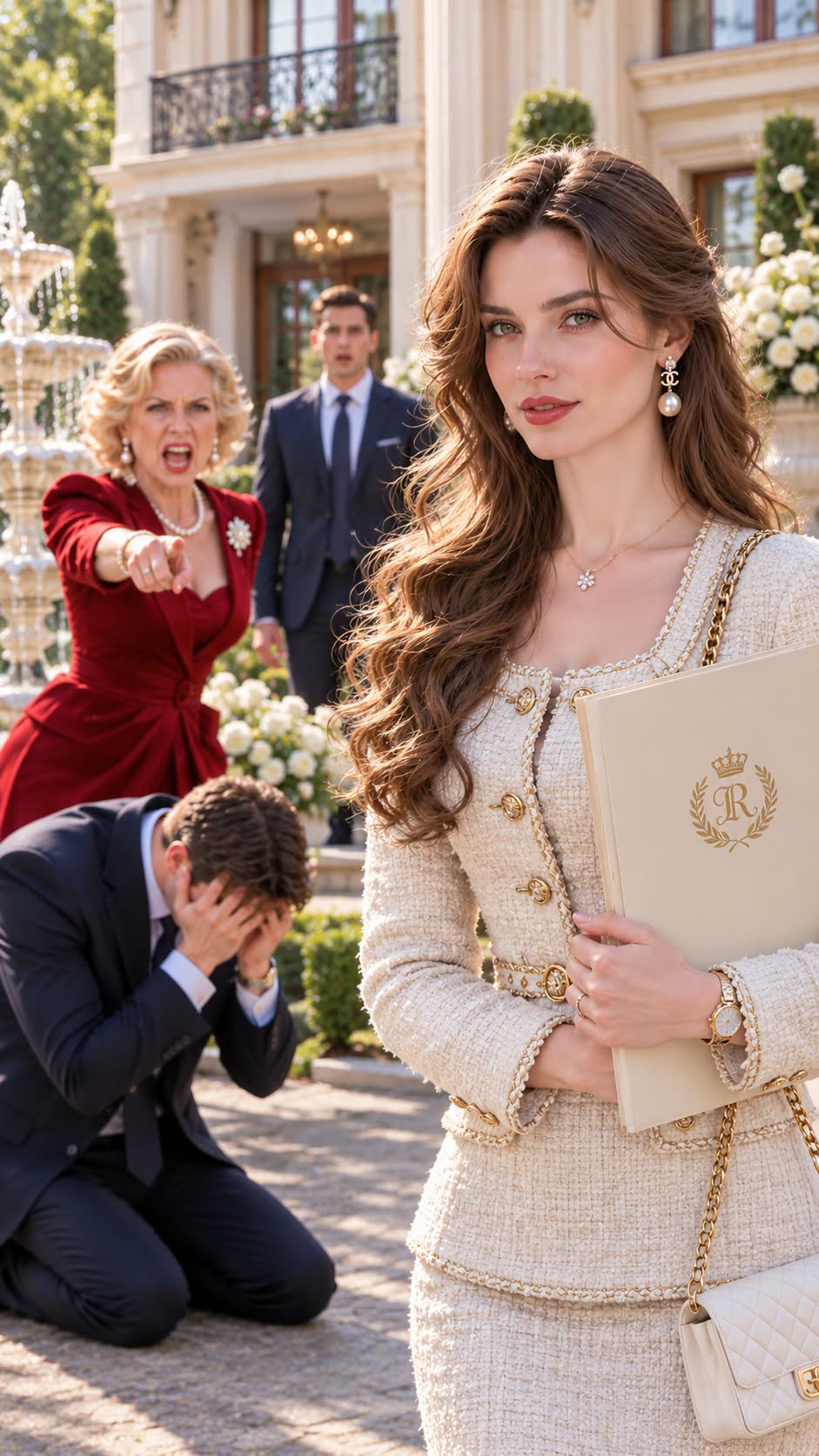
"Get your hands off my father's documents!" I said.
My mother-in-law stopped beside the fountain, gripping an ivory folder stamped with the seal of a four-star general.
Beneath the gold seal, someone had written three words in red ink.
Do not sign.
She thought she had found my weakness.
She had found her own.
My name is Claire Bennett Whitmore, and six days before that moment, I had married a man I believed loved me for who I was.
His name was Michael Whitmore.
He had kissed my forehead in front of eighty-seven wedding guests, promised to stand beside me through every hardship, and whispered that he couldn't wait to spend the rest of his life making me happy.
I believed him.
That was my first mistake.
My second mistake was believing his mother, Eleanor Whitmore, when she said she wanted to welcome me into the family.
But there was one mistake I had never made.
I had never told Michael about the sixty-eight million dollars my father left me.
And on the morning Eleanor arrived at my father's estate with a lawyer, that decision saved me from losing far more than money.
It saved me from losing myself.
At 9:17 that morning, my phone rang while I was standing in the kitchen, drinking coffee from my father's favorite white ceramic mug.
Michael had already left for work.
He'd kissed my cheek on his way out, told me he had an early meeting, and reminded me that we were supposed to have dinner together that evening.
"Seven o'clock," he'd said.
"I'll be here."
He smiled.
"Wouldn't miss it."
I remembered thinking how ordinary the exchange felt.
How comforting.
Six days into marriage, I was still learning the rhythm of sharing my life with another person.
I had spent most of my adult years alone.
Not lonely, exactly.
Just independent.
My father had raised me to be that way.
General Thomas Bennett had commanded thousands of soldiers, advised presidents, and spent most of his professional life making decisions that other people were too frightened to make.
But at home, he was simply Dad.
The man who burned pancakes every Sunday.
The man who never missed my birthday, even when he was stationed overseas.
The man who once drove four hours through a snowstorm because I had called him from college crying over a breakup.
He had been gone for eleven months.
And I still reached for my phone sometimes, forgetting there was no one left to answer.
The call that morning came from an unfamiliar number.
"Mrs. Whitmore?"
A woman's voice.
Professional.
Controlled.
"Speaking."
"This is Patricia from the front security gate. There's a Mrs. Eleanor Whitmore here to see you."
I frowned.
"My mother-in-law?"
"Yes, ma'am. She's accompanied by a gentleman who identifies himself as her attorney."
My coffee stopped halfway to my mouth.
"Her attorney?"
"Yes, ma'am."
I looked toward the large kitchen windows.
Beyond them stretched the gardens my father had loved.
White roses.
Stone pathways.
A fountain imported from Italy.
And a long driveway leading to the gates.
"Did she say why she's here?"
"She said it's an urgent family matter."
I set down the mug.
"Tell her I'll be there shortly."
"Of course, ma'am."
I ended the call and stood still.
An urgent family matter.
With a lawyer.
Six days after my wedding.
There are moments when your instincts recognize danger before your mind has enough evidence to explain it.
That was one of them.
I walked to the small study adjoining the kitchen and opened the bottom drawer of my father's old desk.
Inside was a black leather notebook.
My father had given it to me when I turned twenty-five.
On the first page, in his unmistakable handwriting, were the words:
When someone pressures you to make a decision quickly, ask yourself who benefits from your hurry.
I read them twice.
Then I called my attorney.
Her name was Rebecca Hayes.
She was fifty-three, sharp-minded, and had represented my father for nearly two decades.
She was also one of the few people who knew the full details of my inheritance.
"Claire?" she answered. "Everything all right?"
"My mother-in-law is at the gate."
A pause.
"All right."
"With a lawyer."
Another pause.
This one longer.
"What's his name?"
"I don't know yet."
"Don't sign anything."
"I wasn't planning to."
"Don't even accept documents without letting me review them."
"Rebecca, what's going on?"
She exhaled.
"I was hoping we wouldn't have to discuss this so soon."
My stomach tightened.
"Discuss what?"
"Something happened yesterday."
"What happened?"
"Someone contacted the trust administration office asking whether your recent marriage changed the ownership or distribution rights of your father's estate."
I stared at the wall.
"Who?"
"They claimed to be conducting a routine legal review on behalf of your husband's family."
My fingers tightened around the phone.
"Michael's family?"
"That's what they said."
"Did anyone give them information?"
"Nothing confidential. But Claire, whoever called knew enough to ask unusually specific questions."
"Such as?"
"The approximate value of the trust."
I stopped breathing for a second.
"How approximate?"
Rebecca hesitated.
"Sixty-eight million."
I looked down at my wedding ring.
A simple platinum band.
Michael had chosen it himself.
He'd told me he loved that it wasn't flashy.
That it suited me.
"Rebecca," I whispered, "I never told Michael how much money my father left me."
"I know."
"I never told his mother, either."
"I know that too."
"Then how did they find out?"
"That's what I'm trying to determine."
I closed my eyes.
For the first time since my wedding, I remembered something that had seemed harmless at the time.
Three weeks earlier, Michael had asked whether my father's estate had finally been settled.
I told him most of the paperwork was complete.
He asked whether there had been complications.
I said no.
Then he'd laughed and said, "Your dad must have left you pretty comfortable."
I'd smiled.
"He made sure I'd be okay."
Michael had kissed me.
"That's all I care about."
At the time, I thought it was sweet.
Now I wasn't sure.
"Claire?" Rebecca said.
"I'm here."
"Listen carefully. Your father's trust has protections that your marriage doesn't automatically change. Your mother-in-law cannot simply arrive and claim ownership."
"I understand."
"But if she brings documents, I want photographs of every page."
"Okay."
"And I want you to call me before you agree to anything."
I looked through the window again.
A black sedan was approaching the fountain.
"Eleanor's coming up the driveway."
"Then remember what your father taught you."
I swallowed.
"Never let someone else's urgency become your emergency."
"Exactly."
Eleanor Whitmore stepped out of the sedan like a woman arriving to inspect property she already owned.
She was seventy-two, impeccably dressed, and accustomed to being obeyed.
Her silver hair was cut into a severe bob.
She wore a deep-purple tailored suit, black heels, and a sapphire brooch large enough to catch the morning sunlight.
Behind her emerged a man carrying a black leather briefcase.
He appeared to be in his early fifties.
Dark suit.
Silver tie.
Rectangular glasses.
The kind of professional who looked as though he billed clients for the seconds they spent breathing.
Eleanor spotted me near the mansion entrance.
"Claire!"
She didn't sound pleased.
She sounded victorious.
I walked down the steps.
"Eleanor. This is unexpected."
She looked me up and down.
Her eyes lingered on my emerald-green pantsuit.
"Well, I certainly see you're enjoying your new circumstances."
I glanced at her.
"My circumstances?"
"This house. These clothes. All of it."
I said nothing.
She turned toward the man beside her.
"This is my daughter-in-law, Claire."
He extended a hand.
"Daniel Mercer. Attorney."
I shook it briefly.
"Claire Bennett Whitmore."
Eleanor's smile tightened.
"Whitmore now, dear. You're married."
I looked directly at her.
"Bennett is still my name."
The lawyer shifted his briefcase from one hand to the other.
Eleanor laughed.
A small, unpleasant sound.
"Of course. Well, we have some important matters to discuss."
"Then perhaps you should have called first."
Her expression changed.
Only slightly.
But I noticed.
"Family doesn't need appointments, Claire."
"My security team disagrees."
She stared at me.
Then she smiled again.
"Still adjusting to marriage, I see."
I gestured toward the courtyard seating area.
"Would you like to sit?"
"No. This shouldn't take long."
She held out her hand.
"Daniel?"
The lawyer opened his briefcase.
Inside were several neatly organized documents.
He removed a thick folder and handed it to Eleanor.
She offered it to me.
"These are simply some arrangements we need to formalize."
I didn't take it.
"What arrangements?"
"Family financial arrangements."
"Whose family?"
She blinked.
"Ours, naturally."
I folded my hands in front of me.
"Eleanor, please explain exactly what you want."
Her patience disappeared.
"Michael and I have discussed your situation."
"My situation?"
"Your inheritance."
There it was.
No hesitation.
No pretense.
She said the word as though it belonged to her.
I looked at the folder.
"Go on."
"Your father left you a considerable estate."
"He did."
"And now that you're married, it's only sensible to make sure those assets are managed properly."
"Managed by whom?"
"By people with experience."
"Such as?"
"Michael. Myself. Our advisers."
I studied her face.
She genuinely believed this was a reasonable request.
"Why would my inheritance need to be managed by your family?"
"Because you're a Whitmore now."
I waited.
She mistook my silence for uncertainty.
"Claire, you may have been raised with certain ideas about independence, but marriage requires cooperation."
"I agree."
"Good."
"Cooperation isn't the same as surrendering ownership."
Her smile vanished.
Daniel Mercer cleared his throat.
"Mrs. Whitmore, perhaps I could explain the proposed arrangement."
"Please do."
He opened the folder.
"The documents would establish a family asset-management structure. Certain holdings would be transferred into an entity overseen by designated trustees."
"Which trustees?"
He glanced at Eleanor.
"Mrs. Eleanor Whitmore and Mr. Michael Whitmore."
I nodded slowly.
"And me?"
"You would retain a beneficial interest."
"What voting authority?"
He hesitated.
"That would depend on the final structure."
"Does the draft give me authority to remove either trustee?"
Another pause.
"Not unilaterally."
"Does it give Eleanor authority to approve distributions?"
"Yes."
"Does it give Michael authority over investment decisions?"
"Yes."
"And does it require my signature to become effective?"
"Yes."
I looked at Eleanor.
"So you came here to ask me to transfer control of my father's estate to you and Michael."
She lifted her chin.
"That's a very dramatic way of describing a perfectly ordinary family arrangement."
"Is it?"
"Yes."
I held out my hand.
"May I see the documents?"
Daniel passed them over.
I opened the folder.
The first page contained language about marital asset coordination.
The second discussed trustee appointment.
The third concerned authority over distributions.
Then I turned to the fourth page.
And felt something cold settle in my stomach.
There was a section authorizing the transfer of assets into a newly established holding company.
The proposed ownership structure gave Michael and Eleanor effective control of the company through its voting interests.
I looked at the name.
Whitmore Family Holdings LLC.
Then at the date.
The company had been formed nineteen days earlier.
Thirteen days before my wedding.
I read the date again.
There was no mistake.
I turned another page.
A resolution identified Michael as managing member.
Eleanor as chairwoman.
And me as the contributing asset holder.
I almost laughed.
Not because it was funny.
Because it was so shameless.
"Daniel," I said, "when was this company established?"
He adjusted his glasses.
"Recently."
"What date?"
He glanced down.
"October fifteenth."
"And when did Michael and I get married?"
Eleanor interrupted.
"Claire, what difference does that make?"
I looked at her.
"It makes a great deal of difference."
She crossed her arms.
"You're being unnecessarily difficult."
"Your son formed a company to receive my inheritance before we were married."
"That's called planning."
"Planning for what?"
"For your future!"
I closed the folder.
"My future?"
"Yes."
"Or your access to my money?"
Her face reddened.
"How dare you?"
The fountain continued running behind us.
A bird landed on the stone railing.
Somewhere beyond the garden, a groundskeeper's cart moved along a distant path.
Everything ordinary continued as though my marriage weren't unraveling in front of me.
Eleanor took a step closer.
"Let me make something clear, young lady. I did not raise my son to marry a woman who hides money from him."
I looked at her.
"Did Michael tell you I was hiding money?"
She hesitated.
"That's beside the point."
"No. It's exactly the point."
Her jaw tightened.
"Michael deserves a wife who trusts him."
"Then perhaps Michael should have married someone he trusted enough not to investigate before the wedding."
For the first time, Daniel looked uncomfortable.
Eleanor noticed.
"Daniel, explain to her what happens when a wife refuses to cooperate with her husband's family."
He opened his mouth.
Then closed it.
I watched him carefully.
"Yes, Daniel," I said. "Please explain."
He cleared his throat.
"Mrs. Whitmore, no one can compel you to execute these documents merely because of your marital status."
Eleanor spun toward him.
"That is not what you told me!"
"I explained that the proposed arrangement would require her voluntary agreement."
"You said it was legally sound!"
"The structure may be legally permissible if properly executed. That doesn't mean Mrs. Whitmore is obligated to participate."
I tilted my head.
"So there's no legal obligation."
"Not on the facts currently presented."
Eleanor's cheeks flushed.
"You're supposed to be representing me!"
"I am."
"Then stop helping her!"
Daniel lowered his gaze.
I opened the folder again.
This time, I examined the signature pages.
There were spaces for three signatures.
Eleanor Whitmore.
Michael Whitmore.
Claire Bennett Whitmore.
Eleanor's signature was already present.
Michael's was there too.
Mine was blank.
But something else caught my attention.
A small notation in the lower corner.
Exhibit C — Prior Consent.
I turned to the next page.
There was no Exhibit C.
I flipped through the folder.
Nothing.
"Daniel."
"Yes?"
"Where is Exhibit C?"
He looked at the documents.
"Which exhibit?"
"The one referenced on page eleven."
He took the folder.
His eyes moved down the page.
His expression changed.
"That should be attached."
"It isn't."
He looked toward Eleanor.
"Mrs. Whitmore, where is the prior-consent exhibit?"
Eleanor's eyes narrowed.
"I don't know. You prepared the papers."
"That exhibit wasn't part of the draft I sent you."
A silence followed.
I watched them both.
"Then who added the reference?"
Neither answered.
I took out my phone.
"Excuse me."
Eleanor looked offended.
"Who are you calling?"
"My attorney."
Her expression hardened.
"Absolutely not."
I paused.
"Excuse me?"
"This is a private family matter."
"You're standing outside my house with a lawyer asking me to transfer sixty-eight million dollars. I think my attorney qualifies as relevant."
Eleanor's eyes widened.
For the first time, she seemed to realize I knew the amount.
Not approximately.
Exactly.
"Who told you that figure?" she demanded.
I stared at her.
"It's my inheritance."
"Michael said you didn't know the full value yet."
The words came out before she could stop them.
Daniel turned toward her.
I didn't move.
"Michael said that?"
Eleanor's mouth tightened.
"I meant—"
"Did he tell you I didn't know how much my father left me?"
She looked away.
"You're twisting my words."
"No. I'm repeating them."
I called Rebecca.
She answered immediately.
"Claire?"
"Eleanor is here with Daniel Mercer. They brought a transfer agreement for Whitmore Family Holdings."
Silence.
Then Rebecca said, "Put me on speaker."
I did.
"Mr. Mercer," she said, "this is Rebecca Hayes, counsel for Claire Bennett and the Bennett Family Trust."
Daniel straightened.
"Ms. Hayes."
"Has Mrs. Bennett signed anything?"
"No."
"Good. Please identify the legal basis on which your client believes she can obtain control of trust assets."
Eleanor snapped, "This is ridiculous!"
Rebecca ignored her.
"Mr. Mercer?"
He looked at the folder.
"The documents contemplate a voluntary transfer."
"Then there is no basis to demand execution."
"No."
"Are you aware that the Bennett Family Trust contains restrictions on assignment and transfer of certain interests?"
Daniel went still.
"I haven't reviewed the governing trust instrument."
"Then I suggest you do so before making any representations about the availability of those assets."
I watched his face.
Something was changing.
Rebecca continued.
"Claire, turn to the final attachment in the folder you received."
I frowned.
"There isn't a final attachment."
"Check again."
I opened the back cover.
A thin pocket had been built into the folder.
Inside was a single folded page.
I removed it.
It was a photocopy of a document bearing my father's signature.
At least, it appeared to.
Across the top were the words:
Supplemental Authorization.
My father's name appeared beneath them.
General Thomas E. Bennett.
I stared at the page.
My chest tightened.
I knew my father's signature.
I'd seen it on birthday cards.
Letters.
School permission slips.
Military commendations.
The final note he'd left me before his last hospitalization.
This signature looked close.
Very close.
But the final stroke of the B curved upward.
My father always finished that letter with a downward line.
Always.
"Rebecca," I said quietly.
"What is it?"
"There's a document with Dad's signature."
"What document?"
"Something called Supplemental Authorization."
"Read me the date."
I looked at the top.
"March fourteenth."
Rebecca went silent.
Then she asked a question I would never forget.
"Claire, are you certain?"
"Yes."
"March fourteenth of this year?"
"Yes."
I heard her take a breath.
"Your father was hospitalized on March twelfth."
"I remember."
"He was under heavy sedation by the fourteenth."
I looked at the signature again.
Rebecca's voice became colder.
"Claire, your father could not have signed that document in the manner represented without extraordinary circumstances. We need to verify its origin."
Eleanor stepped forward.
"Give me that!"
I moved the paper out of her reach.
"No."
She pointed at me.
"That document belongs to the family!"
I looked directly into her eyes.
"Which family?"
She stopped.
I continued.
"My father's family? Or the family that created a company to take his money before I even walked down the aisle?"
Her face twisted with anger.
"You ungrateful little—"
"Finish that sentence carefully."
My voice was quiet.
I didn't raise it.
I didn't need to.
Daniel had gone pale.
He reached for the document.
"May I examine that?"
I handed him the photocopy.
He read the first paragraph.
Then the second.
His fingers tightened around the paper.
"Mrs. Whitmore," he said to Eleanor, "where did you obtain this?"
She folded her arms.
"Michael gave it to me."
My heart seemed to stop.
"Michael?"
"Yes."
Daniel looked at her.
"When?"
"Several weeks ago."
"Who prepared it?"
"I don't know."
"Who represented to you that it was authentic?"
Eleanor stared at him.
"My son."
Daniel lowered the document.
"Mrs. Whitmore, this is not the document I reviewed during our initial consultation."
Eleanor's voice sharpened.
"What are you talking about?"
"This copy contains language that wasn't in the version you previously supplied."
"Then you must have overlooked it."
"No."
His voice was suddenly firm.
"I did not."
I watched him read another paragraph.
He stopped.
Then he turned the page over.
There was a handwritten notation on the back.
Three words.
Do not sign.
Written in red ink.
My father's handwriting.
I recognized it immediately.
Not the signature on the front.
The handwriting on the back.
It was his.
Rebecca spoke through the phone.
"Claire? What's happening?"
I couldn't answer.
Because beneath those three words was something else.
A number.
Not a bank account.
Not a phone number.
A military records reference.
My father had used that numbering system when organizing his private correspondence after retirement.
And I knew exactly where the corresponding records were stored.
In the locked archive beneath his study.
A room Michael had asked about twice since moving into the mansion.
I looked at Eleanor.
"Who gave Michael this document?"
She hesitated.
"I told you. Someone who knew your father."
"Who?"
"One of his former associates."
"Name."
"I don't remember."
I stepped closer.
"Eleanor. His name."
She looked toward Daniel.
Then toward the mansion.
Finally, she said, "You don't understand what you're getting involved in."
I felt my stomach tighten.
"What does that mean?"
She said nothing.
I held out my hand for the document.
Daniel returned it.
His expression had changed completely.
The confidence was gone.
In its place was something that looked disturbingly like fear.
"Ms. Hayes," he said toward my phone, "I believe we need to suspend this discussion immediately."
Rebecca replied, "I agree."
Eleanor turned on him.
"Absolutely not! We came here to settle this!"
Daniel closed his briefcase.
"Mrs. Whitmore, I cannot advise you to proceed."
"You work for me!"
"That doesn't change my professional obligations."
Her face reddened.
She stepped toward me.
"Claire, you will sign those papers today."
"No."
"You have no idea what you're doing."
"Actually, I think I'm beginning to understand."
She pointed directly at my face.
"Your father may have been a general, but that doesn't make you untouchable!"
I didn't blink.
"And being Michael's mother doesn't make you entitled to my inheritance."
For several seconds, no one spoke.
Then Eleanor said something that changed everything.
"Your father should have told you what really happened before he died."
The fountain seemed suddenly louder.
I stared at her.
"What did you say?"
Her expression shifted.
She had revealed too much.
"I said your father should have prepared you better."
"No."
I took a step closer.
"That's not what you said."
She looked away.
"Eleanor."
"Enough."
"What really happened before he died?"
Her lips pressed together.
I looked at Daniel.
He wouldn't meet my eyes.
I looked down at the document.
The red handwriting.
The records reference.
The signature that couldn't have been written when the document claimed it was.
And suddenly, I remembered my father's final evening at home.
He'd been sitting in his study.
A glass of water untouched beside him.
His face unusually tired.
I'd asked whether everything was all right.
He'd looked at me for a long moment.
Then he'd said, "Claire, if someone ever tells you I made a promise about your inheritance, don't believe them until you've heard it from Rebecca."
At the time, I thought he was simply being cautious.
Now I understood that he had been warning me.
But about whom?
And why?
By the time Eleanor left the estate, her lawyer had refused to continue discussing the transfer.
He had even dropped to one knee beside his fallen briefcase after the confrontation, pressing his hands against his face as he struggled to compose himself.
Eleanor had stared at him in disbelief.
I'd never seen her look so powerless.
But I took no satisfaction in it.
Not yet.
Because one question mattered more than all the others.
What had Michael known?
And when had he known it?
I spent the afternoon with Rebecca on the phone.
We photographed every page Eleanor had left behind.
We documented the company formation date.
We identified the suspicious authorization.
Rebecca arranged to preserve the trust's records and asked her staff to examine the origins of the disputed document.
Then I went into my father's study.
The room smelled faintly of leather and cedar.
His desk stood beneath a framed photograph of him receiving his fourth star.
I sat in his chair.
For the first time in eleven months, I allowed myself to cry.
Not for the money.
Not even for my marriage.
For the possibility that someone had exploited my father's final illness to manufacture a document in his name.
I wiped my face.
Then I opened the locked drawer where he kept his private correspondence.
The archive reference on the back of the document pointed to a file labeled:
B-17.
I found the corresponding key.
But before I could open the archive cabinet, my phone rang.
Michael.
I watched his name appear on the screen.
I let it ring twice.
Then answered.
"Hi."
"Hey, sweetheart."
His voice sounded normal.
Too normal.
"How's your day?"
"Interesting."
He laughed softly.
"That sounds ominous."
I said nothing.
He continued.
"Listen, I'm running a little behind. I'll be home at seven."
"Okay."
"Everything all right?"
I looked at the disputed authorization lying on my father's desk.
"Michael?"
"Yeah?"
"Did your mother mention she was coming by today?"
Silence.
Only a second.
But enough.
"Mom?"
"Yes."
"Uh, no. Why?"
"Just wondering."
"Did she call you?"
"Something like that."
Another pause.
Then he said, "Claire, if Mom says anything strange, don't take it personally. You know how she gets."
I looked down at my wedding ring.
"Do I?"
He laughed nervously.
"Come on. You know what I mean."
"Not really."
"She's just protective."
"Of you?"
"Of the family."
I closed my eyes.
"Of course."
"I love you," he said.
The words landed differently than they had that morning.
I wanted to believe them.
That was the worst part.
"I'll see you at seven," I replied.
Then I ended the call.
At exactly seven that evening, the garage door groaned open.
I was sitting on a stool beside the granite kitchen island.
The legal papers lay in a thick stack in front of me.
My father's handwriting was visible on the top page.
Michael entered carrying his briefcase.
His shoulders were slumped.
He looked exhausted.
But when he saw me, he forced a smile.
"Hey."
I didn't answer.
He glanced around the kitchen.
Then toward the hallway.
"Where's my mother?"
I watched him.
"And what happened to the lawyer?" he added.
I slowly pushed the documents across the countertop.
They slid toward him.
He stopped smiling.
"Your mother was kind enough to leave me something to remember her visit by."
His eyes dropped to the papers.
He didn't touch them.
"Claire—"
"Did you know she was coming?"
"Listen, I can explain."
"That's not what I asked."
He set down his briefcase.
"I knew she wanted to talk to you."
"About my father's inheritance."
He swallowed.
"Yes."
"How long have you known?"
He looked toward the window.
"Claire, please—"
"How long?"
"A few weeks."
I nodded.
"And the lawyer?"
"I swear I didn't know she was bringing him."
"Maybe not. But you knew she wanted control of my money."
"That's not fair."
I almost laughed.
"Fair?"
"You're making it sound like we planned something terrible."
I opened the folder.
"Whitmore Family Holdings was established thirteen days before our wedding."
His face changed.
"Where did you get that?"
"Your mother's lawyer brought the documents."
He stared at me.
I continued.
"Your name is on the company formation papers."
"Claire—"
"Your signature is on the proposed transfer agreement."
"Let me explain."
"And someone produced an authorization bearing my father's signature, dated while he was hospitalized."
Michael went completely still.
I watched the color drain from his face.
"You knew about that document," I whispered.
He said nothing.
"Didn't you?"
He lowered his eyes.
My heart broke a little more.
But my voice stayed steady.
"Michael, I need one honest answer."
He looked up.
I leaned forward.
"How much money were you and your mother planning to take?"
His lips trembled.
For several seconds, he couldn't speak.
Then he whispered, "It wasn't supposed to happen this way."
I stared at him.
"What wasn't?"
He shook his head.
"Mom said you'd never find out."
The room seemed to tilt.
I gripped the edge of the counter.
"Find out what?"
Michael looked toward the hallway.
Then at the legal documents.
His eyes filled with panic.
"Claire, there was someone else involved."
I stopped breathing.
"Who?"
He opened his mouth.
But before he could answer, my phone vibrated.
A message from Rebecca appeared on the screen.
Claire, I found the original filing attached to the disputed authorization. The person who submitted it used a name you know.
A second message arrived.
I'm sending you the identification record now.
I opened the attachment.
The photograph began loading.
Michael saw the screen.
His face turned white.
He reached toward my phone.
"Claire, don't open that."
I pulled it away.
The photograph sharpened.
And the person staring back at me was—






Comments 0