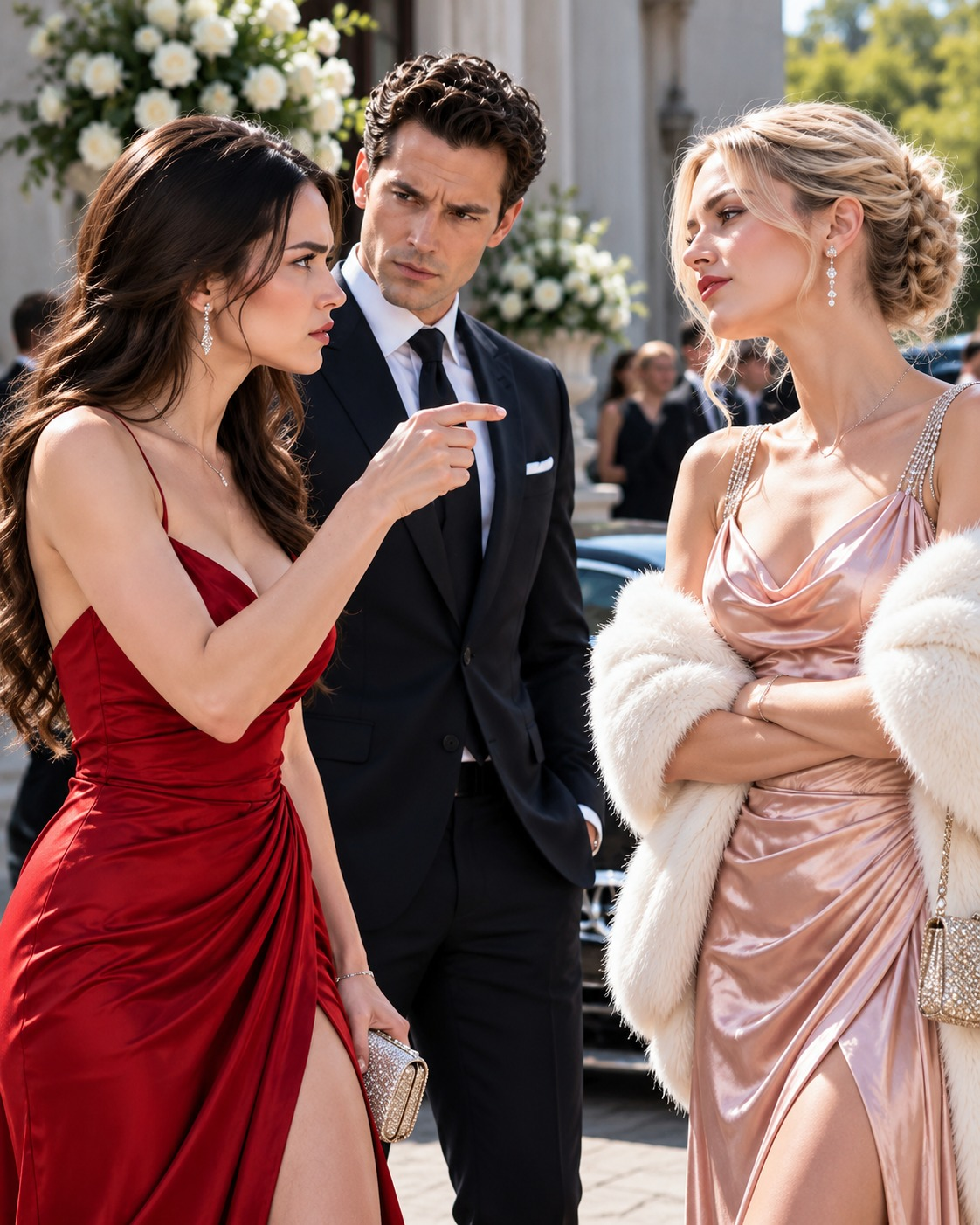
The bedroom door opened.
I shoved the photograph beneath my sweater just as Preston stepped into Emma’s room.
He looked at the porcelain angel first.
Then he looked at me.
“What are you doing in here?”
His voice was calm, but his eyes were not.
I stood beside the dresser, my phone still pressed against my ear. Lydia’s call had ended seconds earlier, leaving me with nothing but her warning and the sound of my own heartbeat.
“Looking for something,” I replied.
Preston glanced at the open drawer.
“What?”
I closed it.
“Something that belonged to Emma.”
His expression changed.
Not dramatically. Preston was too practiced for that. His eyebrows lifted slightly, and his mouth tightened as though I had disappointed him by bringing up an unpleasant subject.
“You need to stop doing this.”
“Doing what?”
“Searching through her things. Looking for hidden meanings. Turning every little detail into another reason to hurt yourself.”
I studied his face.
Three years earlier, those words would have wounded me. I would have apologized, closed the drawer, and let him guide me out of the room.
That was before I found Vanessa wearing Emma’s bracelet.
Before the photograph.
Before the message warning me about October 12.
Now I could hear something different beneath Preston’s concern.
Fear.
He was not afraid that I would hurt myself.
He was afraid that I would discover why he had been lying.
“I found something,” I said.
His eyes moved toward my sweater.
The photograph was hidden against my skin, its corner pressing into my ribs.
“What did you find?”
“A picture.”
He became very still.
“What picture?”
“One of Emma.”
For a moment, neither of us spoke.
Then Preston extended his hand.
“Let me see it.”
I did not move.
“Why?”
“Because I want to know what you're talking about.”
“You already know.”
His jaw tightened.
The silence that followed was so complete that I could hear the faint hum of the air conditioner.
Preston lowered his hand.
“Celeste, I know this day has been difficult. The memorial brought back a lot of painful memories. You're tired, and you're looking for explanations because sometimes grief makes the past feel unfinished.”
I almost admired him.
Even now, with his eyes fixed on the photograph hidden beneath my clothes, he was trying to make me doubt my own mind.
“Did Vanessa visit Emma in the hospital?” I asked.
His expression barely changed.
“Of course she did. She supported the foundation.”
“Was she there on October 12?”
He looked away.
It lasted less than a second.
But I saw it.
“Why are you asking about that date?”
“Answer me.”
His face hardened.
“Don't speak to me like that.”
I had heard those words so many times that they should have frightened me.
Instead, they sounded strangely small.
I took a breath.
“Was Vanessa in Emma's room that night?”
Preston stepped closer.
“Give me the photograph.”
“No.”
The word came out quietly.
It still seemed to surprise him.
He stared at me as though I had suddenly begun speaking a language he did not understand.
Then he reached toward my sweater.
I stepped back.
His hand stopped in midair.
For several seconds, we looked at each other.
I saw the man I had married, the father who had carried our daughter through hospital corridors, the husband who had held me while I cried after the funeral.
I also saw the stranger who had convinced me that my memories were unreliable, who had taken control of our foundation, and who now stood in our daughter's bedroom demanding a photograph he had no right to possess.
“Preston,” I said, “what happened that night?”
He withdrew his hand.
“Nothing happened.”
“Then why are you afraid of a photograph?”
“I'm not afraid of anything.”
He said it too quickly.
I glanced toward the porcelain angel.
The tiny camera remained hidden behind its wings.
If Preston knew about it, he had not removed it yet.
That meant I still had a chance to understand what had happened.
I needed him to believe I knew less than I did.
So I lowered my eyes.
“I'm sorry,” I whispered.
His shoulders relaxed.
It was almost insulting how quickly he accepted the apology he had spent years teaching me to offer.
“I know you're struggling,” he said, his voice softening. “I know you miss her. But you can't keep living inside that bedroom.”
I nodded.
He reached for my hand.
I allowed him to take it.
“We need to move forward,” he continued. “Together.”
I looked at our joined hands.
“Together,” I repeated.
He kissed my forehead.
Then he left the room, closing the door behind him.
I waited until his footsteps faded down the hallway before pulling the photograph from beneath my sweater.
My hands were shaking.
On the front, Emma smiled from her hospital bed, her stuffed rabbit tucked beneath one arm. Preston stood beside her, wearing a blue shirt I remembered him buying specifically for hospital visits.
Vanessa stood on Emma's other side.
But it was the date on the back that frightened me.
October 12.
The same date as the hidden recording.
The same date Emma's music box disappeared.
The same date Preston had claimed to be attending an emergency meeting with the foundation's board.
I turned the photograph over.
The words were still there.
She was alive when they took her home.
I sat on the edge of Emma's bed.
For three years, I had believed I knew exactly what happened during my daughter's final hours.
The doctors had explained her condition. They had told us that her heart had stopped. I remembered the frantic movement of nurses, the cold light above the bed, and Preston holding me while I begged someone to do something.
I remembered the doctor returning with tears in his eyes.
I remembered saying goodbye.
Those memories were painful, but they were mine.
Now a stranger had suggested that someone had hidden the truth inside my daughter's bedroom.
I wanted to reject the message.
I wanted to tear the photograph into pieces and return to the life I had understood.
But I could not ignore the bracelet.
I could not ignore Vanessa's expression.
And I could not ignore the fear in Preston's eyes when I mentioned October 12.
I opened my phone and checked the recording again.
The woman entered Emma's room at 12:07 a.m. She wore a dark coat and black shoes. Her face remained partly concealed, but the silver ring on her hand was unmistakable.
I enlarged the image.
The ring had a dark oval stone surrounded by a narrow engraved border.
I knew that ring.
My mother had worn it for nearly thirty years.
After she died, Lydia inherited her jewelry.
I had seen the ring on my sister's hand at Christmas, at family dinners, and once when she helped me search Emma's room for the missing memory box.
Why would Lydia enter Emma's bedroom after midnight?
Why would she hide a photograph?
And why had she begged me not to let Preston see it?
I called her.
She didn't answer.
I tried again.
Nothing.
I sent a message asking her to call me immediately.
Then I noticed something in the recording I had overlooked.
The woman was not alone.
Just before she entered the room, another shadow passed across the hallway wall.
A second person stood outside the door.
I paused the video.
The shadow was tall and broad-shouldered.
The figure wore dark trousers and polished shoes.
I knew those shoes.
Preston owned a pair with a distinctive silver buckle, a gift from his father on our wedding day.
I replayed the clip.
The shadow disappeared.
The woman entered Emma's room.
A few seconds later, she opened the dresser drawer and removed something small.
Then she turned toward the camera.
Her face came into focus for less than a second.
It was Lydia.
I dropped the phone onto the bed.
My sister had entered Emma's room that night.
My husband had been standing outside.
And both of them had kept it from me.
I pressed a hand against my mouth.
For several minutes, I could do nothing but stare at the screen.
I had trusted Lydia because she had never asked me to pretend that everything was fine. She had helped me through the worst days of my life. She had sat beside me through the funeral, held my hand during the memorial, and defended me whenever Preston suggested that grief had damaged my judgment.
If she had been part of whatever happened on October 12, then every conversation we had shared since that night suddenly felt different.
Had she been protecting me?
Or had she been protecting herself?
My phone rang.
Lydia's name appeared.
I answered immediately.
“Tell me the truth.”
There was a long silence.
Then she whispered, “You watched the recording.”
It was not a question.
“Yes.”
“Did you see Preston?”
“Yes.”
Another silence.
“Celeste, you have to listen to me. I didn't take Emma's bracelet. I didn't take the memory box. I swear to you.”
“Why were you in her room?”
“I can't explain over the phone.”
“Then come here.”
“I can't.”
“Why?”
Her breathing became uneven.
“Because Preston knows I've been talking to you.”
I stood.
“He knows about the camera?”
“I don't know how much he knows. But he called me after the memorial and asked about the photograph.”
I looked toward the bedroom door.
“He asked me for it, too.”
“Did you give it to him?”
“No.”
“Good.”
The relief in her voice was immediate.
Then she said something that made my blood turn cold.
“Celeste, that photograph wasn't supposed to exist.”
I gripped the phone.
“What does that mean?”
“It means someone wanted you to find it.”
“Who?”
“I don't know.”
“Lydia, stop lying to me.”
“I am not lying.”
“Then tell me why you were in Emma's room that night.”
She began to cry.
I had heard Lydia cry before. I had heard her grieve for our mother, mourn the loss of her marriage, and break down after Emma's funeral.
This was different.
This was the sound of someone who had been carrying a secret for so long that speaking it aloud had become more frightening than keeping it.
“I went there because Preston asked me to,” she whispered.
The room seemed to tilt.
“What did he want?”
“He said there was something important in Emma's memory box. He told me you had given him permission to move it.”
“I never gave him permission.”
“I know that now.”
“You knew then.”
She did not answer.
I closed my eyes.
“What did you take from the room?”
“Nothing.”
“Then why does the recording show you opening the drawer?”
“Because I was looking for something.”
“What?”
Lydia's voice dropped to a whisper.
“The original hospital discharge papers.”
I stared at Emma's photograph.
“Why would discharge papers be in her memory box?”
“They weren't supposed to be.”
“What are you talking about?”
Before she could answer, I heard a sound on her end of the line.
A door closing.
Then a man's voice.
Preston's voice.
“Lydia? Who are you talking to?”
My sister stopped breathing.
I heard the phone move, followed by a muffled exchange I could not understand.
Then the call ended.
I tried calling back.
The number went straight to voicemail.
I stood in the middle of Emma's bedroom, staring at the phone.
The original hospital discharge papers.
Preston's request.
Lydia's midnight visit.
None of it made sense.
I needed proof, not another frightened confession.
I returned to the recording and watched the final seconds again.
Lydia opened the drawer.
She reached behind the wooden lining.
Then she withdrew a small envelope.
She did not remove the memory box.
She did not take the bracelet.
She took the envelope.
I watched her turn toward the door.
For a moment, she looked directly at the camera.
Her lips moved.
I enlarged the frame and adjusted the volume.
The recording was faint, but the words were clear enough.
“I'm sorry, Emma.”
Then she left.
I sat motionless.
Why would Lydia apologize to a child who had died three years earlier?
I replayed the words.
Again.
And again.
A soft knock came from the hallway.
I quickly locked my phone and slipped it into my pocket.
“Celeste?”
Preston stood outside the door.
His voice sounded pleasant.
Almost affectionate.
“Can I come in?”
I looked at the photograph in my hand, at the empty drawer, and at the porcelain angel concealing the camera.
I had spent three years believing that my daughter's death was the one terrible truth I would never have to investigate.
Now the people I loved most were connected to a night they refused to explain.
I folded the photograph and hid it inside the lining of my handbag.
Then I opened the bedroom door.
Preston stood there holding a small white envelope.
His expression was unreadable.
“I found something in my study,” he said.
He held the envelope out to me.
On the front, written in my daughter's childish handwriting, were four words that made my knees weaken.
Mommy, please don't trust Dad.
Preston watched my face as I read them.
Then he quietly asked, “Do you know who wrote this?”






Comments 0