The fourth bracelet said REBECCA.
I stared at the photograph until the letters blurred.
Four newborn babies lay side by side on a narrow hospital mattress, each wrapped in a white blanket. The image was old, its edges yellowed, its colors faded by time.
Lena.
Grace.
Sebastian.
Rebecca.
My name.
My twin sister's name.
The name of the man who had spent months helping arrange my destruction.
And the name of the woman I had been told was my biological mother.
I looked at Detective Collins.
"That doesn't make sense."
She nodded slowly.
"You're right."
I pointed at the screen.
"Rebecca Hale was supposed to be my mother."
"According to the later adoption records."
"But this photograph says she was a baby."
"Yes."
My throat tightened.
"Then somebody lied about who gave birth to us."
Roman stood beside the conference table, his face pale.
For once, he didn't try to explain.
He simply looked at the photograph as though the entire history of his family had been rewritten in front of him.
I turned to him.
"Did you know Sebastian was adopted?"
"No."
"Did you know he might be related to me?"
"No."
I searched his face.
"Did you know anything about a fourth child?"
Roman shook his head.
"I swear I didn't."
I believed him.
Not because I had forgotten his mistakes.
Not because I had forgiven everything.
But because I was finally beginning to understand the difference between a man who had hidden the truth and a man who was willing to face it.
Detective Collins placed her phone on the table.
"We need to be careful about what this photograph proves."
I looked at her.
"What do you mean?"
"These are four babies photographed together. The names on the bracelets may have been assigned by the foundation. They don't establish that all four children had the same biological parents."
I stared at the screen.
"So Sebastian might not be my brother."
"Correct."
"And Rebecca might not be my sister."
"Correct."
I swallowed.
"Then what are they?"
Collins's expression was serious.
"That's what the original laboratory records may tell us."
I looked at the photograph again.
Four babies.
Four names.
Twenty-seven years of lies.
And somewhere inside those records, the truth.
"Where are the laboratory records?"
Collins turned her tablet toward me.
"In the third box. Beneath the photograph."
My heart hammered.
"Have you read them?"
"Investigators have begun reviewing them."
I leaned forward.
"Then tell me."
She hesitated.
"Lena, the results are complicated."
I shook my head.
"I don't care."
My voice trembled.
"I have spent my entire life being told stories about who I am. I'm finished with stories. I want facts."
Collins studied me.
Then nodded.
"All right."
She opened the file.
And for the first time in my life, I learned how I had really come into the world.
The original records weren't birth certificates.
They were laboratory reports, maternity charts, adoption files, and handwritten notes from a physician who had worked at the Vale-Rinaldi Medical Foundation before its records were altered.
The documents told a story that was far more complicated than the one Eleanor had been given.
Twenty-seven years earlier, two women had delivered babies within forty-eight hours of each other.
One was my biological mother.
Her name was Rebecca Hale.
The other was a young woman named Marianne Vale, a relative of Daniel Vale.
Rebecca Hale had given birth to twin girls.
Grace and me.
Marianne Vale had given birth to a boy and a girl.
Sebastian and another child.
Four babies.
Two sets of twins.
The foundation had placed them together for a photograph during a transfer review, then assigned temporary identification names that did not consistently match the mothers' identities.
The fourth bracelet, REBECCA, was not the name of a child.
It was a temporary identifier referencing Rebecca Hale's maternity file.
The actual fourth child had been a girl.
Her name was Claire.
I stared at Detective Collins.
"Claire Vale?"
She nodded.
"Yes."
My heart stopped.
Claire.
The woman who had warned Roman about Isabella.
The woman who had helped uncover the letter.
The woman everyone believed was Isabella's younger sister.
I looked at Roman.
His face had gone white.
"Claire was adopted?"
Collins nodded.
"According to these records, yes."
Roman sank into a chair.
I stared at him.
"Did she know?"
He shook his head.
"I don't think so."
I looked back at Collins.
"Then Sebastian and Claire are twins."
"According to the original records, yes."
"And Grace and I are twins."
"Yes."
I swallowed.
"Are we related to Sebastian?"
Collins looked at the laboratory report.
"Your biological father was Daniel Vale. Sebastian and Claire's father was a different man, according to the original records. Their mother, Marianne, was Daniel's cousin."
I closed my eyes.
Distant relatives.
Not siblings.
Not the family arrangement Alessandro had wanted us to believe.
Just four children whose identities had been manipulated for financial reasons.
I opened my eyes.
"Why did they put Sebastian in the Rinaldi family?"
Collins turned another page.
"Because his biological father had been a Rinaldi business associate who died shortly before he was born. Alessandro arranged for Sebastian to be raised as the son of Roman's uncle."
Roman looked down.
"He was never my uncle's biological child."
"No."
I swallowed.
"And Claire?"
"She was placed with the Vale family under an amended adoption record."
I stared.
"Isabella believed Claire was her younger sister."
Roman nodded slowly.
"Yes."
Collins continued.
"That placement appears to have been legal in form but supported by falsified parental information."
I looked at the documents.
Four babies.
Four names.
Two sets of twins.
One foundation.
And a man who had turned children into pieces on a board.
"Why?"
My voice broke.
"Why would Alessandro do that?"
Detective Collins looked at Roman.
He took a slow breath.
"Because he wanted control over the Vale trust."
I stared at him.
Roman continued.
"Daniel Vale had established an inheritance arrangement for his descendants. The foundation controlled certain assets until the children reached adulthood."
I swallowed.
"And Alessandro wanted the money."
"Yes."
"All of it?"
"As much as he could obtain."
I looked down at the papers.
"And the adoption records made it possible."
Roman nodded.
"By changing identities, guardianship arrangements, and beneficiary records, he could redirect money through people he controlled."
I felt sick.
"Sebastian."
"Yes."
"Claire."
"Yes."
"Grace and me."
Roman looked at me.
"Yes."
I sat back.
For years, I had believed my life was ordinary.
Difficult, sometimes.
Lonely, often.
But ordinary.
Now I understood that my childhood had been shaped by decisions made in rooms I had never entered.
My father's death.
My mother's silence.
My sister's disappearance.
All of it.
I looked at Detective Collins.
"Did Thomas know?"
She nodded.
"He discovered the original placements."
My throat tightened.
"And he tried to expose them."
"Yes."
I looked down.
My father had known Grace existed.
He had known about Sebastian and Claire.
He had known the foundation was stealing identities.
And he had tried to stop it.
I whispered, "That's why they killed him."
Collins's expression hardened.
"That's what the evidence is beginning to establish."
By sunrise, David Whitmore was in custody.
He had been arrested at a private storage facility outside Chicago after investigators traced the transmitter attached to Thomas's hidden cabinet.
David had gone there to retrieve documents he believed could help him escape prosecution.
Instead, he found police waiting.
Alessandro Rinaldi was arrested three hours later.
He had been staying at a secluded property under the name Alexander Reed.
His false death had been supported by fraudulent records and a staged accident, arranged years earlier when investigators began examining the foundation's finances.
The man Roman had mourned for fifteen years had been living less than two hours from Chicago.
He had watched his son inherit the family business.
Watched him struggle with Isabella's disappearance.
Watched him search for answers.
And had used that grief to keep him obedient.
When Detective Collins told Roman about the arrest, he didn't smile.
He didn't look relieved.
He simply sat down and covered his face with both hands.
I understood.
The man who had destroyed so many lives was his father.
And the truth did not erase that relationship.
It only made it harder to bear.
The evidence against David and Alessandro grew stronger over the following weeks.
Investigators recovered financial records, communications, altered adoption documents, and copies of the original maternity authorizations.
The forged agreement concerning my pregnancy was traced to David's office.
The signature had been copied from my old scholarship application.
Grace's witness signature had been obtained through deception.
And the document had never been legally executed by me.
It had no authority over my children.
No court had granted custody or guardianship to anyone.
The entire scheme had been designed to frighten me into surrendering control.
When Detective Collins told me that, I cried.
Not because everything was suddenly safe.
Not because the future was certain.
But because one terrible possibility had finally been taken away.
No one could wave a forged document in my face and claim that my babies belonged to them.
They never had.
They never would.
David's confession came later.
He did not confess out of remorse.
He confessed after investigators confronted him with the original correspondence, financial transfers, and a recording Eleanor had preserved for eleven years.
That recording had been hidden inside the base of the wooden model house David once gave me.
Thomas had discovered the device and concealed a copy of the conversation before taking the toy away.
Eleanor had kept the house after his death, too frightened to open it until the police recovered it from a storage unit.
On the recording, David could be heard arguing with Thomas in our kitchen.
Thomas's voice was unmistakable.
"You can't keep doing this."
David answered, "The foundation belongs to people who understand how the world works."
"Those children have families."
"They have placements."
"They have names."
David laughed.
"Names can be changed."
Then Thomas spoke the words that made me break down when I heard them.
"Not while I'm alive."
The recording continued.
There was an argument.
A struggle.
A heavy impact.
Eleanor screaming.
David ordering someone to call a doctor.
Thomas had been struck during the confrontation and collapsed. Investigators later determined that David had deliberately delayed medical assistance while searching for the original records.
The official cause of death had been falsified as a cardiac event.
My father hadn't died because his heart simply stopped.
He had died because he refused to surrender evidence.
David was charged in connection with his death.
When I learned that, I sat in my apartment for nearly an hour without moving.
Then I opened the old photograph of Thomas holding me as a baby.
He was smiling.
I was reaching for his glasses.
I touched the screen.
"I know now, Dad."
My voice broke.
"I know what you tried to do."
For the first time in eleven years, I no longer had to wonder whether his death had been an accident.
The truth hurt.
But it was finally the truth.
My mother asked to see me two weeks after the arrests.
I almost refused.
I had spent so much time being angry with her that anger had begun to feel easier than grief.
But I wanted answers.
And I wanted to hear them from her.
We met in a quiet room at the police facility, where she was continuing to cooperate with investigators.
Eleanor looked older.
Her copper-red hair had been pulled into a loose knot. There were dark circles beneath her eyes.
She stood when I entered.
"Lena."
I sat across from her.
"Mom."
She began crying immediately.
I waited.
Finally, she whispered, "I'm sorry."
I looked at her.
"I know."
She swallowed.
"I should have told you."
"Yes."
"I should have gone to the police when Thomas died."
"Yes."
"I should never have given Victor your information."
I closed my eyes.
"Yes."
She began crying harder.
"I thought I could keep you safe."
I looked at her.
"You didn't."
She nodded.
"I know."
For a long moment, neither of us spoke.
Then I asked the question that had been waiting inside me for years.
"Did you love me?"
Her face crumpled.
"Lena."
"Please."
She reached for my hand.
I let her take it.
"More than anything."
I swallowed.
"Then why did you let me believe I was alone?"
She closed her eyes.
"Because I was afraid that if you knew where you came from, you would leave me."
My throat tightened.
"Mom."
She began sobbing.
"I know how selfish that sounds."
I looked down.
"It was selfish."
She nodded.
"Yes."
I swallowed.
"But I wasn't going to stop being your daughter because I learned I had another family."
She looked at me.
"I know that now."
I sat back.
For a moment, I saw the woman who had taught me to ride a bicycle.
The woman who had stayed awake with me when I had pneumonia.
The woman who had cried at my college graduation.
Those memories were real.
So were her betrayals.
Both things could exist.
I took a slow breath.
"I don't know when I'll be able to forgive you."
She nodded.
"I understand."
"But I want you to keep telling the truth."
"I will."
"All of it."
She looked at me.
"All of it."
I stood.
She stood too.
For a moment, we faced each other.
Then I stepped forward and hugged her.
It wasn't forgiveness.
Not completely.
It wasn't a promise that everything would return to the way it had been.
But it was a beginning.
And for now, that was enough.
Cora's marriage ended before the winter was over.
Michael Bennett had known more about the wedding arrangement than he admitted.
He had introduced Sebastian's intermediary to Cora and concealed the financial agreement, telling her the money was an advance from a business partner.
Investigators also discovered that he had helped David obtain old foundation records through a subcontracting company.
He had not known every detail of the child-transfer scheme, but he had knowingly participated in financial fraud and later attempted to intimidate Cora into silence.
He was arrested after the hospital incident.
Cora filed for divorce.
When she told me, we were sitting in my apartment with takeout containers spread across the coffee table.
She looked exhausted.
But different.
Less frightened.
"I should have told you about the money," she whispered.
I nodded.
"Yes."
"I thought I was saving our house."
"I know."
She looked at me.
"I almost destroyed your life."
I swallowed.
"You helped put me in danger."
Tears filled her eyes.
"I know."
I looked down at my hands.
Then I said, "But you also came back and told the truth."
She nodded.
"I did."
I reached across the table.
She took my hand.
"I don't know how to make this right," she whispered.
I looked at her.
"Start by never lying to me again."
She nodded.
"I won't."
I squeezed her hand.
"And next time you're in trouble, call me before you accept twenty thousand dollars from a stranger."
She laughed through her tears.
It was the first time either of us had laughed in weeks.
And it felt wonderful.
The truth about Isabella's daughter came in March.
The original medical records were recovered from the hidden archive at St. Catherine's.
Independent genetic testing confirmed that the surviving child was Isabella's biological daughter.
And Roman's.
Her name was Sophia Isabella Rinaldi.
Sophie.
The little girl in the yellow coat.
The child who had carried the envelope marked 303.
The child Roman had spent eight years believing had died before she was born.
She was nearly eight years old, though she looked younger because of a medical condition that had affected her growth.
The other two fetuses from Isabella's pregnancy had not survived.
Their records had been altered to conceal the surviving birth.
Adrian Mercer had signed the false paternity acknowledgment under pressure from Alessandro.
The document was part of the effort to keep Sophie outside the Rinaldi succession.
Isabella had been kept isolated in private medical facilities, moved under false identities, and repeatedly told that her daughter was dead.
Sophie had been raised by Margaret Vale, who had believed she was protecting her niece's child from dangerous relatives.
When the truth emerged, Margaret cooperated fully.
Isabella and Sophie were reunited under the guidance of medical professionals and child specialists.
Roman met his daughter a few weeks later.
He asked me to come with him.
I hesitated.
Then agreed.
Not because I wanted to pretend the past had disappeared.
But because I understood what it meant to find family after believing it was lost forever.
We met Sophie in a small garden behind the rehabilitation center where Isabella was recovering.
She wore a yellow cardigan.
Her hair was braided.
And she held a stuffed rabbit.
Roman stopped when he saw her.
For a moment, he couldn't speak.
Sophie looked up.
"Are you Roman?"
He nodded.
"Yes."
She studied him.
Then asked, "Are you my dad?"
Roman's eyes filled with tears.
"Yes."
She looked at him for a long moment.
Then held out the rabbit.
"His name is Mr. Buttons."
Roman knelt.
"That's a good name."
Sophie smiled.
"Mom says you like horses."
Roman laughed softly.
"I do."
"Do you have one?"
"Several."
Her eyes widened.
"Really?"
He nodded.
"Really."
She considered that.
Then asked, "Can I meet them someday?"
Roman's voice broke.
"I would like that very much."
She stepped forward.
And hugged him.
Roman closed his eyes.
I looked away.
Because some moments were too private to watch.
Even when they were beautiful.
Isabella and I spoke alone that afternoon.
She sat beside me on a bench beneath a bare tree.
Her face was still thin.
Her hands trembled slightly.
But she was recovering.
And for the first time, she was free.
"I owe you an apology," she said.
I shook my head.
"No."
She looked at me.
"I was afraid when I heard about you."
I swallowed.
"Because of Roman?"
She nodded.
"Partly."
I looked toward the garden, where Sophie was showing Roman a drawing.
Isabella continued.
"But mostly because I thought they were going to do the same thing to you."
I pressed a hand against my stomach.
"I know."
She looked at me.
"Are you going to have the babies?"
I was quiet for a moment.
Then nodded.
"Yes."
She smiled softly.
"All three?"
"That's what the doctors are hoping."
I looked down.
"I've had a lot of appointments. They're monitoring everything closely."
Isabella nodded.
"Good."
I swallowed.
"I was terrified when I first found out."
She looked at me.
"That makes sense."
"I went to the clinic because I didn't know if I could do it."
She reached for my hand.
"And now?"
I looked toward Roman.
He was laughing at something Sophie had said.
I thought about the life I had imagined before the wedding.
My small apartment.
My freelance work.
My bills.
My quiet mornings.
I thought about the life that might come next.
Three children.
A complicated family.
A man I still didn't completely trust.
And a future I had chosen after weeks of fear and careful thought.
I smiled.
"Now I'm scared for different reasons."
Isabella laughed softly.
"That's probably normal."
I nodded.
"Probably."
We sat together in silence.
Then she said, "Roman is a good man."
I looked at her.
She smiled sadly.
"But he wasn't always a brave one."
I swallowed.
"I know."
She looked toward him.
"He spent years trying to be different from his father without admitting how much power he still wanted."
I nodded.
"Yes."
She turned back to me.
"If he wants a future with you, make him earn it."
I smiled.
"I intend to."
She laughed.
And for the first time, the woman Roman had once loved didn't feel like a shadow standing between us.
She felt like someone who understood.
Roman's reckoning took longer.
He gave investigators the records he had kept.
He testified about his father's businesses.
He admitted destroying the ledger eight years earlier.
He acknowledged that his decisions had helped conceal crimes, even when he hadn't understood their full extent.
His attorneys negotiated his cooperation with prosecutors.
He faced civil penalties and scrutiny of his businesses, and several companies were placed under independent management while investigators examined their records.
Roman did not escape consequences.
He sold assets connected to the foundation and used part of the proceeds, through a court-supervised process, to establish a restitution fund for families harmed by the fraudulent placements.
He also resigned from positions that gave him unilateral control over the disputed trusts.
The legitimate assets were placed under independent trustees.
The forged guardianship provisions were challenged and removed from the operative arrangements.
Sebastian's involvement was exposed through financial records and his own statements.
He had knowingly helped Alessandro arrange the wedding and attempted to exploit the trust provisions for his benefit.
He faced prosecution for fraud, conspiracy, and related offenses.
The original birth records also gave him a truth he had never known.
Claire was his twin sister.
He had been raised under a false identity.
That did not excuse what he had done.
But it explained why Alessandro had been able to manipulate him so effectively.
Claire chose to meet him while he was in custody.
I didn't go.
Some relationships needed to begin without me.
Some wounds weren't mine to heal.
Roman and I didn't get back together immediately.
There were too many things between us.
Too many lies.
Too many choices he had made without asking me.
Too many moments when his instinct had been to control rather than listen.
We started with conversations.
Then walks.
Then coffee.
Sometimes we argued.
Sometimes I cried.
Sometimes he apologized.
And sometimes I told him that an apology wasn't enough.
He listened.
He attended counseling.
He learned to ask before making plans that affected me.
He learned that paying for something didn't give him the right to decide how it would be done.
He learned that I could be frightened and still capable.
And I learned that accepting help didn't mean surrendering my independence.
I kept my apartment.
I kept working.
I hired my own attorney.
I chose my own doctors.
Roman contributed to prenatal expenses after we discussed a written arrangement, but he never used money as leverage.
When I told him I wanted to continue the pregnancy, he didn't act as though he had won something.
He sat beside me on the couch and asked, "What do you need?"
I looked at him.
"Time."
He nodded.
"You have it."
"Patience."
"Yes."
"And honesty."
He took my hand.
"Always."
I studied him.
"Even when it's ugly?"
He nodded.
"Especially then."
For the first time, I believed he understood.
My pregnancy was not easy.
Triplets meant frequent appointments, careful monitoring, and more uncertainty than I had ever imagined.
I spent long afternoons in waiting rooms.
I learned medical terms I had never wanted to know.
I worried about growth measurements, blood pressure, and whether the babies would arrive too early.
Roman came to appointments when I invited him.
He learned to sit quietly when the doctors explained things.
He learned not to interrupt.
He learned to ask questions without trying to take control.
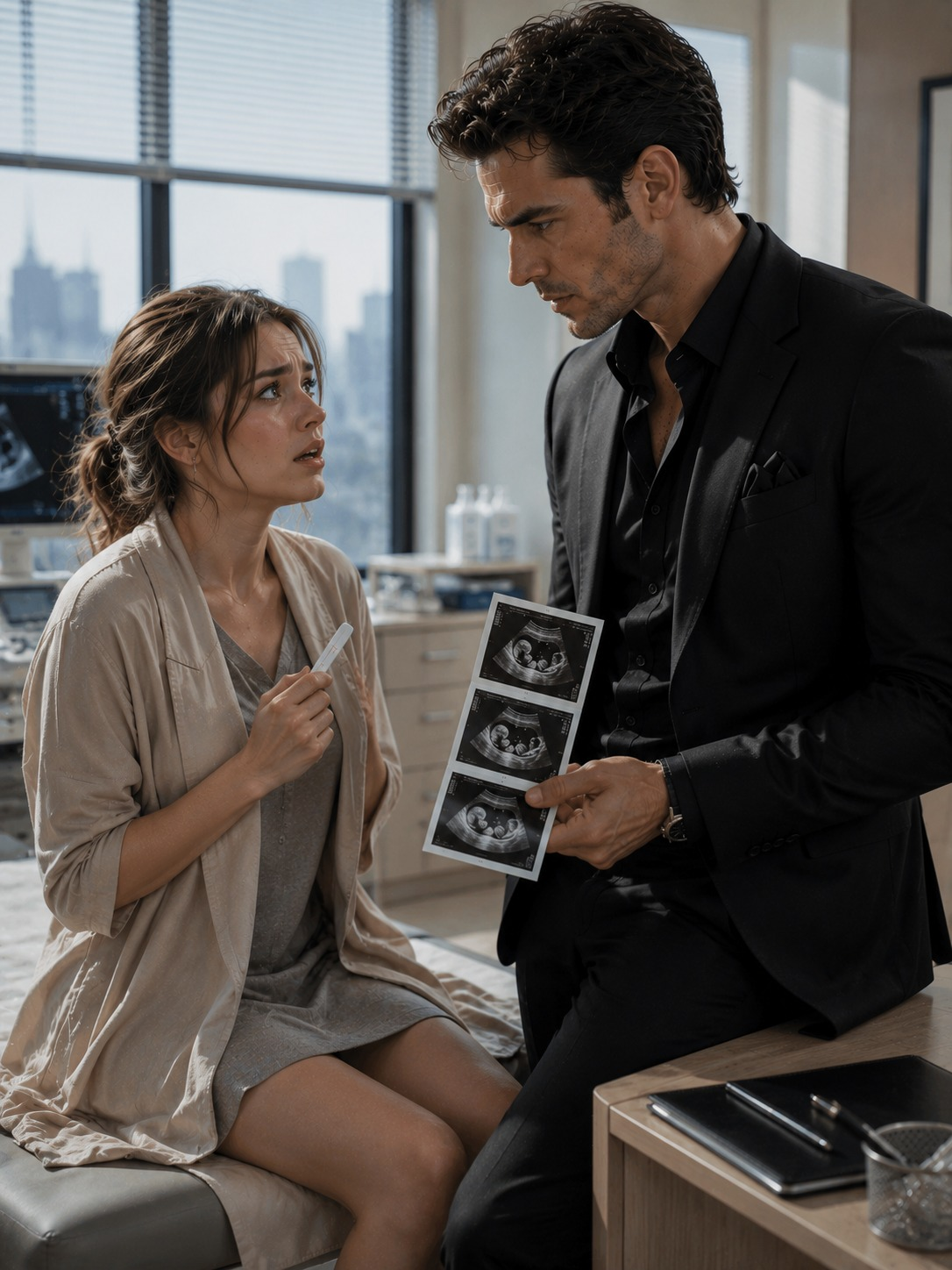
And every time the ultrasound showed three beating hearts, his expression changed.
The first time he heard all three, he cried.
Not dramatically.
Not loudly.
Just three silent tears slipping down his face.
I looked at him.
"Roman?"
He wiped his eyes.
"Sorry."
I smiled.
"Don't be."
He looked at the screen.
"Three."
I nodded.
"Three."
He laughed softly.
"I still can't believe it."
I looked at the tiny shapes.
Neither could I.
The babies arrived on a rainy morning in late spring.
Earlier than a full-term singleton pregnancy, as our medical team had prepared us for.
I had been admitted for monitoring, and when complications made delivery necessary, the doctors recommended a cesarean section.
Roman was beside me.
He wore hospital scrubs and looked more frightened than I had ever seen him.
I reached for his hand.
"Roman."
He looked at me.
"Yes?"
"You're squeezing too hard."
He immediately loosened his grip.
"Sorry."
I laughed.
Even then.
Even with fear pressing against my chest.
I laughed.
He bent closer.
"You're incredible."
I shook my head.
"I'm terrified."
"So am I."
I looked at him.
"Good."
He blinked.
"Good?"
"At least we're being honest."
He laughed.
Then kissed my forehead.
And stayed beside me.
The first baby arrived crying.
A boy.
Small.
Furious.
Beautiful.
The doctor announced his birth, and I began crying before I even saw him.
The second baby followed.
A girl.
Her cry was softer.
But just as determined.
Then came the third.
Another girl.
For one frightening moment, the room seemed too quiet.
The medical team moved quickly.
I held my breath.
Roman's hand tightened around mine.
Then we heard her cry.
A thin, beautiful sound.
I sobbed.
Roman bent over me, tears falling freely.
"She's here," he whispered.
I nodded.
"She's here."
All three babies needed specialized newborn care because they were premature.
The doctors had prepared us for that possibility.
Still, seeing them surrounded by monitors and nurses was harder than I had imagined.
There were days when I was afraid to hope too much.
Nights when I sat beside their incubators and watched their tiny chests rise and fall.
Roman stayed whenever the hospital allowed.
He brought coffee.
He read aloud.
He learned how to change diapers around medical wires.
He learned how to hold a baby small enough to fit against his chest.
And he never once told me not to worry.
He simply worried with me.
Over the following weeks, the babies grew stronger.
One by one, they learned to feed.
One by one, they needed less support.
One by one, the doctors began talking about going home.
And eventually, all three were ready.
We named our son Thomas Daniel Rinaldi-Marsh.
For the father who raised me.
And the father whose blood I carried.
Our first daughter became Rebecca Grace Rinaldi-Marsh.
For the woman who gave me life.
And the sister who had finally found me.
Our youngest daughter became Hope Isabella Rinaldi-Marsh.
For everything we had nearly lost.
And for the woman who survived long enough to reclaim her own child.
When I told Isabella about Hope's middle name, she cried.
Then she hugged me.
"I don't know what to say."
I smiled.
"You don't have to say anything."
She looked down at the baby in my arms.
"She's beautiful."
I nodded.
"She is."
Sophie stood beside her mother.
She peered into the stroller.
"Which one is Hope?"
I pointed.
"The one with the pink blanket."
Sophie studied her.
Then whispered, "She's really little."
I laughed.
"She is."
Sophie looked at Roman.
"Can I teach her to ride a horse when she's bigger?"
Roman smiled.
"If she wants to."
Sophie nodded seriously.
"Okay."
I looked at him.
He caught my eye.
And smiled.
It was a small moment.
But it meant more than any grand promise he had ever made.
Six months after the babies came home, I visited Thomas Marsh's grave.
The sky was clear.
The grass was wet from the previous night's rain.
I carried a small bouquet of white flowers.
Roman waited near the path with the stroller.
Grace stood beside him.
Cora had come too.
And Eleanor.
For the first time in years, the people I loved were standing together without a secret dividing them.
I knelt beside the headstone.
THOMAS MARSH
BELOVED HUSBAND AND FATHER
I touched the engraved letters.
"Hi, Dad."
My voice broke.
"I wish you could see them."
I looked back.
Roman was adjusting Hope's blanket.
Grace was laughing at something Cora had said.
Eleanor stood quietly beside the stroller, wiping her eyes.
I smiled through my tears.
"You would have loved them."
I placed the flowers against the stone.
"And you would have loved Grace."
My throat tightened.
"She has your stubborn streak. I know she isn't yours by blood, but I think you would have recognized her immediately."
I looked down.
"Thank you for trying to protect us."
The wind moved gently through the trees.
I closed my eyes.
For eleven years, I had carried questions about my father's death.
Now I had answers.
They weren't the answers I wanted.
But they were real.
And the people responsible were being held accountable.
I touched the headstone one last time.
"We're okay, Dad."
I swallowed.
"We're finally okay."
Roman asked me to marry him the following autumn.
Not at a restaurant.
Not at a gala.
Not in front of his business associates.
He asked me in our kitchen.
We had moved into a house we chose together, with a sunny room for my drafting table and enough space for three cribs.
The house was comfortable.
Not enormous.
Not surrounded by gates.
It had a garden.
A porch.
And neighbors who waved when they walked their dogs.
That evening, the babies were asleep.
Sophie was spending the weekend with us, and she had gone upstairs after insisting on reading the same bedtime story three times.
Roman stood beside the sink holding a dish towel.
I was drinking tea.
He looked nervous.
I smiled.
"What's wrong?"
He shook his head.
"Nothing."
I raised an eyebrow.
"Roman."
He laughed softly.
"All right."
He reached into his pocket.
My heart began to pound.
He took out a small ring box.
I stared.
"Roman."
He opened it.
Inside was a simple gold ring.
No enormous diamond.
No display of wealth.
Just a beautiful ring.
He looked at me.
"Lena, I spent most of my life believing that love meant protecting people from things they couldn't control."
I swallowed.
"I know."
He nodded.
"And I was wrong."
My eyes filled with tears.
He continued.
"You taught me that love means telling the truth. Listening. Respecting choices. Staying when things are difficult."
I looked at him.
His voice broke.
"I can't change what happened before I met you."
I shook my head.
"No."
"But I can choose what kind of man I am from now on."
He took my hand.
"I love you. I love our children. I love the family we've built."
Tears slipped down my face.
"And I would be honored if you chose to marry me."
I stared at him.
Then smiled.
"Are you asking because you think you have to?"
He shook his head.
"No."
"Because of the babies?"
"No."
"Because of the trust?"
He laughed softly.
"Definitely not."
I smiled.
"Then why?"
Roman looked directly into my eyes.
"Because I want to spend my life beside you."
I swallowed.
Not in front of me.
Not behind me.
Beside me.
I looked at the ring.
Then at the man holding it.
The man who had walked into a clinic and changed my life.
The man who had made terrible mistakes.
The man who had finally faced them.
The man who had learned that love could not be bought, inherited, or commanded.
I smiled through my tears.
"Yes."
Roman stopped breathing.
"Yes?"
I laughed.
"Yes, Roman."
He slipped the ring onto my finger.
Then kissed me.
And for the first time, the future didn't feel like something being decided by other people.
It felt like ours.
We married the following spring.
In a small garden.
With flowers growing along a white fence.
No armed guards.
No secret agreements.
No powerful men deciding where I should stand or what I should wear.
Grace stood beside me.
Cora stood beside her.
Eleanor sat in the front row, crying openly.
Isabella sat beside Sophie.
Claire attended with her family, and afterward she told me she had begun rebuilding a relationship with Sebastian through supervised correspondence while he served his sentence.
There were still difficult truths.
Still complicated relationships.
Still people learning how to live with the consequences of their choices.
But nobody was pretending anymore.
Roman stood beneath an arch of white roses.
He wore a dark blue suit.
His hair was still touched with silver at the temples.
And when he saw me, his face changed in the same way it had at the vineyard.
Only this time, there were no secrets waiting behind the moment.
I walked toward him.
Our three children sat with their caregivers in the front row.
Thomas waved both hands.
Rebecca squealed.
Hope tried to pull off her little white shoes.
I laughed.
Roman laughed too.
And when I reached him, he took my hands.
The ceremony was simple.
We promised honesty.
Patience.
Respect.
We promised to build a home where our children would never have to earn love.
Where they would know their history.
Where no one would hide their identities to protect an inheritance.
Where family would mean the people who showed up, told the truth, and stayed.
When Roman kissed me, our guests applauded.
Thomas began crying.
Rebecca joined him.
Then Hope.
Everyone laughed.
Roman leaned his forehead against mine.
"Three miracles," he whispered.
I smiled.
"Three very loud miracles."
He laughed.
Then kissed me again.
That evening, after the guests had gone and the children were finally asleep, Roman and I stood on the back porch.
The garden lights glowed softly.
The air smelled of roses and freshly cut grass.
Inside, our home was quiet.
Not the kind of quiet I had known before.
Not loneliness.
Not fear.
Just the peaceful silence of a house full of people who belonged there.
Roman wrapped an arm around my waist.
I leaned against him.
For a long moment, we watched the stars.
Then he said, "Do you ever think about the clinic?"
I nodded.
"Sometimes."
He looked down.
"What do you remember?"
I smiled faintly.
"How scared I was."
He kissed my hair.
"I'm sorry."
I shook my head.
"You don't have to apologize for that day anymore."
He was quiet.
I continued.
"I remember sitting in that room, thinking my life had already become too difficult."
I looked toward the house.
"Then I heard three heartbeats."
Roman smiled.
"And I walked in."
I laughed.
"Yes. You certainly did."
He looked embarrassed.
"I wasn't very subtle."
"No."
"Or particularly respectful of boundaries."
"Definitely not."
He laughed.
Then grew serious.
"I wish I'd done it differently."
I turned toward him.
"I know."
He took my hand.
I looked at our wedding rings.
Then toward the upstairs windows, where our children were sleeping.
"I used to think a happy ending meant getting everything you wanted."
Roman watched me.
"And now?"
I smiled.
"Now I think it means getting to choose your own life."
He squeezed my hand.
"And having people who respect that choice."
I nodded.
"Exactly."
Inside the house, a baby began crying.
Then another.
Roman closed his eyes.
"That sounds like Thomas and Rebecca."
I laughed.
"And Hope will join them in about ten seconds."
As if on cue, a third cry rose through the baby monitor.
Roman looked at me.
"All three."
I smiled.
"All three."
He held out his hand.
"Shall we?"
I took it.
And together, we went inside.
Upstairs, three little lives were waiting.
Not heirs.
Not beneficiaries.
Not names on a contract.
Our children.
Thomas.
Rebecca.
Hope.
They would grow up knowing that their mother had once been frightened of the future.
That their father had learned how to become a better man.
That their family had survived terrible secrets.
And that the people who loved them had chosen to break the cycle.
They would know Grace.
And Cora.
And Eleanor.
And Isabella.
And Sophie.
They would know the truth about Thomas Marsh, the man who had given his life trying to protect children who couldn't protect themselves.
They would know that family was not defined by money, power, or the names printed on legal documents.
It was defined by love.
By honesty.
By the choices we made every day.
Roman lifted Thomas from his crib.
I picked up Rebecca.
Then we both leaned over Hope, who was waving her tiny fists with great determination.
Roman laughed.
"She's going to be the boss."
I smiled.
"Not if Rebecca has anything to say about it."
Thomas reached for my hair.
Hope sneezed.
Rebecca began laughing.
And suddenly, all five of us were laughing together.
I looked at Roman.
He looked back.
No fear.
No secrets.
No unfinished promises.
Just us.
A family we had chosen.
A future we had built.
And three little miracles who would never have to wonder whether they belonged.
They did.
They always would.






Comments 0