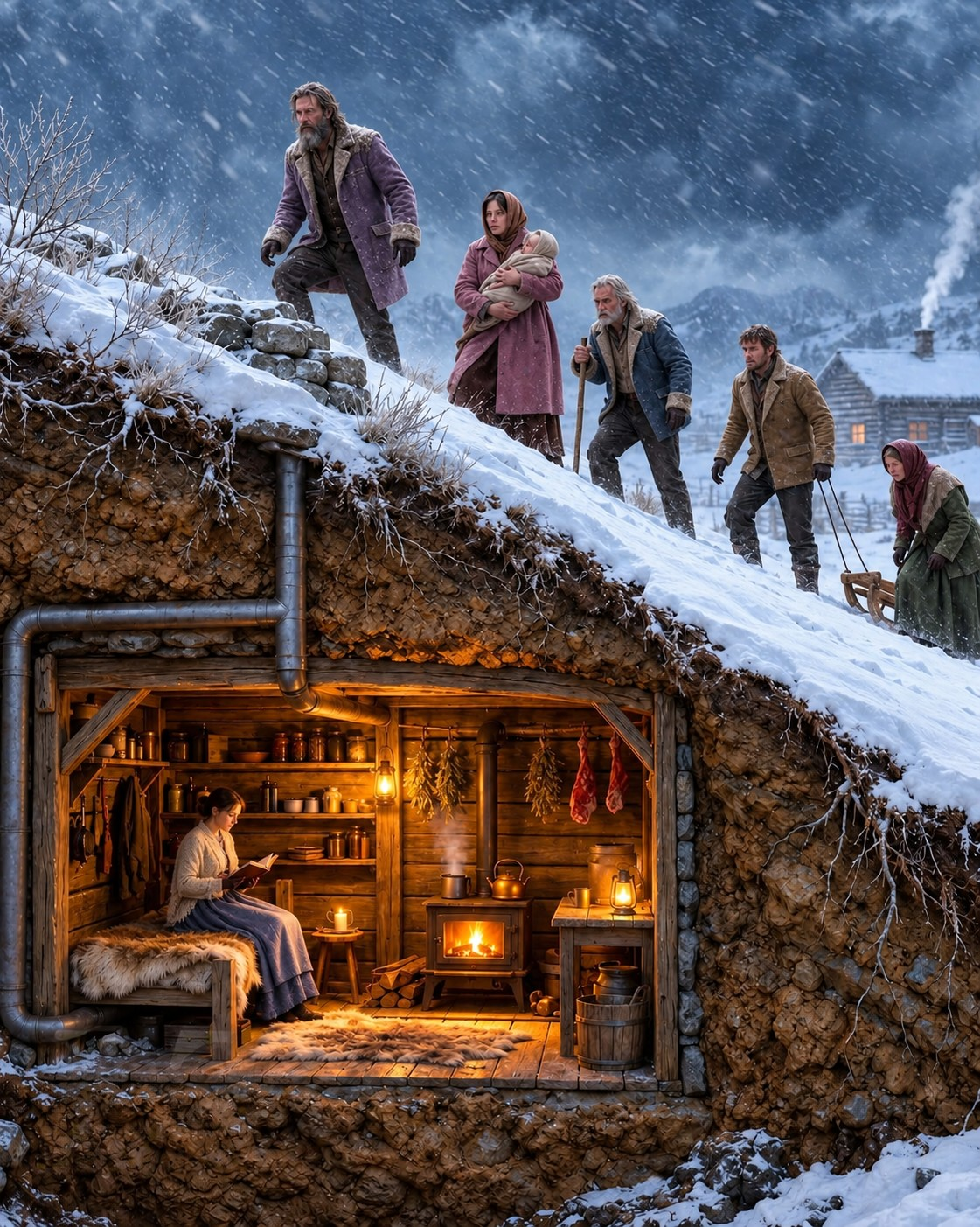
"Get behind the shed," Niels whispered.
Sena grabbed his sleeve.
The horse was coming closer.
Niels folded the threatening note and slipped it into his coat. Then he pushed Sena gently toward the narrow space between the storage shed and a fallen tree.
"Don't move until I tell you."
"But my notebook—"
"Your life is worth more than a notebook."
Sena obeyed.
Seconds later, a rider emerged from the darkness.
The man wore a heavy brown coat and a black hat pulled low over his face. His horse stopped near the creek, its breath rising in pale clouds.
Niels stepped forward, leaning on his walking stick.
"Evening."
The rider stiffened.
"Didn't expect anyone out here."
"That's strange," Niels replied. "Considering you're riding straight toward my shed."
The man glanced toward the building.
Sena recognized him.
Caleb Mercer.
He worked occasionally at the mercantile and had been one of the men laughing beside Alderman Cobb when she walked through Havenwood.
Caleb looked at Niels's walking stick.
"Just passing through."
"At this hour?"
"Lost something earlier."
Niels nodded slowly.
"Must be important."
Caleb's eyes shifted toward the excavation hidden beyond the trees.
"That Lindall girl still around?"
Sena pressed herself against the cold wooden wall.
Niels did not move.
"Why?"
"People are worried about her."
"Are they?"
"She's digging holes in the hills. Could get herself killed."
"That's a curious concern from people who wouldn't offer her a bed."
Caleb's expression hardened.
"I don't make the town's decisions."
"No," Niels said. "You just carry them out."
For a moment, neither man spoke.
Then Caleb adjusted his reins.
"Tell the girl she'd be wise to come back before the snow gets worse."
"Come back to what?"
Caleb had no answer.
He turned his horse.
As he rode away, Niels noticed a folded piece of paper protruding from the man's coat pocket.
It had the same pale blue edge as Sena's missing notebook.
Niels waited until the hoofbeats disappeared.
Then he called her out.
Sena stepped from behind the shed.
"He took it."
"I believe so."
"Why would he steal my drawings?"
Niels looked toward Havenwood.
"Because somebody sent him."
Sena's throat tightened.
"Cobb?"
"We don't know that yet."
"But he was watching us yesterday."
"Yes."
"And Caleb was standing with him when he laughed at me."
"Yes."
Sena looked down at her hands.
The blisters had barely begun healing.
Now someone had stolen the plans she had worked so hard to understand.
"What if they stop us?"
Niels approached her.
"Then we find another way."
"What if they destroy everything?"
"Then we rebuild what we can."
She shook her head.
"You make it sound simple."
"It isn't simple."
His voice softened.
"Nothing worth protecting ever is."
They did not sleep much that night.
Niels remained near the stove inside the storage shed, examining the torn piece of paper.
Sena sat at the small table with a fresh sheet of writing paper.
She was trying to recreate the missing drawings from memory.
The first attempt was terrible.
The measurements did not match.
The drainage channel was in the wrong place.
She crumpled the paper.
Then she tried again.
By midnight, she had completed a rough outline of the main chamber.
Niels looked over her shoulder.
"That's close."
"Not close enough."
"We'll measure again tomorrow."
Sena pressed her pencil against the page.
"They stole three days of work."
"They stole paper."
She looked at him.
"The work is still in your head."
Sena considered that.
Then she opened her father's pocketknife and placed it beside the drawing.
Eric had always insisted that understanding mattered more than memorizing.
When she was younger, he sometimes removed the instructions from a repair project and asked her to explain the process herself.
At the time, she thought he was being unnecessarily difficult.
Now she understood.
A person could steal a drawing.
They could steal a tool.
They could even destroy a building.
But they could not easily steal the knowledge that created it.
Sena picked up her pencil.
She started again.
By the time the lantern burned low, she had reconstructed almost the entire plan.
The next morning, Niels made a decision.
They would no longer leave their materials exposed.
They moved the tools into the shed and covered the excavation with branches whenever they stopped working.
They also changed their routine.
Instead of arriving at the hillside at the same hour each morning, they varied their schedule.
Sometimes they worked before sunrise.
Sometimes they waited until afternoon.
Niels kept watch from the creek while Sena dug.
It slowed their progress.
But it reduced the chance of being surprised.
The work itself became increasingly difficult.
The upper layer of earth was hard with frost.
Beneath it, the soil was dense and heavy.
Every bucket Sena carried seemed to weigh more than the last.
She developed blisters on her palms.
Then the blisters broke.
Even with gloves, the repeated friction left her hands raw.
One afternoon, she dropped a bucket and sat down beside the excavation.
Her fingers would not close properly.
Niels came over.
"Let me see."
She tried to hide her hands.
"They're fine."
"Sena."
She reluctantly held them out.
The old man examined the damaged skin.
"You need to stop for today."
"We haven't finished the entrance."
"And you won't finish anything if you cannot hold a shovel."
She looked toward the dark opening.
It was still too shallow to offer meaningful shelter.
The winter sky was growing darker every day.
"I don't have time to rest."
Niels sat beside her.
"Your father once told me something about you."
Sena looked up.
"What?"
"He said you were the most determined child he'd ever known."
A faint smile touched her face.
"That sounds like him."
"He also said your greatest weakness was believing determination could replace judgment."
Sena's smile faded.
Niels held out the salve.
"Rest is not surrender."
She accepted it.
That evening, she cleaned her hands and wrapped them carefully.
Then she sat beside the lantern and studied the revised drawings.
She could not dig.
But she could plan.
By the second week, the entrance passage had begun taking shape.
Niels supervised the placement of temporary supports while Sena removed the soil in small sections.
They checked the ground repeatedly.
The hillside was not simply a hole to be hollowed out.
Every section needed to remain stable.
Every beam had a purpose.
Every drainage channel had to carry water away from the living space.
Sena learned to recognize the warning signs of shifting earth.
She learned why a support should never be removed merely because it appeared inconvenient.
She learned that a roof buried beneath soil could be far more dangerous than a roof exposed to the sky.
And she learned to respect the difference between courage and carelessness.
One morning, a small section of the excavation crumbled.
Loose soil fell near her boots.
She jumped backward.
Niels immediately ordered her away from the opening.
They spent the next several hours inspecting the area and reinforcing the affected section before continuing.
Sena stared at the fallen earth.
"If I'd been standing farther inside..."
She did not finish.
Niels rested a hand on her shoulder.
"That's why we never trust a structure simply because it held yesterday."
For the rest of the day, Sena worked more slowly.
She checked every support.
She measured twice.
And when she was uncertain, she asked.
Niels noticed the change.
He did not praise her.
He simply allowed her to make more decisions.
That meant more to her than words.
At the farmhouse, Greta Lindall had begun hearing rumors.
People said Sena was living near the northern creek.
Some claimed she was building a shelter.
Others insisted she had lost her mind.
Greta dismissed the stories.
"She'll come crawling back when she's hungry."
But one afternoon, Alderman Cobb arrived at her door.
Greta invited him inside.
He removed his hat and accepted a cup of coffee.
"I've been hearing unusual things about your stepdaughter."
Greta stiffened.
"She's no longer my responsibility."
"Of course."
Cobb placed a folded sheet of paper on the table.
Greta looked at it.
"What is that?"
"A drawing."
She unfolded it.
The paper showed a rough underground chamber, an entrance passage, and a concealed chimney.
Greta frowned.
"Where did you get this?"
"Someone found it near the creek."
It was a lie.
But Cobb delivered it easily.
Greta studied the measurements.
"She drew this?"
"Apparently."
Greta shook her head.
"Eric filled that girl's head with foolish ideas."
Cobb leaned forward.
"Did Eric ever mention building anything in the northern hills?"
Greta hesitated.
"Not that I remember."
"Think carefully."
She looked toward the window.
"Years ago, he spent time out there with Niels Bergman."
"Doing what?"
"I never asked."
Cobb's eyes narrowed.
"Did he own land there?"
"I don't know."
"Did he leave any papers?"
Greta became defensive.
"Everything he owned is here."
Cobb studied her.
"Everything?"
Greta placed the drawing on the table.
"Why are you so interested?"
Cobb smiled.
"Because a young girl living alone in the wilderness could become a public concern."
Greta folded her arms.
"Then let the wilderness deal with her."
Cobb did not answer immediately.
He looked around the farmhouse.
At the furniture.
The polished table.
The framed photographs.
The property Eric had spent years building.
Then he returned his attention to Greta.
"If the girl is constructing something on land that belongs to someone else, there could be legal complications."
Greta's expression changed.
"What kind?"
"That depends on who owns the land."
He rose.
"I suggest you look through your late husband's papers."
After Cobb left, Greta remained at the table.
Then she went to Eric's old desk.
She opened the drawers.
She searched through receipts, letters, and property documents.
Near the bottom, she found a small envelope tied with string.
Across the front, Eric had written:
For Sena, when she is old enough to understand.
Greta stared at the handwriting.
Then she slipped the envelope into her apron pocket.
Back at the hillside, Sena was learning how to carry timber.
The work required patience and careful coordination.
Niels had identified several usable fallen trees near the creek.
They cut manageable lengths and transported them using a simple wooden drag.
The first load took most of the morning.
Sena slipped twice on the frozen ground.
By the time they reached the excavation, her shoulders ached.
She dropped the rope and leaned against a rock.
"How many more?"
Niels counted the marked pieces.
"Enough that you shouldn't ask."
Sena laughed despite herself.
The sound surprised them both.
For a moment, the hillside felt less lonely.
They rested beside the creek and ate bread with a little preserved meat.
Niels told her stories about the early days of Havenwood.
He remembered when the town had only a few buildings.
He remembered the first harsh winter.
He remembered families sharing food because there was not enough for everyone.
"People were different then," he said.
"Better?"
"Not always. But they understood how quickly a person could become helpless."
Sena looked toward the town.
"What happened?"
Niels considered the question.
"Comfort makes some people forget."
She thought about Cobb.
About Greta.
About the neighbors who had watched her walk away.
"Do you think they would help me if they knew I was in trouble?"
Niels did not answer immediately.
"Some would."
"Not Cobb."
"Perhaps not."
"Not Greta."
He looked at her.
"Your stepmother has made her choices."
Sena lowered her eyes.
"I still miss the house."
"Of course you do."
"I miss the kitchen. The barn. The chair Papa used to sit in."
Niels waited.
"Sometimes I dream I'm back there. I wake up thinking I can hear him chopping wood."
Her voice trembled.
"Then I remember."
Niels placed his hand over hers.
"Grief doesn't disappear because you're busy."
Sena swallowed.
"I know."
"But it can become something you carry without letting it stop you."
She looked toward the unfinished shelter.
"That's what I'm trying to do."
"I know, child."
The first snowfall that remained on the ground arrived near the end of October.
Sena woke to find the creek bordered by white.
The hills looked unfamiliar.
The excavation was partially covered.
For several minutes, she stood outside the shed and watched the snow fall.
It was beautiful.
It was also a warning.
Winter was coming faster than she had hoped.
She hurried to the hillside.
Niels arrived shortly afterward with a small wagon.
Inside were boards, nails, a length of stovepipe, and a battered wooden door.
Sena stared.
"Where did you get all this?"
"Old materials."
"From where?"
"Places where nobody was using them."
She examined the door.
Its paint had peeled away, and one hinge was bent.
But the wood was solid.
"It's perfect."
Niels smiled.
"Not yet. But it can be."
They spent the morning repairing it.
Sena removed the damaged hinge and fitted a replacement.
She sanded the rough edges.
Then she checked the frame.
Niels watched her work.
"Your father taught you well."
Sena looked up.
"He said a door should close properly even when nobody is watching."
"That sounds like Eric."
By afternoon, the repaired door stood beside the excavation.
It was the first object that made the project feel like a real home.
Sena touched the wood.
For the first time, she could imagine closing a door behind herself and knowing she was safe.
The main chamber took shape slowly.
They installed the first permanent support beams.
Then the next.
They reinforced the ceiling and checked the drainage.
Sena carried soil away from the entrance and spread it where the disturbed ground would be less noticeable.
They used natural stones and vegetation to preserve the hillside's appearance.
From the road, the work remained difficult to see.
But inside, a room was emerging.
A small one.
Low-ceilinged.
Rough.
Dark.
Yet large enough for a bed, a stove, a table, and shelves.
Sena stood inside it one afternoon, holding a lantern.
She looked around.
The walls were unfinished.
The floor was uneven.
The ceiling supports were exposed.
But it was hers.
She turned toward Niels.
"I can stand inside my own house."
The old man smiled.
"Almost."
Sena laughed.
"You're impossible."
"Someone has to keep you from getting too proud."
She looked around again.
Then her expression softened.
"I wish Papa could see it."
Niels removed his hat.
"He would have been proud."
Sena looked down.
For several seconds, she could not speak.
Then she whispered, "I hope so."
Two days later, the rumors reached the mercantile again.
A customer claimed to have seen smoke near the northern hillside.
Another insisted the Lindall girl was digging herself a grave.
Cobb listened without interrupting.
Then he asked a question.
"Has anyone actually seen the girl?"
The men exchanged glances.
One had seen her near the creek.
Another had noticed Niels hauling timber.
But no one had seen a completed shelter.
Cobb tapped his fingers against the counter.
"Then perhaps it's time we take a proper look."
Caleb Mercer stood nearby.
He shifted uncomfortably.
Cobb noticed.
"You've been out there."
Caleb nodded.
"Once or twice."
"And?"
"There's digging."
"Where?"
Caleb hesitated.
"Near the ridge."
Cobb leaned closer.
"Did you find an entrance?"
"No."
"A chimney?"
"No."
"A cabin?"
"No."
Cobb frowned.
"Then what exactly is she building?"
Caleb looked away.
"I don't know."
Cobb studied him.
Then he took the stolen notebook from his coat.
He opened it to the drawing of the main chamber.
"Perhaps we should find out."
At the hillside, Sena had begun building her bed.
She used rough boards for the frame and placed it against the wall farthest from the entrance.
Niels helped her make sure the legs stood evenly.
Then she covered it with a folded blanket.
It was narrow.
Hard.
Nothing like the bed she had slept in at the farmhouse.
But when she sat on it, she smiled.
"I think this is the best bed I've ever owned."
Niels raised an eyebrow.
"That says more about your circumstances than the bed."
She laughed.
They installed a small shelf above the table.
Sena placed her father's photograph on it.
Then she set the pocketknife beside the frame.
The room changed immediately.
It was no longer simply an excavation.
It had a memory.
A purpose.
A person who belonged there.
That evening, Niels brought a small iron stove.
It was old and scratched, but the firebox was sound.
Sena stared at it.
"How did you carry that?"
"Very carefully."
She laughed.
Then she noticed how heavily he was breathing.
"Sit down."
"I'm fine."
"Sit."
Niels looked at her.
She folded her arms.
He sighed and lowered himself onto the bed.
"You're becoming bossy."
"I learned from the best."
He smiled.
Together, they positioned the stove and checked the chimney arrangement.
Niels explained the importance of proper ventilation, a secure flue, and preventing smoke from entering the room.
They inspected every connection before lighting the first small fire.
Sena watched anxiously.
The flames caught.
The stove began warming.
A faint ribbon of smoke traveled through the pipe.
They checked for leaks.
There were none.
Niels nodded.
"Good."
Sena moved closer.
Warmth touched her face.
For several seconds, she simply stood there.
Then she began crying.
Quietly.
Without warning.
Niels rose.
"Sena?"
She shook her head.
"I'm all right."
But the tears continued.
She looked at the stove.
At the bed.
At the rough walls.
At the photograph of her father.
"I thought I was going to die out here."
Niels said nothing.
"I really thought I was going to die."
He approached and placed a hand on her shoulder.
"But you didn't."
Sena wiped her cheeks.
"No."
She looked around.
"I built this."
Niels smiled.
"You did."
She took a slow breath.
Then she whispered the words she had wanted to say since the day Greta slammed the farmhouse door.
"I have a home."
That night, Sena slept inside the hillside for the first time.
Niels remained nearby to make sure the stove and ventilation worked properly.
The fire burned low.
The room stayed warm.
Outside, the wind moved across the prairie.
Inside, Sena lay beneath her blanket and listened.
She could hear the occasional creak of timber.
The faint sound of the stove.
The distant wind above the earth.
But she could not hear the town.
No laughter.
No insults.
No Greta.
No Cobb.
For the first time in weeks, she felt safe enough to close her eyes.
Before sleeping, she reached for her father's pocketknife.
She held it against her chest.
"I did it, Papa."
Then she placed it beside her pillow.
And slept.
The following morning, Niels stepped outside before sunrise.
He climbed the slope to inspect the concealed chimney.
A thin ribbon of smoke rose between the rocks.
It drifted upward into the cold air.
From a distance, it appeared to emerge directly from the earth.
Niels watched it for several seconds.
Then he heard horses.
He turned.
Four riders were approaching from the road.
At their front rode Alderman Vernon Cobb.
Niels hurried back toward the entrance.
Inside, Sena was preparing breakfast.
She looked up when he entered.
"What's wrong?"
"Visitors."
Her expression changed.
"Who?"
"Cobb."
Sena set down the kettle.
"How many?"
"Four."
She looked toward the stove.
The fire was still burning.
The chimney was still releasing smoke.
Niels moved toward the concealed entrance.
"Stay inside."
Sena nodded.
He stepped outside and carefully restored the camouflage.
Then he climbed toward the rocks.
The riders were closer now.
Cobb dismounted.
He looked at the ground.
Then toward the rising smoke.
"Well," he said, "what have we here?"
One of the men pointed toward the hillside.
"Smoke."
Cobb removed his gloves.
He walked toward the rocks.
Niels watched from behind a cluster of brush.
Cobb crouched.
He placed his hand against a stone.
Then he looked toward the other men.
"There's a fire somewhere beneath us."
The men exchanged uneasy glances.
Cobb stood.
"Spread out."
They began searching.
One man walked toward the creek.
Another examined the rocks.
Caleb Mercer moved toward the concealed entrance.
Inside the shelter, Sena heard footsteps.
She froze.
A shadow passed across the tiny window.
Then another.
She slowly extinguished the lantern.
The room darkened.
Above her, Cobb shouted.
"Find the entrance!"
Sena pressed her back against the wall.
She could hear boots scraping against the frozen ground.
Someone was moving closer.
Then came a metallic sound.
A shovel striking stone.
Again.
And again.
Sena looked toward the concealed doorway.
A thin line of daylight appeared beneath it.
Someone outside was pulling away the covering.
She stepped backward.
The wooden latch began to move.
Then a man's voice came from the other side.
"I found something."
The latch lifted.
The door started opening.
And Sena recognized the voice of the man standing outside.
It was Alderman Vernon Cobb.






Comments 0