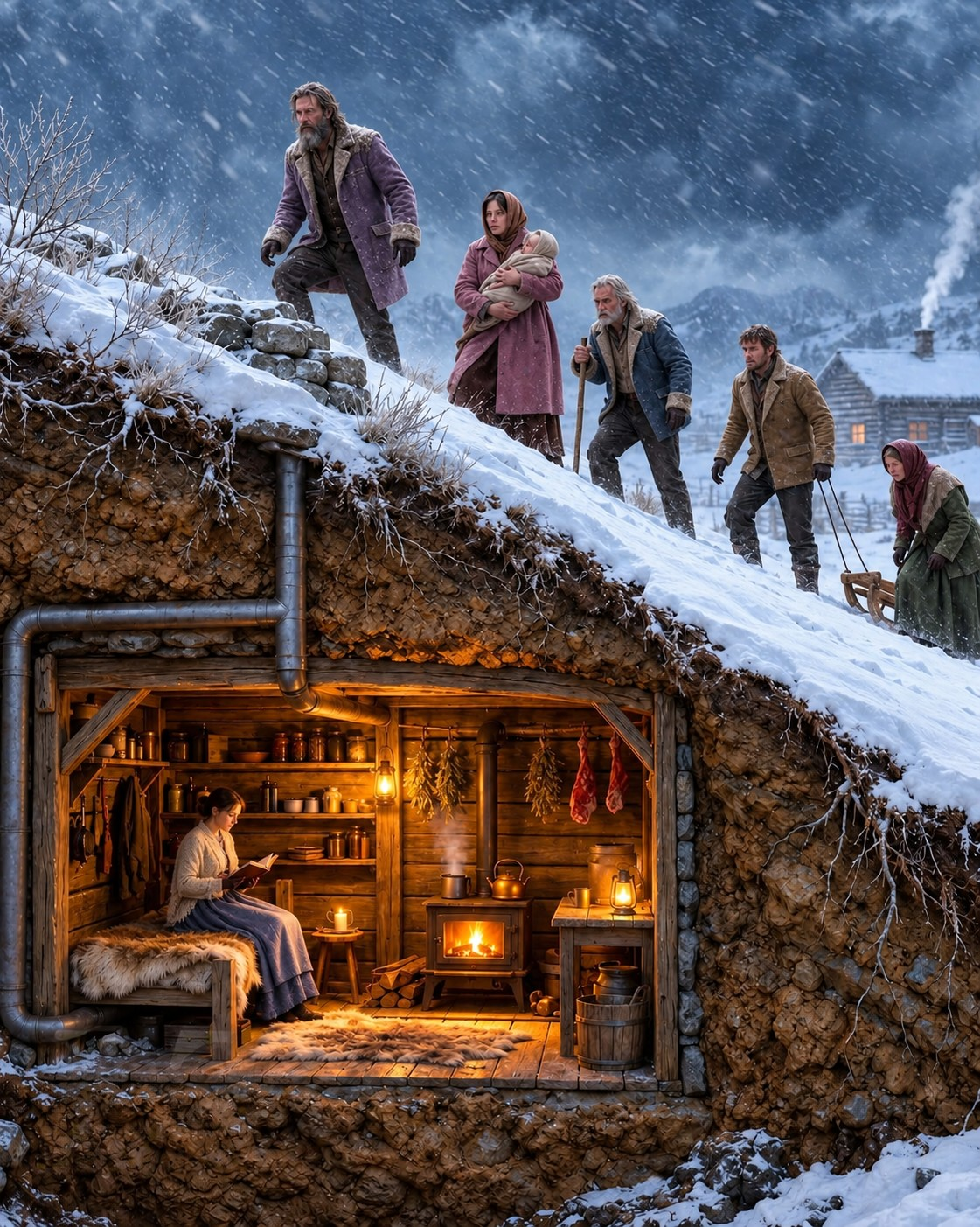
A seventeen-year-old girl dragged a small suitcase down the farmhouse steps, crying:
"Please, Greta. Don't send me away."
Greta Lindall stood in the doorway, holding the deed to the property.
Three days after her husband's funeral, she had made her decision.
Sena looked at the paper in her stepmother's hand.
Her father's name was still written across the top.
But his signature was no longer enough to protect her.
"You're leaving today," Greta said.
Sena tightened her fingers around the handle of her suitcase.
"Where am I supposed to go?"
Greta looked past her toward the frozen prairie.
"That's no longer my problem."
The door slammed.
And just like that, Sena Lindall became homeless.
She remained on the porch for several minutes, unable to move.
The wind slipped through the thin wool of her coat. Somewhere behind the farmhouse, a loose wooden shutter knocked repeatedly against the wall.
She stared at the door.
A part of her still expected it to open.
She expected her father to appear, wiping his hands on an old work apron, asking why she was standing outside in the cold.
He would have looked at Greta.
He would have understood immediately.
And he would have told her that nobody was going to throw his daughter out of her own home.
But her father was buried beneath six feet of earth.
And the door remained closed.
Sena lowered her eyes.
Her suitcase contained two dresses, three pairs of stockings, a worn wool shawl, a small Bible, and a photograph of her father.
The only valuable thing she possessed was the pocketknife he had given her when she turned twelve.
It had a dark wooden handle, a slightly crooked blade, and a tiny scratch near the hinge.
Her father had carved that scratch accidentally while repairing a fence.
He had laughed when she noticed it.
"Now you'll know it's yours, little sparrow. No other knife will have that mark."
Sena slipped the knife into her coat pocket.
Then she picked up the suitcase.
She walked away.
Her father, Eric Lindall, had not been a wealthy man.
He had arrived in Dakota Territory as a young Norwegian immigrant with almost nothing except a strong back, a few tools, and an extraordinary belief that honest work could build a better life.
He had purchased the farmhouse after years of saving.
He had repaired the roof himself.
He had built the barn with timber hauled from a distant creek.
He had planted fruit trees, raised livestock, and worked the soil until the land finally began rewarding him.
When Sena was little, he carried her on his shoulders while walking across the fields.
When she was twelve, he taught her how to sharpen an axe.
At fifteen, she could split firewood almost as quickly as some of the men in Havenwood.
She knew how to preserve vegetables, repair a broken hinge, mend clothing, recognize dangerous weather, and identify which plants could be used for medicine.
Her father never treated those lessons as chores.
He treated them as gifts.
"People can take your money," he often told her, "and they can take your possessions. But what you know stays with you."
Sena had never understood how important those words were.
Not until the morning she lost everything.
Her father had died in October.
A frightened horse had thrown him after a rattlesnake appeared near the trail. He suffered severe injuries, and despite the efforts of the local physician, he died before sunrise.
Sena had held his hand until it became cold.
Greta had stood near the bedroom window.
She had not cried.
Greta had married Eric six years earlier. She was a woman who cared deeply about appearances, property, and the opinions of people who possessed more money than she did.
She had never considered Sena her daughter.
While Eric was alive, she tolerated the girl because he insisted that the household belonged to both of them.
After the funeral, Greta no longer felt obligated to pretend.
The farmhouse, the barn, the livestock, and the surrounding property became her priorities.
Sena became an inconvenience.
Three days after the burial, Greta ordered her out.
She gave her no money.
No food.
No explanation beyond the fact that she was not going to spend another winter supporting someone who was not her blood.
Sena had begged.
She had reminded Greta that her father had promised she would always have a home.
Greta had answered with a single sentence.
"Your father is dead."
There was nothing left to say.
By the time Sena reached Havenwood, the afternoon light had begun fading.
The town consisted of a mercantile, a blacksmith's workshop, a small church, a schoolhouse, a doctor's office, and several wooden homes clustered along a muddy main road.
She knew nearly everyone.
That made walking through town harder.
People recognized her.
Some stopped talking when she approached.
Others watched from windows.
A woman who had once purchased eggs from Eric lowered her eyes.
An older man removed his hat but did not offer a greeting.
Sena continued walking.
At the mercantile, she heard laughter.
"Well, look who's still walking."
She stopped.
Alderman Vernon Cobb stood beside the entrance.
He was a broad man in his late fifties, with a thick reddish-blond mustache and a dark felt hat.
His olive-green coat was expensive by frontier standards.
Two men stood beside him.
Cobb had spent years building a reputation as the man who knew what was best for Havenwood.
He controlled town meetings, influenced property disputes, and enjoyed reminding people that his opinions carried weight.
He looked at Sena's suitcase.
"Where are you going, girl?"
She hesitated.
"North."
"North?"
"Toward the hills."
Cobb laughed.
"Planning to build yourself a palace?"
The two men beside him chuckled.
Sena did not answer.
Cobb stepped closer.
"Listen carefully. A girl who cannot keep peace in her own family has little chance of surviving alone."
"My father never said that."
Cobb's smile disappeared for a moment.
Then he shrugged.
"Your father isn't here anymore."
Sena felt those words more sharply than the cold.
She looked at him.
For several seconds, she considered answering.
She wanted to tell him that Eric had worked harder than Cobb ever would.
That her father had helped half the people standing on that street.
That he had never turned away a hungry neighbor.
But she realized something.
Cobb did not want an answer.
He wanted an audience.
He wanted her to cry.
He wanted the townspeople to see a frightened teenager who had failed.
So Sena picked up her suitcase.
"Good afternoon, Alderman."
She walked away.
Behind her, Cobb laughed again.
"She won't last a week!"
Nobody followed.
Nobody offered help.
And when the last buildings of Havenwood disappeared behind her, Sena finally allowed herself to stop.
She stood beside a frozen creek.
Her suitcase rested in the snow.
Her hands trembled.
She looked toward the distant ridge.
The prairie stretched endlessly before her, broken only by scattered rocks and patches of dead grass.
She had no house.
No family.
No money.
Winter was approaching.
For the first time since her father's death, she began to cry.
She sat on a flat stone and covered her face.
"I don't know what to do, Papa."
The wind answered.
She remained there until the sunlight began disappearing behind the western hills.
Then she heard footsteps.
Slow.
Uneven.
Coming from behind her.
"That's a poor place to sit when the temperature is dropping."
Sena quickly wiped her face.
An elderly man stood several feet away.
He wore a dark burgundy overcoat, a mustard-colored scarf, and worn leather boots.
His silver-white hair was tied behind his neck.
His back was bent, and he held a wooden walking stick.
Sena recognized him.
Niels Bergman.
He had known her father long before Eric purchased the farmhouse.
The old man had helped build fences, repair wagons, and construct several early buildings around Havenwood.
He had also spent years living beyond the settled parts of the territory.
He understood the prairie better than most people.
"Mr. Bergman," Sena said quietly.
Niels studied her suitcase.
Then her face.
"Where is your father?"
Sena lowered her eyes.
"He died."
Niels removed his hat.
He stood silently for a moment.
"When?"
"Three days ago."
The old man closed his eyes.
"I hadn't heard."
Sena swallowed.
"Greta made me leave."
Niels looked toward the distant town.
"She threw you out?"
Sena nodded.
He was quiet for several seconds.
Then he lowered himself onto the stone beside her.
"Your father would have been furious."
A faint, broken laugh escaped Sena.
"Yes. He would."
Niels examined her coat.
It was too thin for the approaching winter.
"Have you eaten today?"
She shook her head.
He reached into his leather satchel and produced a small piece of bread wrapped in cloth.
"Take it."
"I don't have money."
"I didn't ask for any."
Sena accepted the bread.
She ate slowly, trying not to appear too hungry.
Niels watched her.
Then he asked a question she did not expect.
"Do you remember the hill beyond the northern creek?"
Sena looked up.
"The one with all the rocks?"
"That's the one."
"Yes."
"Your father once helped me there."
Sena frowned.
"What did he help you do?"
Niels glanced toward the ridge.
"Something the town has forgotten."
He pointed to a low rise covered with frozen grass.
"There's a way to build a home inside that hill."
Sena stared at him.
"Inside it?"
"Under the earth. Protected from the wind. Hidden from anyone passing on the road."
She thought he was joking.
But Niels's face remained serious.
He began explaining an old construction method he had learned through years of frontier work and from Indigenous building knowledge shared with him by people who understood the land long before settlers arrived.
The structure relied on packed earth, carefully supported timber, proper drainage, and a concealed air passage.
The entrance could be hidden behind the natural shape of the hillside.
From a distance, the shelter would look like ordinary ground.
A person could walk above it without knowing there was a home underneath.
Sena listened without interrupting.
"Could someone actually live there?" she asked.
"If it is built properly."
"Through winter?"
"That's what it was designed for."
Sena looked at the ridge again.
There were no houses nearby.
No fences.
No neighbors.
Only frozen grass, scattered stones, and the endless prairie.
"Why would you tell me this?"
Niels leaned on his walking stick.
"Because your father once asked me to teach you something important."
Sena's eyes filled.
"What?"
The old man looked directly at her.
"How to survive when nobody else is willing to help."
For the first time that day, Sena felt something other than grief.
It was not happiness.
Not yet.
It was possibility.
She looked toward the hill.
Then down at her blistered hands.
"Will you teach me?"
Niels studied her for a long moment.
"Yes."
Sena breathed out.
"But listen carefully, child. I'll show you what I know. I'll help you plan. I'll bring what tools I can."
He tapped the frozen ground with his walking stick.
"But the digging will be yours."
Sena nodded.
"I can do that."
Niels looked at the darkening sky.
"Then we start tomorrow."
They reached the northern hillside just before sunset.
Niels showed Sena a natural depression between two rocky sections of the ridge.
From the road, it looked like an ordinary patch of uneven ground.
A cluster of stones concealed part of the slope.
Dead prairie grass covered the surface.
The place offered protection from the strongest western winds.
Niels knelt carefully and brushed away some snow.
"Look at the ground."
Sena crouched beside him.
He pointed toward the way the slope descended.
"Water runs downhill. If we ignore that, the first heavy rain will turn your bedroom into a pond."
He showed her where drainage would need to go.
Then he explained how supporting beams would carry the weight of the earth above.
He pointed to a distant cluster of timber near the creek.
"We'll need straight pieces for the main supports."
Sena listened closely.
Her father had taught her many of these principles, but Niels understood how to combine them into a concealed shelter.
He explained the ventilation system.
The chimney.
The placement of the stove.
The need for an emergency exit.
Nothing could be rushed.
Nothing could be guessed.
A single structural mistake could bury her alive.
Sena understood the danger.
But she also understood that this was her only chance.
Niels stood.
"One more thing."
"What?"
He looked at the hillside.
"Never build a home only to hide from the world."
Sena frowned.
"Then why are we hiding it?"
"Because you need time to become strong enough to decide when the world deserves to find you."
She remembered those words.
She would remember them for years.
As darkness settled, Niels walked her to a small abandoned storage shed near the creek.
It was not comfortable, but it offered temporary protection.
He left her with food, a blanket, and a lantern.
Before leaving, he turned back.
"Tomorrow, bring your father's knife."
Sena touched the pocket of her coat.
"Why?"
"Because every good home begins with remembering why you're building it."
Then he disappeared into the darkness.
Sena sat alone inside the shed.
She placed her father's photograph beside the lantern.
For a long time, she studied his face.
Then she opened the pocketknife.
The small scratch near the hinge caught the light.
She ran her thumb over it.
"I'll make it, Papa."
Outside, the wind moved across the frozen prairie.
Somewhere in Havenwood, Greta was sleeping in the farmhouse.
Cobb was probably telling another group of men that the Lindall girl would not survive the month.
Neither of them knew what Sena was planning.
Neither of them knew that the empty hillside would soon become something extraordinary.
And neither of them knew that the first shovel would enter the frozen earth at sunrise.
Because before the next winter storm arrived, Sena intended to build herself a home that no one could take away.
But the following morning, when she reached the hillside, she discovered something that made Niels stop walking.
Someone had already been there.
And beside the exact spot where they planned to dig, a fresh set of horse tracks disappeared beneath the snow.






Comments 0