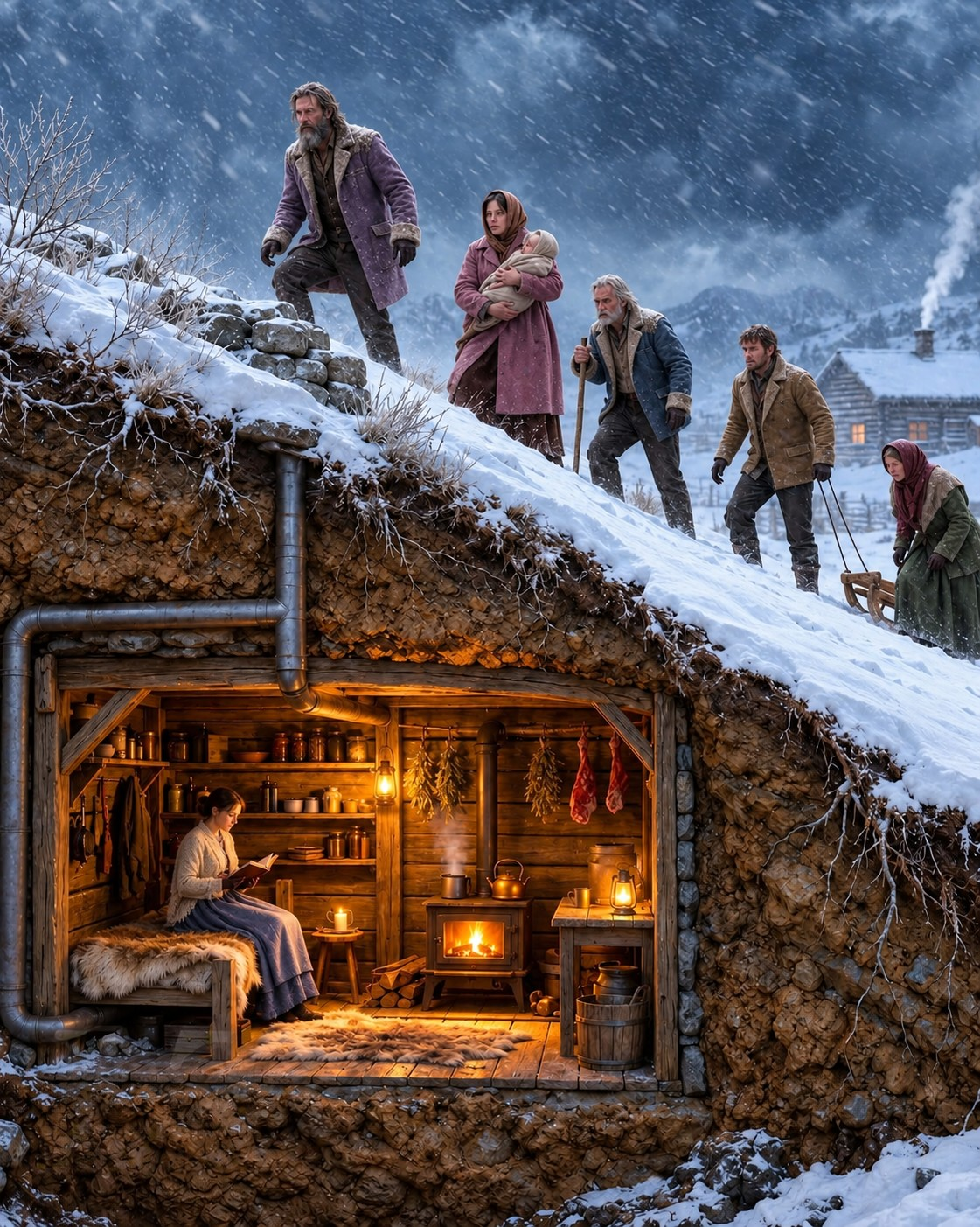
Doctor Samuel Whitmore stood beneath the entrance of the underground chamber, holding a leather folder in both hands.
Sena stared at him.
Behind the doctor stood Reverend Thomas Hale, his face pale and his eyes lowered.
Niels stepped forward.
"Put the documents on the table."
Whitmore hesitated.
"I didn't come here to fight."
Peter gave a bitter laugh.
"You should have thought about that before helping Silas."
The doctor looked toward Sena.
"I know what you believe about me. But there's something you need to understand before tomorrow's hearing."
Sena held her father's letter against her chest.
"Then speak."
Whitmore opened the folder.
Inside were three documents.
The first was a medical report.
The second was a payment record.
The third was an agreement bearing Eric Lindall's signature.
Whitmore placed them on the wooden table.
"Your father signed this agreement voluntarily."
Sena frowned.
"Papa would never have surrendered the springs."
"He didn't surrender them. He transferred temporary responsibility for the medical records and survey documents to me."
"Why?"
"Because he believed Silas was monitoring everyone close to him."
Peter examined the paper.
"Why didn't you tell the truth years ago?"
Whitmore looked down.
"Because I was afraid."
The doctor explained that Silas had discovered Eric's original survey and demanded that he help obtain the documents.
When Whitmore refused to surrender the entire water survey, Silas threatened his family.
Whitmore had initially cooperated by providing information about Eric's movements.
He had convinced himself that he could prevent violence by keeping Silas informed.
But the arrangement had gone too far.
On October 16, Eric had confronted him.
The argument ended with Eric leaving the medical office injured.
Whitmore admitted that he had treated Eric's wounds but had not reported the assault.
Instead, he had allowed Silas to convince him that Eric would be taken somewhere safe until he agreed to surrender the survey.
That was the decision Whitmore regretted most.
"Where did they take him?" Sena asked.
The doctor looked at her.
"To the old creek bridge."
Greta closed her eyes.
Whitmore continued.
"Silas struck him there. I arrived afterward. Eric was still alive, but badly injured. Reverend Hale helped us move him to the church."
Sena turned toward the minister.
"You knew?"
Thomas nodded.
"I helped carry him inside."
"Then why did everyone say he died in a horse accident?"
The minister's voice broke.
"Because Silas threatened to burn the church and kill anyone who testified."
Whitmore lowered his head.
"I signed the false medical report. I told myself it was the only way to keep the others alive."
Sena looked at him.
"And my father?"
Whitmore could not meet her eyes.
"Your father died the following morning. His injuries were too severe."
The chamber became silent.
For years, Sena had believed that her father had died because of a terrible accident.
Now she knew the truth.
He had been attacked by men who wanted to steal something he had discovered.
But there was one final question.
"Did Papa suffer?"
Whitmore looked at her.
"He was conscious when I treated him. He asked me to protect you."
Sena closed her eyes.
The doctor continued.
"He didn't ask me to protect his land. He didn't ask me to protect his money. He only asked me to make sure his daughter would have a home."
Tears rolled down Sena's cheeks.
Niels lowered his head.
Peter placed a hand on her shoulder.
And for the first time, Sena allowed herself to cry for the father she had lost.
The following morning, Havenwood gathered in the town hall.
News of the emergency hearing had spread quickly.
Farmers, merchants, families, and several elderly settlers filled the wooden benches.
Some had come because they wanted to protect their property.
Others wanted to know whether the strange smoke rising from the northern hillside had really come from a hidden underground home.
But everyone wanted to hear what Sena Lindall had discovered.
Silas Rourke arrived shortly before the hearing began.
He wore his finest black coat.
Vernon Cobb entered beside him.
Both men looked confident.
Silas believed the auction would proceed.
Cobb believed the council would support him.
Neither expected Judge Abigail Foster to arrive carrying a thick folder of original territorial records.
She took her place at the front.
"Today's hearing concerns the disputed ownership of the northern ridge, the underground water system, and the validity of the proposed auction."
Silas stood.
"I object to this proceeding. The property is legally registered under my client's claim."
Judge Foster looked at him.
"Sit down, Mr. Rourke. You will have an opportunity to speak."
Silas reluctantly returned to his seat.
Sena sat beside Walter.
Niels sat on her other side.
Greta remained a few rows behind them.
Peter stood near the entrance.
For the first time, the people who had once watched Sena walk out of town with nothing were now waiting to hear her speak.
Judge Foster opened the hearing.
"Miss Lindall, would you please come forward?"
Sena stood.
Her hands were trembling.
She looked toward the audience.
She recognized faces from the mercantile, the church, and the streets where she had once been mocked.
A few people lowered their eyes.
Others watched with genuine curiosity.
She approached the table.
Judge Foster spoke gently.
"Tell us what you discovered."
Sena placed her father's original survey on the table.
"My father discovered three underground springs beneath the northern ridge. He believed the water should remain available to the people of Havenwood."
She showed the judge the original agreement.
"He also discovered that the water system was connected to older territorial rights. Those rights were never legally transferred to a private owner."
Silas stood again.
"That's an interpretation."
Judge Foster raised her hand.
"You will have your turn."
Sena continued.
"My father spent years protecting these records. He built a hidden shelter because he believed someone would eventually search for them."
A murmur passed through the room.
She showed the original maps.
Then the old territorial agreement.
Finally, she placed the black ledger on the table.
"This book contains payments made to people who helped Silas Rourke obtain information about the water system."
Silas stood abruptly.
"Those records are stolen!"
Walter immediately responded.
"They were recovered from property belonging to Eric Lindall."
Judge Foster examined the ledger.
"Sit down, Mr. Rourke."
Silas remained standing for another moment.
Then he sat.
Eleanor Price was called to testify.
She explained how the original territorial documents had been preserved and why the later land transfer had never been properly registered.
She showed the council the missing registry number.
She demonstrated that Greta's signature had been obtained on a document that was never legally completed.
Greta was then asked to testify.
She walked slowly to the front.
Her hands shook.
She looked at Sena before speaking.
"I made mistakes."
The room became quiet.
"I allowed fear to control my decisions. I signed documents I did not understand, and I kept secrets that should never have been hidden."
She explained how Silas had threatened her.
She admitted that she had known Eric was being pressured.
And she admitted that she had thrown Sena out of the farmhouse because Silas had convinced her that keeping the girl away would protect her.
"I was wrong," Greta said.
Her voice broke.
"I was wrong to abandon her. I was wrong to let this town believe her father had died in an ordinary accident. And I was wrong to let a seventeen-year-old girl face a winter alone."
She turned toward Sena.
"I cannot ask you to forgive me. But I want everyone here to know that Eric never stopped loving his daughter. He would have been proud of what she built."
Sena looked at her stepmother.
She did not smile.
But she did not turn away.
Greta returned to her seat.
Reverend Thomas Hale was next.
He confirmed that Eric had reached the church after being attacked.
He described the injuries.
He confirmed that Silas had threatened him.
He also admitted that he had helped prepare the false account of the accident.
His testimony was difficult to hear.
Several people in the audience began whispering.
But the minister did not defend himself.
"I was afraid of losing the church. I was afraid of losing my life. But my silence allowed an innocent girl to suffer."
He looked toward Sena.
"I am sorry."
Then Doctor Whitmore was called.
He confirmed the medical payments.
He admitted that he had altered Eric's medical report.
He identified Silas's signature on the payment agreement.
Finally, he presented the original medical notes he had kept hidden for years.
They confirmed that Eric's injuries were inconsistent with the official account of a simple fall from a horse.
The judge examined them carefully.
Then she looked toward Silas.
"Do you have an explanation?"
Silas stood.
"All of this is based on the word of frightened people who have spent years protecting one another."
Judge Foster remained calm.
"Then perhaps you can explain the financial records."
Silas said nothing.
She placed another document on the table.
It showed payments made to the territorial office.
Cobb's signature appeared beneath several entries.
The alderman stood.
"This is outrageous!"
Walter turned toward him.
"Would you like to explain why public funds were used to support a private land claim?"
Cobb looked toward Silas.
For the first time, the two men were no longer standing together.
Silas tried one final argument.
He claimed that Eric had voluntarily transferred the land.
He claimed the original documents were incomplete.
He claimed the water system was too complicated for public management.
But Judge Foster had already examined the evidence.
She asked Peter to present the original territorial agreements.
Peter placed them before her.
The old seals were intact.
The signatures matched.
The survey descriptions matched the land.
And the original provisions clearly established that the water system could not be privately owned.
Judge Foster read the final paragraph aloud.
"The underground water sources and their connecting channels shall remain protected for the benefit of the surrounding settlements."
A quiet murmur passed through the room.
Silas looked toward the door.
Two territorial officers were standing there.
Judge Foster continued.
"The proposed auction is suspended immediately. The disputed land claim is referred for further investigation. All attempts to transfer or restrict access to the underground water system are prohibited until the matter is fully resolved."
She turned toward the officers.
"Mr. Rourke and Mr. Cobb will remain available for questioning concerning the financial records, fraudulent filings, and the circumstances surrounding Eric Lindall's death."
Silas stood.
"You cannot do this!"
Judge Foster looked at him.
"I just did."
The officers approached.
Cobb began protesting.
Silas remained silent.
As they escorted him past Sena, he stopped briefly.
"You think you've won?"
Sena looked at him.
"No."
Silas frowned.
She continued.
"I think my father finally gets to be heard."
The officers led him away.
For several seconds, the town hall remained completely silent.
Then someone began applauding.
Another person joined.
Soon the entire room was filled with the sound.
Sena looked toward the ceiling.
She imagined her father standing beside her.
And for the first time, she felt that the truth had finally reached the surface.
The weeks that followed brought enormous changes to Havenwood.
The investigation into Silas and Cobb continued.
Several financial records were recovered from the territorial office.
Doctor Whitmore agreed to provide full testimony.
Reverend Hale resigned from his administrative position at the church and publicly apologized to the families affected by his silence.
Cobb was removed from the council.
The proposed auction was permanently canceled.
The northern ridge remained protected.
And the original water agreements were formally recognized.
But the most important decision came during a public meeting several weeks later.
The people of Havenwood gathered to establish a community water trust.
Every household would have access to the water system.
Farmers would receive fair access for irrigation.
New wells would be constructed carefully.
The natural springs would be protected from private exploitation.
Sena was asked to help oversee the project.
She hesitated.
"I'm only seventeen."
Judge Foster smiled.
"You understand the land better than most people twice your age."
Niels nodded.
"And you understand why it matters."
Sena looked around the room.
The same people who had once laughed when she walked into the northern hills were now waiting for her answer.
She thought of her father's words.
Never fear the land.
Learn to listen to it.
"I'll help," she said.
The room erupted in applause.
Greta approached Sena after the meeting.
She carried a small wooden box.
Sena recognized it immediately.
It was the box that had disappeared from her father's study.
Greta placed it on the table.
"I found it in Silas's storage room after the officers searched his property."
Sena opened it.
Inside were the small stones her father had collected.
The pale mineral sample was there too.
Beside it lay a photograph.
Eric was standing with Sena beside the old barn.
She was smiling.
He was holding her hand.
On the back, he had written:
My little sparrow. The greatest thing I will ever build is not a house, a barn, or a well. It is the courage I hope you carry into the world.
Sena ran her fingers across the words.
Greta stood quietly.
"I don't expect you to come home with me."
Sena looked up.
"Where would you go?"
Greta shrugged.
"I'll find work. Perhaps in town."
Sena closed the box.
"You can stay at the farmhouse."
Greta looked stunned.
"Why?"
"Because it's still your home too."
Tears filled Greta's eyes.
"Sena..."
"That doesn't mean everything is forgotten."
"I understand."
"But we can start by telling the truth."
Greta nodded.
She did not ask for more.
For the first time, the two women stood together without pretending the past had never happened.
Peter decided to remain in Havenwood.
He helped Niels repair the old farmhouse.
He also assisted with the water trust, using the knowledge he had gained during his years away.
The two brothers spent long afternoons working together.
Sometimes they argued.
Sometimes they laughed.
But they no longer allowed old disagreements to separate them.
One afternoon, Sena found Peter sitting on the porch.
He was holding an old photograph of himself and Eric.
"Do you miss him?" she asked.
Peter nodded.
"Every day."
Sena sat beside him.
"I wish I had known him longer."
Peter looked at her.
"You knew him better than you think."
He handed her the photograph.
"Every time you make a decision based on what is right rather than what is easy, you carry something of him with you."
Sena looked at the picture.
Then she placed it beside the small wooden bird.
"Will you teach me more about the land?"
Peter smiled.
"Anything you want to learn."
By spring, the hidden shelter beneath the northern ridge had become an important part of the community project.
Niels and Sena repaired the entrance.
They strengthened the supporting beams.
They improved the drainage system.
They installed proper ventilation.
The little stove was cleaned.
The shelves were repaired.
And the narrow underground window was replaced with new glass.
The shelter was no longer a secret place where a frightened girl hid from a town that had rejected her.
It became a demonstration of practical frontier construction.
Niels taught local families how earth-covered shelters could provide protection during severe weather.
Sena explained how they had built the chimney to blend with the surrounding rocks.
She showed them the storage area.
The drainage channel.
The insulated walls.
The carefully planned entrance.
People listened.
Some apologized for laughing at her.
Others admitted they had believed she would never survive.
Sena did not humiliate them.
She simply continued working.
The town had a great deal to repair.
And she had decided that the future mattered more than revenge.
One warm afternoon, Sena returned to the hillside alone.
The prairie grass had begun growing again.
Small flowers appeared between the rocks.
She stood near the concealed entrance.
In her hand was the wooden pendant Peter had given her.
She opened it.
Her father's photograph was still inside.
For a long time, she said nothing.
Then she whispered:
"I did it, Papa."
She looked toward Havenwood.
Smoke rose from dozens of chimneys.
Children ran along the road.
Farmers prepared their fields.
The old church bell rang in the distance.
And beneath the hillside, the water continued flowing.
She thought about the girl who had stood barefoot outside the farmhouse with only a thin coat, a pocketknife, and a small bundle of belongings.
That girl had believed she had lost everything.
But she had not lost her father's knowledge.
She had not lost her courage.
And she had not lost the ability to build a future.
A familiar voice came from behind her.
"Ready?"
It was Niels.
Sena smiled faintly.
"Ready."
He held out a shovel.
"There's work to do."
She took it.
Together, they walked toward the new community well.
By summer, the first public water station opened.
Families gathered around it.
Children filled wooden buckets.
Farmers tested the flow.
Martha Ellis brought bread for everyone.
Walter delivered the official trust papers.
Eleanor arrived with copies of the original territorial agreement, now safely registered.
Reverend Hale attended quietly.
He did not take the pulpit.
He simply helped carry water.
Greta stood beside Sena.
Peter and Niels worked near the well.
For the first time, the entire town was gathered around something that belonged to everyone.
Judge Foster arrived shortly before noon.
She handed Sena a sealed document.
"The final registration."
Sena opened it.
The underground water system was now officially protected under the community trust.
The northern ridge could no longer be sold as a private water resource.
The original agreement had been restored.
Sena read the document twice.
Then she looked at the people around her.
"Thank you," she said.
Judge Foster smiled.
"Your father started this."
Sena looked toward the hills.
"And everyone helped finish it."
The judge nodded.
"That is how a community is supposed to work."
That evening, the townspeople gathered outside the farmhouse.
They had organized a small celebration.
There was food, music, and laughter.
Children played near the barn.
Martha told stories about Eric.
Peter shared memories of their childhood.
Niels laughed so hard that he nearly spilled his drink.
Even Greta smiled.
Sena sat on the porch steps.
She wore a simple blue dress.
Her father's pocketknife rested in her hand.
She had cleaned it carefully and repaired the leather case.
Beside her sat the wooden box containing his stones.
Walter approached.
"May I sit?"
She nodded.
He looked toward the hills.
"You know, when you first disappeared, most people thought you wouldn't survive a week."
Sena smiled faintly.
"I remember."
"I was one of them."
She turned toward him.
"At least you admit it."
Walter laughed.
"Fair enough."
He looked at the little wooden bird beside her.
"Your father would be proud."
Sena looked at the photograph in the pendant.
"I hope so."
Walter stood.
Then he offered her his hand.
"Come on. They're waiting for you."
Sena accepted.
Before the celebration ended, Judge Foster asked Sena to say a few words.
She stood before the townspeople.
For a moment, she remembered the day she had been forced to leave the farmhouse.
She remembered the laughter.
The closed doors.
The cold creek.
The first hole she had dug into the hillside.
The blisters on her hands.
The nights when the wind shook the earth above her.
And the mornings when she had awakened to find that she was still alive.
She looked at the people gathered before her.
"I was seventeen when I left this town," she began.
"I thought I had lost my home, my family, and everything my father had worked for."
The crowd became quiet.
"But I learned something beneath that hill. A home isn't only the place where you sleep. It's the place where people are willing to stand beside you."
She paused.
"My father taught me to listen to the land. Niels taught me how to build. Peter helped me understand the past. And the people of this town have shown me that even after terrible mistakes, a community can choose to do better."
She looked toward Greta.
Her stepmother was crying.
Sena continued.
"I cannot change what happened. But I can help decide what happens next."
She lifted the small wooden bird.
"This is what my father left me. Not wealth. Not a title. Just a little reminder that even the smallest person can protect something important."
The crowd applauded.
Sena stepped back.
Niels wiped his eyes.
Peter smiled.
And Greta quietly whispered:
"Eric would have been so proud."
A year later, Havenwood looked different.
The water trust had helped several families repair their wells.
New channels provided reliable irrigation.
The northern ridge was protected.
The underground shelter remained open for educational visits, and Sena helped teach practical building and land-survival skills.
She was no longer known as the homeless girl who had disappeared into the hills.
People called her the Sparrow of Havenwood.
She disliked the nickname at first.
But eventually, she accepted it.
Not because it made her famous.
Because it reminded her of her father.
One morning, Sena stood outside the shelter.
A little girl approached her.
She was carrying a small wooden shovel.
"Miss Lindall?"
Sena turned.
"Yes?"
"My mother said you built a house under the ground."
Sena smiled.
"I did."
"Why?"
The girl looked genuinely curious.
Sena crouched to her level.
"Because sometimes the safest place is the one nobody thinks to look."
The girl considered this.
"Can you show me?"
Sena held out her hand.
"Of course."
They walked toward the entrance together.
Behind them, the morning sun rose over the prairie.
A thin ribbon of smoke drifted from the shelter chimney.
This time, nobody wondered where it came from.
Everyone knew.
Beneath the hill was a home built by a girl who had once been told she had nowhere to go.
And above that hill was a town that had finally learned to make room for her.
Sena looked toward the distant farmhouse.
The old porch had been repaired.
The barn stood strong.
Her father's chair had been placed beside the window.
Greta was preparing breakfast.
Niels was already working near the well.
Peter was teaching two young boys how to read a survey map.
The house was full again.
Not because the past had been erased.
But because the people who remained had chosen to build something better.
Sena touched the silver sparrow pendant around her neck.
Then she looked at the little girl beside her.
"Come on," she said gently. "There's a lot to learn."
And together, they stepped into the shelter.
The stove was warm.
The shelves were full.
The water was flowing.
And for the first time in her life, Sena no longer needed to hide from the world.
She had found her home.






Comments 0