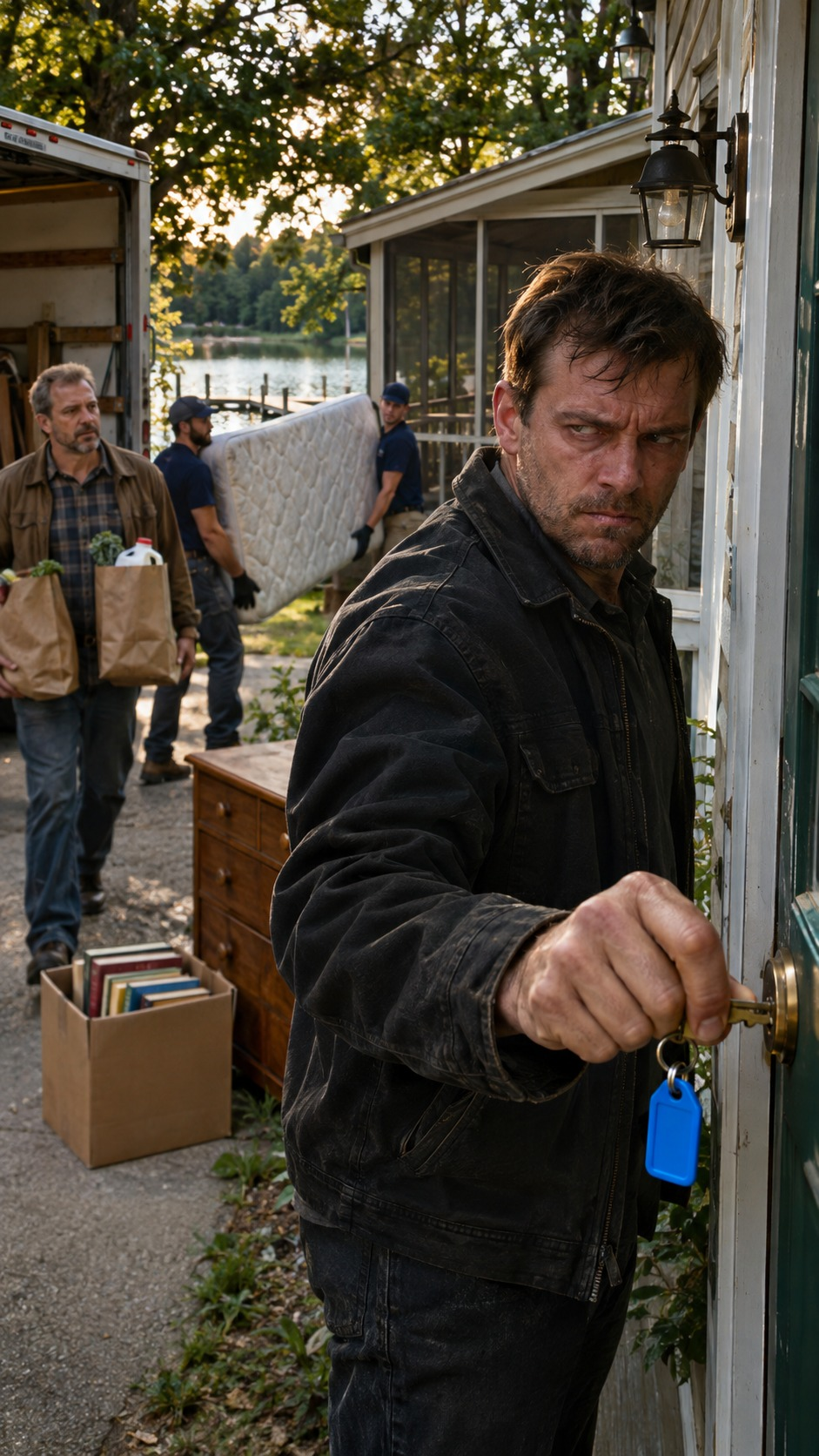
The name on the deed was Daniel Collins.
My son.
I stared at the document on my phone, waiting for the letters to become something else.
They didn't.
GRANTEE: DANIEL COLLINS.
Below his name was the address of my lake house.
My house.
The place I had purchased with my own savings after thirty-eight years of working in Michigan public schools. The place where I had planned to drink coffee in the mornings, watch the seasons change, and spend whatever years I had left without asking anyone's permission.
Someone had recorded a document claiming I had given it to my son.
And the signature beside my name was one I had never written.
For several seconds, I couldn't move.
Then I called Helen.
She answered immediately.
"Margaret, did you see the document?"
"Yes."
"Are you at the house?"
"Yes."
"Stay there. I've already contacted the county register of deeds and the title company that handled your purchase."
I looked at the front door.
"Does Daniel own my house now?"
"No," Helen said firmly. "A recorded deed does not automatically make an unauthorized transfer valid. But we need to act quickly to challenge the document and prevent anyone from relying on it."
I sat down.
"Someone forged my signature."
"That's what the evidence strongly suggests."
"Daniel's name is on it."
"I know."
I closed my eyes.
For the past several days, my son had been bringing me documents, admitting mistakes, and promising to cooperate.
He had stood on my porch with Aaron and Eli.
He had helped his son hang a birdhouse.
He had told me he wanted to earn my trust again.
And now his name appeared on a deed transferring my house.
I felt sick.
"Helen, I can't do this again."
Her voice softened.
"You don't have to handle it alone."
I pressed my fingers against my forehead.
"How did this happen?"
"We're investigating the submission. I've requested the recording information and the documents associated with it."
I looked at the date.
That morning.
Someone had filed the deed while I was sitting in my kitchen believing the worst of the investigation might finally be behind me.
"What should I do?"
"First, don't sign anything. Second, don't confront Richard. Third, preserve the messages and photographs you've received."
I nodded.
"And Daniel?"
"I want to speak with him as soon as possible."
I looked at his name on the deed.
"So do I."
After we ended the call, I sat at the kitchen table.
I could hear the refrigerator humming.
Outside, the lake was calm.
I thought about calling Daniel immediately.
I wanted to ask him whether he had lied to me again.
Whether the apology on my porch had been another performance.
Whether he had known that someone was preparing to take my house.
But I remembered what had happened every time I acted before seeing the complete records.
I had been hurt.
I had been angry.
And sometimes, I had been wrong about the meaning of a document.
This time, I would wait for the evidence.
My phone rang twenty minutes later.
Daniel.
"Mom?"
His voice sounded frightened.
"Helen just called me."
I said nothing.
"She told me about the deed."
I looked at the photograph.
"Your name is on it."
"I know."
"Did you sign it?"
"No."
"Did you authorize Richard to file it?"
"No."
I closed my eyes.
"Daniel, I need the truth."
"Mom, I swear I didn't know."
I wanted to believe him.
But wanting wasn't enough anymore.
"Then come to Helen's office," I said. "Bring every document you have."
"I'll be there."
He paused.
"Mom?"
"Yes?"
"I don't want your house."
I looked toward the window.
"Then help me prove that."
Helen's office was quiet when I arrived.
Daniel was already there.
Aaron sat beside him.
Neither of them stood when I entered.
Daniel looked pale.
"Hi, Mom."
I nodded.
Helen came in carrying a folder.
"Thank you for coming."
She placed the recorded deed on the table.
The document listed me as the grantor.
Daniel as the grantee.
And Richard Bennett's company as the party that had prepared the instrument.
There was a notarial acknowledgment attached.
I examined the signature.
It looked like mine.
But the date was impossible.
I had been at the lake house that morning.
I had not met with a notary.
I had not signed a deed.
Helen turned to Daniel.
"Have you ever seen this document before today?"
"No."
"Have you ever signed an acceptance or acknowledgment related to this transfer?"
"No."
"Did Richard ever discuss putting the property in your name?"
Daniel hesitated.
"Yes."
I felt my stomach tighten.
"When?" Helen asked.
"Before the moving truck."
I looked at him.
He lowered his eyes.
"Richard said that if Mom eventually agreed, the property could be transferred into a family arrangement."
"Did you agree to that?" Helen asked.
"I said I wanted a place for Aaron and Eli."
"Did you tell Richard he could prepare a deed?"
"No."
"Did you know he intended to file one?"
"No."
Helen studied him.
"Did you sign any document granting Richard authority to act for you?"
Daniel opened his folder.
"I signed a representation agreement."
He handed it across the table.
Helen read it.
Then she pointed to a paragraph.
"Daniel, this authorizes Richard to communicate with lenders about a proposed transaction. It does not give him permission to sign for Margaret or transfer her property."
Daniel nodded.
"I understand that now."
I looked at him.
"Did you understand it then?"
He swallowed.
"No."
I felt anger rise.
"Daniel, you were willing to let Richard handle my house because you thought you would benefit."
He didn't argue.
"Yes."
"And you didn't ask me."
"No."
I looked away.
He continued quietly.
"But I didn't tell him to forge your signature."
Helen placed the representation agreement beside the deed.
"That distinction matters. We need to establish exactly who prepared, signed, notarized, and submitted this instrument."
She turned to me.
"Margaret, the register of deeds has provided the submission details. The document was delivered through a third-party recording service."
"Who submitted it?"
"An account associated with Richard's business."
I took a breath.
"And the notary?"
Helen looked at the acknowledgment.
"The commission number and name don't match the state records for an active notary."
I stared at her.
"So the notarization is false?"
"It appears to be. We're obtaining formal confirmation."
Daniel lowered his head.
Aaron reached for his hand.
Helen continued.
"I've already prepared the necessary filings to challenge the deed and give notice of the dispute. We'll also seek a court order confirming Margaret's ownership and preventing further attempts to transfer or encumber the property."
I felt my shoulders relax slightly.
"Can Richard sell my house?"
"Not lawfully. And we've notified the relevant parties that the recorded deed is disputed. The title company is cooperating."
I looked at Daniel.
"Will you sign a statement saying you never accepted this transfer?"
"Yes."
"Will you cooperate if the authorities investigate?"
"Yes."
"Even if it means explaining everything you did before the moving truck arrived?"
He looked directly at me.
"Yes, Mom."
For the first time, I believed he understood what accountability required.
Not a private apology.
Not a promise that everything would work out.
The truth.
Even when it made him look bad.
The next several weeks were exhausting.
There were meetings with Helen.
Calls with the lender.
Requests for records.
Formal statements.
Documents that had to be signed in person and carefully reviewed.
I learned more about property records and financial authorizations than I had ever wanted to know.
But this time, I wasn't alone.
Helen handled the legal filings.
Daniel provided his emails and business records.
Aaron helped organize the correspondence.
Eleanor turned over the original settlement documents and admitted, in a signed statement, that she had certified an authorization years earlier without personally witnessing my signature.
Carol provided the records she had taken from Richard's office.
And Richard finally lost control of the story he had been telling everyone.
The lender confirmed that the recent loan application had been rejected after the disputed authorization was investigated.
No money had been released.
No mortgage had been recorded against my lake house.
The county's records showed the suspicious deed, but the court proceedings established that I had never executed it.
The notarial acknowledgment was invalid.
The signature was not mine.
Daniel formally disclaimed any ownership interest and testified that he had never authorized anyone to forge my name.
The court entered an order declaring the purported transfer void and confirming that I remained the sole owner.
Helen arranged for the order to be recorded.
When she handed me the certified copy, I held it for a long time.
"Is it finished?" I asked.
"The ownership dispute is resolved," she said. "The county records now reflect the court's decision."
I looked at the document.
My name.
My address.
My property.
No family arrangement.
No authorized representative.
No beneficiary designation.
Just me.
"Thank you," I whispered.
Helen smiled.
"You did the important part, Margaret. You refused to accept a false claim about your own property."
I shook my head.
"I was terrified."
"Being terrified didn't stop you."
I looked down at the paper.
For the first time since the moving truck arrived, I felt safe in my own house.
The financial investigation took longer.
The old settlement had been complicated by years of missing records, misleading documents, and transfers between companies.
But eventually, the records told a coherent story.
Robert had been entitled to a substantial settlement from his former business arrangement with Richard.
He had instructed that the proceeds be held for my benefit.
Eleanor had been appointed to help administer the original distribution.
Richard had controlled the financial paperwork.
And Carol had provided him with personal information and documents that should never have left our family records.
The account associated with my name had been opened without my authorization.
The six-hundred-thousand-dollar balance was real.
The transfer to Richard's company was real.
But the designation naming Daniel as the final beneficiary had not resulted in that money being paid to him.
It had been used as part of a misleading paper trail.
Richard had moved the settlement funds through companies he controlled or shared with Carol.
Some money had gone toward business expenses.
Some had been transferred to Carol.
Some had been used to pay obligations that had nothing to do with me.
The twenty-five thousand dollars I had received years earlier had been a small portion of the settlement.
Robert had been told it was an initial distribution while the rest was being reconciled.
He had begun questioning the records.
He had demanded an accounting.
And before he could finish pursuing the matter, he became too ill.
That was why he had prepared the private instructions.
That was why he had warned me about Richard.
And that was why he had insisted Daniel should never be allowed to treat my property as something he could claim.
The second transfer—the three hundred thousand dollars intended for my future—had been a separate arrangement Robert made while trying to protect me.
Carol had received authority to help complete the transaction.
Instead, she redirected the funds.
Two hundred and seventy thousand dollars went to Daniel's business.
Thirty thousand went to Richard.
Daniel hadn't understood the original purpose when he first received the money.
But two years before the lake house incident, he discovered that it had been intended for me.
And he kept quiet.
That was his responsibility.
No one could take it away from him.
Carol had tried to justify her actions by saying she believed Daniel needed the money more urgently.
Richard had encouraged her to think of the transfers as temporary.
He had promised that later business deals would replace the funds.
He had told her the family would eventually benefit.
But the money was never hers to redirect.
And the promises never came true.
When the old settlement dispute resurfaced, Richard had tried to use my lake house as a new source of financing.
He needed an asset that could support another transaction.
Carol knew I had bought the property.
Daniel needed a home and money for his struggling business.
Richard saw an opportunity.
He convinced Carol that Daniel's occupancy would help establish a family arrangement.
He convinced Daniel that Robert's old documents gave him authority.
He prepared the false authorization.
He used copied signatures.
And when the lender suspended the application, he attempted to record a deed transferring my property to Daniel.
The moving truck had been part of that plan.
It wasn't an innocent misunderstanding.
It was an attempt to put pressure on me before I could refuse.
I remembered watching the security footage from my hotel room.
Daniel carrying boxes through my front door.
Aaron following him.
Eli's dresser.
The blue emergency key.
And Daniel's words when I asked why he hadn't called.
Because I knew what you'd say.
He had known I would say no.
That was the truth beneath every document.
Richard's actions led to a criminal investigation.
The authorities reviewed the forged signatures, the false notarization, the lender communications, and the financial records.
Eventually, he entered guilty pleas to charges arising from the fraudulent financial documents and the attempted property transfer.
The court ordered restitution and imposed a sentence that included incarceration.
I attended the hearing.
Not because I wanted to see him suffer.
Because I wanted to hear him acknowledge what he had done.
He stood before the judge in a dark suit.
For years, he had spoken as though he knew what was best for everyone.
He had used complicated language and official-looking papers to make people feel foolish for questioning him.
But that morning, he couldn't hide behind an agreement.
He admitted that he had submitted documents containing signatures he knew were unauthorized.
He admitted that he had made false representations to the lender.
And he admitted that the deed had been prepared and recorded without my consent.
When the judge asked whether he understood the consequences of his plea, he said yes.
I watched him.
I felt no satisfaction.
Only relief.
The man Robert had warned me about could no longer pretend that the documents made him right.
Carol's situation was different.
She cooperated with the investigation and admitted her role in redirecting the three-hundred-thousand-dollar transfer, providing confidential records, and impersonating me during the lender's verification call.
She faced criminal consequences as well.
Her cooperation and the evidence of Richard's influence were considered, but they didn't erase her choices.
She received a sentence that included probation, financial penalties, and restitution obligations.
I didn't attend her sentencing.
I couldn't.
Helen called afterward and explained the outcome.
I thanked her.
Then I sat quietly for a long time.
Carol had been my sister for sixty-four years.
She had been my friend before I understood what friendship meant.
We had shared a bedroom as children.
We had borrowed each other's clothes.
We had fought over silly things and made up before dinner.
She had held my hand when Robert died.
And she had betrayed me.
Both things were true.
I didn't know how to make them fit together.
Eventually, I realized I didn't have to.
I could remember the good years without pretending the betrayal hadn't happened.
And I could hold her accountable without wishing her harm.
Recovering the money was not simple.
Some of the settlement funds had been spent years earlier.
Some assets had been transferred between companies.
Some records were incomplete.
Helen had warned me from the beginning that a court order couldn't create money that no longer existed.
She was right.
But the investigation identified assets and accounts that could be used toward restitution.
The civil proceedings also resulted in a negotiated recovery from available funds and property associated with Richard's businesses.
It was not the full amount Robert had intended for me.
I would never pretend otherwise.
But it was substantial.
Enough to replace a meaningful portion of what had been taken.
Enough to strengthen the retirement savings I had built through years of work.
Enough that I no longer lay awake wondering whether I could afford repairs if the lake house roof began leaking.
When Helen told me the final recovery amount, I sat in her office and cried.
She handed me a tissue.
"Margaret, are you all right?"
I nodded.
"I just wish Robert knew."
Helen waited.
I looked at the papers.
"He worked so hard to make sure I'd be comfortable. And for six years, I thought he'd left me nothing more than what we had already saved."
I wiped my eyes.
"He was trying to give me a future."
Helen smiled gently.
"And now you have one."
I took a breath.
For once, I didn't feel guilty about that.
Daniel's repayment was separate.
Helen helped us establish a written agreement based on what he could realistically afford.
He acknowledged the money he had received and his obligation to repay it.
There were no vague promises.
No family understanding.
No expectation that I would forget the debt because he was my son.
There was a schedule.
There were records.
There were consequences if he failed to meet his obligations.
Daniel signed it without arguing.
Then he surprised me.
He sold most of his contracting equipment.
He closed the business that had been losing money for years.
And he took a position with an established construction company.
The salary was smaller than the income he had once hoped to earn.
But it was steady.
He came home at a reasonable hour.
He had health insurance.
He had weekends with Aaron and Eli.
And for the first time in years, he wasn't calling me every few weeks because another payment was overdue.
One afternoon, he came to the lake house with an envelope.
He called before arriving.
I met him on the porch.
"What's this?" I asked.
"My first repayment."
I looked inside.
There was a check.
Not a large one.
But it was real.
I looked at him.
"Thank you."
He nodded.
"I know it doesn't make up for everything."
"No," I said. "It doesn't."
He looked down.
"But it's a start."
"Yes."
He took a breath.
"Mom, I've been thinking about what Dad wrote."
I waited.
"About not making other people responsible for my mistakes."
I nodded.
"He was right."
I looked at my son.
For years, I had wanted him to understand that.
I had tried explaining it.
I had tried helping him.
I had tried giving him another chance.
But sometimes people didn't change until they could no longer avoid the truth.
"I'm glad you're listening now," I said.
He nodded.
Then he asked, "Can I come by next Sunday with Aaron and Eli?"
I smiled.
"Yes."
He hesitated.
"Should we bring lunch?"
I laughed softly.
"That would be nice."
For once, he was offering something instead of asking for it.
Eli was the easiest person to forgive.
He had never done anything wrong.
He was twelve.
He had believed his fathers when they told him they were moving to the lake.
He had carried his books into my house because he thought it was going to be his home.
And he had been frightened when the deputy arrived.
I made sure he understood that none of the adult decisions had been his responsibility.
One Saturday, I invited him to spend the afternoon with me.
Just the two of us.
Aaron dropped him off.
Eli came through the door carrying a backpack.
"Hi, Grandma."
"Hello, sweetheart."
He looked toward the lake.
"Can we go fishing?"
I smiled.
"If you don't mind that I'm not very good at it."
He laughed.
"Dad says you're better than him."
"Your dad exaggerates."
We spent two hours near the water.
Eli caught one small fish.
I caught nothing.
He insisted that made him the winner.
I agreed.
Later, we sat on the porch eating sandwiches.
He looked at the birdhouse hanging near the railing.
"Do birds use it yet?"
"Not yet."
He nodded thoughtfully.
"Maybe next spring."
"Maybe."
He took another bite of his sandwich.
Then he asked, "Grandma, are you going to live here forever?"
I smiled.
"I hope to live here for a very long time."
He looked relieved.
"Good."
"Why?"
"Because I like knowing where to find you."
My chest tightened.
I reached across the table and squeezed his hand.
"You'll always know where to find me."
He smiled.
Then he returned to his sandwich.
Children had a way of asking questions that reached directly into the heart of things.
Eli didn't care about deeds or financial agreements.
He didn't care who had been named on an old bank document.
He wanted to know whether his grandmother would still be there.
And I could finally give him an answer.
Yes.
Carol wrote to me several months later.
The letter arrived in an ordinary white envelope.
Her handwriting was familiar.
For a long time, I left it unopened on the kitchen table.
Then one evening, I sat beside the window and read it.
She didn't ask me to forget.
She didn't say she had only been trying to help.
She didn't blame everything on Richard.
Instead, she wrote that she had spent years convincing herself she could repair what she had done before I discovered it.
She admitted that every lie had required another lie.
She admitted that she had used my kindness against me.
And she admitted that she had been afraid I would stop loving her if I knew the truth.
I read the final paragraph twice.
I know I don't deserve your trust. I don't expect you to give it back. I only want you to know that I am sorry for what I did, not simply because I was caught, but because I finally understand what I took from you.
I folded the letter.
I cried.
Then I placed it in a drawer.
I didn't call her that night.
Or the next.
Several weeks later, I wrote back.
I told her I had received her apology.
I told her I hoped she would continue taking responsibility for her actions.
I told her I wasn't ready to return to the relationship we had before.
And I told her I would not pretend the past had been different.
But I also told her I didn't wish her harm.
That was all I could offer.
For now, it was enough.
Eleanor sent me a letter too.
She acknowledged that withholding Robert's documents had been wrong.
She admitted that her fear of confronting Richard had allowed the confusion to continue.
She also provided the remaining original records to Helen and cooperated fully with the investigation.
I thanked her for doing that.
But I didn't resume our friendship.
Trust had become something I valued too much to give away simply because someone apologized.
By the following spring, the lake house looked different.
Not because it had changed dramatically.
Because I had finally made it mine.
I painted the kitchen cabinets a soft white.
I replaced the old curtains.
I bought a comfortable chair for the living room and placed it beside the window.
I planted flowers near the front steps.
And I put a small table on the porch where I could drink coffee in the morning.
I kept the birdhouse Eli had made.
By April, a pair of small birds had begun investigating it.
Eli was delighted.
He came over one afternoon and stood beneath it, watching quietly.
"Grandma," he whispered, "I think they're moving in."
I laughed.
"Well, at least these guests asked first."
He looked at me.
Then he burst out laughing.
I laughed too.
It felt good.
For so long, the moving truck had been a painful memory.
Now I could mention it without feeling my stomach tighten.
The house no longer seemed connected to that morning.
It was simply my home again.
One Sunday, Daniel and Aaron brought lunch.
Eli helped me set the table.
Daniel carried the food inside.
Aaron opened the windows to let in the spring air.
We ate together.
We talked about ordinary things.
Eli's school project.
Aaron's work.
Daniel's new supervisor.
A neighbor who had adopted a very noisy dog.
Nobody asked me for money.
Nobody discussed an authorization.
Nobody suggested that the house should belong to the family.
After lunch, Daniel helped me repair a loose board on the porch.
He had brought his tools.
When he finished, he stood up and wiped his hands.
"There," he said. "That should hold."
I tested the board.
"Looks good."
He smiled.
Then he hesitated.
"Mom?"
"Yes?"
"Can I ask you something?"
I looked at him.
"Of course."
He glanced toward the lake.
"Do you ever regret buying this place?"
I considered the question.
I thought about the sheriff's deputy.
The forged signatures.
The bank records.
The family arguments.
The nights I had sat awake wondering whether I would lose everything.
Then I looked at the water.
"No," I said.
Daniel nodded slowly.
"Even after everything?"
"Even after everything."
He looked down.
"I'm glad."
I studied him.
"Why?"
"Because you seem happy here."
I smiled.
"I am."
He nodded.
Then he said something I had waited years to hear.
"You deserve that."
I looked at my son.
For a moment, I couldn't speak.
Then I reached for his hand.
"Thank you."
That summer, I took my first real vacation in years.
Not the kind where I spent the entire trip worrying about what was happening at home.
Not the kind where my phone rang constantly because someone needed help.
I drove north for several days.
I visited small towns.
I walked along beaches.
I ate breakfast in diners where nobody knew my name.
And I left my phone in my bag for hours at a time.
When I returned, the lake house was exactly as I had left it.
The doors were locked.
The windows were closed.
The porch was empty.
There were no moving trucks.
No unfamiliar cars.
No boxes stacked beside the driveway.
I unlocked the front door with my own key.
I stepped inside.
The house smelled faintly of wood polish and the lavender soap I kept beside the kitchen sink.
I placed my bag on the floor.
Then I walked to the window.
The lake shimmered in the afternoon sun.
I stood there for a long time.
Six years earlier, I had lost Robert.
For a while, I had believed the best part of my life was over.
I had continued working, paying bills, helping Daniel, and showing up whenever Carol needed me.
I had been useful.
Dependable.
Available.
But I had forgotten that I was allowed to want something for myself.
The lake house had been my first real decision to change that.
And when my family tried to take it, I had almost allowed their disappointment to make me question whether I deserved it.
I remembered the first time Daniel told me I was being selfish.
I remembered Carol saying the house should be shared.
I remembered wondering whether calling the sheriff made me a bad mother.
Now I knew the answer.
I had not been wrong to protect my home.
I had not been wrong to demand the truth.
And I had not been wrong to expect the people who loved me to respect my decisions.
I walked to the small desk in the living room.
Inside the top drawer was a folder.
I opened it.
The first page was the recorded court order confirming my ownership.
The second was the updated title report.
The third was the letter from the lender confirming the fraudulent application had been closed without funding.
The fourth was Robert's handwritten note.
She deserves one place where she doesn't have to explain herself.
I read those words slowly.
Then I smiled.
Robert had understood something about me that I had taken too long to understand myself.
I had spent my life trying to make sure everyone else was comfortable.
I had worried about being a good wife.
A good mother.
A good sister.
A good grandmother.
And somewhere along the way, I had begun believing that being good meant never disappointing anyone.
But I could love Daniel without giving him my house.
I could care about Carol without excusing what she had done.
I could forgive some things without forgetting them.
And I could say no without offering a long explanation.
I placed Robert's note back in the folder.
Then I closed the drawer.
That evening, I made dinner for one.
A simple meal.
Grilled chicken.
Roasted potatoes.
A small salad.
I carried my plate to the porch and sat at the table overlooking the water.
The sun was beginning to set.
A gentle breeze moved through the trees.
I could hear birds calling from the far shore.
My phone vibrated.
A message from Daniel.
Thanks for having us Sunday. Eli wants to come fishing again next weekend. Would that be okay?
I smiled.
I typed:
Of course. Saturday afternoon works for me.
A moment later, he replied:
Perfect. Love you, Mom.
I looked at the message.
Then I wrote:
Love you too.
I put the phone down.
No argument.
No demand.
No guilt.
Just a son asking whether he could visit his mother.
And a mother deciding that she would like that very much.
I finished dinner.
Then I carried my plate inside and washed the dishes.
The house grew quiet.
I turned on a lamp beside the living room chair.
I picked up a book I had been meaning to read for months.
Before sitting down, I glanced toward the front door.
The new lock gleamed beneath the porch light.
My key hung on a small hook beside the kitchen.
There was no blue emergency tag.
No spare key entrusted to someone who might decide my boundaries were inconvenient.
I had arranged a secure emergency access plan with a professional service.
Daniel knew how to contact me.
Aaron knew how to contact me.
Eli knew he was always welcome when we made plans together.
And I knew that the house belonged to me.
Not because a document said I was valuable.
Not because a judge had finally confirmed what should never have been questioned.
But because I had worked for it.
I had chosen it.
And I had protected it.
I walked back to the porch one last time.
The lake was dark now.
A few lights glowed from houses across the water.
Somewhere in the distance, a dog barked.
I rested my hands on the railing.
I thought about Robert.
I wished he could have seen the flowers.
The white kitchen cabinets.
Eli's birdhouse.
The little table where I drank my morning coffee.
I wished he could have sat beside me and watched the sunset.
But I also knew he would have been pleased.
Not because the money had been partly recovered.
Not because Richard had finally been held accountable.
Not even because the house was legally secure.
He would have been pleased because I had finally stopped asking whether I was allowed to have a life of my own.
I looked out across the water.
Then I whispered, "I did it, Robert."
The breeze moved gently through the trees.
I smiled.
For the first time in a very long while, I didn't feel the need to explain myself to anyone.
I went inside.
I closed the door.
I turned the lock.
And I settled into the home I had chosen, ready to enjoy the life that was still waiting for me.






Comments 0