I read the email three times.
Your son has been given only half of the original agreement.
The attached document was dated three days before Robert died.
At the bottom of the page was his signature.
Beneath it was Daniel's name.
Daniel Collins — Beneficiary and Authorized Representative.
I couldn't understand what I was looking at.
For six years, I had believed Robert's estate had been settled properly. I had attended the meetings, signed the necessary paperwork, and followed every instruction his attorney gave me.
There had been no arguments.
No disputes.
No complicated family arrangements.
Or at least, that was what I had been led to believe.
I enlarged the attachment.
The document contained several paragraphs about family assets, financial responsibilities, and future property decisions.
But one section caught my attention.
It referred to an arrangement that would become effective only under certain circumstances.
I read the paragraph again.
Then I noticed something strange.
The page number was missing.
There was no indication that this was the first page or the final page of a complete agreement.
It looked like an extracted section.
Someone had sent me only part of a document.
I immediately called Helen Parker.
She answered while I was still looking at the screen.
"Margaret?"
"I received an email about Robert's final instructions."
"What does it contain?"
"A document dated three days before he died. It has his signature and Daniel's name."
"Who sent it?"
"An unfamiliar email address."
"Have you responded?"
"No."
"Good. Don't respond yet. Forward the email to me, including the original attachment and the sender information."
I did exactly as she requested.
Helen examined the attachment while we remained on the telephone.
After several minutes, she spoke.
"This appears to be an incomplete document."
"That's what I thought."
"Do you recognize the wording?"
"No. I never saw this particular page."
"Does it identify the document as an estate authorization?"
"It mentions an agreement involving family assets."
Helen paused.
"Margaret, I need to be careful here. A person's name appearing in a document doesn't automatically establish what rights that person received. We need the complete agreement, the surrounding pages, and the original records."
I nodded.
"Can you find the original?"
"I can request the relevant records from the attorney who handled Robert's estate. But I want you to understand something. If this document was created or circulated after Robert's death, the date printed on it may not tell us when it was actually prepared."
I stared at the signature.
"Do you think someone changed it?"
"I don't know. That's something we need to investigate."
After we ended the call, I printed the attachment.
I placed it beside the authorization Daniel had brought to my house.
The signatures looked different.
The older document carried Robert's genuine signature, or at least one that appeared consistent with the estate records I had seen.
The newer authorization carried a version that looked copied.
I could not prove it myself.
But I knew Robert's handwriting.
I had watched him sign birthday cards, Christmas letters, insurance forms, and thousands of ordinary household documents.
I knew how he held a pen.
I knew how he wrote his name.
The signature on Daniel's authorization looked like someone had tried to imitate him.
The signature on the older document looked natural.
I put both pages into separate folders.
Then I called the email sender.
The number wasn't listed.
There was no phone number in the message.
I searched the sender's address online.
Nothing useful appeared.
I checked the email headers as Helen had instructed me.
The message appeared to have been sent through a generic business account.
There was no clear identification.
I was about to close the laptop when another email arrived.
It came from the same address.
Mrs. Collins, I understand you have questions. Please don't confront your son until you have seen the complete agreement.
I felt my stomach tighten.
I typed a response.
Who are you?
The reply arrived less than a minute later.
Someone who worked with your husband.
I stared at the screen.
Richard Bennett?
There was no immediate response.
Then another message appeared.
You remember more than I expected.
I pushed my chair backward.
Richard.
The man from Robert's retirement dinner.
The man my husband had once warned me never to trust.
I called Helen again.
"Someone just confirmed that he knows Robert."
"Who?"
"Richard Bennett."
Helen became quiet.
"Do you know him?"
"Robert did. They worked together years ago."
"Have you spoken to him?"
"No."
"Don't arrange a private meeting. If he has documents relevant to your property or your husband's estate, we should handle that through the appropriate channels."
I agreed.
Then I asked:
"Why would he contact me now?"
"I can't answer that. But the timing is important. Preserve everything."
I saved the emails.
I downloaded the attachment.
Then I made a second copy and stored it separately.
That evening, Daniel called again.
I almost didn't answer.
But I wanted to hear what he knew about the agreement.
"Hello."
"Mom, have you been talking to Aaron?"
I looked at the phone.
"Why?"
"He's been acting strangely."
"Perhaps you should ask him."
Daniel sighed.
"I know he's been discussing the paperwork with you."
"Yes."
"That's not helping."
I leaned back.
"Daniel, I received a document from someone claiming your father made arrangements involving you."
He became silent.
Then he asked:
"What document?"
I felt a chill.
"You don't know?"
"Mom, what are you talking about?"
"A document dated three days before Robert died. It identifies you as a beneficiary and authorized representative."
Daniel took a breath.
"Where did you get that?"
"Someone emailed it to me."
"Who?"
"Richard Bennett."
The silence that followed was different from the others.
It wasn't irritation.
It sounded like genuine surprise.
Finally, Daniel said:
"Richard contacted you?"
"Yes."
"What did he send?"
I looked at the printed page.
"Only part of an agreement."
Daniel exhaled.
"Mom, you shouldn't be talking to him."
I straightened.
"Why?"
"Because he isn't trustworthy."
I almost laughed.
"That's interesting."
"What?"
"Your father said the same thing."
Daniel didn't answer.
I continued.
"Did you know Richard before Robert died?"
"Yes."
"How?"
"He worked with Dad."
"Did he prepare any documents for you?"
Another pause.
"Not that I remember."
"Then why are you worried about him?"
Daniel lowered his voice.
"Because he knows things about the family that he shouldn't."
I stared at the kitchen table.
"What things?"
"Mom, I don't want to discuss this over the phone."
"Then come here and explain."
"I'll come tomorrow."
"Bring the complete agreement."
He became defensive.
"I don't have it."
"Then find it."
"Mom, you need to stop assuming everyone is working against you."
I closed my eyes.
"Daniel, I'm not assuming anything. I'm asking questions about documents bearing my name and your father's signature."
He sighed.
"Fine. I'll see what I can find."
We ended the call.
I wasn't convinced.
But I had learned something important.
Daniel knew Richard Bennett.
And he didn't want me speaking to him.
The following morning, I drove to the lake house.
I checked the front and back doors.
The new locks were secure.
The security cameras were functioning.
I had also changed the access password for the system.
Nobody could enter without my knowledge.
I made coffee and sat on the screened porch.
For the first time in days, I allowed myself to think about something other than documents.
I remembered the summer Robert and I had taken a short trip along Lake Michigan.
We had stopped at small towns, eaten at local diners, and spent an entire afternoon watching boats near the harbor.
He had wanted to buy a little house near the water.
We never did.
Life always seemed to get in the way.
There were school expenses.
Car repairs.
Medical bills.
Daniel's business problems.
Then Robert became ill.
By the time he died, the idea of buying a lake house had become something I associated with a life we would never have.
I eventually purchased it because I wanted to fulfill that dream for myself.
I wanted to sit on the porch and watch the water.
I wanted to read without being interrupted.
I wanted to wake up without wondering who needed something from me.
It was never supposed to become an inheritance discussion.
I had never promised it to Daniel.
I had never offered it to Carol.
I had bought it for myself.
My phone rang.
The caller ID displayed Aaron's name.
I answered.
"Hello?"
"Margaret, are you alone?"
"Yes."
"Can I tell you something?"
"Go ahead."
He sounded nervous.
"Daniel has been looking for the original agreement."
I sat upright.
"Which agreement?"
"The one from Robert's estate."
"Why?"
"Because he thinks Richard still has it."
I looked toward the lake.
"Does Daniel know what the complete agreement says?"
"I don't think so."
"Why not?"
"Because Carol only showed him the pages that supported what she wanted him to believe."
My heart began beating faster.
"What did she show him?"
"The section that mentioned him as an authorized representative."
I closed my eyes.
"Did she show him the rest?"
"No."
"How do you know?"
"Because I saw the document."
I gripped the phone.
"Where?"
"At our apartment."
"How long ago?"
"Before we went to your house."
I waited.
Aaron continued.
"Daniel was excited. He thought Robert had left him some kind of authority over family property. Carol told him the paperwork proved it."
I felt a sharp ache.
"And you believed her?"
"I wasn't sure."
"Why didn't you ask me?"
Aaron's voice became quiet.
"Because Daniel said you already knew."
I shook my head.
"I didn't."
"I know that now."
I took a slow breath.
"What happened to the rest of the document?"
"Carol said Richard had the original."
"Why?"
"She told Daniel he needed to speak to Richard before doing anything else."
I stared at the porch railing.
"Did Daniel speak to him?"
"Yes."
"When?"
"Several times."
"Did they discuss my lake house?"
"I heard them talking about it once."
"What did they say?"
Aaron hesitated.
"Daniel asked whether the authorization could be used for a property he acquired through family arrangements."
I felt my stomach tighten.
"Acquired?"
"That's the word he used."
I looked at the house.
My house.
"Did Richard agree?"
"I don't know."
"Did he tell Daniel that he could move into my property?"
"I never heard that."
I remained silent.
Aaron continued.
"Margaret, there's something else."
I closed my eyes.
"What?"
"Daniel didn't just want somewhere to stay."
"What do you mean?"
"He told me the house could become a permanent family place."
I stared at the water.
"Permanent?"
"Yes."
"Did he say he intended to take ownership?"
Aaron was quiet.
Then he said:
"He believed your father had left him the right to manage the property."
I corrected him automatically.
"Your father-in-law."
"Sorry."
I didn't care about the mistake.
I was thinking about Daniel's belief.
He had apparently convinced himself that Robert's old documents gave him authority over a house that didn't even exist when Robert died.
"Did he tell you he wanted to sell it?"
Aaron's voice became almost inaudible.
"He mentioned refinancing."
I froze.
"Refinancing what?"
"The house."
I looked at the printed authorization inside my folder.
"Daniel doesn't own the house."
"I know."
"Then how could he refinance it?"
"I don't know. He said Richard would explain how the paperwork worked."
I felt cold.
"Did he ever mention using the house as security for a loan?"
Aaron didn't answer.
That silence was enough to make my hands tremble.
"Did he?"
Finally, Aaron said:
"I heard him talking about it with Carol."
I stood up.
"What did she say?"
"She told him he needed to be careful."
"Careful about what?"
"About making sure everything was in place before the move."
I closed my eyes.
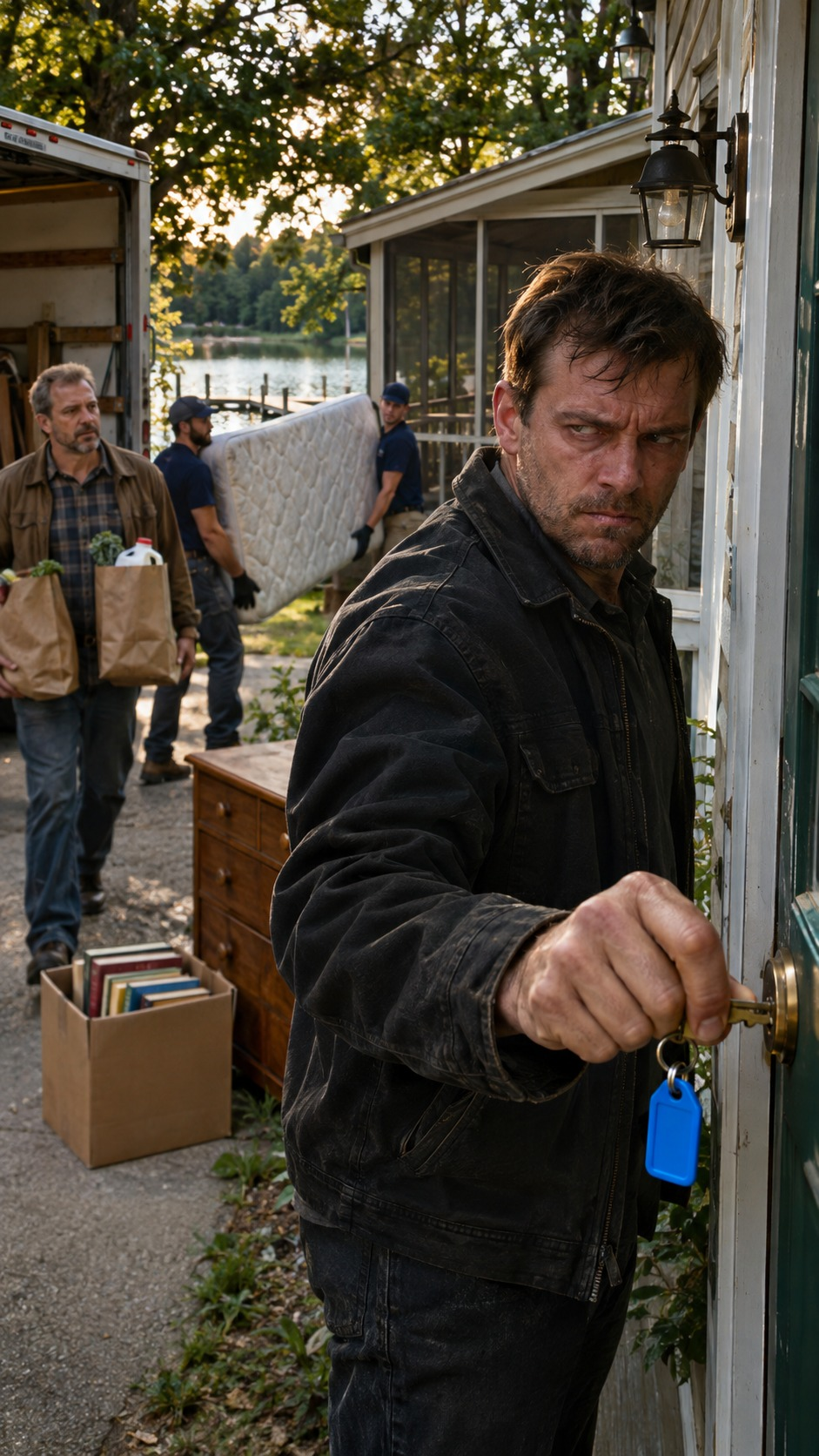
The moving truck.
The mattress.
The storage bins.
The postal notification.
The old authorization.
The incomplete agreement.
It was becoming increasingly difficult to believe Daniel had simply needed a temporary place to stay.
He had wanted to establish himself at the property.
And perhaps he had hoped that once he was inside, nobody would question the arrangement.
I thanked Aaron for telling me.
Before ending the call, he said:
"Please don't tell Daniel I spoke to you."
I looked at the phone.
"Why?"
"Because I don't know what he'll do."
I felt a deep sadness.
Aaron was afraid of upsetting his husband.
I understood that.
But I also knew the truth was becoming more dangerous the longer everyone tried to hide it.
"I won't discuss our conversation without thinking carefully," I told him.
We ended the call.
I immediately contacted Helen.
I explained what Aaron had told me.
She listened without interrupting.
When I finished, she said:
"Margaret, I think we need to establish whether anyone has attempted to use your property as collateral or represented themselves as having authority over it."
"Can they do that?"
"That is exactly what we need to check. We'll review the public records and contact the appropriate offices."
I agreed.
She asked me to send her the latest messages and the partial agreement.
I did.
Then she gave me one instruction.
"Don't confront Richard directly. If he contacts you again, preserve the communication and let me know."
I promised.
That afternoon, I received another email.
This time, the sender had included a second attachment.
The subject line read:
THE COMPLETE AGREEMENT — PAGE TWO.
I opened it carefully.
The document appeared to be part of the same agreement from three days before Robert died.
There were several paragraphs explaining Daniel's potential role in managing certain family matters.
But near the bottom was a section titled:
LIMITATIONS OF AUTHORITY.
I read the first sentence.
Then the second.
My breathing slowed.
The agreement explicitly stated that Daniel's authority was limited to specific assets identified in an attached schedule.
It did not extend to property independently purchased by me after Robert's death.
It did not grant him ownership.
It did not give him the right to occupy my future property.
And it did not allow him to use my name to secure loans or financial obligations.
I sat back.
There it was.
The missing part.
The section that Carol had apparently never shown him.
Or perhaps she had shown him and he had chosen to ignore it.
I scrolled further.
The final paragraph contained a handwritten addition.
It was Robert's writing.
I recognized the shape of the letters immediately.
Margaret's future purchases remain entirely under her control. Daniel must never interpret this agreement as permission to make decisions for her.
My eyes filled with tears.
Robert had been clear.
There had been no ambiguity.
The document was not a promise that Daniel would eventually control my property.
It was a warning that he never should.
I forwarded the page to Helen.
Then I printed it.
I placed it beside the first document.
The two pages together told a very different story.
But something still bothered me.
Why had the sender waited six years to reveal this?
Why had they sent the documents anonymously?
And why had they specifically warned me not to confront Daniel?
I opened the email again.
At the bottom was a short note.
There is one more page. It was never included in the copy Carol received.
I stared at the screen.
I typed:
Send it.
The reply came almost immediately.
I will. But you need to understand that Robert didn't just leave instructions about Daniel.
I felt my pulse quicken.
Another message arrived.
He left instructions about Carol, too.
I stared at the words.
Then the sender attached another file.
Its title was simple.
FINAL PRIVATE INSTRUCTIONS — ROBERT COLLINS.
I clicked it.
The first page appeared.
At the top was a handwritten date.
Three days before Robert died.
And directly beneath the title was a sentence that made me reach for the edge of the table.
If Carol ever attempts to use these documents to obtain control of Margaret's property, the following person must be contacted immediately.
I scrolled down.
There was a name.
A name I hadn't heard in six years.
And beneath it was a handwritten warning from my husband:
Do not tell Daniel who this person is.






Comments 0