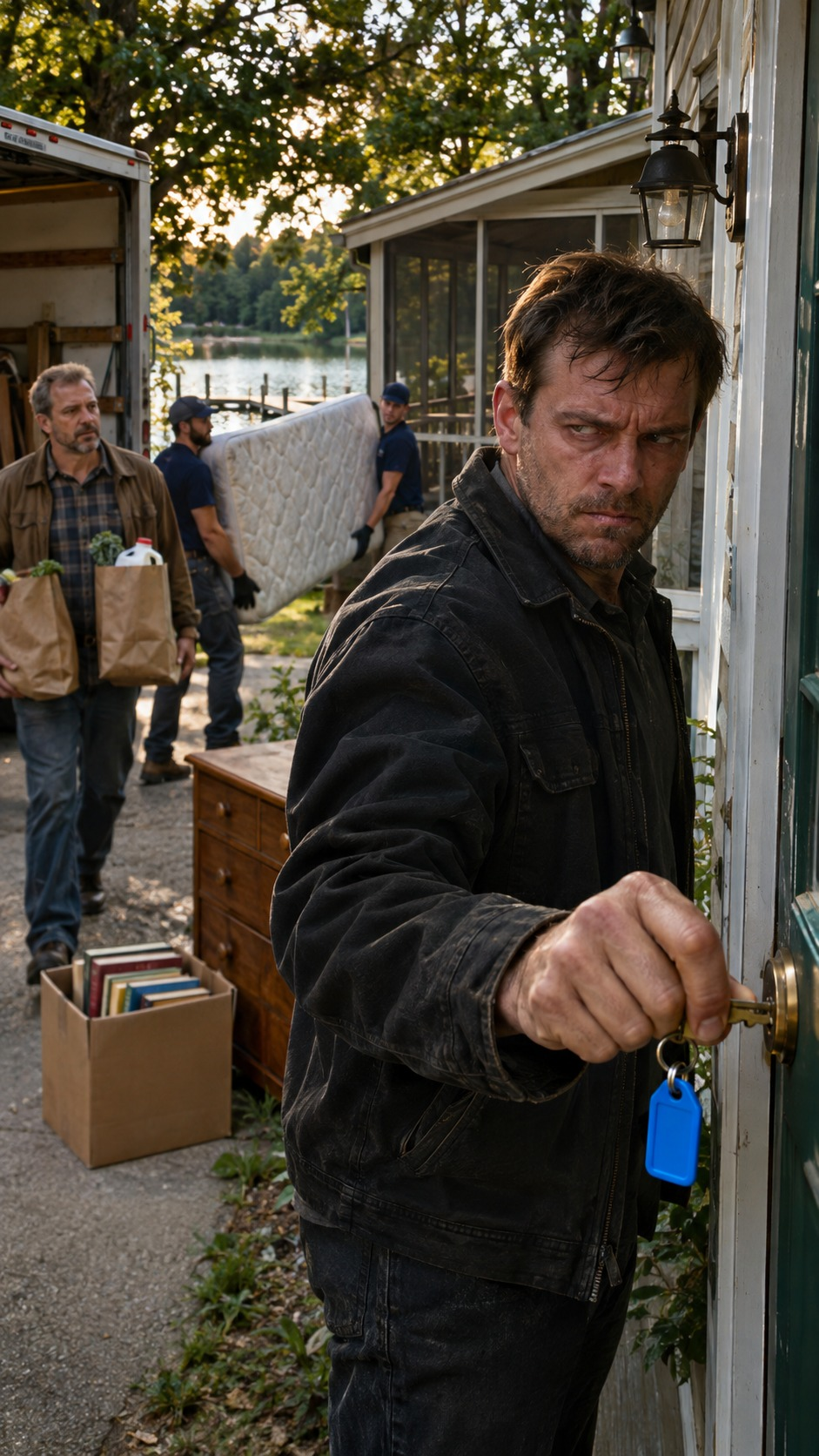
"Mom, the email says we needed to be inside your house before the lender completed its review."
Daniel's voice was barely above a whisper.
I stood in my kitchen with the telephone pressed against my ear.
For a moment, I couldn't speak.
"Read that again."
He took a shaky breath.
"The email says, 'Once Daniel establishes occupancy at the property, we can proceed with the final verification. Margaret is unlikely to remove her grandson after the family has moved in.'"
I closed my eyes.
There it was.
The sentence that explained everything.
The moving truck.
The mattress.
Eli's dresser.
The storage bins stacked beside my driveway.
They hadn't simply been moving into a house they believed they could use.
Someone had calculated that I would be too ashamed, too frightened, or too guilty to make my own grandson leave.
And they had written it down.
"Who sent that email?" I asked.
"Carol."
"To whom?"
"Richard Bennett."
"Was anyone else copied?"
Daniel hesitated.
"Me."
I sat down.
"You received this email?"
"Yes."
"When?"
"Four days before the move."
I stared at the kitchen wall.
"Then you knew."
"Mom, I didn't understand what they meant by final verification."
"But you understood the part about using Eli to make me agree."
Silence.
"Daniel?"
His voice cracked.
"I thought you would let us stay once we got there."
I felt a pain in my chest that had nothing to do with surprise.
For weeks, I had been trying to determine whether Richard and Carol had manipulated my son.
Now I was hearing something more complicated.
Daniel had been deceived about the paperwork.
But he hadn't been deceived about my permission.
He had known I might refuse.
He had known the house belonged to me.
And he had deliberately chosen to move his family in before I could stop him.
"Send me the email," I said.
"Mom—"
"Every message in the conversation. Include the dates and the attachments."
"Okay."
"And Daniel?"
"Yes?"
"Don't contact Richard or Carol about this until you've spoken to Helen."
He was quiet.
Then he said, "I think they're already trying to get rid of the evidence."
My fingers tightened around the telephone.
"What makes you say that?"
"Richard called me this morning. He told me to delete our messages because the loan application had been canceled."
"Did you?"
"No."
"Good."
"He sounded angry, Mom."
I looked at the folder containing Robert's documents.
"Then let him be angry."
After we ended the call, I sat motionless.
I had spent thirty-eight years working in Michigan public schools. I had dealt with difficult parents, complicated situations, and people who insisted they had done nothing wrong even when the evidence was sitting directly in front of them.
I knew how to listen.
I knew how to ask questions.
But I had never imagined I would need those skills to protect myself from my own family.
My laptop chimed.
Daniel had sent the emails.
There were fourteen messages in the conversation.
I opened the earliest one.
It was dated almost three months before the moving truck arrived.
The subject line was:
LAKE PROPERTY — FAMILY OCCUPANCY ARRANGEMENT.
Carol had written to Richard.
Margaret has purchased the property independently. She hasn't told Daniel because she wants to avoid family expectations.
I stared at the sentence.
Carol had known exactly why I kept the house secret.
She hadn't misunderstood.
She hadn't forgotten.
She had taken the most personal reason I gave her and passed it directly to a man Robert had warned me not to trust.
The next paragraph was worse.
Daniel's financial situation is becoming urgent. If we can establish his occupancy before Margaret objects, she may be persuaded to formalize the arrangement afterward.
I read it twice.
Then I scrolled down.
Richard had replied:
Occupancy alone will not establish ownership or borrowing authority. We will need proper documentation and confirmation from the legal owner.
That sentence was important.
Richard had understood that moving Daniel into the property would not automatically give him rights over it.
He knew.
And yet the plan had continued.
Several days later, Carol sent another message.
I have copies of Robert's old documents. Can those be used as supporting evidence?
Richard's reply came the following morning.
Send everything you have. I will review the available language.
I opened the next attachment.
It was a photograph of the withdrawn estate agreement.
The same agreement Eleanor had told me Robert specifically replaced before his death.
Carol had sent it to Richard.
She had also attached a copy of Robert's signature.
I stared at the screen.
Then I opened another message.
Richard had written:
The older authorization is insufficient by itself. Additional signatures and owner confirmation would be required.
My stomach tightened.
The next email was dated two weeks later.
Carol wrote:
Margaret is away frequently, and I have emergency access. Daniel can begin preparing the move.
I felt cold.
She had been planning to use the emergency key long before she handed it to my son.
The little blue tag had not simply changed hands during a desperate family situation.
It had become part of a plan.
I forwarded the complete conversation to Helen.
Then I called her.
She answered immediately.
"Margaret?"
"I have the emails."
"From Daniel?"
"Yes. Carol and Richard discussed moving him into the house before I could object."
Helen became quiet.
"Have you preserved the original messages?"
"Daniel forwarded the conversation."
"Good. Ask him to retain the messages in his account as well. We may need the original electronic records."
I agreed.
Then I told her about the sentence involving Eli.
Helen sighed.
"That is troubling."
"They were counting on me feeling guilty."
"That's what the language suggests."
I looked toward the lake.
"Helen, Richard knew occupancy wouldn't give Daniel ownership."
"According to the email you've described, yes."
"Then why did he continue?"
"We need to determine what he actually submitted to the lender and whether he represented that you had authorized the transaction."
I opened the final message.
"There's something else."
"What?"
"Richard wrote that the application would be easier to complete if Daniel was already living at the property."
Helen paused.
"Read the exact wording."
I did.
She asked me to send that page separately.
Then she said, "Margaret, I want to meet with you and Daniel. If he's willing to cooperate, we should obtain a complete account of what he signed and what he understood at the time."
I looked at the telephone.
"Can we meet tomorrow?"
"Yes."
I thanked her.
Before ending the call, she added, "Please don't let anyone pressure you into withdrawing the dispute. The lender is reviewing the application, and we need to preserve that process."
"I won't."
That evening, Daniel called again.
He sounded exhausted.
"Aaron wants me to tell you something."
"What?"
"He found an apartment."
I sat upright.
"An apartment?"
"Yes. It's small, but we can afford it if I sell some equipment and take more work."
I remained silent.
Daniel continued.
"We should have done that before."
"Yes," I said quietly. "You should have."
He didn't argue.
That surprised me.
For years, every difficult conversation with Daniel had become a negotiation.
He would explain why his circumstances were different.
Why I should understand.
Why family had to help family.
But this time, he simply accepted my answer.
"How is Eli?" I asked.
"He's confused."
My chest tightened.
"Does he think I'm angry with him?"
Daniel hesitated.
"He asked why Grandma didn't want us at the lake."
I closed my eyes.
"Daniel, you need to tell him the truth."
"I know."
"Not every detail. He's twelve. He doesn't need to know about the financial documents. But he needs to understand that the house belongs to me and you should have asked before moving in."
Daniel was quiet.
Then he said, "I told him you called the sheriff because we surprised you."
I felt something inside me harden.
"That wasn't the truth."
"I know."
"You need to correct it."
"I will."
I took a breath.
"I love Eli. Nothing about this changes that."
"I know, Mom."
"And I love you."
His breathing became uneven.
"But loving you doesn't mean I can keep allowing you to make decisions for me."
He didn't answer.
For a moment, I wondered whether he would become angry again.
Instead, he whispered, "I understand."
I wanted to believe him.
But understanding was not the same as changing.
And I had learned that promises meant very little without action.
The following morning, I arrived at Helen's office carrying two folders.
One contained Robert's estate documents.
The other contained everything connected to the lake house.
Daniel arrived ten minutes later.
He looked older than he had a week earlier.
His shirt was wrinkled, and there were dark circles beneath his eyes.
For a moment, he stood in the doorway as though he wasn't sure whether to approach me.
"Hi, Mom."
"Hello, Daniel."
He sat across from me.
Helen entered with a legal pad.
"Thank you both for coming."
She began by explaining that the meeting was intended to clarify the documents and preserve accurate information.
Then she asked Daniel to describe how he first learned about the lake house.
He looked at me.
"Aunt Carol told me."
"When?" Helen asked.
"About three months before the move."
"What did she say?"
"She said Mom had bought a place near the lake and was keeping it quiet because she didn't want anyone asking for help."
I felt my cheeks grow warm.
Helen continued.
"Did Carol tell you Margaret had agreed to let you live there?"
"Not at first."
"What did she say?"
"She said Mom would probably agree once she understood how bad things were."
Helen wrote something down.
"When did the authorization paperwork become part of the discussion?"
"Richard introduced it."
"How did you meet Richard?"
"Carol arranged it."
Daniel explained that Richard had shown him old estate documents bearing Robert's signature.
He had been told those papers established certain family rights.
Richard had also discussed the possibility of using the lake house as part of a business financing arrangement.
Helen asked Daniel whether he understood that the property belonged solely to me.
"Yes."
"Did Margaret give you written permission to use it as collateral?"
"No."
"Did she give you verbal permission?"
"No."
"Then why did you sign the application?"
Daniel stared at his hands.
"Because Richard said the old agreement gave me authority."
Helen waited.
Daniel continued.
"And because Carol said Mom would eventually approve it."
I watched my son.
He was finally saying the words I had needed to hear.
He had relied on what other people told him instead of asking the person who actually owned the property.
Helen turned another page.
"Did you know the application identified Margaret as a guarantor?"
"Yes."
"Did you believe she had agreed?"
Daniel hesitated.
"At the time, I wanted to believe she had."
The room became quiet.
I looked at him.
He didn't meet my eyes.
Helen asked another question.
"Did you personally witness Margaret sign the guarantee?"
"No."
"Did you witness Robert sign the recent authorization?"
"No."
"Did you know Robert had been deceased for six years?"
"Yes."
Helen set down her pen.
"Then I need you to explain why you accepted a document that appeared to have been witnessed by him after his death."
Daniel swallowed.
"Richard told me it was a reproduction of an older estate document. He said the date referred to when the authorization was assembled, not when Dad signed the original."
Helen nodded without agreeing.
"Did you ask for an explanation in writing?"
"No."
"Did you obtain independent legal advice?"
"No."
I looked away.
Daniel had trusted Richard because Richard told him what he wanted to hear.
And Carol had helped make the explanation seem believable.
Helen continued through the remaining documents.
She asked about the postal change-of-address request.
Daniel admitted submitting it before the move.
He acknowledged that he had never lived at the property.
He also confirmed that Carol had given him the emergency key.
Then Helen asked about the three hundred thousand dollars.
Daniel's face changed.
He looked toward me.
I said nothing.
He took a breath.
"Carol told me Dad had left money for the family."
"Did you receive it?" Helen asked.
"Yes."
"How much?"
"Two hundred and seventy thousand dollars reached my business account. I later learned Richard had received thirty thousand."
"Did you know Margaret was the intended beneficiary?"
"Not when the money first arrived."
"When did you learn?"
"Two years ago."
"What did you do after learning that?"
Daniel stared at the table.
"Nothing."
The word hung between us.
Nothing.
For two years, my son had known that money intended for my future had been used to support his business.
And he had said nothing.
Helen asked whether he had retained the bank records.
He nodded.
Then he removed a folder from his bag.
Inside were statements, emails, and copies of the old financial agreement.
He pushed them across the table.
"I brought everything I could find."
Helen examined the first page.
Then she stopped.
"Daniel, where did you obtain this?"
"Richard's office."
"Did he give it to you?"
"No."
Helen looked up.
"Explain."
Daniel shifted in his chair.
"I went there after Mom started asking questions. Richard was out, but his assistant let me collect my own file. These papers were inside."
Helen examined the document.
It appeared to be an internal summary of the old transfer.
The amount was listed.
Three hundred thousand dollars.
The date matched the original transaction.
The distribution was divided into two parts.
Two hundred and seventy thousand dollars to Daniel's contracting business.
Thirty thousand dollars to Richard Bennett's company.
But there was another line.
A handwritten notation.
Source authorization: Carol Collins.
I leaned forward.
"Carol authorized the transfer?"
Helen studied the page.
"That's what this record appears to indicate. We still need the original banking documents."
Daniel nodded.
Then he said something I hadn't expected.
"There's another page."
He removed a folded sheet from the back of the folder.
Helen opened it.
I watched her expression change.
"What is that?" I asked.
She looked at Daniel.
"Where did this come from?"
"It was attached to the original transfer instructions."
Helen placed the page in front of me.
At the top was Robert's name.
Beneath it was a section identifying the intended beneficiary.
Margaret Collins.
Then came a line labeled:
Alternate Authorized Recipient.
The name was Carol Collins.
I stared at it.
"Robert never told me Carol could receive money on my behalf."
Helen examined the wording.
"This may have been an administrative designation rather than permission to use the funds. We need to review the complete agreement."
I looked at Daniel.
"Did Carol tell you about this?"
He shook his head.
"No."
"Did Richard?"
"No."
Helen placed the page beside the others.
"That distinction may be important. Someone authorized to receive funds for another person isn't necessarily authorized to keep or redirect them."
I thought about Carol's confession.
I used the money.
She hadn't claimed Robert gave it to her.
She hadn't claimed I agreed.
She had simply admitted using it.
I felt a strange calmness settle over me.
For days, I had been angry.
Now I was beginning to feel something colder.
Clarity.
Helen continued examining the documents.
Then she found a second handwritten notation.
It referred to a reconciliation statement.
"Daniel, do you have the attachment mentioned here?"
He frowned.
"What attachment?"
Helen pointed to the reference.
"Schedule B. Final beneficiary accounting."
Daniel searched his folder.
He shook his head.
"No."
Helen looked at me.
"That accounting could help establish where the money went and what Carol represented to the financial institution."
I nodded.
"Can we obtain it?"
"We'll request it."
The meeting continued for another hour.
By the time we finished, Daniel had agreed to preserve his records and cooperate with the lender's review.
Helen explained that the disputed loan application and the old transfer were separate matters, even though some of the same people and documents were involved.
She would continue investigating both.
When we left the office, Daniel followed me into the parking lot.
"Mom?"
I turned.
He looked uncomfortable.
"I know saying I'm sorry doesn't fix anything."
"No, it doesn't."
"I want to make it right."
I studied his face.
"Then start by telling the truth, even when it makes you look bad."
He nodded.
"I will."
"And stop allowing Carol and Richard to speak for you."
"I already told Richard I won't sign anything else."
"Good."
Daniel hesitated.
Then he asked, "Do you think you'll ever forgive me?"
I looked at my son.
I remembered him as a little boy, running through our backyard with muddy shoes.
I remembered helping him learn to ride a bicycle.
I remembered sitting beside him during his first heartbreak.
I remembered how proud Robert had been when Daniel started his contracting business.
I loved him.
But I had also spent years protecting him from consequences he needed to face.
"I don't know when," I said.
His eyes filled with tears.
"But forgiveness isn't something you can demand from me, Daniel. You'll have to give me time."
He nodded.
Then he stepped backward.
"I understand."
For once, he didn't ask for anything else.
I drove home.
The afternoon sunlight reflected off the lake.
I parked in the driveway and sat in the car for a moment.
The house looked exactly as it had before the moving truck arrived.
The porch was empty.
The doors were locked.
The windows reflected the trees.
But I no longer looked at it as simply a peaceful place.
It had become proof that I was capable of protecting something important to me.
I went inside and made tea.
Then I opened my laptop.
There was a new email from Helen.
She had received confirmation from Northstar Capital Partners that the disputed loan application remained suspended.
No funds had been released.
The institution was reviewing the authorization documents.
I read the message twice.
Then I noticed another attachment.
It was a copy of the lender's internal verification record.
Helen had forwarded it because it contained a detail she wanted me to examine.
The record listed the person who had supposedly confirmed my consent.
I opened the file.
There was a date.
A time.
A telephone number.
And a short notation:
Owner authorization confirmed verbally.
I stared at the screen.
Nobody from Northstar had ever called me before I disputed the application.
I checked the telephone number.
It wasn't mine.
I searched my contacts.
Nothing.
Then I remembered something.
Carol had once used a separate phone for her volunteer work.
She had given me the number years earlier, but I rarely called it.
I searched my old messages.
There it was.
The same number.
My stomach tightened.
I called Helen immediately.
"Margaret?"
"The verification number belongs to Carol."
There was a pause.
"Are you certain?"
"I have an old message from her with that number."
"Send me a screenshot."
I did.
Helen examined it.
Then she said, "That may be significant. I'll ask the lender to preserve the call record and any recording associated with the verification."
I looked at the document.
"Does this mean Carol pretended to be me?"
"We don't know yet. But the number is worth investigating."
I nodded.
After ending the call, I sat in silence.
Carol had given Daniel the key.
She had arranged meetings with Richard.
She had redirected money intended for me.
And now a telephone number associated with her appeared in a record claiming I had approved the loan.
I felt sick.
I wanted to call her.
I wanted to demand an explanation.
But I remembered Helen's advice.
Preserve the evidence.
Don't confront anyone before the records are secured.
I put my phone down.
Then it rang.
Carol.
I stared at the screen.
For a moment, I considered ignoring it.
But I answered.
"Hello."
"Margaret."
Her voice sounded strained.
"We need to talk."
"About what?"
"Everything."
I remained quiet.
She continued.
"I know you've been speaking to Daniel."
"Yes."
"And Helen."
"Yes."
Carol exhaled.
"Richard says you're trying to destroy us."
I looked at the folder on my table.
"I'm trying to establish what happened to my money and why my property was used in a loan application without my consent."
"Margaret, you don't understand."
"Then explain."
She began crying.
"I never wanted any of this."
I waited.
"I was trying to help Daniel."
"By taking money Robert intended for me?"
Silence.
"By giving him my emergency key?"
She sniffed.
"Margaret—"
"By telling a lender I had approved something I never approved?"
Her breathing stopped.
For several seconds, neither of us spoke.
Then she whispered:
"How did you find out about the phone call?"
I felt my stomach tighten.
I hadn't told her there was a call.
I had only mentioned the lender.
"Carol, what phone call?"
She didn't answer.
"Did you speak to Northstar?"
A long silence followed.
Then she said:
"Richard told me what to say."
I closed my eyes.
"What did he tell you?"
"That it was only a routine verification."
"Did you pretend to be me?"
Carol began crying harder.
"I thought the loan would be approved and Daniel could repay everything."
I felt cold.
"Answer my question."
She whispered:
"Yes."
I sat perfectly still.
My sister had impersonated me.
She had allowed a lender to believe I had agreed to guarantee a loan.
And she had done it after already using money Robert intended for my future.
I looked toward the window.
The lake was calm.
The house was quiet.
But something inside me had changed.
"Carol," I said slowly, "you need to tell Helen everything."
She began pleading.
"Margaret, please don't involve the authorities."
"That decision isn't yours to make."
"We're sisters."
"I know."
"I helped you when Robert died."
I closed my eyes.
That was the sentence I had been dreading.
The reminder of every kindness she had ever shown me.
The implication that I owed her silence because she had once helped me through the worst period of my life.
I took a breath.
"You did help me, Carol. And I loved you for it."
She was crying.
"But helping me doesn't give you permission to take my money or use my identity."
"Margaret, please."
"I need the truth."
She went silent.
Then she said:
"There's something about Richard you don't know."
I looked at the phone.
"What?"
"He didn't just arrange the loan."
My fingers tightened.
"What else did he do?"
Carol's voice dropped.
"He made copies of documents that were supposed to be destroyed."
I felt a chill.
"Which documents?"
"The old estate agreement. The authorization. The transfer records."
"Why?"
She hesitated.
"Because he said we might need them again."
I stared at the table.
"Again?"
Carol began breathing unevenly.
Then she whispered:
"Margaret, the lake house wasn't the first property he tried to use."
I stopped moving.
"What do you mean?"
She didn't answer.
"Carol?"
I heard paper rustling on her end.
Then she said:
"I found something in his office."
"What?"
"A folder with your name on it."
I stood up.
"What was inside?"
She took a shaky breath.
"Documents from before Robert died."
My heart began beating faster.
"Send them to Helen."
"I can't."
"Why not?"
"Because Richard knows I took them."
I stared at the phone.
"Where are you?"
Carol didn't answer.
Instead, I heard a door open.
A man's voice spoke in the background.
Richard.
"Carol, who are you talking to?"
Her breathing changed.
"Nobody."
I heard footsteps.
Then Richard spoke again.
"Give me the phone."
Carol whispered my name.
"Margaret."
"What?"
Her voice became barely audible.
"There's a second account."
I gripped the edge of the table.
"What second account?"
She took one shaky breath.
Then the line went dead.
I stared at the screen.
A second later, a message arrived from Carol's number.
It contained a photograph of an old bank document.
The account holder was listed as Margaret Collins.
The opening date was seven years earlier.
And beneath the account number was a balance that made my hands go numb.
$612,840.17
I enlarged the photograph.
Then I saw the authorization signature.
It wasn't mine.
It wasn't Robert's.
And it wasn't Carol's.
I recognized the name printed beneath it.
Richard Bennett.
But the most frightening detail was the handwritten note at the bottom of the page.
ACCOUNT CLOSED — FUNDS TRANSFERRED TO NEW BENEFICIARY.
I scrolled down to the final line.
The beneficiary's name had been covered with a strip of white paper.
Then another message arrived from Carol.
Margaret, I know who received the money.
I reached for the phone.
Before I could reply, a third message appeared.
And you need to know why Robert never told you about this account.
Then a photograph began downloading.
It showed the missing beneficiary page.
The white strip had been removed.
The name was finally visible.
And as the image came into focus, I realized it belonged to someone who had been sitting across from me only hours earlier.






Comments 0