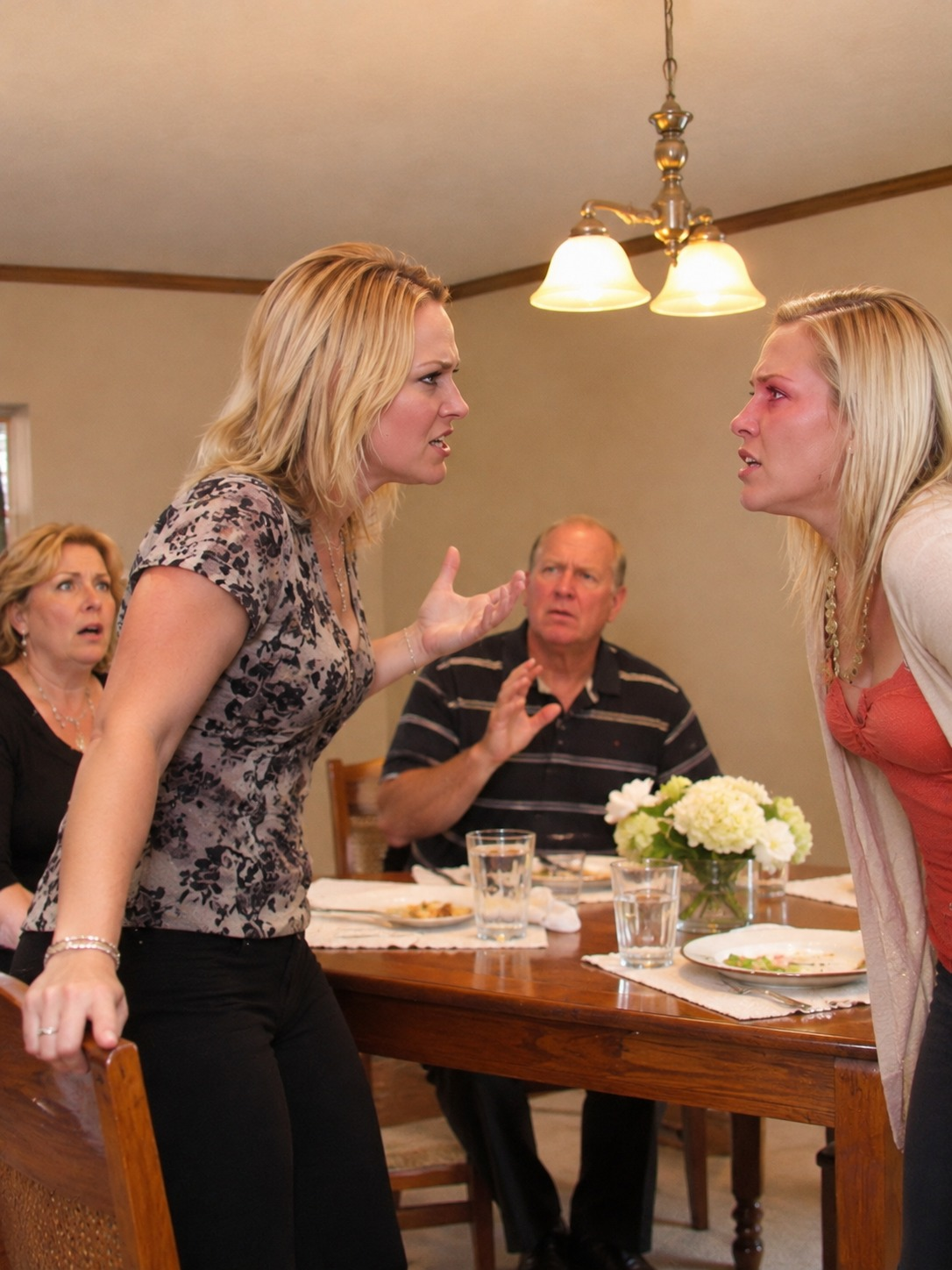
"Emily Carter was never supposed to receive that scholarship."
I read the sentence three times before I realized my hands were shaking.
It was written in blue ink on a document dated fifteen years earlier.
Beneath it was another sentence.
Mrs. Patterson told me Emily's application would be reviewed even without the missing materials.
And below that, in handwriting I recognized immediately, was a name.
Margaret Carter.
My mother.
I stood in my Denver kitchen, staring at my phone while the vegetables I'd been chopping sat forgotten on the counter.
"Rachel," I whispered, "why is my mother's name on this?"
Rachel didn't answer immediately.
I could hear her breathing.
Then she said, "That's what I've been trying to figure out."
I enlarged the scanned document.
The page was an old student incident statement from Westbrook High School. At the top were Bonnie's name, the date, and the signature of a guidance counselor named Linda Harrison.
I remembered Mrs. Harrison.
She was a kind woman with silver-framed glasses who kept peppermint candies in a glass bowl on her desk.
I'd visited her twice during my senior year.
Once to discuss college applications.
And once after my portfolio disappeared.
She'd told me not to give up.
She'd helped arrange replacement recommendation letters.
And she'd reassured me that one setback didn't define my future.
Now I was looking at a document suggesting my mother had been involved in a conversation I knew nothing about.
"Read the whole thing," Rachel said quietly.
I scrolled upward.
The counselor's question was typed.
Did you remove or interfere with any materials belonging to your sister, Emily Carter?
Beneath it, Bonnie had written six words.
I only wanted her to fail.
I felt the air leave my lungs.
There it was.
Not a joke.
Not a misunderstanding.
Not an accusation someone could dismiss as sibling rivalry.
My sister had admitted, in writing, that she wanted me to fail.
I lowered myself into a kitchen chair.
"Emily?" Rachel asked.
"I'm here."
"Are you okay?"
I almost laughed.
It was such a strange question.
Was I okay?
I'd spent fifteen years believing I'd misplaced something important.
I'd carried the embarrassment of that mistake into adulthood.
I'd become the kind of person who checked every email twice, kept backups of backups, and apologized before anyone accused me of doing anything wrong.
And now I was discovering that the mistake hadn't been mine at all.
"I don't know," I admitted.
Rachel was quiet.
I scrolled farther down.
The next section was labeled Additional Persons Mentioned.
My mother's name appeared beneath it.
Next to her name, the counselor had written a short note.
Parent contacted regarding student statement. Follow-up requested.
I frowned.
"Rachel, this doesn't prove my mother knew what Bonnie did."
"No," she said. "It doesn't."
"It says she was contacted."
"Right."
"That could mean anything."
"I know."
I appreciated that she didn't push me toward a conclusion.
For all the terrible things Rachel had done in high school, she seemed determined not to invent anything now.
"There's another problem," she said.
I closed my eyes.
"Of course there is."
"The document is incomplete."
I looked at the bottom of the page.
A small handwritten notation appeared beside the counselor's signature.
See attached parent conference summary.
I stared at those words.
"Where's the attachment?"
"I don't have it."
"Did you ask the school?"
"Not yet. And I don't know whether they'd release an old confidential record."
I rubbed my forehead.
"So we don't know what Mom was told."
"No."
"Or what she said."
"No."
I stared at my mother's name.
For years, I'd imagined that discovering the truth would feel satisfying.
I thought I'd finally have something I could place in front of my parents and say, See? I wasn't making it up.
Instead, I felt exhausted.
Because the truth was becoming more complicated than I'd expected.
And I wasn't sure how much more of it I wanted to know.
I didn't sleep much that night.
At two in the morning, I opened my laptop and searched through old emails.
I still had messages from my senior year.
College acceptance letters.
Scholarship notifications.
A few notes from Mrs. Patterson.
Most of them were ordinary.
Congratulations.
Reminders.
Deadlines.
Then I found an email I'd forgotten.
It was dated April 17, fifteen years earlier.
The subject line read:
Revised Scholarship Submission.
Mrs. Patterson had written:
Emily, I've spoken with the committee. They will accept the replacement materials, but the original portfolio cannot be evaluated unless it is recovered before Friday.
I remembered reading that message.
I remembered crying afterward.
At seventeen, I'd been convinced I'd destroyed my own opportunity.
Now I wondered whether Bonnie had known exactly what the deadline meant.
Whether she'd deliberately waited until there was almost no time left.
I opened another email.
This one came from the scholarship committee.
It confirmed that my application remained under consideration.
A month later, I'd received a partial scholarship.
Enough to make college possible.
Not enough to eliminate the financial pressure.
I stared at the screen.
Then I opened a blank document.
At the top, I typed:
Things I Know.
Underneath, I wrote down the facts.
Bonnie had taken my assignments.
Rachel had witnessed it.
Bonnie had admitted wanting me to fail.
My mother had been contacted by the school.
I paused.
Then I added another heading.
Things I Don't Know.
What my mother had been told.
Whether she believed Bonnie.
Whether she had known about the missing portfolio.
Whether anyone had deliberately kept the truth from me.
I looked at the two lists.
The second was longer.
That bothered me.
But something else bothered me more.
For the first time, I was separating what I knew from what I feared.
Growing up, I'd never been allowed that distinction.
My family had always treated my feelings as evidence that I was overreacting.
Now I wanted actual answers.
Not assumptions.
Not accusations.
Answers.
I saved the document.
Then I closed my laptop.
At three in the morning, I finally fell asleep.
The next day, I went to work.
That probably sounds strange.
I had just discovered that my sister had deliberately sabotaged my education, and I was sitting in a conference room discussing client retention rates.
But work had always been the place where I felt most like myself.
At my office, nobody called me the heavier sister.
Nobody compared me to Bonnie.
Nobody suggested that my accomplishments mattered less because I wasn't married.
People listened when I spoke.
They asked for my opinions.
They trusted me with decisions.
And for years, that had been enough to make Denver feel like home.
I moved there after college with two suitcases, a used laptop, and less than three thousand dollars in savings.
My parents hadn't understood.
"Why Denver?" Mom had asked.
"Because I got a job there."
"There are jobs in Missouri."
"I know."
"Then why move so far away?"
I hadn't known how to explain it.
How could I tell my mother that I needed to live somewhere my sister's reputation didn't follow me?
Somewhere nobody knew what I'd looked like in seventh grade?
Somewhere I could walk into a room without wondering whether people had already heard a joke about me?
So I told her I wanted independence.
She'd sighed.
"You're always trying to prove something."
Maybe she was right.
Maybe I was trying to prove that I could build a life without asking my family for permission.
But I didn't regret leaving.
Not for a second.
My first apartment in Denver had been tiny.
The kitchen was barely large enough for one person.
The heating system made strange noises at night.
And the bedroom window faced a brick wall.
I loved it.
I bought secondhand furniture.
I learned to cook simple meals.
I made friends with a woman named Sarah Mitchell, who lived across the hall and worked as a pediatric nurse.
Sarah was the first person in years who invited me somewhere without making me feel like an obligation.
One Friday evening, she'd knocked on my door holding two containers of takeout.
"I ordered too much Chinese food," she said. "Want to help?"
We ate on my living room floor because I hadn't bought a dining table yet.
We talked for hours.
About work.
About terrible dates.
About the strange experience of becoming an adult and realizing nobody really knew what they were doing.
At some point, Sarah asked about my family.
I told her I had a younger sister.
"Are you close?"
I hesitated.
"Not really."
She nodded.
"That happens."
I looked at her.
She didn't ask why.
She didn't insist that family was everything.
She didn't tell me I should try harder.
She simply accepted my answer.
I remember feeling strangely grateful.
Over the years, Sarah became one of my closest friends.
She was there when I got my first promotion.
She helped me move into a better apartment.
She brought soup when I had the flu.
And when I called her after Bonnie's engagement lunch, crying so hard I could barely explain what had happened, she listened without interrupting.
Then she said something I'd never forgotten.
"Emily, people who love you shouldn't need you to feel ugly so they can feel beautiful."
I sat on my couch, staring at the wall.
"She's my sister."
"I know."
"My parents think she's just teasing."
"That doesn't make it harmless."
I wiped my face.
"Maybe I'm too sensitive."
Sarah was quiet for a moment.
Then she said, "Who taught you that?"
I didn't answer.
Because I knew.
At lunchtime, I met Sarah at a small café near my office.
She arrived wearing navy scrubs and carrying the exhausted expression of someone who'd just finished a twelve-hour shift.
"You look like you need coffee," she said.
"I need something stronger."
She raised an eyebrow.
"At noon?"
I managed a smile.
We ordered sandwiches.
Then I showed her the scanned document.
She read it carefully.
Her expression changed.
"Emily."
"I know."
She looked up.
"Bonnie wrote this?"
"Apparently."
"And your mother's name is here?"
"Yes."
Sarah read the note again.
"Do you know what she was told?"
"No."
"Then don't assume."
I looked at her.
"That's what I keep telling myself."
She reached across the table and squeezed my hand.
"But don't minimize what you do know, either."
I swallowed.
"I spent years thinking I was careless."
"You weren't."
"I lost scholarship money."
"Maybe. But we don't know exactly how much the missing portfolio affected the decision."
I nodded.
She was right.
That was one of the things I loved about Sarah.
She could be compassionate without telling me what I wanted to hear.
She didn't turn every uncertainty into proof of the worst possible explanation.
And she didn't ask me to ignore the facts simply because they were painful.
"What are you going to do?" she asked.
I looked down at my sandwich.
"I don't know."
"Are you going to confront your parents?"
"Eventually."
"Bonnie?"
I laughed bitterly.
"She'd deny everything."
"Maybe."
"Or she'd say it was years ago."
Sarah tilted her head.
"Would that change anything?"
I thought about it.
"No."
"Then you don't need her permission to take it seriously."
I stared at her.
Something about that sentence settled inside me.
For most of my life, I'd been waiting for Bonnie to admit she'd hurt me.
Waiting for my parents to acknowledge that I'd been treated unfairly.
Waiting for someone else to validate what I'd experienced.
Maybe I didn't have to wait anymore.
My training session that evening was harder than usual.
Lauren noticed almost immediately.
"You're distracted."
I set down the dumbbells.
"Long week."
"Want to talk about it?"
I hesitated.
Then I told her a little.
Not everything.
Just enough.
"My family has always been critical of my appearance."
Lauren nodded.
"And recently, they made some comments that really got to me."
She leaned against the wall.
"Is that why you started training?"
"Partly."
"Okay."
I looked at her.
"You're not going to tell me that's a bad reason?"
She smiled slightly.
"I'm going to tell you that motivation changes."
I frowned.
"What do you mean?"
"Sometimes people start exercising because they're angry. Or because they want to prove something. That's not unusual."
She gestured toward the weights.
"But if the only reason you keep showing up is to make someone else happy, eventually it becomes exhausting."
I thought about Bonnie.
About my parents.
About the restaurant.
Lauren continued.
"So let's find something that's yours."
"Like what?"
She smiled.
"Tell me one thing your body can do now that it couldn't do six weeks ago."
I thought about it.
"I can climb the stairs to my apartment without getting winded."
"Good. Another."
"I can carry groceries without needing to stop."
"Another."
I laughed.
"I can actually finish the workouts you give me."
Lauren grinned.
"Exactly."
I looked down at my hands.
They were stronger than they'd been a month earlier.
My shoulders felt different.
My posture was changing.
And for the first time, I realized I was beginning to enjoy the process.
Not because of Bonnie.
Not because of the wedding.
Because I liked feeling capable.
Lauren handed me a water bottle.
"That's what we're building on."
I nodded.
And for the rest of the session, I stopped thinking about my family.
I focused on breathing.
On movement.
On the quiet satisfaction of doing something difficult and realizing I could do it.
Over the following months, my life changed gradually.
There was no dramatic overnight transformation.
No magical moment when everything became easy.
Some weeks were wonderful.
Others were frustrating.
I learned that progress wasn't always visible.
That confidence didn't arrive all at once.
That being healthy involved more than a number on a scale.
I also learned that I enjoyed taking care of myself.
I started cooking meals I actually liked.
I went hiking with Sarah and a few friends.
I bought comfortable shoes and walked through Denver's parks on weekends.
I slept better.
My energy improved.
And slowly, my clothes began fitting differently.
One Saturday, Sarah convinced me to go shopping.
I protested.
"I don't need anything."
She looked at the oversized gray sweater I was wearing.
"Emily, you've owned that sweater since the Obama administration."
I laughed.
"It's comfortable."
"So are pajamas. That doesn't mean you have to wear them everywhere."
We spent the afternoon trying on clothes.
At first, I automatically reached for loose black tops.
Sarah gently took one from my hands.
"Do you actually like this?"
I looked at it.
"Not really."
"Then why are you buying it?"
I opened my mouth.
Then stopped.
Because the answer was embarrassing.
I was buying it because it would hide me.
Even after months of feeling stronger, I was still dressing like someone who wanted to disappear.
Sarah handed me a fitted blue blouse.
"Try this."
I hesitated.
"It's not really my style."
"Maybe your style is allowed to change."
I took it into the fitting room.
When I stepped out, Sarah smiled.
"There she is."
I looked in the mirror.
The blouse wasn't dramatic.
It wasn't expensive.
It wasn't even particularly fashionable.
But it fit.
And I liked it.
I bought it.
Then I bought a pair of jeans.
And a dress.
And for the first time in years, I left a clothing store feeling excited instead of defeated.
That evening, I took a photograph of myself.
I almost deleted it.
Then I stopped.
I looked happy.
Not perfect.
Not transformed into someone unrecognizable.
Just happy.
I saved the picture.
By early spring, Bonnie's wedding was approaching.
Mom called more frequently.
She wanted to discuss travel arrangements.
Hotel reservations.
Family photographs.
What I planned to wear.
I kept our conversations short.
Bonnie rarely contacted me directly.
When she did, her messages were mostly about wedding logistics.
She asked whether I'd booked my flight.
Whether I'd bought a dress.
Whether I understood the ceremony schedule.
I answered politely.
I didn't mention Rachel.
I didn't mention the photographs.
And I didn't mention the counselor's statement.
Not because I'd forgotten.
Because I wanted to decide when and how to address it.
For once, I wasn't going to let Bonnie control the timing.
Then, one Thursday afternoon, my mother called while I was leaving work.
"Emily, sweetheart, I have wonderful news."
I smiled automatically.
"What happened?"
"Bonnie's wedding dress is finished!"
"That's great."
"And we finally have the seating arrangements."
"Good."
Mom hesitated.
"There's just one little thing."
I stopped walking.
"What?"
"Bonnie's been worried about the family photographs."
I closed my eyes.
Of course she had.
"What about them?"
"Well, you know how sensitive she can be."
I said nothing.
Mom continued.
"She wants everything to look coordinated."
"Okay."
"And she was wondering whether you'd mind sending us a recent picture of yourself."
I frowned.
"A picture?"
"Just so we can make sure your dress and hairstyle work with the wedding colors."
I looked toward the parking garage.
Something about the request felt strange.
But I didn't want another argument.
"Fine," I said.
"I'll send one."
Mom sounded relieved.
"Wonderful, honey."
I ended the call.
Then I opened my camera roll.
I selected the photograph Sarah had taken of me the previous weekend.
I was standing outside a restaurant in Denver, smiling in a fitted navy dress.
My hair was still brown.
I hadn't visited the salon yet.
I sent the picture.
Mom replied almost immediately.
You look lovely, sweetheart.
I smiled.
Then another message appeared.
Bonnie wants to know how much weight you've lost.
My smile faded.
I stared at the screen.
I could have answered.
I could have explained my workouts.
My meals.
My progress.
Instead, I typed:
Enough to feel good. That's all that matters.
Mom didn't reply.
Ten minutes passed.
Then twenty.
I was putting groceries away when my phone rang.
Bonnie.
I stared at her name.
We hadn't spoken properly in months.
I answered.
"Hi, Bonnie."
There was no greeting.
"Emily, what exactly are you trying to do?"
I froze.
"What?"
Her voice was tight.
"Don't play dumb."
I set the grocery bag on the counter.
"Bonnie, I have no idea what you're talking about."
She laughed sharply.
"Oh, really?"
"Really."
There was a pause.
Then she said something that made my stomach drop.
"I know you've been talking to Rachel."
I gripped the phone.
"Who told you that?"
Bonnie ignored the question.
"You need to stop digging into things that happened fifteen years ago."
I stared at the kitchen wall.
"Why?"
"Because you're going to embarrass yourself."
I felt my pulse quicken.
"Bonnie, did you take my school assignments?"
Silence.
For the first time in our lives, my sister didn't have an immediate answer.
Then she laughed.
A short, brittle sound.
"Oh my God, Emily. You're still obsessed with that?"
I closed my eyes.
"Did you?"
"It was high school."
"That's not an answer."
"You always got everything."
I opened my eyes.
"What?"
"The grades. The awards. The teachers praising you. Mom and Dad acting like you were some kind of genius."
Her voice was rising.
"And I was supposed to just sit there and clap?"
I felt something inside me go very still.
"Bonnie."
"What?"
"You stole my work."
She exhaled sharply.
"That was years ago!"
The words hung between us.
I stared at the wall.
She'd said it.
Not exactly an apology.
Not even a full confession.
But enough.
I lowered my voice.
"Do Mom and Dad know?"
Bonnie didn't answer.
"Bonnie?"
Then she said something I would remember for the rest of my life.
"You really think Mom doesn't know what happened?"
My breath caught.
Before I could respond, Bonnie ended the call.
I stood in my kitchen, staring at the dark screen.
Then I opened my laptop.
I found the scanned counselor's statement Rachel had sent.
I scrolled to the bottom.
To my mother's name.
To the handwritten note about the parent conference.
And for the first time, I noticed something beneath the counselor's signature.
A faint line of text had been partially cut off by the scan.
I enlarged the image.
Adjusted the brightness.
Zoomed in again.
There were four words.
Parent acknowledgment attached separately.
My heart began pounding.
I reached for my phone to call Rachel.
But before I could dial, an email arrived from an unfamiliar address.
The subject line read:
Regarding Your Senior Scholarship File — Confidential
I opened it.
There was no message.
Only one attachment.
A PDF labeled:
MARGARET CARTER — SIGNED ACKNOWLEDGMENT
I moved my finger toward the file.
Then I saw the date beneath the attachment.
It was the same day my mother had told me to stop searching for my missing portfolio.
And the document was already open on another device.






Comments 0