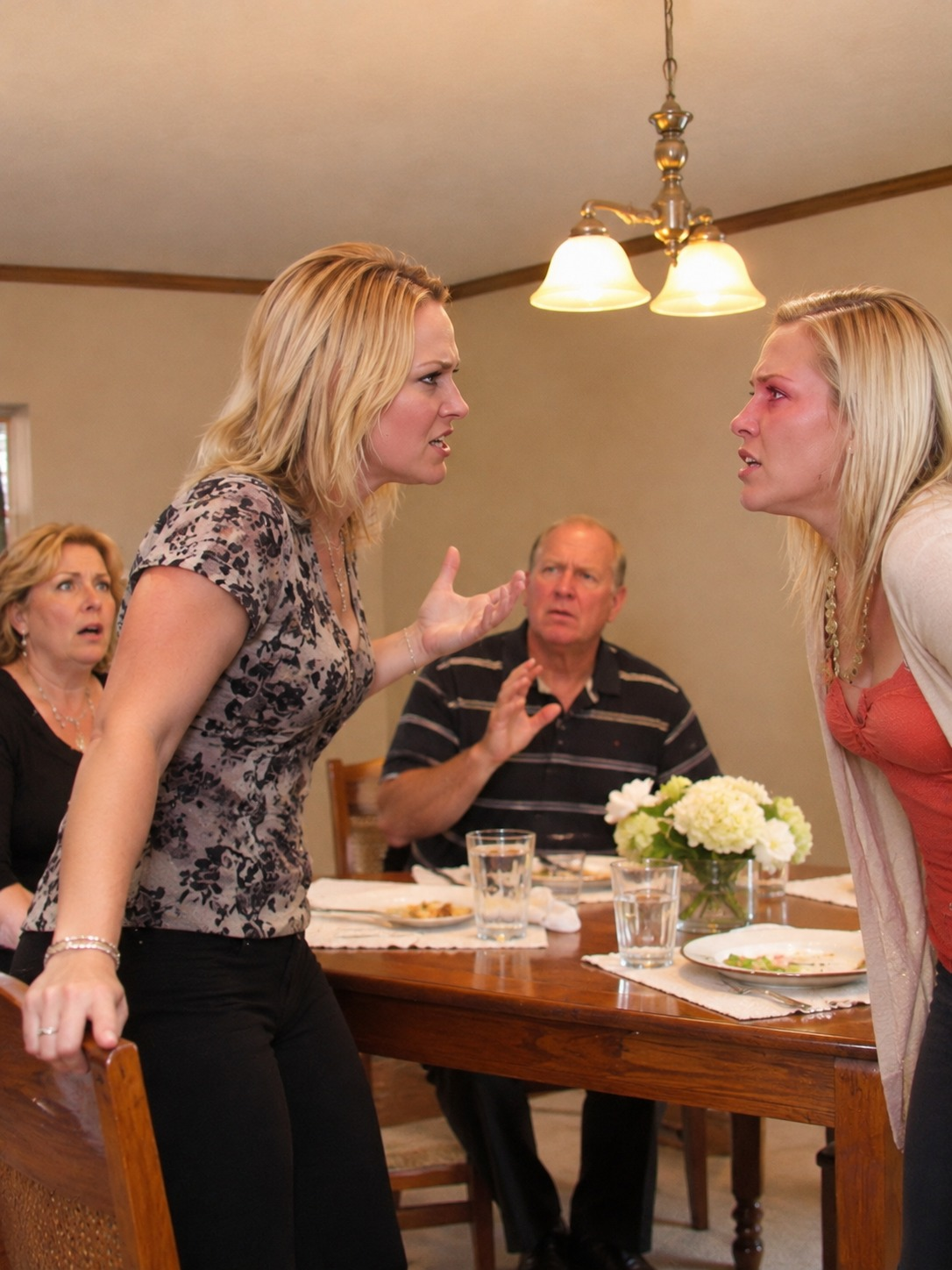
The flash of silver caught my eye before I understood what Bonnie was holding.
Scissors.
A small pair of silver scissors with white ribbon still tangled around one handle.
They must have been lying on the coffee table beside the wedding decorations.
For one terrible second, my sister came toward me with the blades pointed in my direction.
"Bonnie!" Daniel shouted.
I stumbled backward.
My shoulder struck the hallway wall.
Bonnie reached for my hair.
"You're not taking this away from me!"
Daniel caught her wrist before she reached my face.
The scissors fell.
They hit the hardwood floor with a sharp metallic sound.
Mom screamed.
Dad grabbed the scissors and stepped between us.
"Enough!"
I'd never heard my father shout like that.
Bonnie froze.
Daniel released her wrist and backed away.
I stood against the wall, shaking so badly I could barely feel my fingers.
Nobody moved.
Then Bonnie looked at the scissors on the floor.
Her expression changed.
The anger disappeared.
In its place came something that looked like disbelief.
As though she couldn't understand what she'd almost done.
"Emily," she whispered.
I couldn't answer.
She took one step toward me.
I flinched.
Bonnie stopped.
Her face crumpled.
"Oh my God."
Daniel looked at her.
"Bonnie, you need to sit down."
She shook her head.
"I wasn't going to hurt her."
My throat tightened.
"You came at me with scissors."
Her eyes filled.
"I just wanted—"
She stopped.
There was no sentence she could finish that would make it better.
Dad pointed toward the couch.
"Sit down, Bonnie."
This time, she obeyed.
Mom was crying.
Daniel stood near the window, his face pale.
And I realized something that made my chest ache.
For the first time in my life, everyone in that room had seen Bonnie's anger without being able to pretend it was harmless.
I reached for my purse.
Mom stepped forward.
"Emily, honey—"
"Don't."
She stopped.
I swallowed.
"I need to leave."
Dad nodded immediately.
"Of course."
Bonnie looked up.
"Emily, please."
I turned toward her.
She was crying.
For years, her tears had been enough to make me apologize.
Now they only made me tired.
"I didn't mean to scare you," she whispered.
I stared at her.
"But you did."
She looked down.
I took a breath.
"Bonnie, I have spent my entire life trying not to upset you."
Her shoulders shook.
"I know."
"No," I said quietly. "I don't think you do."
She looked up.
I continued.
"I changed how I dressed. I laughed when you insulted me. I stayed quiet when Mom compared us. I pretended your jokes didn't hurt."
My voice cracked.
"And when I finally started feeling good about myself, you wanted me to become someone you could look down on again."
Bonnie covered her face.
I looked at Daniel.
"I'm sorry."
He shook his head.
"Emily, don't apologize."
I swallowed.
Then I turned toward my parents.
"I love you both. But I'm going back to Denver."
Mom began crying harder.
"Please don't leave like this."
I looked at her.
"Mom, I can't stay in a house where someone just tried to cut my hair because I wouldn't do what she wanted."
She closed her eyes.
Dad nodded.
"You're right."
The words surprised me.
He stepped toward Bonnie.
Then he looked at me.
"Your mother and I will handle this."
I held his gaze.
"Then handle it differently than you did fifteen years ago."
His face tightened.
He nodded slowly.
"We will."
I wanted to believe him.
But this time, I wasn't going to stay and supervise his promises.
I walked toward the door.
Nobody tried to stop me.
I drove back to the hotel with both hands gripping the steering wheel.
At the first red light, I started crying.
Not because Daniel had called off the wedding.
Not because Bonnie had screamed at me.
Not even because she'd come at me with scissors.
I cried because I finally understood how much of my life I'd spent being afraid of my own family.
Afraid of disappointing them.
Afraid of embarrassing them.
Afraid of being too fat.
Too loud.
Too successful.
Too visible.
And now, apparently, too beautiful.
By the time I reached the hotel, my face was wet and my chest hurt.
I parked.
Turned off the engine.
Then sat in silence.
My phone buzzed.
A message from Sarah.
How are things?
I stared at it.
Then I typed:
I'm coming home.
She replied almost immediately.
Do you want me to pick you up at the airport?
I smiled through my tears.
Yes, please.
Then another message appeared.
And Emily?
I waited.
I'm proud of you.
I covered my mouth.
For years, I'd wanted those words from my parents.
Now they came from someone who had watched me become myself without ever asking me to be smaller.
The next morning, I changed my flight.
I was leaving Missouri that afternoon.
Before checking out, I called the attorney I'd met earlier in the week.
I explained what had happened at my parents' house.
She listened carefully.
Then she advised me to write down the incident while the details were fresh, preserve the messages and documents, and consider making a police report.
I did.
At the local police station, I described the confrontation, including the scissors and Daniel stopping Bonnie.
I asked that the incident be documented.
The officer explained my options and gave me a report number.
I didn't know whether Bonnie would face any legal consequences.
I wasn't going to invent certainty where there wasn't any.
But I wanted a record.
I wanted the next person who heard what happened to understand that it wasn't a harmless family argument.
Then I returned to the hotel.
Packed my suitcase.
And called Daniel.
He answered after two rings.
"Emily."
"Hi."
His voice sounded exhausted.
"Are you okay?"
"I'm safe."
He exhaled.
"Thank God."
I hesitated.
"How's Bonnie?"
There was a long pause.
"She's staying with your parents."
I looked toward the window.
"And you?"
"I'm at our apartment."
I swallowed.
"Daniel, I'm sorry about the wedding."
He was quiet.
Then he said, "Emily, I need you to hear me."
I waited.
"You didn't end my engagement."
My throat tightened.
He continued.
"I did."
I closed my eyes.
"I know."
"No, I mean it."
His voice was firm.
"I asked Bonnie to postpone because I couldn't trust her. Then I watched her try to hurt you because you wouldn't change your hair."
I swallowed.
"Daniel—"
"I can't marry someone who thinks love means getting her way."
The words hung between us.
I looked down.
"Do you still love her?"
He sighed.
"Yes."
I closed my eyes.
He continued.
"But loving someone doesn't mean pretending their behavior is okay."
I nodded.
"I understand."
He was silent for a moment.
Then he said, "I've canceled the ceremony."
My stomach tightened.
"Are you sure?"
"Yes."
He sounded sad.
But certain.
"I've already spoken with the venue. I'll help handle the practical arrangements."
I swallowed.
"That must be awful."
"It is."
He took a breath.
"But getting married because everyone expects us to would be worse."
At the airport, I received a call from Dad.
I almost let it go to voicemail.
Then I answered.
"Hi."
"Emily."
His voice sounded tired.
"Are you at the airport?"
"Yes."
He was quiet.
Then he said, "I heard you filed a report."
I swallowed.
"Yes."
He exhaled.
"Okay."
I waited for the argument.
For him to tell me I'd embarrassed the family.
For him to say Bonnie hadn't meant it.
For him to ask me to withdraw the report.
Instead, he said, "You had every right."
My eyes filled.
"Dad."
He took a shaky breath.
"I spent too many years telling you to overlook things that should never have happened."
I closed my eyes.
He continued.
"I won't ask you to do that again."
I swallowed.
"Thank you."
There was a pause.
Then he said, "Your mother and I have talked to Bonnie."
I looked toward the departure board.
"And?"
"We told her she needs professional help."
I was quiet.
Dad continued.
"Not because she's a bad person. Because she's been hurting people, and we've spent years making excuses for it."
I swallowed.
"Did she agree?"
"Not at first."
I waited.
"She was angry. She blamed you. She blamed Daniel. She blamed us."
I closed my eyes.
"That sounds like Bonnie."
Dad sighed.
"Yes."
Then he said, "But this morning, she agreed to meet with a counselor."
I looked down.
I wanted to feel relieved.
I wanted to believe this was the moment everything changed.
But I knew better than to confuse a promise with progress.
"That's a start," I said.
Dad nodded.
"That's what we told her."
He hesitated.
"Emily, there's something else."
My stomach tightened.
"What?"
"Your mother and I are going to provide written statements about the scholarship documents."
I went still.
Dad continued.
"We'll tell the foundation exactly what we did."
I closed my eyes.
"And the forged signature?"
He was quiet.
Then he said, "I signed your name."
The airport noise seemed to disappear.
I stared at the floor.
For fifteen years, I'd wondered who had done it.
Now I knew.
My father.
The man who'd taught me to be honest.
The man who'd told me that integrity mattered.
The man who'd watched me work two jobs during college.
He'd signed away my scholarship opportunity.
And then he'd let me believe I'd failed.
I swallowed.
"Why are you telling me now?"
His voice broke.
"Because you deserve the truth, even if it means you never forgive me."
I closed my eyes.
For a long moment, I couldn't speak.
Then I whispered, "Thank you for finally telling me."
Dad began crying.
I didn't try to comfort him.
Not because I didn't care.
But because his guilt was his responsibility.
And for once, I was going to let him carry it.
Sarah was waiting when I landed in Denver.
She stood near baggage claim wearing jeans, sneakers, and a ridiculous oversized sweatshirt that said NURSES NEED COFFEE.
When she saw me, she opened her arms.
I walked straight into them.
And cried.
She held me tightly.
No questions.
No advice.
No attempts to make the situation smaller.
Just a hug.
When I finally stepped back, she looked at me.
"Ready to go home?"
I nodded.
"More than you know."
She picked up my suitcase.
Then she grinned.
"By the way, your hair looks amazing."
I laughed.
A real laugh.
The first one I'd had in days.
"Thank you."
She linked her arm through mine.
"And if anyone tries to tell you otherwise, I'll fight them."
I smiled.
"Please don't."
She shrugged.
"Fine. I'll use my words."
We laughed all the way to the parking garage.
The following weeks weren't easy.
I didn't suddenly stop feeling angry.
I didn't wake up one morning and discover that fifteen years of pain had disappeared.
Some days, I felt strong.
Other days, I cried while washing dishes because a memory surfaced without warning.
I remembered being fourteen and hiding in my bedroom after Bonnie laughed at my school photograph.
I remembered being seventeen and searching the house for my missing portfolio.
I remembered being twenty-two and skipping meals to save money for textbooks.
And I remembered my mother telling me that Bonnie had always been the pretty one.
Those memories didn't vanish.
But I began to understand that they didn't have to control what happened next.
I continued seeing my therapist.
I went to the gym with Lauren.
I met Sarah for coffee.
I prepared for my regional leadership interview.
And for the first time, I stopped treating my family's problems like emergencies I was required to solve.
The interview took place on a Thursday morning.
I wore a navy blazer.
Black trousers.
Simple gold earrings.
My blonde hair was styled in soft waves.
When I looked in the mirror, I smiled.
Not because I looked perfect.
Because I looked like myself.
The interview lasted nearly two hours.
I answered questions about leadership, client relationships, team development, and difficult decisions.
At one point, one of the directors asked, "What's the most important thing you've learned about leading people?"
I thought for a moment.
Then I said, "That being kind doesn't mean avoiding difficult conversations."
The director nodded.
I continued.
"Sometimes the most respectful thing you can do is tell someone the truth, set a clear expectation, and give them the opportunity to take responsibility."
I paused.
"And sometimes leadership means recognizing that you can't make someone change. You can only decide what behavior you're willing to accept."
The director smiled.
"That's a thoughtful answer."
I smiled back.
"Thank you."
When the interview ended, I walked outside into the Denver sunshine.
My phone buzzed.
A message from Lauren.
How did it go?
I typed:
I think I did well.
She replied:
Of course you did. Now come lift something heavy.
I laughed.
And for the first time in weeks, the future felt exciting.
A month after I returned to Denver, I received a letter from the scholarship foundation.
It was addressed directly to me.
I sat at my kitchen table and opened it carefully.
The foundation had reviewed the historical records, including the documents my parents had submitted and the additional evidence provided by Thomas Bennett.
They confirmed that my full scholarship had been approved and that the declination had been submitted without my authorization.
They acknowledged that their procedures at the time had failed to verify my wishes directly.
The letter included a formal apology.
It also explained that the original award could not simply be reinstated fifteen years later.
I read that part twice.
I wasn't surprised.
But it still hurt.
Then I continued.
The foundation had agreed to correct its historical record to reflect that I had not voluntarily declined the scholarship.
They were also reviewing their procedures to prevent similar situations from happening to future applicants.
I set the letter down.
For a moment, I stared at it.
The money was gone.
The years were gone.
Nothing could give them back.
But the record would no longer say I'd turned down an opportunity I'd worked so hard to earn.
I picked up my phone and called Mrs. Patterson.
I'd finally located her through Mrs. Harrison.
She was retired and living in Kansas City.
When she answered, I introduced myself.
There was a pause.
Then she said, "Emily Carter?"
I smiled through my tears.
"Yes, ma'am."
"Oh, sweetheart."
Her voice broke.
"I've wondered about you for years."
I swallowed.
"I wanted to thank you."
She was quiet.
"For what?"
"For believing in me."
There was a long pause.
Then she said, "Emily, you made that very easy."
I laughed through my tears.
We talked for nearly an hour.
She told me she'd left Westbrook after a difficult year and accepted a position at another school.
The complaint my parents had filed had been painful, but it hadn't ended her career.
She'd continued teaching for another decade.
I felt relieved.
Before we hung up, she said something I would never forget.
"Emily, I hope you know your success was never an accident."
I closed my eyes.
"Thank you."
"You earned every bit of it."
Two months later, David called me into his office.
He was smiling.
That was my first clue.
"Emily, have a seat."
I sat down.
He folded his hands.
"How would you feel about leading our regional consulting team?"
For a moment, I stared at him.
Then I laughed.
"Are you serious?"
He grinned.
"Very."
My eyes filled.
He continued.
"The panel was impressed with your interview. Your team speaks highly of you. And your client results have been outstanding."
I covered my mouth.
David smiled.
"Congratulations, Emily. The position is yours if you want it."
I stared at him.
Then I said the words without hesitation.
"I want it."
He stood and shook my hand.
"Then congratulations."
I laughed.
I cried.
And when I left his office, I called Sarah.
She screamed so loudly I had to hold the phone away from my ear.
Then I called Lauren.
She told me I was buying dinner.
And that night, surrounded by people who celebrated my success without feeling threatened by it, I realized how different happiness could feel when nobody expected me to apologize for it.
My relationship with my parents changed slowly.
Dad sent me copies of the statements he'd provided to the foundation.
He acknowledged forging my signature and explained the decisions he'd made to conceal Bonnie's misconduct.
Mom wrote her own statement.
She admitted taking my portfolio from Megan and withholding the scholarship correspondence.
Both agreed to cooperate with any further review.
They also began family counseling separately from Bonnie.
At first, I wasn't sure what to do with their efforts.
Part of me wanted to forgive them immediately.
Another part wanted to never speak to them again.
My therapist reminded me that I didn't have to choose between those extremes.
I could love my parents.
I could recognize that they were trying.
And I could still need distance.
So I took it.
We spoke occasionally.
Mostly by phone.
I stopped answering calls when conversations became manipulative.
I stopped discussing my weight.
I stopped allowing Mom to compare me with Bonnie.
And when Dad began making excuses for the past, I gently ended the conversation.
At first, they struggled.
Then, slowly, they began to respect the boundaries.
One Sunday afternoon, Mom called.
We talked about my new job.
She asked about Sarah.
She asked about Denver.
Then she hesitated.
"Emily, can I tell you something?"
I braced myself.
"Okay."
Her voice trembled.
"I saw a photograph of you from your promotion dinner."
I smiled.
"Sarah posted one."
"Yes."
There was a pause.
Then Mom said, "You looked so happy."
I swallowed.
"Thank you."
She continued.
"And I realized something."
I waited.
"I spent years worrying about whether Bonnie felt special."
Her voice broke.
"And I forgot that you needed to feel special too."
My eyes filled.
Mom began crying.
"I'm sorry, Emily."
I closed my eyes.
This time, I didn't feel the need to reassure her immediately.
I let the apology exist.
Then I said quietly, "Thank you, Mom."
Bonnie's path was harder.
Daniel moved out of their apartment and ended the engagement.
They canceled the wedding.
Some deposits were lost.
Guests were disappointed.
There were awkward conversations.
But the world didn't end.
And for the first time, Bonnie couldn't blame me for everything without being challenged.
Daniel told her clearly that the decision had been his.
Mom and Dad refused to repeat the old story that I'd ruined her happiness.
And Bonnie began attending counseling.
At first, she was angry.
She sent me messages accusing me of destroying her life.
I didn't respond.
Then, after several weeks, the messages stopped.
Three months later, I received an email.
The subject line was simple.
I'm sorry.
I stared at it for a long time before opening it.
Bonnie had written several pages.
She admitted stealing my assignments.
She admitted signing the statement about my emotional stability.
She admitted knowing that the statement was meant to discredit me.
She acknowledged that she'd spent years making jokes about my body because she felt threatened by my achievements.
And she admitted that when I lost weight and changed my hair, she'd felt the same jealousy she'd felt at seventeen.
There were no excuses.
No demands.
No accusations.
Just an apology.
At the end, she wrote:
I don't expect you to forgive me. I know I haven't earned that. But I want you to know I'm trying to understand why I needed you to feel bad about yourself for me to feel good about myself.
I read the email twice.
Then I cried.
Not because everything was fixed.
Because for the first time, Bonnie seemed to understand what she'd done.
I waited three days before replying.
Then I wrote:
Thank you for taking responsibility. I hope you keep doing the work. I'm not ready for us to be close again, but I want good things for you.
She replied with two words.
Thank you.
And for once, that was enough.
Six months after the canceled wedding, I flew back to Missouri.
Not because someone demanded it.
Not because I was afraid of disappointing my family.
Because I wanted to.
Mom and Dad had invited me for a quiet weekend.
No parties.
No family photographs.
No comments about my appearance.
Just dinner.
When I arrived, Dad opened the door.
He smiled.
"Emily."
I hugged him.
"Hi, Dad."
Mom appeared behind him.
Her eyes filled when she saw me.
"Look at you."
I stiffened slightly.
Then she smiled.
"You look happy."
I relaxed.
"I am."
She hugged me.
And for the first time in years, I didn't feel like I was walking into a house where I needed to prepare for battle.
Bonnie arrived later that evening.
She looked nervous.
So did I.
For a moment, we stood across from each other in the living room.
Then she smiled faintly.
"Hi, Emily."
"Hi, Bonnie."
She looked at my hair.
I noticed.
She noticed that I noticed.
Then she gave a small, embarrassed laugh.
"It really does look good on you."
I smiled.
"Thank you."
She swallowed.
"I mean it."
"I know."
For a moment, neither of us moved.
Then Bonnie stepped forward.
"Can I hug you?"
The question surprised me.
She'd never asked before.
She'd always assumed she could hug me when she wanted forgiveness and insult me when she wanted attention.
I looked at her.
Then I nodded.
"Okay."
She hugged me gently.
Not tightly.
Not desperately.
Just a hug.
When she stepped back, her eyes were wet.
"I'm sorry," she whispered.
I swallowed.
"I know."
She looked down.
"I've been working on things."
"I heard."
She nodded.
"It's harder than I thought."
I smiled sadly.
"Most important things are."
She laughed softly.
Then she looked at me.
"I don't expect us to go back to how things were."
I shook my head.
"I don't want us to."
She nodded.
"Me neither."
For a moment, we stood in silence.
Then Bonnie smiled.
"Maybe we could start over."
I thought about it.
Then I said, "Maybe we can start differently."
Her eyes filled.
"I'd like that."
That evening, we sat around the same dining table where so many painful conversations had taken place.
Mom served roast chicken.
Dad poured water.
Bonnie talked about a new position she'd accepted at work.
I told them about my regional leadership role.
Nobody compared us.
Nobody made jokes about my weight.
Nobody asked me to change my hair.
When Bonnie mentioned she'd started taking a writing class, I smiled.
"That's great."
She looked surprised.
"Really?"
"Of course."
She smiled.
"Thanks."
Later, Mom brought out dessert.
Chocolate cake.
My favorite.
She placed a slice in front of me.
Then hesitated.
I looked up.
She smiled nervously.
"I remembered you liked this."
I stared at the cake.
For years, Mom had made comments whenever I ate dessert.
She'd told me to be careful.
To watch my portions.
To think about my weight.
Now she simply sat down.
No warning.
No judgment.
Just cake.
I picked up my fork.
And took a bite.
It was delicious.
A year after Bonnie's canceled wedding, my life looked nothing like it had before.
I was thriving in my new position.
I had a team I respected.
Friends who loved me.
A home that felt peaceful.
And a relationship with my body that was no longer built around punishment.
I still worked out with Lauren.
I still enjoyed healthy meals.
But I also ate birthday cake.
Went out for pizza.
Took vacations.
And wore clothes because I liked them.
Not because they made me look smaller.
My parents continued counseling.
Bonnie continued hers.
Our relationships weren't perfect.
But they were more honest.
And that mattered.
One Saturday morning, Sarah and I went shopping.
We wandered through a small boutique in downtown Denver.
I found a beautiful navy dress.
Fitted at the waist.
Simple.
Elegant.
The kind of dress I would once have been afraid to wear.
I stepped into the dressing room.
Changed.
Then looked in the mirror.
For a moment, I saw the woman I'd been years earlier.
The girl who hid behind oversized clothes.
The teenager who believed she wasn't pretty enough.
The young woman who thought love had to be earned by making herself smaller.
Then I looked again.
And saw the woman standing there now.
Thirty-three.
Confident.
Successful.
Happy.
Not perfect.
Not untouched by pain.
But free to be herself.
I stepped out of the dressing room.
Sarah looked up.
Her face lit up.
"Emily!"
I laughed.
"What?"
She grinned.
"That dress is gorgeous."
I looked down.
"Really?"
She raised an eyebrow.
"Are you seriously asking me that?"
I laughed.
Then I turned toward the mirror.
The navy fabric fit beautifully.
My blonde hair fell over my shoulders.
I smiled.
Not because I was prettier than Bonnie.
Not because I'd finally won some competition.
But because there had never been a competition worth winning.
I had spent years believing my sister was the beautiful one and I was the smart one.
As though we were only allowed to be one thing.
As though one woman's beauty took something away from another.
As though my worth depended on whether I could make everyone around me comfortable.
But I knew better now.
I could be intelligent and beautiful.
Strong and gentle.
Ambitious and kind.
I could love my family without surrendering myself to them.
I could forgive without forgetting.
And I could choose happiness without asking permission.
Sarah stepped beside me.
"So?"
I smiled at my reflection.
"So what?"
She laughed.
"Are you buying it?"
I looked at the dress.
Then at the woman wearing it.
"Absolutely."
Sarah grinned.
"Good."
I turned toward her.
"And you know what?"
"What?"
I smiled.
"I think I'm finally becoming the person I was always supposed to be."
She shook her head gently.
"Emily, I think you've always been that person."
My throat tightened.
She continued.
"You just finally stopped believing everyone who told you otherwise."
I looked back at the mirror.
For a moment, I thought about Bonnie.
About my parents.
About the scholarship.
About the years I'd spent trying to earn a kind of love that should never have required me to disappear.
Then I smiled.
Because none of those memories could change what I knew now.
I wasn't the ugly sister.
I wasn't the disappointing daughter.
I wasn't the girl who had to stand in the background.
I was Emily Carter.
And for the first time in my life, that was more than enough.






Comments 0