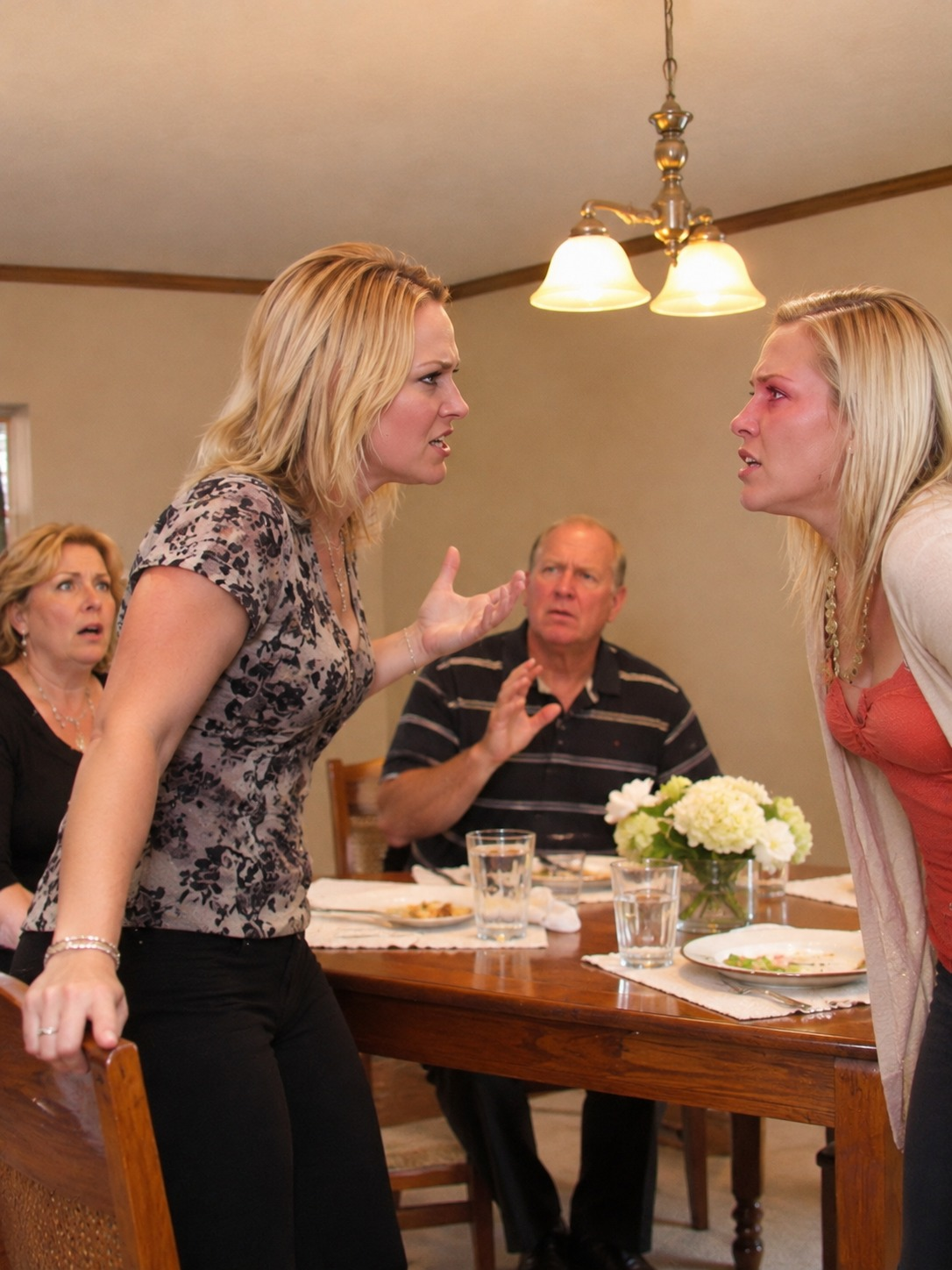
"Emily, have you been talking to Linda Harrison?"
My father's voice was so sharp that I almost dropped the phone.
I stood in my Denver kitchen, staring at the photograph Mrs. Harrison had just sent me.
Three signatures appeared at the bottom of an old school conference record.
Linda Harrison.
Margaret Carter.
Robert Carter.
My father.
For fifteen years, he'd told me I was responsible for losing my senior portfolio.
Now his name was on a document connected to the investigation into its disappearance.
And somehow, he already knew I'd contacted the counselor.
I swallowed.
"Hello to you too, Dad."
"Answer the question."
I looked at the photograph again.
"Why?"
"Because I just received a strange phone call."
"From whom?"
"That's not important."
I almost laughed.
My father had always been very good at deciding which questions deserved answers.
Usually, they were his.
"Dad, did you attend a meeting at Westbrook High School about my missing assignments?"
Silence.
It lasted long enough for me to hear the refrigerator humming behind me.
Then he said, "That was fifteen years ago."
I closed my eyes.
It was almost word for word what Bonnie had said.
As though time could turn something wrong into something harmless.
"That's not an answer."
"Emily, I don't know what you're trying to accomplish."
"I'm trying to understand what happened."
"You lost some school papers. You still graduated. You still went to college. You have a good career."
I stared at the wall.
There it was.
The familiar list of reasons I wasn't allowed to be upset.
Because things had eventually worked out, I was apparently supposed to pretend nothing bad had happened.
"Did you know Bonnie took my portfolio?"
He exhaled.
"Your sister was a teenager."
My stomach dropped.
I gripped the phone.
"Dad."
"What?"
"Did you know?"
He didn't answer.
I felt something inside me go still.
For years, I'd imagined confronting my parents about Bonnie's cruelty.
I'd pictured them being shocked.
I'd pictured my father demanding an explanation.
I'd pictured my mother apologizing for not believing me.
I had never imagined that my father might respond as though the truth was an inconvenience.
"Emily," he said finally, "we're not doing this over the phone."
"Then when?"
"When you come home for the wedding."
I looked at the calendar hanging beside my refrigerator.
The ceremony was four weeks away.
I'd already booked my flight for the previous evening, planning to stay through the weekend.
Suddenly, four weeks felt like a very long time.
"I want to know now."
"You're getting worked up over something that happened when you were a child."
"I was seventeen."
"Exactly."
I stared at the phone.
"That doesn't make it okay."
He sighed.
"Nobody said it was okay."
"Then why did you tell me I was careless?"
Another silence.
I could practically picture him sitting in his recliner, rubbing his forehead and looking toward Mom for help.
"Your mother and I did what we thought was best."
The sentence made my skin crawl.
Best for whom?
I wanted to ask.
But I already knew what he'd say.
For the family.
For the peace.
For Bonnie.
Always for Bonnie.
"Dad, did you sign something about my scholarship?"
His breathing changed.
"Who showed you that?"
I closed my eyes.
So the signature was real.
He hadn't denied it.
"Mrs. Harrison."
"That woman should have left this alone."
My heart began pounding.
"Why?"
"Because she doesn't know what she's talking about."
"She was the school counselor."
"And your mother and I were your parents."
I stared at the floor.
For the first time, I heard something in his voice that I hadn't recognized before.
Not authority.
Not concern.
Fear.
"Dad," I said quietly, "what happened at that meeting?"
He didn't answer.
Then, after a long pause, he said, "Just come home, Emily."
The line went dead.
I stood in the kitchen for several minutes.
My phone remained in my hand.
I kept looking at the photograph of the conference record.
My father's signature was unmistakable.
The same broad R.
The same uneven T.
The same heavy pressure he'd used when signing birthday cards and permission slips.
He'd been there.
He'd known something.
And he'd spent fifteen years allowing me to believe I'd lost my own work.
I wanted to call him back.
I wanted to demand answers.
Instead, I called Sarah.
She answered immediately.
"Hey, what's up?"
"My dad knew."
There was a pause.
"About Bonnie?"
"I think so."
I explained the photograph, the phone call, and his refusal to answer my questions.
Sarah listened without interrupting.
When I finished, she asked, "Are you alone?"
"Yes."
"Do you want me to come over?"
I looked around my apartment.
Everything was familiar.
The blue couch.
The bookshelves.
The little plant beside the window that I somehow hadn't killed.
The life I'd built hundreds of miles away from my family.
"No," I said. "I'm okay."
"Are you sure?"
I thought about it.
"I'm upset. But I'm okay."
Sarah was quiet for a moment.
Then she said, "That's allowed, you know."
"What is?"
"Being upset without falling apart."
I sat down.
A strange laugh escaped me.
"I think my family would prefer it if I fell apart."
"Why?"
"Because then they could say I was being dramatic."
Sarah sighed.
"Emily."
"I know."
"No, listen."
Her voice grew firmer.
"You don't have to prove you're reasonable by pretending something doesn't hurt."
I stared at the floor.
That was another thing I was learning.
I could be angry and still be thoughtful.
I could be hurt and still be strong.
I could love my family and still refuse to accept the way they treated me.
Those things weren't contradictions.
They were simply complicated.
And adulthood, I was discovering, involved learning to live with complications instead of letting other people define them for you.
The next morning, I called Mrs. Harrison.
She answered after several rings.
"Emily?"
"Hi. I'm sorry to bother you."
"You're not bothering me."
I sat at my kitchen table.
"I saw the photograph."
There was a pause.
"I thought you should."
"My father's signature is on it."
"Yes."
I swallowed.
"He called me last night."
Mrs. Harrison was quiet.
Then she asked, "What did he say?"
"Not much."
I looked toward the window.
"He told me to leave it alone."
She sighed.
"I'm sorry."
"Mrs. Harrison, I need to ask you something."
"Of course."
"Did my parents know Bonnie took my portfolio?"
She didn't answer immediately.
Then she said, "I believe your parents were informed of the allegation and of Bonnie's written statement."
My chest tightened.
"Both of them?"
"Both attended the meeting."
I closed my eyes.
There it was.
Not every detail.
Not every answer.
But enough to make the past feel suddenly different.
"Why didn't anyone tell me?"
Mrs. Harrison's voice softened.
"Emily, I wish I'd handled that situation differently."
I stared at the table.
"What do you mean?"
"At the time, there were disagreements about how the matter should be addressed. Your parents wanted to handle the family issues privately."
I felt cold.
"And the school agreed?"
"Not entirely. We documented what we could. But some decisions about your scholarship materials were outside my authority."
I thought about the old email from Mrs. Patterson.
The replacement documents.
The deadline.
The partial scholarship.
"Did my parents stop you from telling me?"
Mrs. Harrison hesitated.
"I don't want to give you an incomplete answer."
"Then tell me what you remember."
She sighed.
"I remember being concerned that you were blaming yourself for something that might not have been your fault."
Tears stung my eyes.
"Then why didn't you say anything?"
"Because I was told the family had already discussed it with you."
I went still.
"What?"
Mrs. Harrison paused.
"Emily?"
I gripped the phone.
"My parents told you they'd discussed it with me?"
"That was my understanding."
I closed my eyes.
I remembered sitting at the kitchen table, crying over my missing portfolio.
Mom had told me to stop being careless.
Dad had said mistakes had consequences.
Bonnie had offered me a tissue.
Nobody had told me anything about a meeting.
Nobody had mentioned a statement.
Nobody had apologized.
I opened my eyes.
"They lied."
Mrs. Harrison was silent.
I wiped my face.
"They never told me."
Her voice became very quiet.
"I'm sorry, Emily."
I swallowed.
"Why did you keep your notes?"
"Because something about that meeting never sat right with me."
"What?"
"I'd rather show you the full context in person."
I wanted to argue.
But I understood.
Fifteen-year-old records.
Incomplete memories.
A family that had already twisted the truth more than once.
I needed to see everything.
"When can we meet?"
She gave me a date.
The Wednesday before Bonnie's wedding.
I checked my calendar.
That was two days earlier than I'd planned to arrive.
"I can change my flight," I said.
"Are you sure?"
"Yes."
She hesitated.
"Emily, there's something else."
I held my breath.
"What?"
"Please don't tell your family we're meeting."
I stared at the wall.
"Why?"
"Because I want you to have the opportunity to hear what I remember without anyone trying to influence the conversation."
I thought about my father's phone call.
About his insistence that I leave the past alone.
Then I nodded, even though she couldn't see me.
"Okay."
I changed my flight that afternoon.
It cost more than I wanted.
I didn't care.
I booked a hotel near the airport rather than staying with my parents.
That decision felt surprisingly important.
For years, whenever I visited Missouri, I'd stayed in my childhood bedroom.
Mom insisted.
She said hotels were a waste of money.
She said family should stay together.
She said she didn't understand why I'd want to sleep anywhere else.
But staying in that house always made me feel smaller.
I'd wake up in the same room where I'd cried over school assignments.
I'd walk past the bathroom mirror where I'd once practiced smiling without showing my teeth.
I'd sit at the dining table where my parents had discussed my weight as though I wasn't present.
This time, I wanted somewhere to go when I needed space.
A door I could close.
A room where nobody could walk in and demand an explanation.
So I booked the hotel.
Then I called Mom.
She answered cheerfully.
"Emily! I was just thinking about you."
"Hi, Mom."
"How's work?"
"Busy."
"Well, don't work too hard. You know, Bonnie's been stressed about the wedding."
I waited.
"She's worried about everything," Mom continued. "The flowers, the seating chart, the photographer. Poor thing."
I looked at my laptop.
The hotel confirmation was still open.
"That sounds stressful."
"It is. Which is why we need everyone to be supportive."
There it was.
The warning disguised as a request.
"I'll be supportive," I said.
Mom sounded relieved.
"Good."
I took a breath.
"I'm coming home Wednesday instead of Friday."
She paused.
"Wednesday?"
"Yes."
"Why?"
"I have something to take care of."
"What?"
"Personal business."
Mom went quiet.
Then she said, "Emily, is this about that old school situation?"
I stared at the wall.
My father had told her.
Of course he had.
"Why do you ask?"
"Your father mentioned you've been asking strange questions."
"Strange?"
"Honey, you know what I mean."
"No, Mom. I don't."
She sighed.
"Bonnie is getting married. This is supposed to be a happy time."
I closed my eyes.
"And it can be."
"Then please don't bring up old arguments."
I felt something inside me tighten.
"Mom, did you know Bonnie took my school assignments?"
Silence.
Then she said, "Emily, we've talked about this."
"No, we haven't."
"Well, there's nothing to discuss."
I stared at the wall.
"Did you know?"
Her voice sharpened.
"Your sister was a child."
I closed my eyes.
The same words.
The same excuse.
The same refusal to answer.
I suddenly felt very tired.
"Okay," I said.
Mom sounded relieved.
"Good. Now, about your dress—"
"I'm going to go."
"Emily—"
"I'll see you Wednesday."
I ended the call.
Then I sat quietly for a long time.
The weeks before my trip passed faster than I expected.
Work was busy.
My team was preparing a major client presentation, and I spent several late evenings reviewing reports and helping younger colleagues prepare.
One afternoon, my manager, David, stopped by my desk.
"Got a minute?"
I looked up.
"Sure."
He sat across from me.
"I wanted to talk about the regional leadership position opening next quarter."
I blinked.
"What about it?"
He smiled.
"I think you should apply."
For a moment, I couldn't speak.
The position would mean more responsibility.
A larger team.
A significant salary increase.
And the chance to help shape the company's strategy.
"Really?"
David nodded.
"You've earned it."
I stared at him.
He continued.
"Your team respects you. Clients trust you. And you've handled some difficult projects better than people with twice your experience."
I felt my cheeks warm.
"Thank you."
He smiled.
"Don't thank me yet. The interview process is competitive."
I laughed.
"Of course."
"But I want you to know you're ready."
After he left, I sat at my desk for several minutes.
I thought about my family.
About how often they'd treated my career as a consolation prize.
Something I had because I hadn't found a husband.
Something that mattered less than Bonnie's engagement ring.
Then I looked at the leadership application on my screen.
And I smiled.
Because outside my family, people saw me differently.
They saw someone capable.
Someone valuable.
Someone who deserved opportunities.
I opened the application.
And I started typing.
Two days before my flight, Sarah came over to help me pack.
She stood in my bedroom holding two dresses.
"Navy or green?"
I looked up from my suitcase.
"Navy."
She held the green one against herself.
"Good. I'm stealing this."
I laughed.
"You already have three dresses you borrowed from me."
"Borrowed is such a strong word."
She placed the green dress on the bed.
Then she looked at my suitcase.
"Are you nervous?"
I hesitated.
"Yes."
"About the wedding?"
"About everything."
She nodded.
"Understandable."
I folded a sweater.
"I keep thinking about what my parents will say when they see me."
Sarah glanced at my blonde hair.
"Probably something ridiculous."
I laughed.
"You're not helping."
"I'm being realistic."
I sat on the edge of the bed.
"What if they hate it?"
Sarah put down the dresses.
She sat beside me.
"Emily, do you like it?"
I touched my hair.
"Yes."
"Then that's enough."
I looked at her.
She smiled.
"You've spent so much of your life asking whether your family approves of you. Maybe this trip is your chance to stop asking."
I stared at my hands.
"That sounds harder than it should."
"It probably is."
She nudged my shoulder.
"But you've done harder things."
I smiled.
She was right.
I'd moved across the country alone.
Built a career.
Made friends.
Learned to take care of myself.
And slowly, I'd begun to see the woman in the mirror as someone worth loving.
I wasn't going to undo all of that because Bonnie wanted to remain the prettiest person in the room.
On Wednesday morning, I boarded my flight to Missouri.
I wore comfortable jeans, a fitted cream sweater, and my blonde hair loose around my shoulders.
For once, I didn't choose an outfit based on what my mother might criticize.
I chose something I liked.
During the flight, I looked through the photographs on my phone.
The old school documents.
The picture of my missing portfolio.
The conference record with my parents' signatures.
Then I opened a recent photograph of myself.
The one Sarah had taken after my salon appointment.
I looked happy.
Confident.
Like a woman who had finally stopped apologizing for existing.
I saved it as my phone wallpaper.
Then I turned toward the window.
Below us, the landscape stretched into the distance.
I wondered what would happen when I saw my parents.
Would they recognize how much I'd changed?
Would they be happy?
Would Bonnie be angry?
I didn't know.
But I was no longer arriving as the girl who believed she had to earn a place in her own family.
I was arriving as a woman who had built a good life without their permission.
And whatever happened next, I intended to protect it.
My flight landed shortly after noon.
I collected my suitcase, picked up a rental car, and drove toward my hotel.
I checked in.
Unpacked.
Then sent Mom a short message.
Landed safely. I'll see you tomorrow.
She replied immediately.
Tomorrow? We thought you'd come straight here.
I stared at the screen.
I hadn't told her I was staying in a hotel.
I typed:
I'm staying near the airport tonight. I have plans this afternoon.
Three dots appeared.
Disappeared.
Appeared again.
Then:
What plans?
I put the phone down.
I didn't answer.
At three o'clock, I drove to the address Mrs. Harrison had given me.
It was a small brick house in a quiet neighborhood.
I parked along the curb.
For a moment, I sat in the car, staring at the front door.
My heart was pounding.
Fifteen years.
That was how long I'd waited for answers.
I checked the envelope in my purse.
Inside were copies of the photographs Rachel had sent, the counselor's statement, and the conference record.
I took a deep breath.
Then I got out of the car.
I walked up the path.
Before I could knock, the front door opened.
Mrs. Harrison stood in the doorway.
She looked older than I remembered.
But her eyes were kind.
"Emily," she said softly.
I smiled nervously.
"Hi, Mrs. Harrison."
She stepped aside.
"Come in."
I entered the house.
The living room was small and tidy.
A stack of folders sat on the coffee table.
Mrs. Harrison gestured toward the couch.
"Please, sit."
I took a seat.
She sat across from me.
For a moment, neither of us spoke.
Then she reached for the top folder.
"Emily, before we begin, there's something I need to tell you."
My stomach tightened.
"What?"
She looked at me.
"The meeting your parents attended wasn't the first meeting about your missing assignments."
I froze.
"What do you mean?"
She opened the folder.
"There was an earlier report."
I stared at her.
"From whom?"
Mrs. Harrison hesitated.
Then she turned the folder toward me.
At the top was a handwritten complaint form.
The date was six months before my portfolio disappeared.
And beneath the words Reporting Student was a name I recognized.
Rachel Mercer.
I looked up.
"Rachel reported Bonnie?"
Mrs. Harrison nodded.
"Yes."
I stared at the document.
Then she said something that made my heart stop.
"But Rachel wasn't the only person who reported what Bonnie was doing."
I looked down.
There was a second form beneath the first.
Mrs. Harrison reached for it.
Her hand trembled slightly.
Then she turned the page.
And I saw the name of the person who had tried to warn the school about my sister.
It was someone I had trusted more than anyone in my family.






Comments 0