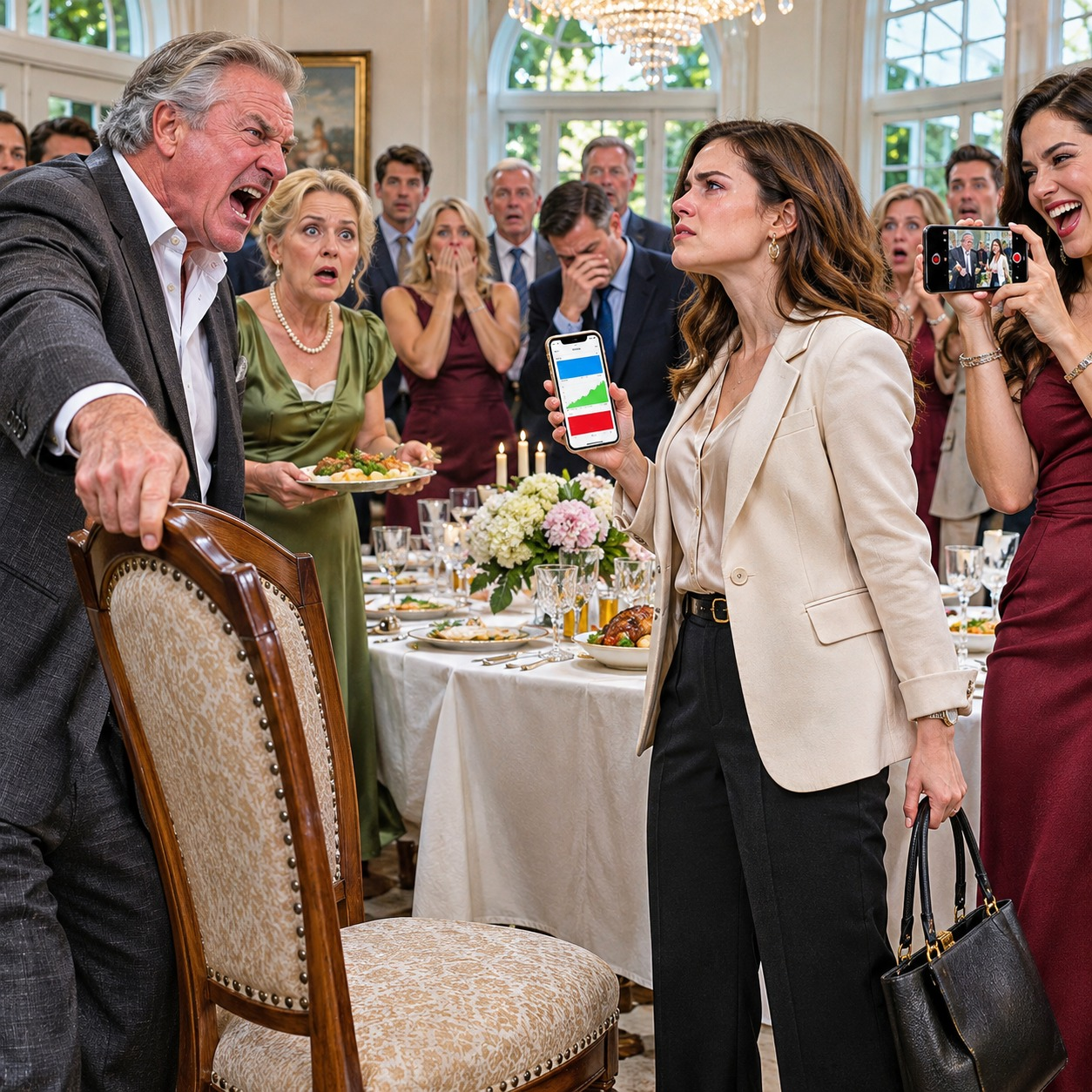
My father crossed the café in twelve long strides.
I counted them because I needed something to concentrate on besides the envelope beneath my hand.
Mom sat across from me, trembling.
The second envelope, the one addressed to me in Grandma Evelyn's handwriting, lay between our coffee cups.
Dad stopped beside the table.
"Elaine."
His voice was low.
Dangerously low.
Mom looked up.
"Graham."
"What are you doing?"
She swallowed.
"Having breakfast with our daughter."
His eyes moved to the envelope.
Then to my hand.
"Give me that."
I didn't move.
"Good morning to you too, Dad."
He ignored me.
"Elaine, I told you to leave those papers alone."
Mom flinched.
I placed my palm flat over the envelope.
"These papers are addressed to me."
"They're family documents."
"Then we're having a family conversation."
His jaw tightened.
"Not here."
I looked around.
The café was half full. A young couple sat near the window. Two construction workers were eating breakfast. Behind the counter, a woman was steaming milk.
It was an ordinary Thursday morning.
For once, I was grateful for ordinary people.
"I'm comfortable here," I said.
Dad leaned closer.
"Maya, don't make a scene."
I looked directly at him.
"That's an interesting request."
He straightened.
"What?"
"Considering what happened at your birthday dinner."
His expression hardened.
Mom reached for her tea.
Her hand was shaking so badly that the spoon rattled against the saucer.
Dad looked at her.
"Elaine. We're leaving."
She didn't stand.
He frowned.
"Elaine."
Mom took a breath.
Then she said something I had waited thirty-five years to hear.
"No, Graham."
He stared at her.
She looked frightened.
But she didn't look away.
"I'm staying with Maya."
For several seconds, my father seemed incapable of understanding what had happened.
Then he pointed toward the envelope.
"That belongs to me."
I pulled it closer.
"No. It has my name on it."
He reached for it.
I moved it out of his reach.
"Don't."
His hand stopped.
The café had grown quieter.
I kept my voice steady.
"If you have something to say, sit down and say it. Otherwise, please leave."
Dad stared at me.
Then he looked at Mom.
Neither of us moved.
Finally, he pulled out the empty chair beside her.
And sat.
I opened Grandma Evelyn's envelope.
Inside were three documents.
The first was a letter.
The second was a copy of a trust distribution statement.
The third was a bank record showing a transfer made six years earlier.
I recognized Grandma's handwriting immediately.
My dearest Maya,
You have always been curious about how things work. Even as a little girl, you wanted to know why a machine stopped, why a shipment arrived late, and why people kept doing things the difficult way when there might be a better one.
Your father understands how to sell. You understand how to build.
Both are gifts, but they are not the same gift.
My throat tightened.
I kept reading.
I have arranged for money to be set aside to help you establish your business. I want you to use it without feeling obligated to surrender control to anyone.
Not even your father.
I looked up.
Dad was staring at the table.
Mom had begun crying.
I continued.
The money is yours. The work will be yours. The mistakes will be yours. And if you succeed, the success will belong to you and the people who helped you earn it.
Never confuse gratitude with ownership.
I pressed my lips together.
Grandma had written those words six years earlier.
Before I hired Rebecca.
Before I signed my first major contract.
Before Whitaker Hospitality Supply became a customer.
Before Dad pulled away my chair.
She had understood something I was only beginning to understand myself.
I turned to the distribution statement.
The original trust allocation was $150,000.
I frowned.
My inheritance had been $50,000.
I looked at Mom.
"Where's the other hundred thousand?"
She covered her mouth.
Dad spoke before she could answer.
"It was used for family purposes."
I stared at him.
"What family purposes?"
"Business expenses."
"Whose business?"
He didn't answer.
I looked at the bank record.
The money had been transferred from Grandma's trust account to an account associated with Whitaker Hospitality Supply.
Six years earlier.
Two weeks after her death.
I felt my chest tighten.
"Dad, did you take money Grandma left me?"
He leaned back.
"I was the trustee."
"That wasn't my question."
He looked irritated.
"The company was going through a temporary cash shortage."
I stared at him.
"So you used my inheritance?"
"I intended to replace it."
"Did you?"
Silence.
Mom began crying harder.
I looked at the statement again.
The documents showed the transfer, but I knew they weren't enough by themselves to establish every legal detail.
Still, they explained why Mom had been so frightened.
And why Dad had never wanted me to read Grandma's letter.
"You told me Grandma left me fifty thousand dollars."
Dad stared at the window.
"That's what you received."
"She intended me to receive one hundred and fifty thousand."
He said nothing.
I took a slow breath.
"Did you ever plan to tell me?"
He looked at me.
"I gave you opportunities worth far more than that."
I felt the familiar anger rise.
Then I remembered Grandma's words.
Never confuse gratitude with ownership.
"Dad, you don't get to decide that taking my money was acceptable because you later gave me a customer contract."
His expression hardened.
"That contract made your company."
"No."
I spoke quietly.
"It helped my company grow. My employees and I built the company."
He looked away.
For the first time, I noticed how tired he seemed.
His face had deep lines around the eyes.
His hands rested heavily on the table.
He looked less like the powerful businessman who had controlled our family and more like an aging man who had spent too many years refusing to admit his mistakes.
But exhaustion wasn't an excuse.
And fear wasn't permission.
I folded Grandma's letter carefully.
"Daniel Foster will review these documents."
Dad's head snapped toward me.
"You're going to sue your own father?"
"I'm going to find out what happened to money Grandma intended for me."
Mom reached across the table.
"Maya, I should have told you."
I looked at her.
"Yes."
Tears rolled down her cheeks.
"I was afraid."
"I know."
She shook her head.
"No. I don't think you do."
I waited.
She took a shaky breath.
"Your father told me that if I told you about the trust, the company might fail and hundreds of people could lose their jobs."
Dad stared at her.
"Elaine."
She didn't stop.
"He said it was temporary. He said he would replace the money before you ever needed it."
I looked at Dad.
"And when he didn't?"
Mom wiped her cheeks.
"He told me it was too late to explain."
I sat back.
For years, Mom had protected him from uncomfortable truths.
Now she was finally saying them aloud.
Dad pushed back his chair.
"This conversation is over."
I looked at him.
"Then you can leave."
He stood.
For a moment, I thought he might shout.
Instead, he looked at Grandma's letter.
His face changed.
Something like regret crossed it.
Then he said quietly, "My mother never understood the pressure I was under."
I looked at him.
"She understood enough to protect me."
He had no answer.
He turned and walked out.
The café door closed behind him.
Mom began sobbing.
I moved around the table and sat beside her.
For a long time, I simply held her hand.
The next three weeks were difficult.
Not dramatic in the way the birthday dinner had been.
Not filled with shouting or slammed doors.
They were difficult in the ordinary, exhausting way that serious problems often are.
There were documents to review.
Records to preserve.
Meetings with attorneys.
Questions that required careful answers.
And people who had spent years avoiding the truth were finally being asked to explain themselves.
Daniel Foster arranged for an independent trust attorney to examine Grandma Evelyn's estate records.
The review confirmed that I had been entitled to the full $150,000 distribution.
The $100,000 transfer had not been authorized as a loan to Whitaker Hospitality Supply under the trust terms.
Dad had been responsible for administering the funds.
And he had failed to do so properly.
When Daniel explained the findings, I sat quietly.
I had expected to feel triumphant.
Instead, I felt sad.
Grandma had tried to give me something.
Dad had taken part of it.
And for six years, I hadn't known.
"What happens now?" I asked.
Daniel folded his hands.
"We can pursue recovery through the appropriate legal process. Your father has also indicated through counsel that he's willing to discuss repayment."
I looked at him.
"Why now?"
"Because the records are clear."
I nodded.
A week later, Dad agreed to repay the missing principal, along with an additional amount negotiated to address the time the funds had been unavailable.
The repayment was documented separately from every business contract involving my company.
I insisted on that.
The inheritance belonged to me personally.
The software belonged to my company.
And neither should be used to excuse what had happened to the other.
When the settlement was finalized, I took Grandma's original letter home.
I placed it in a frame beside my desk.
Not because I needed a reminder that Dad had taken the money.
Because I wanted to remember that Grandma had believed in me before anyone else did.
The investigation into the disputed technology documents took longer.
Daniel worked with independent specialists to examine the files, signatures, email records, and related correspondence.
The findings were uncomfortable for nearly everyone involved.
Peter Lawson had prepared multiple versions of documents describing ownership arrangements that had never been approved by my company.
Several versions contained signatures presented as mine.
The document histories showed that the files had been created and modified long after the dates they purported to represent.
The notary whose stamp appeared on one amendment confirmed that she had never notarized it.
And the supposed emergency board review had been distributed from a misleading email domain with no authority over my company.
The investigators also confirmed that the purported witness statement attributed to Rebecca contained language absent from the original acknowledgment she had signed.
Rebecca had made a serious mistake by communicating with Peter without authorization.
But she had not signed a statement claiming she witnessed me transfer my company.
That distinction mattered.
I didn't excuse her mistake.
I also didn't punish her for something the evidence showed she hadn't done.
After the independent review, Rebecca accepted a formal warning, completed additional confidentiality training, and agreed to revised approval procedures for outside financial inquiries.
She returned to her responsibilities with my full knowledge of what had happened.
The first morning she came back, she stood in my doorway.
"Maya?"
I looked up.
"Yes?"
"Thank you for giving me a chance to make this right."
I shook my head.
"You earned that chance by telling the truth and cooperating with the review."
Her eyes filled.
"I won't let you down again."
I looked at her.
"Then let's get back to work."
She smiled.
And we did.
Rachel's situation was different.
The access review established that she had used her credentials to search for restricted records after Tessa approached her about a possible position at Whitaker Hospitality Supply.
Although the blocked request had not resulted in a successful download, she had violated company policy and had authorized Peter's late-night visit without verifying it with me.
After a documented employment review, we ended her employment.
I didn't enjoy making that decision.
Rachel had worked hard for years.
But trust mattered.
And the company couldn't function if confidential access became a favor employees could offer to my family.
We helped her collect her personal belongings privately.
We paid everything owed under her employment arrangements.
And we parted without public accusations.
Peter Lawson's involvement was referred to the appropriate authorities for review.
I didn't try to predict the outcome.
I didn't make public allegations beyond what our attorneys could support.
I let the records speak.
The forged-looking documents were withdrawn from the acquisition materials.
Northbridge Capital Partners suspended its original proposal while the ownership representations were corrected.
Caroline Bennett and the other independent directors commissioned a broader review of Whitaker Hospitality Supply's financial position.
That review uncovered the truth Dad had been trying so desperately to hide.
The company wasn't worthless.
It wasn't collapsing overnight.
But its expansion had been too aggressive.
Two recently acquired distribution facilities were underperforming.
Borrowing costs had increased.
And Dad had relied on optimistic projections to justify additional spending.
The proposed acquisition had become more than a growth opportunity.
He had begun treating it as a rescue plan.
When the technology valuation was questioned, the entire financial picture changed.
Marcus Reed told me the board had spent days reviewing alternatives.
Eventually, the directors negotiated a restructuring plan with the company's lenders.
The plan required selling one underused property, reducing discretionary spending, and postponing a planned expansion.
It also required a change in leadership.
Dad stepped down as chief executive.
Marcus became interim CEO.
Caroline oversaw the board's search for a permanent successor.
The business continued operating.
Employees kept receiving their paychecks.
Customers kept receiving their deliveries.
And Whitaker Hospitality Supply began rebuilding on financial information that could actually be supported.
When Marcus called to tell me the board's decision, his voice sounded tired.
But relieved.
"We have a chance to stabilize things," he said.
I looked at the framed photograph of my employees.
"I'm glad."
He hesitated.
"Your father isn't taking it well."
"I didn't expect him to."
"He thinks everyone abandoned him."
I closed my eyes.
For years, Dad had treated disagreement as betrayal.
Now he was surrounded by people who could no longer afford to agree with him simply to keep him happy.
"Marcus," I said, "I hope he eventually understands what happened."
"So do I."
"But I'm not going to pretend the decisions were someone else's."
Marcus was quiet.
Then he said, "Neither am I."
The software renewal was resolved the following month.
Marcus and Olivia reviewed Whitaker Hospitality Supply's operational needs in detail.
The full standard package remained available at $8,900 per month.
After reviewing the reduced-service option, Whitaker chose a package priced at $7,200 per month.
The lower price reflected fewer services, not a family favor.
It was documented.
Approved.
Signed by the proper representatives.
And entirely separate from the ownership dispute.
Our existing agreement continued without interruption until the new one took effect.
No warehouse lost access.
No employees were stranded.
No customers suffered because of my father's decisions.
When Olivia brought me the signed renewal, she smiled.
"Everything is complete."
I looked at the document.
"Any special conditions?"
"Only the standard service terms."
"Any ownership language?"
"Absolutely not."
I laughed.
"Good."
She placed the contract on my desk.
"Marcus said to thank you."
"For what?"
"For keeping the business professional."
I looked at her.
"That's what we should have been doing all along."
Tessa called me two days after Dad stepped down.
I answered from my kitchen.
"Hi."
"Maya."
She sounded nervous.
"Can we talk?"
I looked at the clock.
"Yes."
She took a breath.
"I resigned from my vice president position."
I sat down.
"What?"
"The board was going to review my involvement in the technology presentations. I decided I shouldn't remain in the role."
I was quiet.
Tessa continued.
"I gave them all the emails and the original birthday video."
"I heard."
"And I told them Dad asked me to record you."
I closed my eyes.
"Thank you."
She began crying.
"I'm so sorry."
I looked at the window.
For years, I had wanted my sister to apologize.
Not with excuses.
Not with laughter.
Not with a claim that I was too sensitive.
Just an apology.
Now that it had finally come, I didn't know what to say.
Tessa continued.
"I thought being Dad's favorite meant I was doing something right."
I listened.
"But I wasn't good at my job, Maya. I was good at making him happy."
I felt my throat tighten.
She sniffed.
"I kept agreeing with him because I thought if I stopped, he'd stop loving me."
I closed my eyes.
There it was.
The truth behind so many years of competition.
I had spent my childhood trying to earn Dad's respect through achievement.
Tessa had tried to earn his love through obedience.
Neither of us had understood that the problem wasn't our effort.
It was the price he demanded.
"Tessa," I said quietly, "you hurt me."
"I know."
"You filmed one of the worst moments of my life."
"I know."
"And you helped Dad pursue something that didn't belong to him."
She began crying harder.
"I know."
I took a breath.
"I can't pretend those things didn't happen."
"I'm not asking you to."
I looked down at my hands.
"But I don't want to spend the rest of my life hating you."
She was silent.
Then she whispered, "Do you think we could start over?"
I considered the question.
"Not from the beginning."
She sniffed.
"What do you mean?"
"We can't erase what happened. But we can decide what happens next."
She cried softly.
"I'd like that."
"So would I."
We agreed to meet for coffee the following week.
No parents.
No cameras.
No business favors.
Just two sisters learning how to speak to each other without competing for a seat at someone else's table.
Mom moved into a small apartment that spring.
It wasn't a dramatic departure.
She and Dad had spent months discussing their marriage, and eventually they agreed to live separately while they considered what came next.
Mom began seeing a counselor.
She joined a gardening club.
She started volunteering at a local literacy program.
And for the first time in my life, she began making decisions without asking Dad whether he approved.
One Sunday afternoon, she invited me to lunch.
Her apartment smelled like fresh bread.
There were flowers on the windowsill.
And a small round dining table stood beside the kitchen.
Two chairs.
I smiled when I saw them.
Mom noticed.
"What?"
"Nothing."
She looked at the table.
Then she understood.
Her eyes filled with tears.
"Maya, I'm so sorry I didn't stand up for you that night."
I walked toward her.
"Mom, you can't change that night."
She nodded.
"But you can keep standing up for yourself now."
She hugged me.
"I intend to."
I believed her.
Not because she said it.
Because I had watched her begin doing it.
Dad and I didn't speak for almost four months.
During that time, my company continued growing.
We signed six new customers.
We hired two additional engineers.
We launched an improved inventory forecasting module that reduced manual reconciliation work for several warehouse clients.
Our revenue increased.
Our customer retention remained strong.
And for the first time, I began considering an expansion into a second office.
I still drove my old Ford.
I still lived in my modest townhouse.
But I stopped apologizing for either.
One afternoon, I received a handwritten letter.
The return address belonged to Dad.
I sat at my kitchen table and opened it.
The letter was short.
He wrote that he had spent much of his life believing success meant control.
He admitted that he had treated my accomplishments as though they diminished his own.
He acknowledged that the birthday dinner had been cruel.
He apologized for the documents, the pressure, and the money from Grandma's trust.
He didn't ask me to forgive him.
He didn't demand that I visit.
He didn't mention what I owed him.
At the bottom, he had written:
I don't expect you to trust me because I wrote this letter. I understand that trust would have to be earned.
I read it twice.
Then I placed it beside Grandma's letter.
I didn't call him immediately.
I needed time.
But a week later, I sent a reply.
Dad, I received your letter. Thank you for acknowledging what happened. I'm willing to meet for coffee sometime, but I need our relationship to be different. No insults. No pressure. No business arrangements disguised as family obligations.
He answered three days later.
I understand.
And when we eventually met, he listened more than he spoke.
It wasn't a perfect conversation.
There were awkward silences.
There were moments when he looked as though he wanted to defend himself.
But he didn't raise his voice.
He didn't tell me I was ungrateful.
And when I told him about our new customers, he asked what the software did.
For the first time, he seemed interested in the answer.
I didn't mistake one conversation for a transformation.
But I allowed myself to appreciate the effort.
Six months after the birthday dinner, we held a celebration at my company's office.
We had reached fifty customers.
Our team had grown to nineteen employees.
And we had completed our strongest quarter since the business began.
Rebecca organized the event.
Olivia handled the invitations.
The engineers decorated the conference room with blue and silver streamers.
Someone ordered an enormous cake with our company logo.
I arrived early.
The long conference table was already set.
There were nineteen chairs around it.
And one at the head.
I stood in the doorway for a moment.
Then Rebecca appeared beside me.
"Everything okay?"
I smiled.
"Yes."
She followed my gaze.
"The table?"
I nodded.
She smiled.
"There's a seat for everyone."
I laughed softly.
"That's exactly what I was thinking."
The room filled quickly.
Employees arrived with their families.
People laughed.
Children ran between chairs.
Someone spilled lemonade.
Nobody cared.
I looked around at the people who had helped build the company.
Some had been with me from the beginning.
Others had joined only recently.
Every one of them had contributed something I couldn't have created alone.
When Rebecca asked me to say a few words, I stood.
The room grew quiet.
I looked at the faces around the table.
Then I began.
"Six years ago, I started this company with an idea, a borrowed desk, and a laptop that overheated every afternoon."
Everyone laughed.
"I didn't know whether it would work."
I looked at Rebecca.
"I didn't know whether I could afford employees."
Then at Olivia.
"I didn't know whether customers would trust us."
I smiled.
"But I knew there was a problem worth solving."
I paused.
"And I knew I wanted to build a company where people were respected for what they contributed."
The room was quiet.
I took a breath.
"Today, we have fifty customers and nineteen employees. We've made mistakes. We've solved difficult problems. And we've built something I'm incredibly proud of."
I looked around.
"But the thing I'm proudest of isn't the revenue."
I paused.
"It's that people can come to work here and know their work matters."
Rebecca wiped one eye.
I smiled.
"Thank you for believing in this company. And thank you for believing in me."
The room erupted in applause.
I sat down.
Someone handed me a slice of cake.
Olivia raised her glass.
"To Maya."
Rebecca smiled.
"To the whole team."
Everyone cheered.
And for once, I didn't feel the need to prove anything.
Later that evening, after the guests had gone home, I remained in the conference room.
The streamers were still hanging.
There were empty plates on the table.
A few balloons floated near the ceiling.
I began collecting paper cups.
Then I stopped.
On the far side of the room sat an empty chair.
Just a chair.
Wooden legs.
Blue cushion.
Nothing special.
Yet I found myself remembering Dad's birthday dinner.
The sound of the chair scraping against the floor.
The laughter.
The words that had once made me feel so small.
I don't sit with a poor, useless kid.
For months, I had thought about that moment.
I had wondered whether I should have shouted.
Whether I should have confronted him.
Whether I should have told everyone at the table exactly how much my company was worth.
But standing there, surrounded by the evidence of what my team had accomplished, I finally understood why none of those responses had been necessary.
My worth had never depended on winning an argument with my father.
And my success had never required his permission.
I picked up the empty chair.
Carried it back to the table.
And placed it neatly beside the others.
Then my phone buzzed.
A message from Mom.
MOM: How was the celebration?
I smiled.
ME: Wonderful.
Another message arrived.
MOM: I'm proud of you.
I stared at the words.
For years, I had wanted to hear them.
Now they felt different.
Not like permission.
Like love.
I typed:
ME: Thank you. I love you.
Then I turned off the conference room lights.
The following Sunday, I invited Mom and Tessa to dinner at my townhouse.
Uncle Daniel came too.
Rebecca stopped by briefly with a bottle of sparkling cider.
Olivia sent flowers.
I cooked pasta, made a salad, and bought a chocolate cake from the bakery down the street.
Nothing extravagant.
Nothing designed to impress anyone.
Just dinner.
When everyone arrived, we gathered around my small dining table.
Mom sat beside the window.
Tessa helped bring plates from the kitchen.
Uncle Daniel told a terrible joke.
We laughed anyway.
For the first time in years, I felt comfortable in a room with my family.
Not because everything had been forgotten.
But because nobody was pretending anymore.
Tessa looked at me across the table.
"Can I ask you something?"
"Of course."
She smiled.
"Are you ever going to buy a new car?"
I laughed.
"Probably."
"When?"
"When this one stops working."
Everyone laughed.
Mom shook her head.
"Some things never change."
I smiled.
"Some things don't need to."
After dinner, we sat talking until the sky turned dark.
There were no arguments.
No demands.
No secret business arrangements.
And nobody pulled away anyone else's chair.
When the evening ended, I stood at the front door and hugged my family goodbye.
Then I returned to the dining room.
The table was still covered with plates and glasses.
The chairs were slightly crooked.
Someone had left a napkin on the floor.
I looked around and smiled.
Six months earlier, my father had tried to humiliate me by taking away my seat.
He had believed that if he made me feel small enough, I would surrender what I had built.
Instead, the truth had come out.
The money had been recovered.
The disputed documents had been withdrawn.
The business agreements had been corrected.
My employees were secure.
My company was growing.
My mother had found her voice.
My sister had begun finding her own path.
And even my father had finally started learning that respect couldn't be demanded.
It had to be earned.
I walked to the head of the table.
Pulled out my chair.
And sat down.
There was no one to impress.
No one to fear.
No one waiting to tell me I didn't belong.
This was my home.
My life.
My table.
And every seat at it was mine to offer.






Comments 0