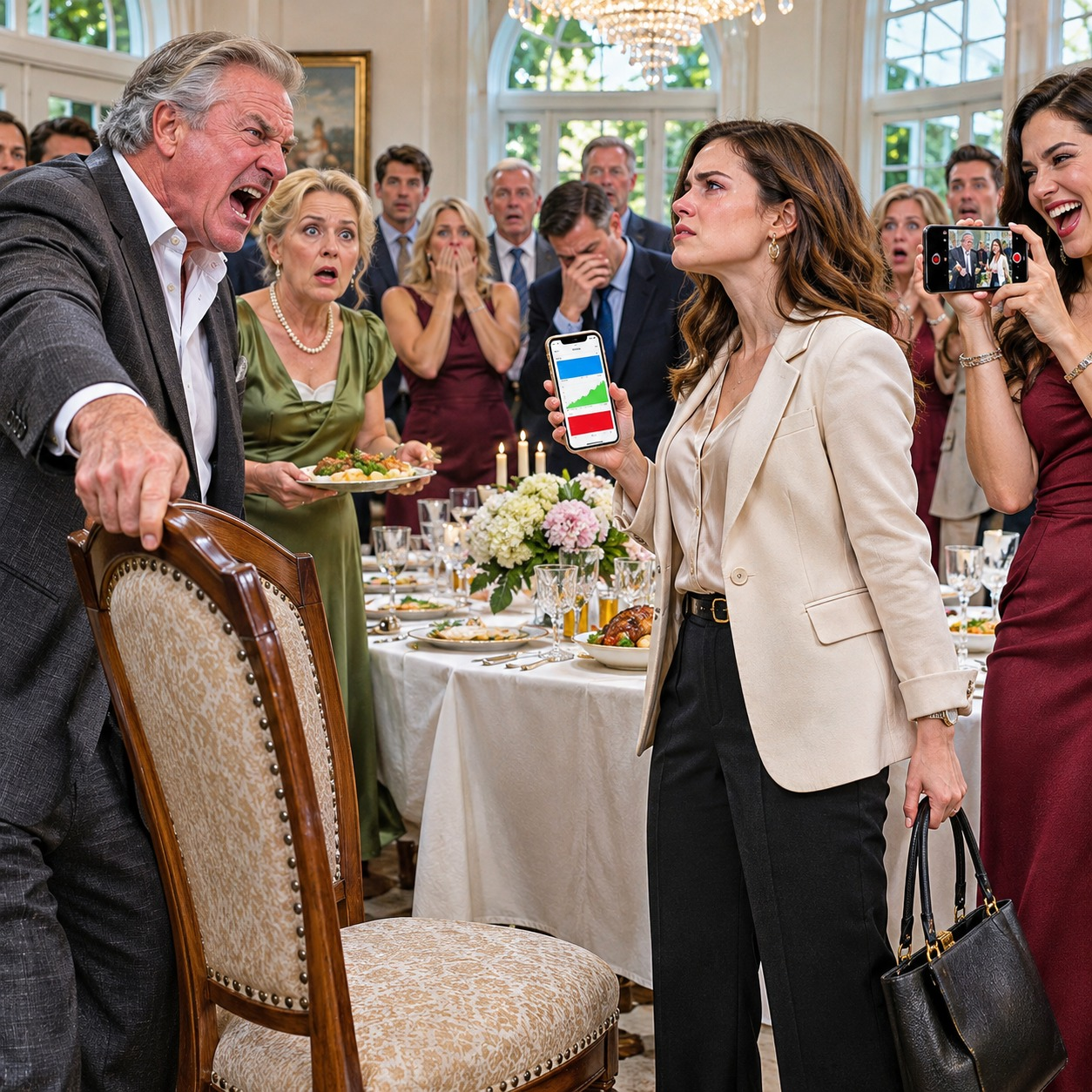
My father yanked the dining chair away just as I reached for it.
"Nobody wants a poor daughter sitting at this table!"
My younger sister raised her phone to record me.
But I noticed something else.
The contract waiting on my phone had not been signed.
And my father had no idea who controlled it.
My name is Maya Whitaker. I was thirty-five years old, and until that evening, I had still hoped my father might eventually learn to respect me.
That hope ended beside a dining table in front of fourteen relatives.
The birthday dinner was supposed to celebrate Graham Whitaker, founder and president of Whitaker Hospitality Supply, a successful distribution company headquartered in Cincinnati, Ohio.
My father had spent thirty years building his business. He owned a beautiful home, drove expensive German cars, and enjoyed reminding everyone that his company supplied equipment and products to hotels, restaurants, and hospitality groups across several states.
He measured success in visible things.
A luxury vehicle.
An expensive watch.
A large house.
An impressive job title.
And, apparently, the amount of money a person could spend without checking their bank account.
My younger sister, Tessa, understood his philosophy perfectly.
At thirty-two, she worked as vice president of marketing and partnerships at his company. She wore designer dresses, carried expensive handbags, and drove a new Mercedes SUV that Dad had helped her purchase.
He introduced her as his greatest professional achievement.
I owned a software company with sixteen employees and forty-three paying business customers.
We developed warehouse management and logistics software that helped distribution companies coordinate shipments, monitor inventory, reduce delivery delays, and manage complicated operations.
Our business was profitable.
We had recurring revenue.
We had long-term customers.
And we were growing.
But my father never seemed interested in hearing any of that.
To him, I was still the daughter who had chosen the wrong career.
I had arrived at the birthday dinner in my seven-year-old Ford, wearing a deep emerald-green blazer, an ivory silk blouse, and charcoal trousers.
I liked my car.
It was reliable, paid off, and had never given me a reason to replace it.
My townhouse outside Cincinnati was comfortable, and I preferred spending money on my employees, my business, and my future rather than trying to impress people.
Unfortunately, my father considered those decisions evidence of failure.
When I entered the house, Tessa greeted me near the front door.
Her copper-red hair was styled perfectly, and her royal-blue evening dress looked as though it had come directly from an expensive boutique.
Her eyes briefly moved toward the keys in my hand.
"You're still driving that Ford?"
I smiled.
"Yes. It still runs."
She laughed.
"That's one way to look at it."
I handed her the cookbook I had brought for our mother, Elaine.
Mom had collected cookbooks for years, and I had found an old regional edition she had once mentioned wanting.
"Can you give this to Mom?" I asked.
Tessa glanced at the cover.
"Another practical gift?"
Before I could answer, Dad called from the dining room.
"Tessa! Come here. I want to show you something."
She immediately turned toward his voice.
I walked inside.
Dad stood beside the fireplace in a charcoal blazer, holding a glass of wine. My uncle Daniel was beside him, listening as he described a new hotel partnership.
"Tessa handled the partnership strategy," Dad announced proudly.
"She's learning how serious business works."
He noticed me.
His expression changed slightly.
"Maya. You made it."
"Happy birthday, Dad."
I handed him his present.
He glanced at the wrapping.
"Thank you."
Then he looked over my shoulder toward the driveway.
"Your old car made it here again?"
A few relatives laughed.
I decided not to respond.
For most of my adult life, I had learned that silence was often cheaper than arguing with Graham Whitaker.
Dinner preparations continued.
Mom moved between the kitchen and dining room, checking the table arrangements and making sure everyone had something to drink.
The dining table was beautiful.
White linen covered its surface. Crystal glasses reflected the chandelier, and silver candlesticks stood between arrangements of fresh flowers.
Fourteen relatives and guests had gathered for the evening.
There was my father's brother, two cousins, an aunt, several business acquaintances, and other family members.
Everyone seemed relaxed.
Except me.
I knew the conversation would eventually turn toward my career.
It always did.
Daniel approached me while Dad was pouring wine.
"How's your company doing?"
"Pretty well," I answered. "We added several accounts this year."
"How many customers now?"
"Forty-three."
He nodded.
"That's impressive."
Dad heard him.
"Forty-three little software subscriptions don't make you a businesswoman, Maya."
The room became slightly quieter.
Tessa lowered her glass.
"She's doing her best, Dad."
Her voice sounded supportive, but her expression suggested otherwise.
Dad smiled.
"Her best? At her age, I already owned commercial property."
I looked at him.
"Congratulations."
His smile tightened.
I could see he wanted an argument.
He wanted me to defend myself.
He wanted to explain why I hadn't bought a luxury car, why I didn't wear expensive jewelry, and why I hadn't followed the career path he had chosen for Tessa.
But I had no interest in giving him another opportunity to make me feel small.
Mom appeared with a platter of roasted vegetables.
"Dinner is ready."
Everyone began taking their places.
I approached the chair beside Mom.
It was the seat I had occupied at family dinners since childhood.
I reached for its wooden backrest.
Then Dad stepped toward me.
He grabbed the chair.
And pulled.
The wooden legs scraped violently across the hardwood floor.
My hand missed the backrest.
For one brief moment, I lost my balance.
Then I straightened.
The room went silent.
Dad stood holding the chair several feet away from the table.
He looked at me with an expression of satisfaction.
"I don't sit with a poor, useless kid."
I stared at him.
I could hear the faint ticking of the clock above the fireplace.
My aunt lowered her eyes.
Daniel stopped moving.
Mom held the serving platter against her chest.
And Tessa?
Tessa raised her smartphone.
She turned the camera toward me and began recording.
She was smiling.
She wanted to capture my humiliation.
She expected me to cry, shout, or beg Dad to stop embarrassing me.
Instead, I looked directly at him.
I didn't reach for the chair.
I didn't ask why he had done it.
I didn't even look at Tessa.
I simply straightened my emerald-green blazer.
Dad laughed.
"What's wrong? Don't you want to sit with the successful people?"
I took a slow breath.
For years, I had allowed him to believe I was struggling.
I had never corrected his assumptions about my business.
I had never told him how much our company earned.
And I had never explained that the software his own company relied on every day belonged to me.
Three years earlier, Whitaker Hospitality Supply had become one of our first major customers.
At the time, the company was experiencing serious operational problems.
Warehouse employees were working with outdated spreadsheets. Delivery appointments were frequently missed. Inventory discrepancies were costing money, and the management team struggled to coordinate shipments across multiple locations.
My team had built a solution.
Marcus Reed, my father's chief operating officer, had evaluated our platform and approved a pilot program.
The results were excellent.
The company eventually signed a thirty-six-month agreement covering two warehouses, software integration, and ongoing technical support.
Dad had approved the agreement.
But he had never understood how important the software would become.
He still believed he had done me a favor by giving my company an early opportunity.
I had never denied that his business helped us get started.
In fact, I had rewarded that early trust.
The original monthly subscription was only $3,250.
As our software developed, our customer base expanded, and our operating costs increased, our standard pricing changed.
Comparable customers were now paying substantially more.
But I had protected my father's original rate.
My finance director had questioned the arrangement several times.
I always gave the same answer.
"They trusted us early. Keep their original pricing."
That decision had cost my company a considerable amount of potential revenue.
And now the contract was approaching its expiration date.
Six weeks earlier, I had asked my finance department to prepare a possible twenty-four-month renewal offer.
The standard commercial price for Whitaker's requirements was now $8,900 per month.
I had also considered offering Dad a discounted family rate.
But I had not approved it.
I had not signed it.
And I had not promised him anything.
The special offer was still sitting in our internal approval system.
I looked at the man standing in front of me.
He was laughing.
He genuinely believed he had won something.
"You just made a very expensive mistake," I said.
Dad burst into laughter.
"What are you going to do, sweetheart? Send me a software bill?"
Tessa laughed behind her phone.
I turned toward Mom.
"I love you."
Her eyes filled with tears.
"Maya, please..."
I gently touched her arm.
Then I picked up my handbag.
Dad called after me.
"Don't come crying when you need help!"
I didn't turn around.
I walked toward the entrance.
Mom followed me into the hallway.
"Please don't leave over one stupid comment."
I looked at her.
"He didn't accidentally move that chair, Mom."
She lowered her eyes.
"And everyone saw it."
She didn't answer.
I stepped outside and crossed the driveway toward my old Ford.
Behind me, the dining room remained brightly illuminated.
I could still hear laughter through the windows.
I unlocked the car and sat behind the steering wheel.
For several minutes, I didn't start the engine.
Then I opened my phone.
The renewal approval was still waiting.
Two options appeared.
The standard commercial rate.
And the special discounted family offer.
I opened the second option.
My finance director had prepared it carefully. It would have kept Dad's company below market pricing for another twenty-four months.
I had considered approving it because I wanted to preserve the relationship.
I had considered it because Whitaker Hospitality Supply had trusted us early.
And perhaps, somewhere inside me, I had still wanted my father to recognize that I had built something worthwhile.
But after what happened that evening, I understood something.
He didn't value my generosity.
He considered it weakness.
I selected the special offer.
Then I changed its status.
DECLINED.
I did not cancel his company's existing contract.
I did not interfere with his employees.
I did not delete their data or interrupt their operations.
I simply stopped offering a discount that had never been approved.
The standard renewal proposal would be sent on Monday morning.
I closed the application and started my car.
My phone rang as I was leaving the driveway.
It was my operations director.
"Everything okay?" she asked.
"Yes. Why?"
"Just checking whether you had reviewed the Whitaker renewal."
"I have."
A brief silence followed.
"Should I release the standard proposal Monday morning?"
I watched the house disappear in my rearview mirror.
"Yes," I answered.
"Exactly as prepared."
"Understood."
I ended the call.
That night, I returned to my townhouse, changed into comfortable clothes, and made myself a cup of tea.
I didn't cry.
I didn't call any relatives to explain what had happened.
I didn't post anything online.
I simply went to bed.
At 9:11 Monday morning, my phone began ringing.
The caller ID displayed one name.
Graham Whitaker.
I answered.
And before I could say hello, my father shouted:
"Maya, there's a serious mistake in this contract!"
I looked at the renewal document beside my keyboard.
Then I heard him say something that made me sit perfectly still—






Comments 0