"Step away from my office door," I said.
The handle stopped moving.
For one terrible second, nobody spoke.
Then a man's voice came through the door.
"Maya, I just need five minutes."
Peter Lawson.
I hadn't heard his voice in nearly three years, but I recognized it immediately.
Tessa stood beside my desk, gripping her handbag so tightly that her knuckles had turned white.
I looked at her.
"You knew he was coming?"
She shook her head.
"Not tonight."
I kept my eyes on the door.
"Peter, how did you get into my building?"
He didn't answer.
I picked up my phone and called building security.
"My name is Maya Whitaker. I'm in the executive office on the fourth floor. An unauthorized visitor is outside my door. I need someone up here immediately."
Peter heard me.
"Come on, Maya. There's no reason to make this dramatic."
I almost laughed.
A man who had apparently helped prepare documents claiming ownership of my company was standing outside my office after nine o'clock at night, carrying an access badge that should have been deactivated years ago.
And he thought I was being dramatic.
"Leave the floor, Peter."
"I can explain everything."
"Then explain it to my attorney."
Silence.
Then I heard footsteps moving away.
Tessa exhaled.
I didn't.
I walked toward the glass wall and watched the hallway.
Peter appeared briefly near the elevators.
He was wearing a dark jacket and carrying a slim leather briefcase.
He looked older than I remembered.
His hair was thinner, and his shoulders seemed narrower.
But what caught my attention was the badge clipped to his jacket.
It bore my company's old logo.
The logo we had stopped using two years earlier.
Peter pressed the elevator button.
Then he turned.
For a moment, he looked directly toward my office.
He raised one hand, as though asking me to reconsider.
I didn't move.
The elevator doors opened.
He stepped inside.
And disappeared.
Building security arrived four minutes later.
The supervisor, a man named Harold, listened carefully as I explained what had happened.
He checked the access logs.
Then he frowned.
"That's strange."
"What?"
"The visitor entered using a temporary guest credential."
"Who authorized it?"
Harold studied his tablet.
"The request was submitted through your office's visitor management account."
I felt my stomach tighten.
"Which account?"
He turned the screen toward me.
RACHEL BENNETT — EXECUTIVE ASSISTANT
I stared at the name.
Rachel.
The woman who had managed my calendar for three years.
The woman who knew which meetings mattered and which documents required my approval.
The woman who had brought me coffee that morning and asked whether I was okay.
I looked at Harold.
"Was Rachel here tonight?"
"No. Her employee badge hasn't been used since six seventeen."
"Could someone have submitted the visitor request remotely?"
"Yes."
I nodded.
"Please preserve the access records and security footage."
"Of course."
"And deactivate Peter Lawson's visitor credentials."
"I'll take care of it."
Harold left.
I turned toward Tessa.
She was standing beside the window.
"Did you contact Rachel?"
Tessa nodded slowly.
"Yes."
"When?"
"Last week."
"What did you ask her?"
She swallowed.
"I asked whether she could find the original Whitaker agreement."
"Why?"
"Because Dad said he needed a copy."
I stared at her.
"Tessa, your company already has a copy."
"I know that now."
"Then why did he need one from my office?"
She looked down.
"He said yours might contain amendments that his copy didn't."
I took a slow breath.
"And Rachel agreed to help?"
"She said she could check the records."
"Did you offer her money?"
Tessa's eyes widened.
"No."
"Did Dad?"
"I don't know."
I studied her face.
For once, she seemed more frightened than defensive.
"Did you tell Peter to come here tonight?"
"No."
"Did you tell him I would be working late?"
She hesitated.
That hesitation was enough.
"Tessa."
"I told Dad you were still at the office."
I closed my eyes.
Of course.
My father knew I was here.
Peter knew I was here.
And someone had arranged access to the building.
I opened my eyes.
"Go home, Tessa."
She looked startled.
"What?"
"Go home."
"But Maya—"
"I've heard enough for tonight."
She stepped toward me.
"Please don't tell Dad I came."
I looked at her.
"You keep asking me to protect you from the consequences of things you willingly participated in."
Her face tightened.
"I was trying to help."
"Who?"
She didn't answer.
"Me? Dad? Or yourself?"
Tears gathered in her eyes.
I didn't raise my voice.
"Go home."
She picked up her handbag.
At the door, she turned.
"Maya, I never wanted you to lose your company."
I looked at her.
"Then you should have asked whether it belonged to you before helping someone take it."
She lowered her eyes.
Then she left.
I stayed at the office another hour.
Rebecca joined me by video call, and we reviewed the access records.
Peter's attempt to enter our restricted contract archive had failed.
No confidential files had been downloaded through that request.
The system had done exactly what it was designed to do.
Still, I instructed our technology team to review access permissions and preserve the relevant logs.
I also asked Rebecca to notify Daniel Foster.
We needed a proper investigation.
Not accusations.
Not rumors.
And certainly not another family argument.
At 10:38 p.m., I finally shut down my computer.
Before leaving, I looked at the original Whitaker contract lying on my desk.
Three years earlier, I had been proud when Dad signed that agreement.
I had believed it might be the beginning of a better relationship.
Maybe he would finally understand what I had built.
Maybe he would see me as a business owner instead of a disappointment.
Instead, he had spent three years telling everyone he had rescued my company.
And now he appeared to be trying to claim part of it.
I locked the office.
Then I drove home.
The next morning, my phone rang at 7:12.
Mom.
I answered while making coffee.
"Good morning."
"Maya, did something happen last night?"
I stopped moving.
"Why?"
"Your sister came home crying."
I closed my eyes.
"She came to my office."
"I know."
"Did she tell you why?"
"She said you accused her of trying to steal your company."
I put down the coffee mug.
"Mom, that's not what happened."
"Then what happened?"
I considered how much to tell her.
For years, Mom had tried to keep our family together by avoiding conflict.
Whenever Dad became angry, she encouraged everyone else to calm down.
Whenever Tessa behaved badly, she asked me to be understanding.
And whenever I set a boundary, she worried that I was making things worse.
But this situation was no longer a disagreement about respect.
It involved business records, questionable signatures, and potential misuse of confidential information.
"Mom, Dad has been presenting documents claiming ownership rights to my software."
She was silent.
"Those rights don't exist."
"Are you sure?"
"Yes."
"But your father says—"
"Mom."
I kept my voice calm.
"I founded the company. I paid for its development. I hired the employees. I own the intellectual property."
She didn't answer.
"Whitaker Hospitality Supply is a customer. That's all."
A long silence followed.
Then she whispered, "Your father says you're trying to ruin him."
I looked toward my kitchen window.
"No, Mom. I'm asking his company to pay the same commercial rate we charge comparable customers."
"He says it's too much."
"Then he can negotiate the service package or choose another provider."
"He says changing systems would be expensive."
"That's why companies evaluate contracts before they expire."
She sighed.
"Maya, please. He's under a lot of pressure."
I leaned against the counter.
"So am I."
"I know."
"Do you?"
She didn't answer.
I looked at the clock.
7:19.
I had a meeting in less than two hours.
"Mom, I love you. But I can't keep sacrificing my business to make Dad feel successful."
Her voice became small.
"I just want my family back."
I swallowed.
"So do I."
Then I ended the call.
At 8:45, I arrived at the office.
Rachel was already at her desk.
She stood when she saw me.
"Good morning, Maya."
"Good morning."
She looked nervous.
I stopped beside her desk.
"Rachel, I need you to come into my office."
Her expression changed.
"Of course."
She followed me inside.
I closed the door.
Then I sat down.
"Did you authorize Peter Lawson to enter the building last night?"
She went pale.
For several seconds, she said nothing.
Then she nodded.
"Yes."
I folded my hands.
"Why?"
"He told me you were expecting him."
"Did you confirm that with me?"
"No."
"Why not?"
She looked down.
"Because I thought he was involved in the Whitaker contract review."
I waited.
She continued.
"Your sister contacted me last week. She said your father needed copies of some old agreements."
"And you agreed to help?"
"I told her I could locate the records if the request was authorized."
"Was it?"
"No."
I took a breath.
"Rachel, did you give anyone confidential documents?"
She shook her head quickly.
"No. I didn't send anything."
"Did you attempt to access the restricted archive?"
Her eyes filled with tears.
"Yes."
I remained still.
"Why?"
"Because I wanted to check whether the amendment existed."
I looked at her.
"Did anyone ask you to do that?"
"Tessa."
I nodded slowly.
"Did she offer you anything?"
Rachel hesitated.
"No money."
"What did she offer?"
She looked miserable.
"She said her father might have a position available at Whitaker Hospitality Supply."
I stared at her.
"What kind of position?"
"Executive operations coordinator."
I leaned back.
"Did you accept?"
"No."
"Did you discuss it with anyone?"
"No."
I watched her carefully.
Rachel had been a good assistant.
She was organized, hardworking, and usually careful with confidential information.
But she had crossed a boundary.
And I couldn't ignore it simply because I liked her.
"Rachel, I'm placing you on paid administrative leave while we review what happened."
She began crying.
"Maya, please. I didn't mean to hurt the company."
"I understand that."
"I thought I was helping resolve a family disagreement."
I shook my head.
"Company records aren't family property."
She wiped her eyes.
"I know."
"Rebecca will contact you about the review. Please don't delete any relevant messages or files."
She nodded.
Then she stood.
At the door, she turned.
"Maya?"
"Yes?"
"Your father called me yesterday."
I looked up.
"What did he say?"
She swallowed.
"He told me that if I helped him find the amendment, you would thank me later."
I stared at her.
Then she added quietly, "He said you didn't understand how much your company owed him."
By 10:00, Daniel Foster had joined Rebecca and me in the conference room.
We reviewed everything.
The disputed renewal authorization.
The alleged ownership amendment.
The notary stamp.
Peter Lawson's consulting invoice.
Rachel's access request.
And the photograph of Dad meeting Peter outside my building.
Daniel listened without interrupting.
When I finished, he closed his notebook.
"We need to separate what we know from what we suspect."
I nodded.
"What do we know?"
"The original signed customer agreement gives Whitaker Hospitality Supply a license to use your software. It does not transfer ownership."
"Correct."
"We also know you rejected the proposed one-dollar purchase option."
"Yes."
"And we have documents bearing signatures you deny making."
"Yes."
He leaned forward.
"What we don't yet know is who created those documents, whether anyone knowingly misrepresented them, or whether they were actually relied upon in a formal transaction."
Rebecca nodded.
"We've preserved the files and access logs."
"Good."
I looked at Daniel.
"What about the renewal?"
He opened another folder.
"The renewal should continue through the ordinary commercial process."
"At $8,900?"
"Yes, assuming that's the documented standard rate and the proposal accurately reflects the services."
Rebecca confirmed it.
Daniel continued.
"Don't use the pricing as leverage in the ownership dispute. And don't threaten to interrupt services."
"I wouldn't."
"I know. But we need everything documented."
I nodded.
He looked at me for a moment.
"Your father may believe he can pressure you because you're family."
I said nothing.
"But the company has obligations beyond your family relationship."
I looked toward the conference room window.
Sixteen employees.
Forty-three customers.
Years of work.
He was right.
At 11:17, Marcus Reed called.
I answered on speakerphone with Daniel present.
"Maya, I need to update you."
"Go ahead."
"The board reviewed the proposed technology restructuring this morning."
I sat straighter.
"What happened?"
"They postponed any decision."
"Why?"
"Because I presented the original signed software agreement."
I looked at Daniel.
Marcus continued.
"The agreement clearly states that your company retains ownership of the technology."
"Did the board accept that?"
"Several directors asked your father to explain the conflicting amendment."
I felt my heartbeat quicken.
"What did he say?"
"He said the amendment was authentic."
I closed my eyes.
"Did he provide evidence?"
"Not yet."
Daniel leaned toward the phone.
"Marcus, this is Daniel Foster, Maya's attorney. Would you be willing to provide a written account of the documents presented and your own involvement?"
"Yes."
"Thank you."
Marcus hesitated.
"There's another issue."
I looked at the phone.
"What?"
"Your father has told the board that he intends to reject the renewal."
I remained silent.
"He believes you'll eventually restore the old price."
I looked at Rebecca.
She shook her head slightly.
Marcus continued.
"I explained that the current agreement expires March thirty-first and that we need a transition plan if we don't renew."
"What did he say?"
"He told me to stop worrying."
I looked at the original contract.
"Marcus, I don't want your employees caught in the middle of this."
"I know."
"Our team will continue providing the contracted services. If Whitaker decides not to renew, we'll cooperate with the agreed transition process."
"I appreciate that."
He paused.
"Personally, Maya, I think your father is making a terrible mistake."
I didn't answer.
Because I agreed.
At 1:30, my father called again.
This time, I answered.
"Maya."
"Dad."
His voice was cold.
"I hear you've been speaking to my employees."
"I had a renewal discussion with Marcus."
"You've been turning him against me."
"No."
"Don't lie to me."
I took a slow breath.
"Dad, Marcus is responsible for your company's operations. He's doing his job."
"He works for me."
"That doesn't mean he has to agree with everything you say."
Silence.
Then Dad laughed bitterly.
"You've become very arrogant."
I looked at my computer.
"I'm trying to run my company."
"Your company."
He repeated the words with obvious contempt.
"You wouldn't have a company without me."
I felt the familiar sting.
But this time, it didn't control me.
"You were an important early customer. I've always acknowledged that."
"Important? I made you!"
I waited.
He continued.
"I gave you credibility. I gave you a contract. I gave you a chance."
"And my team delivered the software."
"You should be grateful."
"I was grateful."
He went quiet.
Then I said something I had never said to him before.
"But gratitude doesn't mean giving you ownership of something you didn't build."
His breathing changed.
"So that's what this is about."
"What?"
"You think I want your little software company."
I looked at the disputed amendment on my screen.
"Do you?"
He didn't answer.
"Dad, did you authorize someone to prepare documents claiming ownership rights?"
Silence.
"Did you?"
His voice hardened.
"You don't understand business at my level."
I looked down.
There it was again.
The same insult.
The same assumption.
The same belief that he could dismiss any question simply because I was his daughter.
"Then explain it to my attorney," I said.
He laughed.
"You're bringing lawyers into a family matter?"
"You're presenting documents involving my company's intellectual property."
"You've forgotten who raised you."
I closed my eyes.
For a moment, I remembered him teaching me how to ride a bicycle.
I remembered him cheering when I graduated from high school.
I remembered the few good moments that had made me believe our relationship could be different.
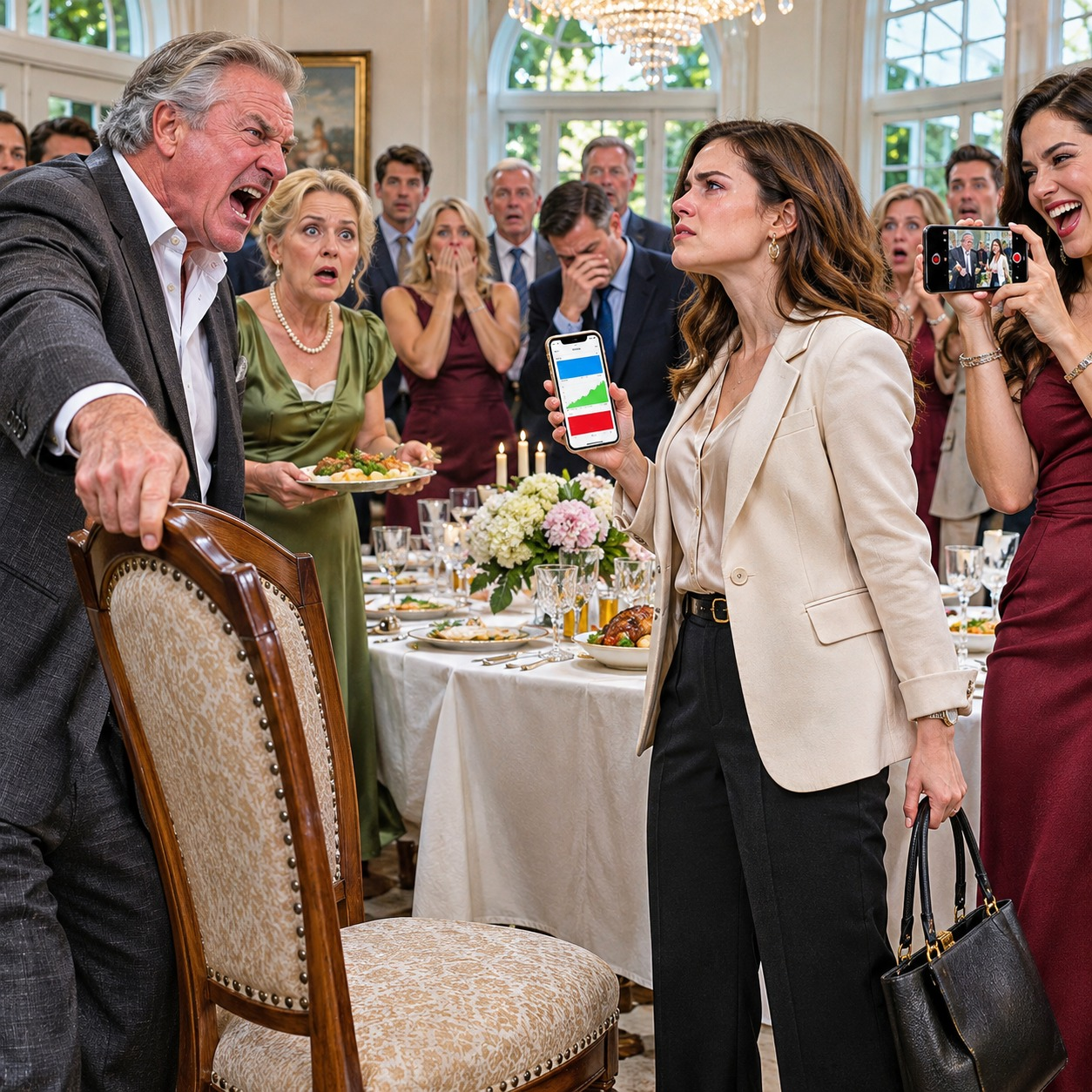
Then I remembered the chair.
The laughter.
Tessa's phone.
Fourteen people watching.
"No, Dad," I said quietly. "I haven't forgotten."
He waited.
"But raising me didn't give you the right to own everything I create."
He said nothing.
Then he spoke in a voice so low that I barely recognized it.
"You'll regret embarrassing me."
I remained calm.
"I'm not trying to embarrass you."
"You already have."
The call ended.
That afternoon, Rebecca came into my office carrying a financial report.
"There's something you should see."
She placed it on my desk.
It was a comparison of Whitaker Hospitality Supply's historical pricing and the current renewal proposal.
The numbers were straightforward.
Original monthly fee: $3,250.
Current standard monthly fee: $8,900.
Monthly difference: $5,650.
Annual difference: $67,800.
Twenty-four-month difference: $135,600.
I studied the report.
For years, I had absorbed that difference because I believed family loyalty meant generosity.
But loyalty was supposed to work both ways.
Rebecca sat across from me.
"There's another reason the discount can't continue."
I looked up.
"What?"
"Our support costs have increased significantly."
She opened another page.
"The Whitaker account requires custom integrations, dedicated support hours, and additional maintenance. At the old rate, the margin is no longer reasonable."
I nodded.
"So even without Saturday's dinner..."
"We would still need to revise the pricing."
I looked at her.
"Then make sure that's documented."
"It already is."
She smiled faintly.
"Maya, you're not doing anything wrong by charging a fair price."
I looked toward the window.
"I know."
And for the first time, I didn't need anyone to convince me.
At 4:56 p.m., I received an unexpected email.
The sender was a member of Whitaker Hospitality Supply's board of directors.
Her name was Caroline Bennett.
I knew her only slightly.
She had joined the board two years earlier and had a reputation for asking difficult questions.
The subject line read:
REQUEST FOR CONFIDENTIAL DISCUSSION
I opened it.
The message was brief.
Caroline wanted to discuss the software renewal and the ownership documents presented at the board meeting.
She asked whether I would be available the following morning.
I forwarded the email to Daniel.
He called almost immediately.
"Don't respond yet."
"Why?"
"Because we need to understand whether she's contacting you personally or on behalf of the board."
I looked at the message again.
"She says it's confidential."
"That doesn't necessarily mean anything improper. But let's clarify the purpose and make sure the conversation is appropriately documented."
I agreed.
Daniel offered to contact her attorney.
Then he asked a question that surprised me.
"Maya, has your father ever discussed selling Whitaker Hospitality Supply?"
I frowned.
"Not seriously."
"Has he mentioned outside investors?"
"He talks about expansion all the time."
"Any recent acquisitions?"
I thought about the birthday dinner.
Dad had been showing Daniel photographs of a luxury hotel group.
He had proudly announced that Tessa handled the partnership strategy.
"There's a new hotel partnership," I said.
"Do you know the terms?"
"No."
Daniel became quiet.
"Why are you asking?"
"Because if the board is reviewing technology ownership during a major transaction, we need to understand whether those representations could affect other parties."
I stared at the email.
"Do you think Dad is trying to sell the company?"
"I don't know."
He paused.
"But I think we should find out."
At 6:10, Marcus called again.
His voice was tense.
"Maya, are you alone?"
"Yes."
"I need to tell you something."
I sat down.
"What happened?"
"The board received a preliminary acquisition proposal."
My heart began pounding.
"From whom?"
"A private investment group interested in Whitaker Hospitality Supply."
I looked at Daniel's notes.
"Does this involve the technology division?"
"That's the problem."
I waited.
Marcus continued.
"Your father has been presenting the company as a vertically integrated distribution and logistics technology business."
I stared at the wall.
"But Whitaker doesn't own our software."
"I know."
"Does the investor know?"
Marcus hesitated.
"I don't think they understand the distinction."
I felt my stomach tighten.
"What exactly has Dad told them?"
"He described the platform as a proprietary technology asset associated with Whitaker Hospitality Supply."
I closed my eyes.
My father had spent years telling relatives that my company wasn't a real business.
Now he was apparently describing my technology as an important asset in his own company's future.
"Marcus, did he tell them Whitaker owns the software?"
"I haven't seen every presentation."
"Then we need to be careful."
"I agree."
He lowered his voice.
"Caroline Bennett has been asking questions."
I looked at her email.
"She contacted me."
"I know."
"Did you ask her to?"
"No."
"Then why?"
Marcus paused.
"Because she's reviewing the acquisition materials."
I sat straighter.
"And?"
"She found a discrepancy."
"What kind?"
"The technology valuation."
I stared at the phone.
Marcus continued.
"The proposal includes a significant amount attributed to software capabilities and intellectual property."
"How significant?"
He hesitated.
"I can't disclose confidential board materials without authorization."
"I understand."
"But Maya..."
His voice became serious.
"If the investor believes Whitaker owns technology that actually belongs to your company, this could become much bigger than a renewal dispute."
I looked at the photograph of my team.
The people who had built that technology.
The people who had trusted me.
"Marcus, I need you to make sure the board has the correct ownership information."
"I've already requested that."
"And?"
He exhaled.
"Your father wants to proceed with the investor meeting tomorrow."
I felt my heartbeat quicken.
"Before resolving the ownership question?"
"Yes."
I stood up.
"Marcus, that's a serious problem."
"I know."
He paused.
Then he said something that made me stop moving.
"Maya, your father has invited you to the meeting."
I stared at the phone.
"What?"
"He wants you there."
"Why?"
Marcus was silent.
"Marcus?"
His voice dropped.
"Because he told the board that you're prepared to confirm the technology ownership arrangement."
I gripped the edge of my desk.
"I never agreed to that."
"I know."
"I haven't even seen the presentation."
"I know."
"Then why would he say that?"
Marcus didn't answer.
For several seconds, all I could hear was the faint hum of my office ventilation system.
Then a new email appeared on my computer.
It was from my father.
The subject line read:
TOMORROW'S INVESTOR MEETING — REQUIRED ATTENDANCE
I opened it.
There was no greeting.
No apology.
No explanation.
Only one sentence.
Maya, you will attend tomorrow's meeting and confirm the agreement we discussed.
Below it was an attachment.
TECHNOLOGY OWNERSHIP CONFIRMATION — FINAL.pdf
I clicked the file.
The first page contained my company's name.
The second page listed my father as the authorized representative of the technology partnership.
And on the third page, beneath a statement transferring certain intellectual property rights, was a signature that looked exactly like mine.
But this time, there was something new.
A second signature.
A witness.
Someone whose name I knew.
Someone who had been sitting at my father's birthday dinner.
Someone who had watched him pull away my chair.
I leaned closer to the screen.
Then my phone rang.
The caller ID displayed:
CAROLINE BENNETT — WHITAKER BOARD
I answered.
"Hello?"
A woman's voice spoke quickly.
"Maya Whitaker?"
"Yes."
"This is Caroline Bennett. I apologize for calling so late, but I need to ask you one question before tomorrow's meeting."
I looked at the document.
"Go ahead."
She hesitated.
Then she said, "Did you authorize your father to represent your company in a proposed multimillion-dollar acquisition?"
My mouth went dry.
"No."
There was a long silence.
Then Caroline whispered, "That's what I was afraid of."
I stared at the screen.
"Why?"
She took a breath.
"Because the investor has already received a signed ownership certification."
I looked at the forged signature.
"Who signed it?"
Caroline paused.
Then she said, "Maya, there's something you need to see immediately."
An email notification appeared.
One attachment.
One photograph.
I opened it.
The image showed my father sitting across from three executives in a private conference room.
A contract lay on the table.
Beside him sat Tessa.
And standing behind them, holding a folder, was someone I had trusted for years.
I zoomed in.
My heart stopped.
It was my mother.
Then I noticed what she was holding.
A document bearing my signature.
And beneath it, in handwriting I recognized from childhood, were four words:
I witnessed her signing.






Comments 0