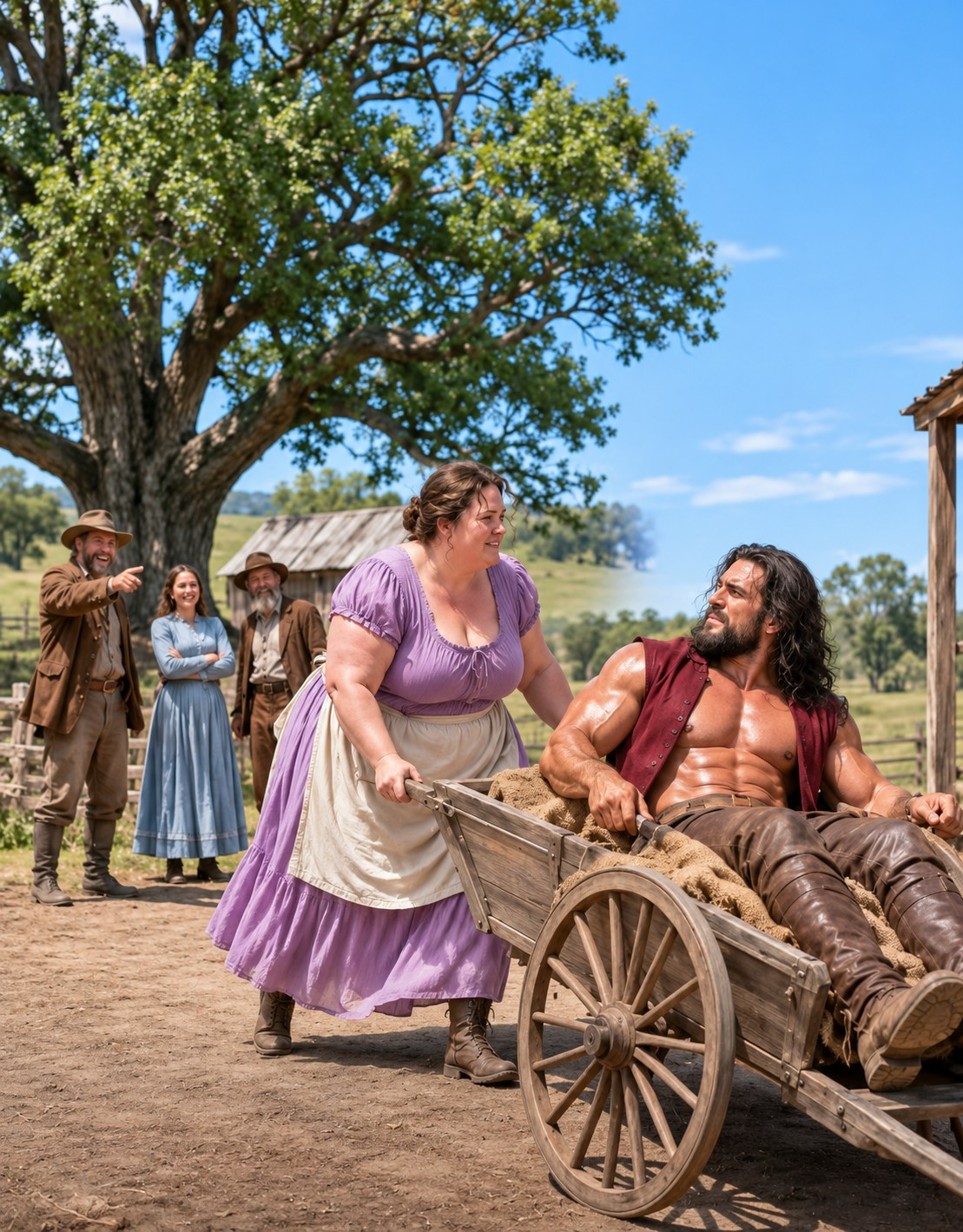
"Bring out the key, Meadow. We know you found it."
The voice came through the cabin door just as Meadow closed her fingers around the small iron key.
Jediah lay on the floor beside the wooden chest, his enormous shoulders trembling from the effort of dragging himself across the room.
"Hide it," he whispered.
Meadow slipped the key into the lining of her apron.
Then she looked toward the door.
"Who told you there was a key?"
Silence.
Mayor Horus Abernathy cleared his throat.
"Mrs. Green, I suggest you open this door before we are forced to enter."
Meadow glanced at the shotgun resting above the fireplace.
It had belonged to Thomas.
She had cleaned it every month since his death, although she hadn't fired it in nearly two years.
"Are you threatening me on my own property, Mayor?"
"Don't be dramatic."
"Then stop behaving like a criminal."
Jediah almost laughed.
Almost.
The second man spoke again.
"Your husband left something that doesn't belong to you."
Meadow froze.
Her husband?
Thomas had been dead for two winters.
What could he possibly have to do with the Ridge Creek Logging Company?
She approached the door but kept the latch secured.
"Who are you?"
"Silas Vane."
Jediah's expression changed instantly.
His fingers dug into the floorboards.
Meadow saw the hatred in his eyes.
The name meant something far more dangerous than she had understood.
Silas Vane was the owner of the logging company.
The man Jediah had confronted before the accident.
The man who had offered him money to remain silent.
And now he was standing on her porch, demanding a key hidden beneath her floor.
Meadow forced herself to breathe normally.
"What do you want, Mr. Vane?"
"My property."
"Then you've come to the wrong house."
"Don't make this difficult."
She looked at Jediah.
He shook his head.
Slowly.
A warning.
Meadow turned back toward the door.
"My husband left this farm to me. Everything inside belongs to me unless a court says otherwise."
Vane gave a short laugh.
"You're a stubborn woman."
"I've been called worse."
"Open the door."
"No."
A heavy fist struck the wood.
Jediah flinched.
Meadow didn't.
"Mrs. Green," the mayor said, his voice suddenly softer, "you don't understand the trouble you're inviting."
"Then perhaps you should explain it."
"That mountain man has filled your head with lies."
Meadow looked toward Jediah.
He was still on the floor, breathing heavily, his face tight with pain.
"Funny," she said. "He hasn't said nearly as much as you have."
The mayor stopped speaking.
Meadow continued.
"Yesterday, you told the entire town he was a helpless burden. Today, you're standing on my porch with a businessman demanding something you claim he stole. Which story should I believe?"
Vane's voice became cold.
"The one that keeps you alive."
The words settled over the cabin.
Meadow felt the first sharp edge of genuine fear.
Not for herself.
For the man lying helplessly behind her.
She had taken Jediah home because she refused to let the town humiliate him.
Now she was beginning to understand that humiliation had only been part of the cruelty.
Someone wanted him silenced.
Permanently.
Meadow reached toward the shotgun.
She lifted it from its hooks and checked the chamber.
Loaded.
Then she returned to the door.
"Mr. Vane?"
"Yes?"
"If you or the mayor step inside my house without permission, I'll consider you trespassers."
A pause followed.
Then Vane laughed.
"Do you really think you can frighten me?"
"No," Meadow answered. "But I can make you leave."
She drew back the curtain just enough for him to see the shotgun resting across her arms.
The mayor stepped backward.
Vane remained motionless.
For several seconds, his dark eyes studied her through the narrow window.
Then he smiled.
It was not a pleasant smile.
"Very well, Mrs. Green."
He stepped away from the door.
"But you should know something."
Meadow said nothing.
Vane adjusted his gloves.
"Your husband made the same mistake you're making."
Her breath caught.
"What did you say?"
But Vane had already turned away.
The mayor hurried after him.
Moments later, horses moved across the yard.
Meadow remained beside the door until the sound of hoofbeats faded.
Only then did she lower the shotgun.
Behind her, Jediah spoke.
"Meadow."
She turned.
His face was pale.
"Get me off this floor."
Moving Jediah back onto the cot took nearly forty minutes.
Meadow used the canvas sling she had prepared the previous evening, securing it to a ceiling beam and carefully lifting his weight while he supported himself with his arms.
The work left her breathing hard.
Her knees throbbed.
Sweat soaked the collar of her dress.
Jediah watched every movement with an expression that grew darker each time she struggled.
When she finally lowered him onto the mattress, he closed his eyes.
"Enough," he muttered.
Meadow wiped her forehead.
"Enough what?"
"Enough of this."
She looked at him.
"I don't understand."
"You shouldn't have to drag me around like a dead ox."
"You're considerably more argumentative than any ox I've owned."
"I'm serious."
"So am I."
He turned toward the wall.
Meadow pulled a chair beside the cot.
"Jediah, look at me."
He didn't.
She waited.
Finally, he turned his head.
"I need to know something," she said.
"Then ask."
"Did Silas Vane have anything to do with Thomas's death?"
Jediah frowned.
"Your husband?"
"Vane said Thomas made the same mistake I was making."
Jediah considered the question.
"What did Thomas do for a living?"
"Farming. Some carpentry. He repaired wagons when people needed help."
"Did he ever work near Ridge Creek?"
Meadow hesitated.
"Sometimes."
"Doing what?"
"He helped repair the old mill years ago. Before it closed."
Jediah's expression changed.
Meadow noticed immediately.
"What?"
"Nothing."
"Don't do that."
"Do what?"
"Look as though you've discovered something terrible and then tell me it's nothing."
He sighed.
"Did Thomas ever mention Silas Vane?"
She searched her memory.
There had been arguments.
Late nights.
A time when Thomas had returned home furious after visiting Oak Haven.
She remembered him sitting at the kitchen table, staring at a folded document.
When she asked what was wrong, he had told her that some men believed money could purchase anything.
At the time, she hadn't understood.
Now the memory felt different.
"He mentioned the logging company once," she said slowly.
"What did he say?"
"That they were stealing more than trees."
Jediah stared at her.
Meadow felt her stomach tighten.
"Why?"
"Because that's exactly what I told Vane before the accident."
The following morning, Doctor Samuel Whitcomb arrived shortly after sunrise.
He was a thin, silver-haired man with tired blue eyes and a black medical bag polished by years of use.
Meadow met him at the door.
"Thank you for coming."
"Of course."
He stepped inside and immediately noticed Jediah.
"Good heavens."
Jediah gave him a flat look.
"I've heard worse."
Whitcomb approached the cot.
"I imagine you have."
He set down his bag and began examining the injured man.
For nearly an hour, the doctor worked carefully.
He checked Jediah's breathing, examined the bruising across his ribs, tested the strength in his arms, and studied the injuries along his lower back.
Then he gently touched Jediah's legs.
"Can you feel this?"
"No."
Whitcomb moved his fingers.
"Here?"
"Nothing."
He tested another location.
Jediah stared at the ceiling.
"No."
Meadow stood near the fireplace, twisting her apron between her fingers.
Finally, Whitcomb sat back.
"How long ago was the accident?"
"Seventeen days," Jediah answered.
"And you've had no movement in either leg?"
"None."
The doctor nodded slowly.
Meadow stepped closer.
"Is there anything you can do?"
Whitcomb looked at her.
"The injury is serious. I won't pretend otherwise."
Jediah turned his head.
"Just say it."
The doctor met his eyes.
"I cannot promise you'll walk again."
Silence filled the room.
Meadow felt the words settle heavily between them.
Jediah looked away.
"I already knew that."
Whitcomb continued.
"But I also won't declare your future settled after one examination. The swelling and bruising are considerable. We need to protect your back, prevent sores, keep your joints moving gently, and watch for changes."
Meadow leaned forward.
"Changes?"
"Any return of sensation. Any voluntary movement. Anything that tells us more about the injury."
Jediah gave a bitter laugh.
"So I lie here and wait for a miracle."
"No," Whitcomb replied. "You stay alive, maintain your strength, and let your body recover as much as it can."
He glanced at Meadow.
"And you mustn't attempt to lift him alone again."
She lowered her eyes.
"I understand."
The doctor reached into his bag.
"I'll show you safer ways to help him change position. We'll also need a better bed and a chair that supports his body."
Jediah frowned.
"A chair?"
"Something with wheels."
"Like a child's toy?"
"Like a means of getting you out of that cot."
Jediah stared at him.
Whitcomb didn't look away.
"Your legs are injured, Mr. Jediah. Your mind and hands are not."
For the first time that morning, Jediah said nothing.
After the doctor left, Meadow went to the barn.
She stood beside Thomas's old workbench, looking at the tools hanging neatly along the wall.
There were saws, hammers, clamps, and several lengths of seasoned oak.
Thomas had built almost everything on the farm with his own hands.
The table.
The porch steps.
The chicken coop.
Even the bed where Jediah now slept.
Meadow ran her fingers along the worn wooden surface.
Then she noticed something.
A small rectangular compartment beneath the workbench.
She had never paid much attention to it.
Thomas had used the space for spare nails and broken hinges.
But now she remembered the iron key.
The one marked with the letter V.
She reached into her apron.
The key was still there.
For a moment, she considered trying it.
Then she stopped.
If Vane knew about the key, perhaps he knew about the compartment.
Perhaps he expected her to open it.
Meadow stepped away.
She needed to think.
She needed time.
And above all, she needed to keep Jediah alive.
Over the next several days, a new routine settled over the homestead.
Meadow rose before dawn.
She fed the animals, collected eggs, hauled water, and prepared breakfast.
Then she helped Jediah wash and change position.
The first few mornings were difficult.
He hated needing assistance.
Every task reminded him of what he had lost.
But Meadow refused to treat him like a child.
She asked before helping.
She listened when he said something hurt.
And when he became angry, she gave him room to recover his dignity.
One afternoon, she returned from the barn carrying a torn leather bridle.
She sat beside the fireplace and began repairing it.
Jediah watched her for several minutes.
Then he spoke.
"You're doing it wrong."
Meadow looked up.
"Excuse me?"
"The awl."
She glanced at the tool in her hand.
"What about it?"
"You're pushing it straight through the leather. Angle it, or the stitching will split."
Meadow examined the bridle.
He was right.
She looked at him.
"Would you like to show me?"
Jediah hesitated.
Then he held out his enormous hand.
"Give it here."
She passed him the leather and the awl.
His thick fingers moved with surprising precision.
He angled the tool, threaded the cord, and pulled the stitches tight.
Within minutes, the damaged section was stronger than before.
Meadow studied his work.
"That's impressive."
"It's just a bridle."
"It's a bridle I couldn't fix."
Jediah looked at the leather in his hands.
Something shifted in his expression.
For the first time since arriving, he had done something useful.
Meadow noticed.
But she didn't make a fuss.
Instead, she brought him another piece of damaged harness.
"Since you're so clever, perhaps you can fix this one too."
He looked at her.
Then at the harness.
A faint smile touched his mouth.
"Your stitching is terrible."
"Then you've got plenty of work."
That evening, Meadow brought a small wooden board to the cot.
She placed it across Jediah's lap.
On it lay three broken harnesses, a damaged saddle strap, and a box of leatherworking tools.
Jediah stared at the arrangement.
"What's this?"
"Your workbench."
He looked at her.
"My what?"
"You said you were a foreman. You know leatherwork. You know timber. You know how to repair things."
"That doesn't mean I can run a farm from a bed."
"No," Meadow said. "But perhaps you can help me keep one standing."
He looked down at the tools.
For a long time, he said nothing.
Then he picked up the awl.
Meadow turned toward the kitchen.
Behind her, she heard him begin working.
The sound was small.
A needle piercing leather.
A thread pulling tight.
But it was the first sound of purpose she had heard from him.
Two days later, Meadow discovered that someone had cut the wire along her northern fence.
Three cattle had wandered into the neighboring pasture.
She spent most of the morning bringing them back.
When she returned, exhausted and angry, Jediah listened as she explained what had happened.
"That wasn't an accident," he said.
"I know."
"Vane?"
"Probably."
Jediah stared toward the window.
"They're trying to frighten you."
"Then they're wasting their time."
He shook his head.
"No. They're testing how much they can take before you give up."
Meadow sat beside him.
"What would you do?"
He looked surprised.
"You're asking me?"
"You're the one who knows how men like Vane think."
Jediah considered the question.
"First, I'd repair the fence. Then I'd reinforce the gate. And I'd make sure anyone entering the property had to come through one visible approach."
Meadow nodded.
"Anything else?"
"Keep a record of every damaged fence, missing animal, and strange visitor."
"Why?"
"Because one day, someone may need proof."
She looked at him.
"Then perhaps you should help me make a plan."
Jediah studied her face.
"You trust me with that?"
"I trust you to know how to build a fence."
He smiled.
This time, she saw it.
A real smile.
Brief.
Unexpected.
But real.
That night, after Meadow finished supper, Jediah asked her to bring the old farm ledger.
She placed it on the board across his lap.
He opened it carefully.
The pages contained years of expenses, crop records, livestock purchases, and notes written in Thomas's familiar handwriting.
Jediah studied the figures.
Then he frowned.
"Meadow."
"What?"
"How much do you owe the bank?"
She hesitated.
"Enough."
"How much?"
"Nearly four hundred dollars."
Jediah looked up sharply.
"Four hundred?"
"The winter after Thomas died was hard. I lost cattle. The roof needed repairs. I borrowed money."
He turned another page.
"And the payments?"
"I'm behind."
"How far?"
"Three months."
Jediah closed the ledger.
Meadow looked away.
She hated admitting it.
She had survived the winter, the loneliness, and the town's cruelty.
But debt was something she couldn't fight with an axe or a shovel.
Jediah watched her.
Then he spoke quietly.
"I made a promise to myself after the accident."
She looked at him.
"What promise?"
"That I wouldn't become the reason someone else's life fell apart."
Meadow shook her head.
"You're not the reason."
"Not yet."
He placed his hand over the ledger.
"But I'm going to help you save this farm."
She stared at him.
"Jediah—"
"I don't know if I'll ever walk again. I don't know if I'll ever return to the mountains. But I can still think. I can still work with my hands. And I can still keep my word."
His voice grew firmer.
"You gave me a place to live when everyone else wanted me gone. I'm not going to sit here and watch them take your home."
Meadow felt something tighten in her throat.
She looked down before he could see the tears gathering in her eyes.
"Then we'll save it together."
Jediah nodded.
"Together."
For the first time in two years, Meadow did not feel entirely alone.
The following morning, she returned to the barn with the iron key.
She had decided it was time to open Thomas's hidden compartment.
Jediah had insisted she bring the contents directly to him before showing anyone else.
Meadow knelt beneath the workbench.
She brushed away the dust.
Then she inserted the key into the small lock.
It turned.
A soft click sounded.
She pulled the compartment open.
Inside lay a folded piece of cloth, a tarnished silver pocket watch, and a sealed envelope.
The envelope had yellowed with age.
Across the front, written in Thomas's unmistakable handwriting, were four words.
For Meadow. If Necessary.
Her hands began to tremble.
She carefully broke the seal.
Inside was a single sheet of paper.
The first sentence made her stop breathing.
My dearest Meadow, if you are reading this, it means the men from Ridge Creek have finally come for what I hid.
She stared at the words.
Then she heard a floorboard creak behind her.
Meadow turned.
A man stood in the open barn doorway.
He wore a dark coat and carried a revolver.
And he was pointing it directly at her chest.






Comments 0