"Ask Jediah why your husband was murdered."
Meadow read the sentence three times before she finally lifted her eyes from the paper.
Across the porch, Caleb Mercer stood motionless, his injured shoulder stiff beneath his coat.
Inside the cabin, Jediah was waiting.
And for the first time since bringing the mountain man home, Meadow was afraid to look at him.
"Who wrote this?" she whispered.
Caleb shook his head.
"I don't know."
"Someone knew Thomas. Someone knew Jediah was here. Someone knew exactly how to hurt me."
Caleb reached for the letter.
Meadow pulled it away.
"No."
"Mrs. Green—"
"I want to hear what Jediah has to say."
She walked past him.
The cabin door opened with a familiar creak.
Jediah was sitting against his pillows, the old farm ledger spread across the wooden board resting on his lap.
He looked up.
One glance at Meadow's expression was enough.
"What happened?"
She approached the cot.
Her hands were trembling, but her voice remained steady.
"Did you know my husband?"
Jediah frowned.
"Thomas?"
"Answer me."
He slowly closed the ledger.
"I knew of him."
"That's not what I asked."
Caleb entered behind her.
"Meadow, perhaps we should—"
She raised one hand.
"Please."
Caleb stopped.
Meadow held out the letter.
"Someone left this outside."
Jediah read it.
His expression changed.
Not dramatically.
His jaw tightened, and the color slowly disappeared from his face.
Meadow noticed every detail.
"Is it true?" she asked.
Jediah looked up.
"Meadow—"
"Did someone murder Thomas?"
He stared at the letter.
Then he said something that made her feel as though the floor had shifted beneath her feet.
"I suspected his death wasn't natural."
The room went silent.
Meadow stepped backward.
"You knew?"
"I didn't know for certain."
"How long?"
Jediah swallowed.
"Since before the accident."
She stared at him.
"You've been living in my house. Eating my food. Letting me care for you. And you never thought to tell me?"
"I didn't have proof."
"You had enough suspicion to keep it from me."
Jediah lowered his eyes.
For a man who had once commanded logging crews in dangerous mountains, he suddenly looked helpless in a way that had nothing to do with his legs.
"I was trying to protect you."
Meadow laughed once.
It was a broken sound.
"That's what Thomas said."
She turned toward the fireplace.
"Every man who ever loved me or claimed to respect me seems to believe I need protecting from the truth."
Jediah said nothing.
Meadow looked back at him.
"Tell me everything."
Jediah took a long breath.
"Two years ago, I was working north of Ridge Creek. We were surveying a section of timber that Vane wanted cleared before winter."
He paused.
"One evening, I overheard an argument outside the company office."
"Between whom?"
"Vane and another man."
"Thomas?"
Jediah nodded.
Meadow gripped the back of a chair.
"What were they arguing about?"
"Land records. Water rights. Thomas accused Vane of stealing property from families who couldn't afford lawyers."
Meadow closed her eyes.
She could almost hear her husband's voice.
Thomas had never been loud.
But when he believed something was wrong, he could become stubborn enough to argue with a thunderstorm.
"He threatened to expose the company," Jediah continued. "Vane told him to think about his wife."
Meadow opened her eyes.
"What did Thomas say?"
Jediah hesitated.
Then he answered.
"He said, 'My wife is stronger than every coward in this room.'"
Meadow's breath caught.
For a moment, she couldn't speak.
That sounded exactly like Thomas.
The man who had kissed her forehead when townspeople mocked her weight.
The man who had never once made her feel ashamed of the body that carried her through long winters and harder summers.
"What happened afterward?"
"I didn't see him again."
"But you heard something."
Jediah nodded.
"Several weeks later, one of Vane's men mentioned that the Green problem had been settled."
Meadow felt cold.
"What did that mean?"
"I didn't know. I asked questions. Nobody answered."
"And then?"
"Months later, I learned your husband had died."
Meadow stared at him.
"You could have come to me."
"I should have."
The admission was quiet.
Honest.
And painful.
"I was afraid of accusing someone of murder without evidence," he continued. "By the time I began finding proof of the land fraud, I realized the same men might have been responsible for Thomas's death."
Meadow looked toward the photograph on the mantel.
For two years, she had believed her husband died because his heart had finally failed him.
Now she remembered details she had buried beneath grief.
Thomas had complained of headaches during his final week.
He had been unusually tired.
On the morning he died, he had drunk coffee with a visitor who arrived before sunrise.
She couldn't remember the man's face.
Only the dark coat.
And the horse tied beside the barn.
Meadow pressed a hand against her mouth.
"Someone came to see him that morning."
Jediah looked up sharply.
"Who?"
"I don't know."
"Try to remember."
She shook her head.
"I was preparing bread. Thomas told me to stay inside."
Caleb stepped closer.
"Did the visitor bring anything?"
Meadow thought carefully.
"A small bottle."
The men exchanged a glance.
"What kind of bottle?" Caleb asked.
"Brown glass. About the size of a medicine bottle."
Jediah's expression darkened.
Meadow noticed.
"What?"
Caleb spoke first.
"Vane's men used to carry bottles like that."
"For what?"
"Chemicals used around the logging camps. Medicines. Cleaning solutions. Things that could make a person sick if handled improperly."
Meadow looked at him.
"Are you saying someone poisoned my husband?"
"I'm saying we don't know."
But the possibility was already there.
And once spoken, it could not be taken back.
Doctor Samuel Whitcomb arrived shortly after noon.
Meadow had sent a message asking him to return because Jediah's back pain had worsened.
She hadn't mentioned Thomas.
Not yet.
The doctor entered carrying his worn black medical bag and a bundle of clean linen.
He found Meadow sitting beside the fireplace, staring into the flames.
"Mrs. Green?"
She looked up.
"Doctor."
"Are you feeling unwell?"
"No."
He studied her face.
"Something has happened."
She hesitated.
Then she handed him the anonymous letter.
Whitcomb read it.
His expression became grave.
"Where did you get this?"
"Someone left it on my porch."
He folded the paper carefully.
"Have you told the sheriff?"
Caleb gave a bitter laugh.
"The sheriff answers to Abernathy."
Whitcomb looked toward him.
"I see."
Meadow stood.
"Doctor, when Thomas died, you examined him."
Whitcomb nodded.
"Yes."
"You said his heart stopped."
"It had."
"Could something have caused it?"
The doctor remained silent.
Meadow stepped closer.
"Please don't protect me from the truth."
Whitcomb looked at her for a long moment.
Then he sighed.
"Thomas had symptoms consistent with a sudden cardiac event. But I did not perform an extensive examination after his death."
"Why not?"
"Because there was no reason to suspect foul play at the time."
Meadow swallowed.
"So you can't tell me whether he was poisoned."
"No."
The answer hurt.
But at least it was honest.
Whitcomb continued.
"However, if someone deliberately harmed him, there may be other evidence. Letters. Witnesses. Records of unusual purchases."
Caleb nodded.
"We're looking."
The doctor returned the letter.
"Then be careful. Accusations like this can become dangerous."
Meadow looked toward Jediah.
"They already have."
After examining Jediah, Whitcomb asked Meadow to bring a chair closer.
"I want to explain something."
Jediah groaned.
"If it's another speech about accepting my condition, save your breath."
Whitcomb gave him a patient look.
"It isn't."
He opened his medical bag.
Inside were several instruments, a small hammer, and a notebook.
"Your injury remains serious. But there are things we can do to prevent further damage and help you regain as much independence as possible."
Jediah stared at him.
"Such as?"
"Strengthening your arms and shoulders. Learning safer transfers. Protecting your skin. Keeping your joints flexible."
Meadow leaned forward.
"And his legs?"
Whitcomb paused.
"We'll continue monitoring them."
Jediah looked away.
"Meaning nothing."
"Meaning I refuse to pretend I know everything about how your body will recover."
The mountain man turned back.
Whitcomb met his gaze.
"I have seen patients regain some movement after injuries that initially appeared hopeless. I have also seen patients who never walked again. I won't promise you a miracle."
Jediah's jaw tightened.
"Then what are you promising?"
"That I won't abandon your care simply because your recovery is uncertain."
The words settled over the room.
Meadow looked down.
She understood them better than anyone.
The doctor continued.
"Your arms are exceptionally strong. With proper equipment, you could learn to move between the bed and a wheeled chair."
Jediah frowned.
"A wheelchair?"
"Yes."
"I don't want to spend my life being pushed around."
"Then we'll build one you can move yourself."
Jediah stared at him.
Whitcomb turned toward Meadow.
"Does your barn have a workshop?"
"It does."
"Good. We'll need sturdy wood, iron fittings, two large wheels, and a seat that supports his back."
Meadow nodded.
"Thomas left plenty of tools."
Jediah looked between them.
"You two have already decided?"
Meadow raised an eyebrow.
"Would you prefer we ask permission to give you a way out of bed?"
He almost smiled.
"You're impossible."
"So I've been told."
The next week brought changes to the homestead.
Caleb remained long enough to help construct a wooden chair fitted with two large wheels salvaged from an old cart.
It was crude.
Heavy.
And far from comfortable.
But when they finally positioned it beside Jediah's cot, he stared at it as though someone had placed a strange animal in the room.
"That thing won't hold me."
Caleb grinned.
"It'll hold a mule."
"I'm heavier than a mule."
"Then try not to eat the furniture."
Meadow laughed.
Jediah gave Caleb a murderous look.
But beneath his irritation was something new.
Interest.
The first attempt to transfer him into the chair was difficult.
Whitcomb supervised, making sure Jediah's back remained supported.
Meadow stood nearby, ready to help.
Jediah gripped the wooden armrests.
His shoulders trembled.
He pushed.
For a moment, his body lifted.
Then his strength failed.
He collapsed back onto the cot.
"Damn it!"
The shout rattled the windows.
Meadow stepped forward.
Jediah raised a hand.
"Don't."
She stopped.
He stared at the floor.
His breathing was ragged.
"I used to carry two hundred pounds of timber on my shoulders."
Nobody answered.
"I used to climb mountains in snow deep enough to swallow a horse."
His voice cracked.
"And now I can't even get into a chair."
Meadow felt tears sting her eyes.
But she refused to pity him.
Instead, she pulled up a stool.
"Then we'll try again tomorrow."
Jediah looked at her.
"What if tomorrow is the same?"
"Then we'll try the day after."
"And if that doesn't work?"
Meadow shrugged.
"We'll keep trying until we find something that does."
He stared at her.
"You're the most stubborn woman I've ever met."
"Good."
She stood.
"Now eat your supper before it gets cold."
Three days later, Jediah managed his first successful transfer with assistance.
It took nearly twenty minutes.
His arms shook.
Sweat ran down his face.
But eventually, he settled into the wooden chair.
For several seconds, he simply sat there.
Upright.
Away from the cot.
Looking at the room from a different height.
Meadow stood beside the fireplace.
Caleb leaned against the wall.
Whitcomb watched quietly.
Jediah looked down at the wheels.
Then he placed his palms against the wooden rims.
He pushed.
The chair moved forward several inches.
He stopped.
Looked at the floor.
Then pushed again.
This time, he moved nearly a foot.
Meadow covered her mouth.
Jediah looked up.
His eyes were shining.
He didn't cry.
He didn't speak.
But something inside him had changed.
For the first time since the accident, he had moved himself somewhere without being carried.
He pushed again.
The chair rolled toward the window.
Sunlight fell across his face.
Outside, the prairie stretched beyond the fences.
Jediah stared at it.
"I want to go outside."
Meadow smiled.
"Then we'll need a ramp."
The ramp took two days to build.
Caleb cut the boards.
Meadow carried them.
Jediah directed the measurements from his chair.
He argued about every angle.
Corrected every mistake.
And insisted the supports be strong enough to hold twice his weight.
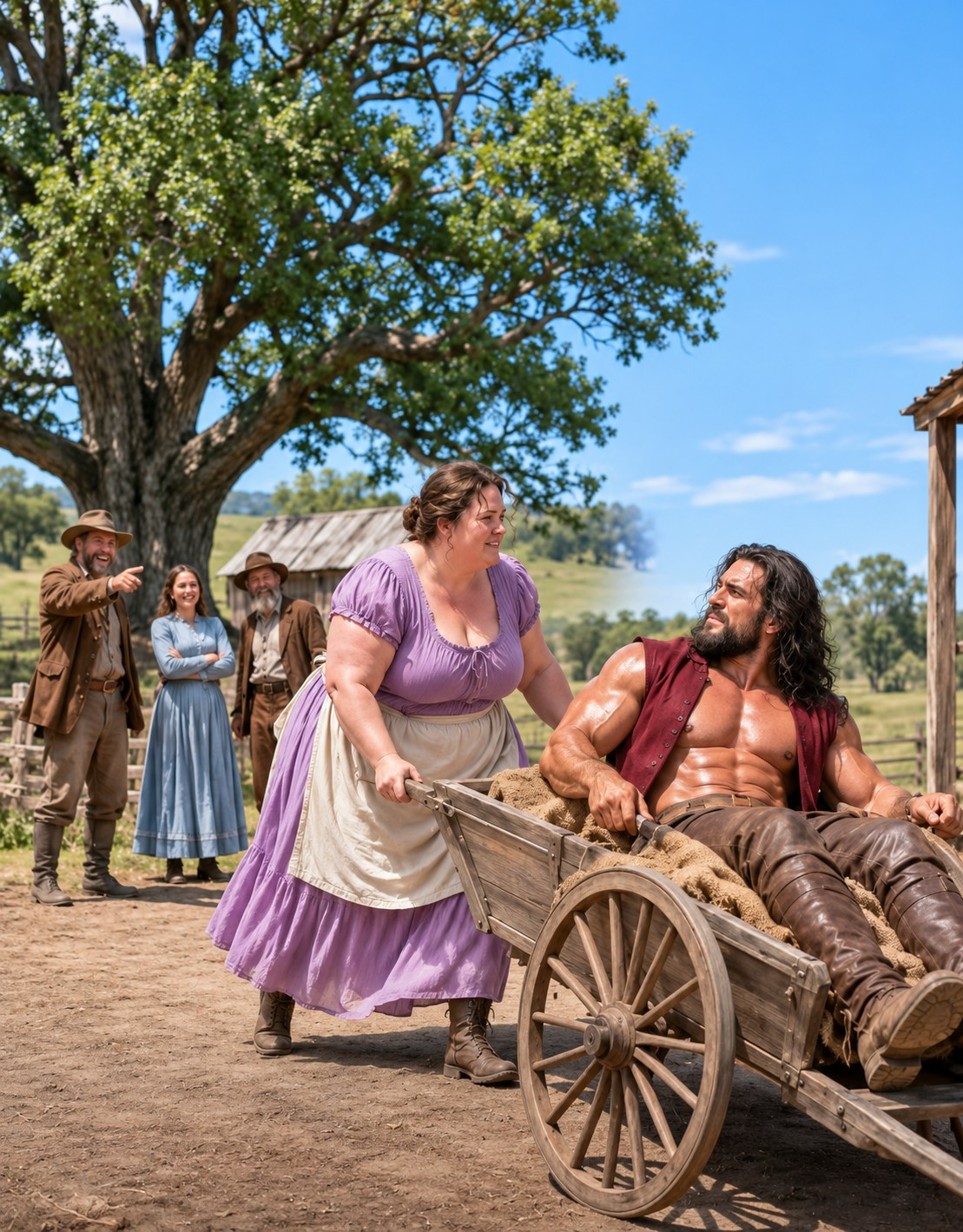
By the time they finished, the ramp was sturdy enough for a loaded wheelbarrow.
Meadow stood at the bottom.
Jediah positioned his chair at the top.
"Ready?" she asked.
He looked at the slope.
Then at the open prairie.
"Ready."
He gripped the wheels.
Slowly, carefully, he guided himself forward.
The chair rolled down the ramp.
Meadow walked beside him.
When he reached the dirt, he stopped.
For a long moment, he simply breathed.
The wind touched his face.
He could smell grass, horses, and the distant creek.
He closed his eyes.
Meadow stood quietly.
Then Jediah opened them.
"Take me to the barn."
She looked at him.
"Why?"
"Because I've got a farm to help save."
That evening, Doctor Whitcomb returned for a final examination before traveling to another settlement.
He tested Jediah's arms.
Checked the healing wounds.
Then carefully examined his legs.
Jediah stared at the ceiling.
"Still nothing."
Whitcomb moved his fingers along the man's right foot.
"Tell me if you notice anything."
Jediah sighed.
"Doctor—"
"Humor me."
The doctor pressed gently near his ankle.
Jediah frowned.
"Wait."
Whitcomb stopped.
"What?"
Jediah looked down.
"Do that again."
The doctor repeated the movement.
Jediah's expression changed.
Meadow stepped closer.
"What is it?"
Jediah swallowed.
"I thought I felt something."
Whitcomb remained calm.
"Describe it."
"Like pressure."
"Where?"
"My right foot."
The doctor repeated the examination.
Jediah closed his eyes.
For several seconds, nobody spoke.
Then he opened them.
"It's gone."
Whitcomb nodded.
"All right."
Jediah looked devastated.
"I imagined it."
"Perhaps. Or perhaps not."
The doctor wrote something in his notebook.
"We'll continue checking."
Meadow placed a hand on Jediah's shoulder.
He looked up at her.
She didn't promise him that he would walk again.
She simply squeezed his shoulder.
And he understood.
Later that night, after Caleb had gone to sleep in the barn, Meadow sat beside Jediah with Thomas's letter.
They had spent the evening discussing the old mill, the missing survey ledger, and the strange markings on Jediah's compass.
Meadow was beginning to see a connection.
Thomas had hidden evidence.
Jediah had discovered forged records.
Vane wanted the key.
And someone was desperate to prevent the truth from reaching the courts.
Jediah examined the compass again.
Three short scratches.
He rubbed his thumb across them.
"These marks," he said quietly, "were used by survey crews years ago."
Meadow leaned closer.
"What did they mean?"
"That a location had been measured and recorded."
"Could they point to the old mill?"
"Possibly."
He turned the compass toward the lamplight.
Then he noticed something he hadn't seen before.
A tiny indentation beneath the brass rim.
He pressed it.
The back of the compass opened.
Inside was a folded strip of paper.
Meadow stared.
"How long has that been there?"
Jediah shook his head.
"I don't know."
He unfolded the paper carefully.
It contained a short message written in faded pencil.
Meadow leaned forward.
The first line read:
The original survey is not at the mill.
Jediah's breathing quickened.
He read the second line.
Then he looked at Meadow.
"What?" she whispered.
He handed her the paper.
Her eyes moved across the final sentence.
The proof is buried where Thomas Green died.
Before Meadow could speak, a sudden knock struck the cabin door.
Three times.
Then a familiar voice called from outside.
"Mrs. Green? It's Doctor Whitcomb."
Meadow frowned.
The doctor had left hours earlier.
She approached the door.
"Doctor?"
His voice trembled.
"Open the door. Quickly."
She lifted the latch.
Whitcomb stood on the porch, pale and breathless.
His medical bag hung from one hand.
In the other, he held a small brown glass bottle.
"Meadow," he whispered, "I found this among my old records from the day Thomas died."
He raised the bottle toward the lamplight.
Then he said the words that made her heart stop.
"And I finally remember who brought it to me."






Comments 0