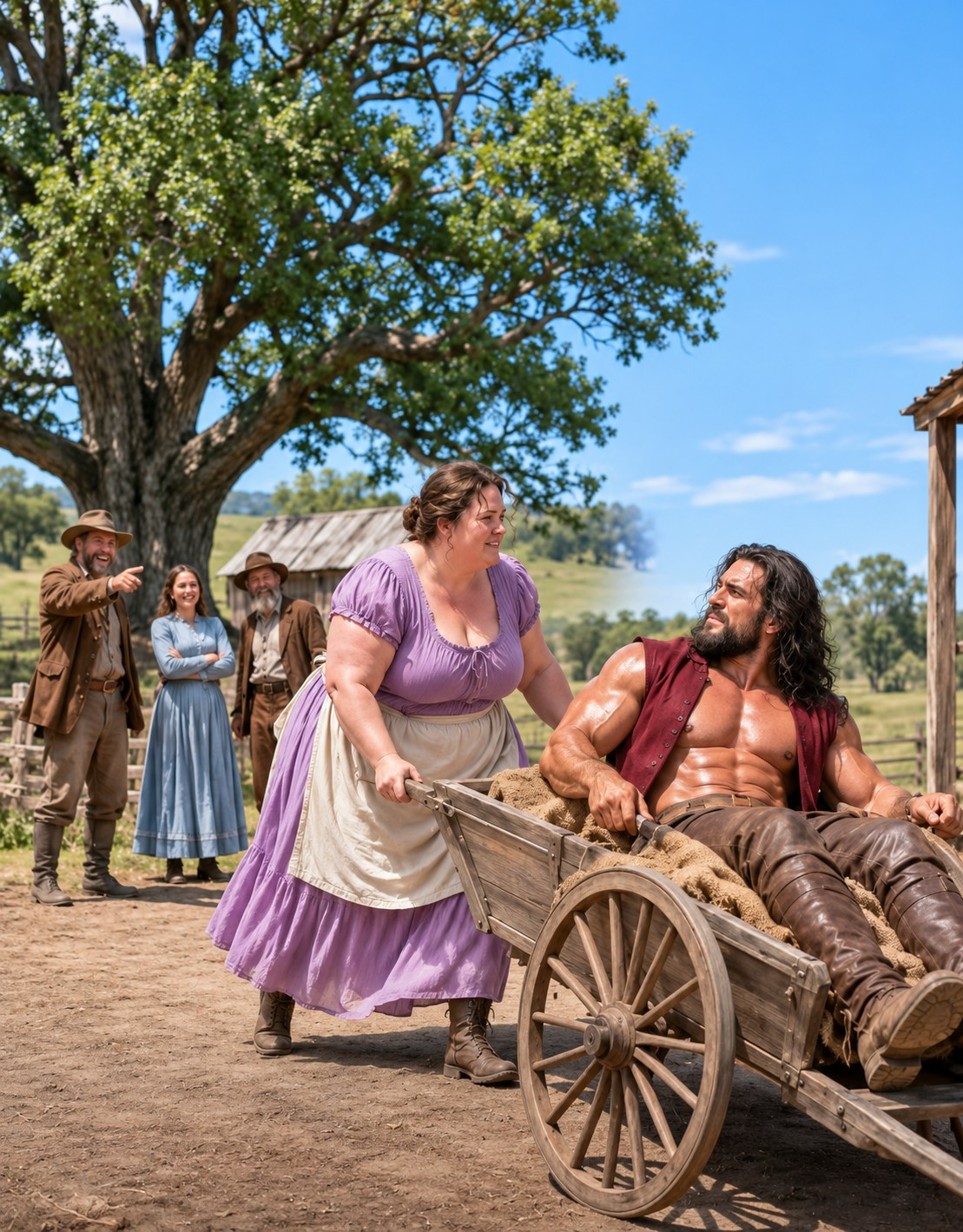
Meadow pushed through the laughing crowd and shouted:
"I'll take him!"
Mayor Horus Abernathy stared at the widow beside the wagon.
A leather strap had been pulled so tightly around the mountain man's chest that it had left a dark mark across his shirt.
The entire town suddenly went silent.
For a moment, nobody moved.
Then the mayor laughed.
It was a short, unpleasant sound, the kind of laugh a man used when he believed the world had just told him a joke that only he understood.
"Well, I'll be damned," he said, adjusting the lapels of his burgundy coat. "Meadow Green actually wants him."
A few men near the platform exchanged glances.
Someone whispered something about the widow's desperate farm.
Another person snickered.
Meadow heard every word.
She simply didn't care anymore.
At forty-two, she had learned that people could make a lifetime out of discussing a woman's appearance while knowing absolutely nothing about the burdens she carried.
They had called her too large to be attractive, too old to remarry, and too unfortunate to ever have children.
They had even blamed her husband's death on the supposed misery of being married to her.
Two winters had passed since Thomas Green died.
Two winters of chopping wood alone, repairing fences alone, and waking in a cold bed without another living soul to speak to.
And now these people had found another way to make her feel small.
Meadow looked at the man in the wagon.
His name was Jediah.
She had heard the mayor mention it earlier, although nobody in the crowd seemed interested in remembering his name.
He was enormous.
Even lying down, his shoulders seemed too broad for the wagon. His thick copper-brown beard covered much of his weathered face, and his powerful hands looked capable of splitting firewood with a single blow.
But his legs were motionless.
Completely still.
His pale gray eyes stared at the people surrounding him.
There was rage in them.
There was humiliation.
But there was something else, too.
Pride.
A terrible, stubborn pride that refused to disappear even when the rest of his life had been taken away.
"Madam," Mayor Abernathy said, "I don't think you understand what you're volunteering for."
Meadow turned toward him.
"I understand perfectly."
"He's a crippled man. He cannot work. He cannot walk. He cannot even take care of himself."
"Then I suppose you'll be relieved when he's no longer your responsibility."
The mayor's smile tightened.
Behind him, two deputies stood near the wagon.
One was a young man with a narrow face and a nervous expression. The other was older, with thick arms and a permanent scowl.
"Unstrap him," Meadow ordered.
The older deputy hesitated.
"Careful," she added. "He's a person, not a sack of feed."
That comment drew a few uncomfortable looks from the crowd.
Jediah turned his head slightly.
For the first time, he looked directly at her.
He seemed almost angry that she had spoken on his behalf.
Perhaps he had spent too many days listening to people discuss his body as though he weren't there.
The deputies began loosening the straps.
"Meadow," the mayor said, lowering his voice, "you have a farm that's barely standing. You can hardly support yourself. What makes you think you can support a man like that?"
She looked at him.
"Perhaps I'll find out."
The mayor shook his head.
"You're making a terrible mistake."
"Then it'll be mine."
That ended the conversation.
The deputies lifted the wooden plank supporting Jediah. His enormous weight made the men grunt as they carried him toward Meadow's weathered buckboard.
The younger deputy nearly lost his grip.
Jediah's shoulder slipped sideways.
Meadow immediately stepped forward.
"Watch his head!"
The men corrected their hold and carefully lowered him into the wagon bed.
Jediah clenched his teeth.
He refused to make a sound.
Meadow noticed the way his fingers dug into the wood.
She also noticed that he was trying desperately not to look at the people watching him.
She climbed onto the driver's bench.
The wooden seat creaked beneath her weight.
A few people laughed again.
This time, she didn't even turn around.
She gathered the reins and looked toward the road.
"Move," she told the horse.
The buckboard rolled away from the platform.
Behind her, the laughter slowly returned.
But it sounded different now.
Less confident.
More uncertain.
Jediah remained silent during the first mile.
The wagon bounced over ruts and stones. Meadow did her best to guide the wheels along the grassy edges of the road, but there was no avoiding every pothole.
She heard his breath catch whenever the wagon struck a particularly deep rut.
"There's a folded blanket beneath the flour sacks," she said without looking back. "If you can reach it, pull it closer."
He didn't answer.
She waited.
Eventually, he spoke.
"Why?"
Meadow glanced over her shoulder.
"Because the ride is going to get colder."
"I didn't ask why about the blanket."
She understood.
The horse continued walking.
"Why did you take me?"
Meadow considered the question.
She could have offered him some sentimental explanation.
She could have told him that she felt sorry for him or that every human being deserved kindness.
But she suspected he had already heard enough speeches from people who wanted to feel generous.
"Because I didn't like watching them laugh at you."
He gave a bitter laugh.
"That's all?"
"That's enough for today."
He turned his face toward the open prairie.
For several minutes, neither spoke.
The afternoon sunlight stretched across the grasslands, illuminating distant hills and scattered cottonwood trees.
Five miles separated Oak Haven from Meadow's homestead.
Five miles of rough road.
Five miles toward a life neither of them had planned.
When the cabin finally appeared, Jediah stared at it.
It was a low, weathered structure with a sod roof and a narrow porch. A barn stood several yards away, its doors hanging slightly crooked.
The place looked lonely.
But it was clean.
The fences had been repaired recently, the woodpile was neatly stacked, and a small vegetable garden stretched beside the kitchen window.
Meadow tied off the horse.
Then she walked around to the wagon.
Jediah was staring at the darkening sky.
His enormous fingers gripped the wooden sides.
"My name is Meadow," she said.
"I know."
"Someone told you?"
"The mayor."
She nodded.
"And yours is Jediah."
He looked away.
"Jediah."
"All right."
She studied the wagon bed.
"I can't lift you by myself."
"Then leave me here."
"That's not going to happen."
"You should have let them shoot me."
Meadow stared at him for a moment.
Then she snorted.
"Bullets cost money. I don't waste money."
His eyes shifted toward her.
He couldn't tell whether she was joking.
Meadow disappeared into the barn.
She returned carrying a heavy block and tackle, thick rope, and a canvas sling.
Jediah watched her arrange the equipment beneath a sturdy oak branch.
"You're going to drop me," he said.
"Probably not."
"Probably?"
"I've never moved a man your size before."
He looked at the rope.
Then at her.
"You're insane."
"Maybe. Now hold still."
The next hour was exhausting.
Meadow worked carefully, using the pulley system to lift him from the wagon. She adjusted the canvas beneath his shoulders and thighs, then slowly lowered him into a wooden wheelbarrow lined with old quilts.
Every movement required patience.
Jediah gritted his teeth.
He was embarrassed by how helpless he had become.
The woman was sweating, breathing hard, and struggling with his weight, yet she never once complained about him.
When the wheelbarrow finally reached the porch, Meadow had to stop twice to catch her breath.
Her knees ached.
Her back burned.
But she continued.
By the time they entered the cabin, both were exhausted.
Meadow transferred him onto a low cot near the fireplace.
She lit the kerosene lamp and brought him water.
He drank the entire cup.
Then he looked around.
The cabin smelled of woodsmoke, dried herbs, and old timber. Everything was worn but orderly.
There were two chairs near the hearth.
A small table.
A shelf filled with jars.
And a framed photograph of a man standing beside a younger Meadow.
"Your husband?" Jediah asked.
"Thomas."
"Dead?"
"Two winters ago."
Jediah nodded.
He understood something about losing the life you had expected to live.
Meadow placed the empty cup on the table.
"Listen carefully. I'm not a nursemaid. I have a farm to maintain, animals to feed, and a roof that leaks whenever it rains hard enough."
He watched her.
"I took you because I wasn't going to let Horus Abernathy have the last laugh. You'll stay here. I'll feed you. We'll figure out the rest."
"And what do you expect in return?"
"Nothing."
He frowned.
"Nobody does anything for nothing."
"Then consider it an investment in proving the mayor wrong."
For the first time, Jediah almost smiled.
Almost.
Meadow pulled another blanket from a wooden chest.
"Get some sleep. Tomorrow we'll figure out what to do."
She turned toward the kitchen.
Behind her, Jediah stared at the ceiling.
He had been rescued by a woman the entire town considered worthless.
And somehow, that made him feel worse than being abandoned.
Because he didn't know what to do with kindness.
He had no money.
No strength in his legs.
No useful trade he could perform from a bed.
And he was terrified that eventually Meadow would look at him the way the town had.
As a burden.
That night, Meadow slept in her own room while Jediah remained beside the fireplace.
The wind moved across the prairie.
The old cabin creaked.
Just before midnight, Meadow woke to a strange sound.
A heavy thump came from the main room.
Then another.
She hurried out of bed and grabbed the lamp.
Jediah was gripping the edge of his cot, trying desperately to pull himself upright.
His face was covered in sweat.
"What are you doing?"
"Nothing."
"You're going to hurt yourself."
"Go back to bed."
Meadow placed the lamp on the table.
Then she noticed the dark stain spreading beneath his hand.
The leather strap from the wagon had torn the skin across his chest.
She approached him.
"Let me see that."
"Don't touch me."
She stopped.
For several seconds, they stared at each other.
Then Jediah whispered something that made her blood run cold.
"That tree didn't fall on me by accident."






Comments 0