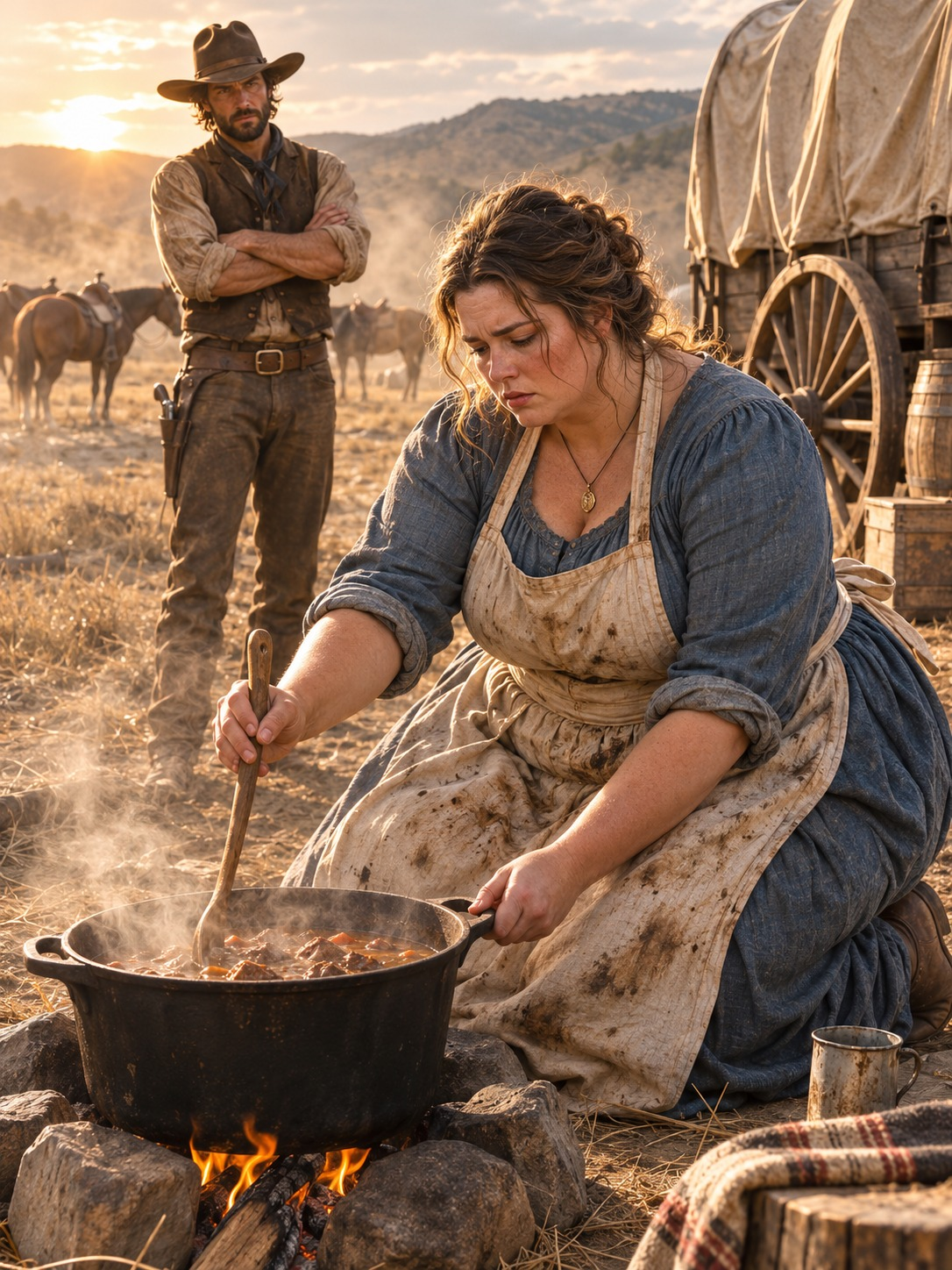
Cora Bell stared at the second signature until the letters blurred.
Samuel Bell.
Her dead husband's name was written beneath hers on a ranch payment receipt dated six weeks after his funeral.
"That's impossible," she whispered.
Wes Talbot stood in the doorway, holding his lantern.
"Mrs. Bell?"
Cora pressed her fingers against the paper.
"Samuel couldn't have signed this."
Wes looked at her.
"Who is Samuel?"
"My husband."
The foreman's expression changed.
Cora swallowed hard.
"He died last November."
For several seconds, neither spoke.
Outside, a horse whinnied near the stable. The wind pushed against the wooden walls of her little room.
Wes looked down at the receipt.
"Then we'd better take this straight to Mr. Shaw."
Cora did not move.
She had spent eleven months learning to live with Samuel's absence. She had packed away his clothes, sold his tools, and trained herself not to turn when someone entered a room, expecting to see him.
But now his name had appeared on a document he could not possibly have signed.
And someone at Briar Creek Ranch had put it there.
"Mrs. Bell?"
She looked up.
"Do you think Amos did this?"
Wes hesitated.
"I don't know."
"Then who?"
"That's what Mr. Shaw intends to find out."
Cora reached for the shawl hanging beside her bed.
Her hands trembled so badly that she struggled with the fastening.
Wes waited without speaking.
When she finally stepped outside, she locked the door behind her.
It was an ordinary habit.
But tonight, the small metallic click sounded painfully inadequate.
Everett Shaw was standing behind his office desk when they arrived.
Three account books lay open beneath the lamplight. Several loose receipts had been arranged in careful rows.
He looked up immediately.
"Mrs. Bell. Please come in."
Cora entered, clutching the suspicious receipt.
Everett noticed her face.
"Wes told you?"
"He showed me the paper."
Everett pulled out a chair.
"Sit down."
Cora shook her head.
"I'd rather stand."
He accepted that without argument.
She placed the receipt on his desk.
"My husband died last November."
Everett's eyes moved to the signature.
"I understand."
"Then how could his name be on a payment made in December?"
"That's one of the questions I'm trying to answer."
Cora looked at the account books.
"Was the money supposed to be mine?"
Everett opened the largest ledger.
"According to this entry, the ranch paid twenty-eight dollars to Cora and Samuel Bell for kitchen labor and miscellaneous services."
Cora stared.
"Twenty-eight dollars?"
"Yes."
"I never received twenty-eight dollars."
"How much were you paid that month?"
"Twelve."
Everett looked toward Wes.
The foreman's jaw tightened.
Cora continued.
"And Samuel never worked here. He was a carpenter in Bellweather."
Everett turned another page.
"Did he ever perform repairs for Briar Creek?"
"Not that I know of."
"Did he have any business dealings with Amos Vick?"
Cora hesitated.
"Not directly."
Everett looked up.
"What do you mean?"
"Samuel sometimes purchased supplies from the general store where Amos's brother-in-law kept an account. But that was before he became ill."
Everett's expression sharpened.
"Which brother-in-law?"
"I don't know his full name. Samuel mentioned a man called Franklin."
Wes looked at Everett.
"Dobbins?"
Cora blinked.
"Is that the man who came here about the kitchen?"
Everett nodded slowly.
"Franklin Dobbins."
A cold sensation traveled down Cora's back.
She had thought the strange receipt might be a bookkeeping mistake.
Now it seemed connected to the very man who had arrived claiming her job was already gone.
Everett closed the ledger.
"Mrs. Bell, I need you to tell me exactly how Samuel handled his business."
Cora drew a careful breath.
"He kept records. Not elaborate ones. Just a notebook with payments and materials. He was particular about being paid for work he'd completed."
"Did he keep copies of receipts?"
"Sometimes."
"Do you still have his papers?"
She looked down.
"Very few."
"What happened to the rest?"
"I sold most of his tools after he died. Some papers were packed with them. I didn't realize they might matter."
Everett nodded.
"That's understandable."
Cora looked at the signature again.
"Mr. Shaw, whoever wrote his name knew what it looked like."
Everett did not answer immediately.
Then he said, "Yes. That's what concerns me."
Everett had learned long ago that a dishonest account could tell a story more clearly than an honest man.
The trick was finding where the figures stopped making sense.
He had built his cattle business by keeping close track of purchases, wages, feed, equipment, and transportation.
A ranch could survive a poor season.
It could survive a broken wagon or a lost shipment.
But it could not survive indefinitely if the people managing its money were allowed to invent expenses.
Amos Vick had been trusted with that responsibility.
For six years, Everett had believed the manager understood it.
Now he was looking at payments made to people who had not received them, deliveries recorded without matching inventory, and a kitchen that appeared far more expensive on paper than it had ever been in practice.
"Mrs. Bell," he said, "I don't want you to worry that this will affect the agreement we signed."
Cora looked up.
"How can it not?"
"Because your employment is separate from whatever Amos may have done."
"But if money is missing—"
"Then I'll find out where it went."
She studied him.
"You're very certain."
"I'm certain that someone needs to answer for it."
Wes shifted near the door.
"Mr. Shaw, should I bring Amos in?"
"Not yet."
Everett gathered the receipts.
"I want copies made before he sees what we've found."
Cora felt a sudden rush of fear.
"What if he already knows?"
Everett looked at her.
"Has he threatened you since we spoke?"
She remembered the footsteps outside her window.
The voices.
The stranger saying the original figures were not all gone.
She hesitated.
"Last night, I heard him talking to someone."
Everett's expression became still.
"What did you hear?"
Cora repeated the conversation as accurately as she could.
The warning about Everett examining the accounts.
The claim that the original figures were gone.
And the second man's reply.
Not all of them.
When she finished, Everett stood.
"Wes, I want someone watching the office and the records room tonight. Quietly."
"Yes, sir."
"And Amos is not to remove any books or papers."
Wes nodded.
Everett turned back to Cora.
"You did the right thing telling me."
She looked at the floor.
"I should have spoken sooner."
"No."
His answer was immediate.
"You were afraid of losing your work and your home. That fear was used against you. The responsibility belongs to the person who used it."
Cora pressed her lips together.
She wanted to believe him.
But she knew something Everett did not.
A wealthy man could afford to make an enemy.
A young widow with twelve dollars in her pocket could not.
The following morning, Cora arrived at the kitchen before sunrise.
She had slept poorly.
Every creak of the building had sounded like footsteps. Every gust of wind had reminded her of the voices beneath her window.
Still, there were twenty men to feed.
The ranch did not stop because her heart was troubled.
She lit the stove, measured the flour, and began preparing breakfast.
At six, Hugh arrived carrying two buckets of water.
"Morning, Mrs. Bell."
"Good morning."
He placed the buckets beside the washing table.
"Wes said we're to bring these every morning."
Cora looked at the water.
"Thank you."
Hugh grinned.
"Better than having you haul them yourself."
He was about nineteen, with freckles across his nose and a cheerful manner that made him seem younger.
Cora had always liked him.
He had been the first to sweep up the broken plate.
"Would you mind bringing another armful of wood?"
"Already stacked outside."
She looked toward the door.
A neat pile of split logs waited beside the wall.
For a moment, she could only stare.
Then she said, "That was thoughtful."
Hugh shrugged.
"Seems like common sense."
He left whistling.
Cora returned to the stove.
Common sense.
She wondered how many difficulties in her life had been made worse because someone with authority had decided common sense was an inconvenience.
By seven, the first men arrived.
They ate quickly, grateful for hot biscuits and eggs.
Wes stopped beside the serving table.
"Twenty for supper again," he told her. "No visitors expected."
Cora nodded.
"Thank you for letting me know."
"That's how it ought to work."
She watched him leave.
The morning was almost peaceful.
Then Amos Vick entered.
Cora's hand stopped over the bread basket.
He stood in the doorway, looking around the kitchen.
His eyes moved from the stacked firewood to the water buckets.
Then to the helper washing dishes.
"So," he said, "you've got yourself quite an operation."
Cora kept her voice steady.
"Good morning, Mr. Vick."
He ignored the greeting.
"Must be nice having everyone running around for you."
The young helper lowered her eyes.
Cora felt the familiar tightening in her stomach.
But this time, she remembered the agreement in her wooden box.
"Mr. Shaw arranged the duties," she said.
Amos smiled without warmth.
"Of course he did."
He stepped closer.
"Enjoy it while it lasts."
Cora said nothing.
Amos leaned toward her.
"Men like Everett Shaw don't stay interested in kitchen troubles for long."
She looked directly at him.
"Then I suppose we'll see."
His smile vanished.
For a moment, she thought he might shout.
Instead, he gave a short laugh.
"Careful, Mrs. Bell. Confidence can be expensive."
He turned and left.
Cora stood still until his footsteps faded.
Then she reached for the bread basket.
Her hands were shaking.
But she had answered him.
And nothing terrible had happened.
Not yet.
That afternoon, Nell Foster arrived with clean linens and a basket of mending.
She found Cora sitting at the preparation table, examining the copy of her employment agreement.
"You're going to wear holes in that paper if you keep reading it," Nell remarked.
Cora smiled faintly.
"I wanted to make sure I understood everything."
Nell set down her basket.
"Has Mr. Shaw changed his mind?"
"No."
"Has Amos?"
"I doubt it."
Nell pulled out a chair.
"Then what's troubling you?"
Cora hesitated.
She trusted Nell.
But the strange receipt involved Samuel, and speaking his name still felt like touching a wound that had never properly healed.
Finally, she told her.
Nell listened in silence.
When Cora described the forged signature, the older woman's face grew serious.
"Samuel Bell?"
Cora nodded.
"His name was written on a ranch payment."
Nell looked away.
"That's peculiar."
"Did you know Samuel?"
"Only a little. He repaired a cabinet for me once."
Cora remembered.
"He told me about that."
"He was a careful worker."
"Yes."
Nell folded her hands.
"Did he ever mention trouble collecting money?"
Cora frowned.
"Sometimes. But that wasn't unusual."
"From whom?"
"Different people."
"Did he ever mention Franklin Dobbins?"
Cora looked up sharply.
"Why?"
Nell hesitated.
"I remember seeing Samuel outside Dobbins's store one afternoon. They appeared to be arguing."
Cora stared.
"When?"
"Last autumn. Before he became ill."
"What were they arguing about?"
"I couldn't hear the words."
Nell looked uncomfortable.
"I didn't think much of it at the time."
Cora's mind raced.
Samuel had never told her about an argument.
But he had come home troubled one evening, saying that some men believed a debt disappeared if they waited long enough.
She had assumed he was speaking about an unpaid carpentry job.
Now she wondered whether there had been more to it.
"Nell, did Samuel look angry?"
"More upset than angry."
"Did Dobbins threaten him?"
"I don't know."
Nell reached across the table.
"Cora, don't build a terrible story out of something neither of us understands."
Cora nodded.
But the uneasiness remained.
By the end of the first week, the new kitchen arrangement had begun to prove itself.
The helper arrived each morning.
Wes provided the meal counts.
The ranch hands carried water and fuel.
Cora could prepare food without wondering whether Amos would suddenly demand six additional portions.
There were still difficulties.
A stove pipe needed repair.
Two sacks of potatoes arrived bruised.
One afternoon, a thunderstorm delayed the men returning from the north pasture.
But those were ordinary problems.
Problems that could be solved with planning and cooperation.
Cora discovered that she liked her work when she was allowed to do it properly.
She liked kneading bread.
She liked the smell of onions softening in butter.
She liked hearing the men praise a meal after a long day.
Most of all, she liked knowing that a mistake would not automatically become a threat to her livelihood.
Everett noticed the difference.
He stopped by the kitchen one evening while Cora was preparing supper.
"How is the arrangement working?"
"Better, sir."
"Anything you need changed?"
She considered the question.
"The helper should be paid for the extra hour she worked yesterday."
Everett nodded.
"How much time?"
"One hour."
"I'll see that it's recorded."
Cora hesitated.
"And the men could use another washing basin."
"Add it to the supply list."
She smiled faintly.
"You're making this rather easy."
Everett looked at her.
"Was it supposed to be difficult?"
She lowered her eyes.
"No, sir."
He studied her for a moment.
Then said, "Mrs. Bell, you don't have to thank me every time I agree to something reasonable."
Cora looked up.
"I'm not accustomed to it."
Everett's expression softened.
"Then perhaps it's time you became accustomed."
For a moment, neither spoke.
Cora became aware of the fire crackling behind her.
The scent of fresh bread filled the room.
Everett stood close enough that she could see the fine lines beside his eyes.
He was not a young man.
There was gray beginning to appear at his temples, and the years had left marks of hard weather and difficult decisions on his face.
Yet there was something steady about him.
Something that made her feel she did not need to choose every word with fear.
She looked away first.
"Will you be staying through winter?"
"That's my intention."
"At Briar Creek?"
"Yes."
She nodded.
"Then perhaps the kitchen can remain open."
Everett smiled slightly.
"That's one of the matters I intend to settle."
On the tenth day, Everett asked Cora to meet him after breakfast.
She found him at the empty supper table with a fresh sheet of paper and several account books.
Wes had already left for the north pasture.
They were alone.
"Mrs. Bell," Everett began, "I've been reviewing the kitchen's actual costs."
Cora sat opposite him.
"Are they too high?"
"No."
She blinked.
"Then why did Mr. Vick keep saying they were?"
"That's what I'm trying to establish."
Everett opened a ledger.
"According to Amos's reports, the kitchen has been losing money for months."
Cora's stomach tightened.
"But?"
"But the figures don't match the supplies you actually received."
She looked at the pages.
Everett pointed to several entries.
"Here, the ranch was charged for four sacks of flour. You recorded receiving two."
"That's correct."
"Here, we paid for twelve pounds of coffee. You received six."
"Yes."
"And here, the kitchen was charged for wages paid to an additional worker."
Cora frowned.
"There wasn't another worker."
"Exactly."
She looked at him.
"Where did the money go?"
Everett closed the ledger.
"I don't know yet."
He paused.
"But I intend to find out."
Cora thought of Amos's threats.
The missing supplies.
The forged receipt bearing Samuel's name.
And the stranger beneath her window.
"Mr. Shaw, is someone stealing from you?"
Everett did not answer immediately.
Then he said, "There are enough discrepancies that I have to consider it."
Cora stared at the table.
She had spent months believing she was failing.
Every shortage had felt like evidence that she was not capable of doing the job.
Every complaint from Amos had made her question herself.
Now she was beginning to understand that the shortages might never have been her fault.
Someone could have been creating them deliberately.
"Mrs. Bell?"
She looked up.
Everett's expression was serious.
"I'd like to extend your arrangement through October."
Her breath caught.
"On the same terms?"
"Yes."
"And after October?"
"We'll review the winter needs together."
She considered it.
"Twenty men will remain at headquarters?"
"That's the present plan."
"Then I can feed them."
Everett nodded.
"I believe you can."
Cora took a breath.
"But I want the agreement to remain in writing."
"Of course."
"And I want the helper's wages guaranteed."
"Agreed."
"And if visitors arrive unexpectedly, I want additional assistance."
"Agreed."
She looked at him carefully.
"Mr. Shaw, may I ask something personal?"
He raised an eyebrow.
"You may ask."
"Why are you doing all this?"
Everett leaned back.
"Because the ranch needs a reliable kitchen."
"That isn't what I mean."
He studied her.
Cora continued.
"You could hire someone else. Someone older. Someone with more experience. Someone who hasn't caused so much trouble."
Everett's expression changed.
"Mrs. Bell, you haven't caused trouble."
She looked down.
"Amos would disagree."
"Amos's opinion is not the measure of your worth."
The words struck her more deeply than she expected.
Everett continued.
"You've fed twenty men under difficult conditions. You've kept records when supplies failed to arrive. You've continued working despite being treated unfairly."
He paused.
"That tells me more about your ability than Amos's complaints ever could."
Cora felt tears gather.
She blinked them away.
Everett pretended not to notice.
"Now," he said, reaching for his pen, "shall we put October in writing?"
She nodded.
"Yes, sir."
That evening, Cora placed the new agreement beside the first.
She had enough money saved to pay Nell for a room if she needed one.
She had work guaranteed through October.
And she had begun to believe that she might survive the winter without being frightened every day.
But Samuel's forged signature remained in her thoughts.
She took his wedding ring from the wooden box.
Turned it between her fingers.
Then remembered something.
A small leather notebook.
Samuel had kept it in the bottom drawer of their old table.
She had sold the table after his death.
But before the buyer collected it, she had emptied the drawer into a cloth bundle.
Most of those papers had been discarded.
Yet she remembered placing the notebook inside a tin box with several letters.
Where was that box?
She searched beneath her bed.
Then inside the wooden chest.
Finally, behind a folded blanket, she found it.
A small dented tin container.
She opened the lid.
Inside were three letters, a faded photograph, and Samuel's notebook.
Cora's hands trembled.
She opened it.
The first pages contained ordinary carpentry measurements.
Then lists of payments.
Names.
Dates.
Amounts.
She turned another page.
And stopped.
Franklin Dobbins.
The name appeared beside a sum of money Samuel had been owed.
Below it, in Samuel's handwriting, were four words.
Payment refused. See Amos Vick.
Cora stared.
She turned the page.
Another entry.
Briar Creek materials. Delivered through Dobbins.
Then another.
Account disputed. Original receipt retained.
Her heart began to pound.
Samuel had been involved in business connected to Briar Creek.
And he had never told her.
She turned toward the back of the notebook.
Several pages had been torn out.
Only their jagged edges remained.
But one folded paper had been tucked into the binding.
Cora carefully pulled it free.
It was a receipt.
Dated October 1886.
Signed by Franklin Dobbins.
And beneath the signature was a handwritten note.
Balance to be collected from A. Vick.
Cora sat motionless.
For months, she had believed Samuel's unpaid work had been nothing more than the ordinary hardship of a struggling carpenter.
Now she wondered whether his debts had been connected to the same men who were trying to close the ranch kitchen.
A knock sounded at her door.
She quickly folded the receipt.
"Who is it?"
"Mrs. Bell?"
Everett Shaw.
She rose.
"One moment."
She placed the notebook on the bed and opened the door.
Everett stood outside with a lantern.
"Forgive the hour. Wes told me you might have some of Samuel's old papers."
Cora stared.
"How did he know?"
"He mentioned that you'd been looking through your belongings."
She nodded slowly.
"I found something."
Everett's expression sharpened.
"What?"
She stepped aside.
"Please come in."
He entered only after she moved away from the doorway.
Cora handed him the notebook.
He read the entries.
Then the receipt.
His face grew serious.
"Where did Samuel get this?"
"I don't know."
Everett examined the signature.
"Franklin Dobbins."
"Yes."
"And Amos Vick."
Cora nodded.
Everett looked at her.
"Mrs. Bell, I think your husband may have discovered something about the ranch accounts before he died."
Cora felt the room tilt.
"Do you think that's why his name appeared on the forged payment?"
"I can't say yet."
He closed the notebook carefully.
"But this may help us find out."
Cora looked at Samuel's ring in her palm.
For the first time since his death, she felt that something about his final months had been left unfinished.
And someone had gone to considerable trouble to keep it that way.
Everett handed the notebook back.
"Keep this safe. Don't show it to Amos."
"I won't."
"And if anyone asks about Samuel's papers, tell me immediately."
Cora nodded.
Everett moved toward the door.
Then stopped.
"Mrs. Bell?"
"Yes?"
"Tomorrow, I'm going into Bellweather to examine the meal supplier's operation myself."
She looked up.
"Will you speak to Franklin Dobbins?"
"Yes."
"And ask him about Samuel?"
Everett considered her.
"I will."
Cora took a breath.
"Then I want to know what he says."
"You will."
He stepped outside.
Cora closed the door.
For a moment, she stood holding the notebook against her chest.
Then she returned to the bed.
She opened the final page.
There, beneath a list of measurements, Samuel had written one sentence.
If the account is changed, the duplicate will prove it.
Cora stared at the words.
A duplicate.
Somewhere, Samuel had kept another copy.
She began turning the pages again, searching for a clue.
Then she noticed a faint indentation on the inside cover.
She held it closer to the candle.
Someone had pressed a message into the leather with a hard pencil.
The writing was barely visible.
Cora tilted the cover toward the light.
Three words slowly emerged.
Ask Nell Foster.
Cora's breath caught.
Nell?
The woman who had offered her a room.
The woman who had known Samuel.
The woman who had been visiting Briar Creek twice a week.
Cora looked toward the window.
Outside, a lantern moved across the yard.
Then another.
She heard footsteps approaching the kitchen.
A man's voice called from the darkness.
"Mrs. Bell?"
It was not Everett.
It was not Wes.
And it was not Amos.
Cora quietly closed the notebook.
The footsteps stopped outside her door.
Then the stranger spoke again.
"Mrs. Bell, I knew your husband."
A pause.
"I was there the night he died."
Cora reached for the lock.
Before her fingers touched it, the man whispered one more sentence.
"And I know why Samuel told Nell Foster to hide the second ledger."






Comments 0