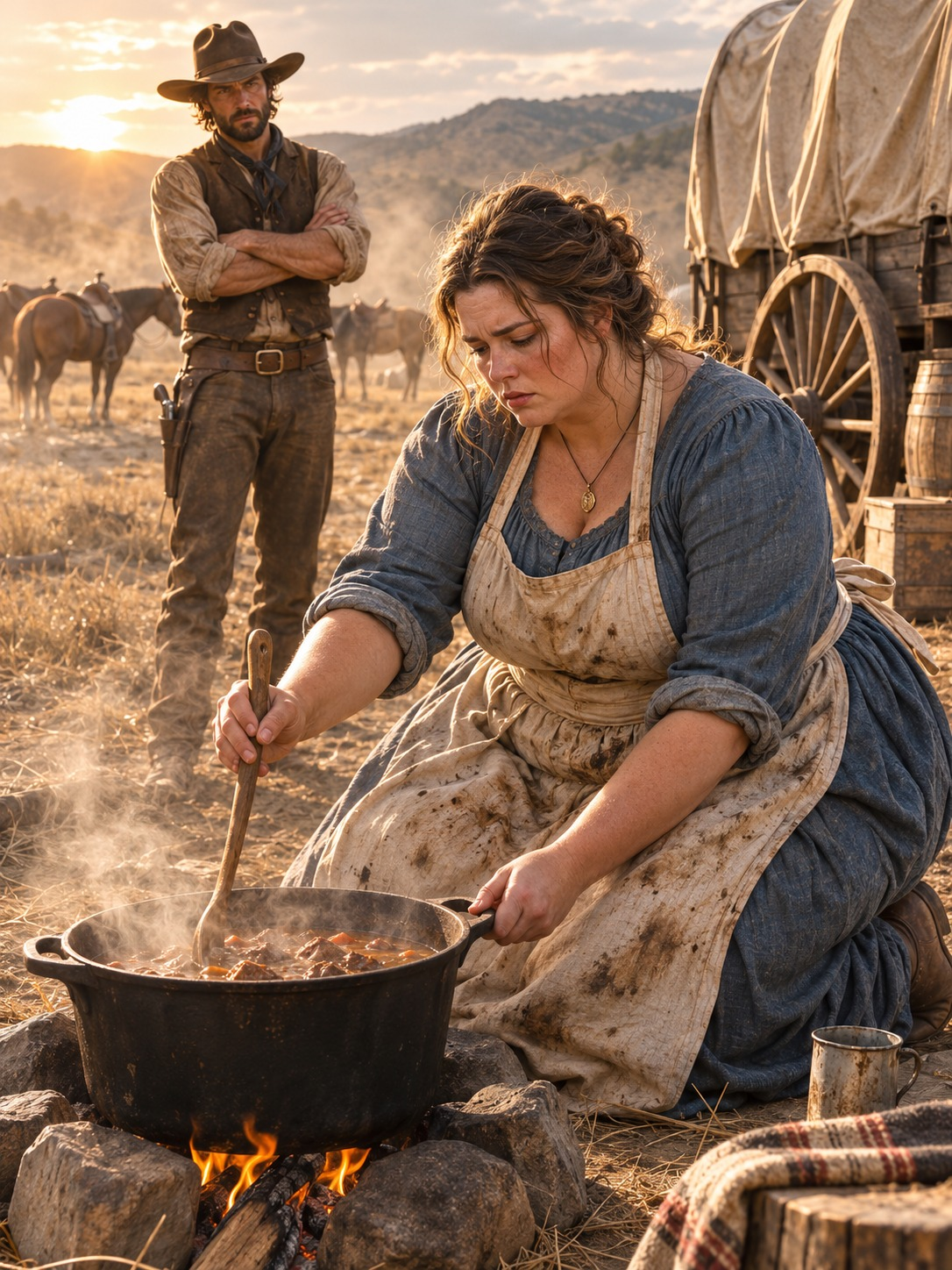
"Replaced?"
Cora Bell heard the word, but for several seconds, she could not make herself understand it.
Wes Talbot stood in the kitchen doorway, his hat crushed between his hands.
"The fellow says he's been hired to take over the kitchen arrangements," he explained. "Claims everything was settled before Mr. Shaw returned."
Everett Shaw slowly lowered the letter he had been reading.
"Who hired him?"
"Amos Vick, sir."
"On whose authority?"
Wes hesitated.
"Yours, according to the fellow."
The silence that followed seemed to swallow every sound in the room.
Cora looked at the notebook lying on the table. Its pages contained months of missing deliveries, unexpected guests, and warnings about losing her position.
She had believed those records might help her explain what had happened.
Now she wondered whether they would become the last evidence that she had ever worked at Briar Creek.
Everett folded the letter.
"Where is this man?"
"Waiting outside the office."
"Tell him I'll see him shortly."
Wes nodded.
"And find Amos."
"Yes, sir."
"Don't threaten him. Don't argue with him. Simply tell him I expect him to report to me."
Wes left.
Cora remained motionless.
Everett turned toward her.
"Mrs. Bell, I want you to understand something."
She tried to answer, but her throat felt tight.
"You have not been replaced."
"But the man outside—"
"Has no authority to decide who works here."
She looked at the letter in his hand.
"Mr. Vick told me for months that the kitchen might close."
"I know."
"He said another woman would be grateful for my position."
Everett's expression hardened.
"He had no right to make those threats."
Cora stared at her hands.
She had spent so many nights imagining the moment she would be dismissed that hearing otherwise felt almost dangerous.
Hope was a costly thing.
She had learned that after Samuel died.
People made promises when they were feeling generous. They offered sympathy at funerals, assistance after church, and assurances that everything would somehow work out.
Then the bills arrived.
And sympathy did not pay them.
"Mr. Shaw," she said quietly, "what happens when you leave again?"
Everett did not answer immediately.
He pulled out the chair opposite her and sat down.
"That's a fair question."
Cora looked up.
"I don't mean to be disrespectful."
"You're not."
He placed the folded letter on the table.
"My cattle holdings have grown faster than I expected. I've spent most of this year traveling between properties, buying stock, and negotiating grazing arrangements. I left the daily management of Briar Creek to Amos because I believed he could be trusted."
He paused.
"That was my responsibility."
Cora listened.
"I intend to make Briar Creek my winter headquarters," he continued. "I'll still take business trips, but they will be shorter. And Amos will no longer control your wages, your room, or the kitchen supplies."
She felt her heart beat faster.
"Even if he remains employed here?"
"Even then."
"And who would I answer to?"
"Me, until we establish a permanent arrangement."
Cora looked toward the stove.
The stew pot had been cleaned and hung to dry. Bread dough waited beneath a cloth on the preparation table.
Ordinary work.
Ordinary things.
Yet her entire future seemed to be resting on the words spoken across that table.
"May I ask something else?"
"Of course."
"If you decide to close the kitchen, will I be told before I lose my room?"
Everett's eyes narrowed slightly.
"Has Amos threatened to put you out without notice?"
"He never said it exactly that way."
"What did he say?"
Cora swallowed.
"He said the room belonged to the ranch. And if the ranch no longer needed a cook, there would be no reason for me to stay."
Everett looked away for a moment.
When he turned back, his voice was firm.
"If you decide to leave during the next two weeks, you'll receive every dollar you've earned. I'll also arrange transportation to Bellweather."
Cora blinked.
"And my room?"
"You may keep it during the trial arrangement."
"Even if Mr. Vick objects?"
"He won't be deciding."
For the first time, Cora allowed herself to breathe deeply.
But she still did not smile.
Not yet.
The man waiting outside Everett's office introduced himself as Franklin Dobbins.
He was a narrow-faced businessman in a dark traveling suit, with polished boots that looked entirely unsuited to a working cattle ranch.
A leather document case rested beside his chair.
When Everett entered, Dobbins rose immediately.
"Mr. Shaw. A pleasure."
Everett did not offer his hand.
"I understand you've come about a meal contract."
"Indeed. Mr. Vick informed me that the arrangements were practically complete."
"Practically?"
Dobbins cleared his throat.
"Subject to final confirmation, naturally."
"From whom?"
"Your manager."
Everett sat behind his desk.
"My manager cannot sign contracts in my name without my approval."
Dobbins blinked.
"I was led to believe—"
"Then you were misinformed."
The businessman opened his document case.
"Perhaps there's been a misunderstanding."
He removed several papers and arranged them carefully.
"My brother-in-law operates a prepared-meal establishment in Bellweather. We discussed supplying your headquarters crew with hot meals throughout the winter."
Everett glanced at the papers.
"How many men?"
"Twenty, according to the figures provided."
"And when would supper arrive?"
"At the appointed hour."
"What hour?"
Dobbins hesitated.
"That would depend upon the day's circumstances."
Everett leaned back.
"Whose circumstances?"
"The establishment's existing business, of course."
"So my men would eat whenever your brother-in-law finished serving his other customers."
"That's rather an unfair way of putting it."
"Is it inaccurate?"
Dobbins adjusted his collar.
Everett continued.
"Eight miles separate Bellweather from this ranch. The roads become difficult in winter. My crews don't always return at the same hour. What happens when a wagon breaks down?"
"We would make reasonable efforts—"
"What happens when snow closes the road?"
"We would endeavor—"
"What happens when twenty hungry men return after dark and discover their supper is still in town?"
Dobbins stopped speaking.
Everett folded his hands.
"Those are not unusual circumstances in the cattle business, Mr. Dobbins. They're ordinary ones."
The businessman attempted a smile.
"Naturally, there are details to be settled."
"Then nothing has been settled."
Dobbins looked toward the door.
"I was told the existing cook had already been informed."
Everett's expression changed.
"Who told you that?"
"Mr. Vick."
"What exactly did he say?"
Dobbins shifted in his chair.
"He said the woman understood her employment would end when the new arrangement began."
"Did he tell you she'd agreed?"
"Not in so many words."
"Did he tell you she'd been given notice?"
Another hesitation.
"He implied it."
Everett reached for the papers.
"Leave these with me."
Dobbins did not immediately release them.
"Mr. Shaw, my brother-in-law has already made preparations."
"On whose written authorization?"
The businessman stared.
Everett waited.
Finally, Dobbins let go.
"Perhaps we should speak again after you've had time to consider the advantages."
"Perhaps."
Dobbins collected his case.
At the door, he turned.
"Mr. Vick assured us you were eager to reduce expenses."
Everett looked up.
"I am eager to run a sound business, Mr. Dobbins. Those aren't always the same thing."
The businessman left without another word.
Everett remained at his desk, studying the papers.
Something about the arrangement troubled him.
Not merely the poor planning.
Not merely the fact that Amos had misrepresented his authority.
It was the speed with which the manager had attempted to move the matter forward.
Months earlier, Everett had asked him to investigate alternatives for feeding the headquarters crew.
Investigate.
Nothing more.
He had never approved closing the kitchen.
He had never authorized dismissing Cora.
And he certainly had never instructed anyone to tell a young widow that she would soon lose the only room she could afford.
Everett opened the folder containing his earlier correspondence.
He found the note he had sent Amos in June.
Please examine whether outside meal service could be practical during winter operations. Obtain estimates. Make no commitments until we review the costs and reliability.
He read the final sentence twice.
Then he placed it beside the papers Dobbins had brought.
Amos had not misunderstood.
He had ignored a direct instruction.
Cora spent the remainder of the morning preparing bread.
Her hands worked automatically.
Fold.
Press.
Turn.
Fold again.
She had performed the movements so many times that she could knead dough while thinking about something else entirely.
Today, she thought about Everett Shaw.
She knew very little about the man who owned Briar Creek.
The ranch hands spoke of his cattle holdings with a mixture of respect and amazement.
He owned thousands of acres through purchases and grazing arrangements. He employed crews at several properties. His cattle traveled east by rail, and his business dealings reached far beyond Bellweather.
Some men called him the most powerful cattle baron in that part of Colorado.
Others said he was simply a businessman who had learned when to take risks.
Cora had seen him only twice before the previous evening.
Once when he rode through the ranch in June.
And once in July, when he stopped briefly to speak with Wes.
On both occasions, she had been too busy cooking to pay much attention.
She had assumed he was like other wealthy men.
Distant.
Busy.
Unaware of the people who worked beneath him.
Yet the previous evening, he had carried plates.
And that morning, he had listened.
Neither act was particularly grand.
But Cora had discovered that ordinary kindness could feel extraordinary when a person had gone too long without it.
"You're working that dough as though it insulted you."
Cora looked up.
Nell Foster stood in the doorway carrying a basket of clean linens.
Nell was a widowed laundress from Bellweather who visited the ranch twice each week.
She was a sturdy woman in her fifties, with silver threaded through her brown hair and a practical manner that Cora had come to trust.
"Nell."
Cora wiped flour from her hands.
"I didn't hear you arrive."
"I noticed."
Nell set down the basket.
"What's happened?"
Cora hesitated.
Then she told her.
About Amos.
The broken plate.
Everett's unexpected return.
The man who had arrived claiming the kitchen was closing.
And the promise that she could remain for a two-week trial.
Nell listened without interrupting.
When Cora finished, the older woman pulled out a chair.
"Well."
Cora waited.
"That's quite a morning."
Despite herself, Cora gave a small laugh.
"It certainly is."
Nell studied her.
"Do you believe Mr. Shaw?"
"I want to."
"That's not what I asked."
Cora looked down.
"I don't know him well enough."
"Then don't trust a promise just because it's kindly spoken."
Cora nodded.
"But don't refuse a fair arrangement simply because someone else treated you badly, either."
Nell reached into her basket and removed a neatly folded towel.
"There's something I've been meaning to tell you."
"What is it?"
"I have a spare room in Bellweather."
Cora stared.
"A room?"
"Small one. Behind the front parlor. It isn't fancy, but the roof doesn't leak, and the stove works."
"I couldn't ask you—"
"You haven't asked. I'm offering."
Cora sat down slowly.
Nell continued.
"There would be a modest weekly charge. I can't afford to give it away. But if you decide to leave this place, you're welcome to rent it."
"How much?"
Nell named the amount.
Cora immediately began calculating.
Her wages.
The money she had saved.
The cost of food.
The price of transportation.
She could manage it for a little while.
Not indefinitely.
But long enough to look for other employment.
The realization brought a strange feeling to her chest.
She had somewhere else to go.
Amos Vick no longer held every possible future in his hands.
"Why would you do that for me?" she asked.
Nell looked surprised.
"Because I have a room, and you might need one."
Cora's eyes filled.
Nell reached across the table.
"Now, none of that."
"I'm sorry."
"Don't apologize for being relieved."
Cora wiped her cheek.
Nell squeezed her hand.
"Try Mr. Shaw's arrangement. See whether he keeps his word. But remember that you have a choice."
A choice.
The word stayed with Cora long after Nell returned to her laundry.
By afternoon, Everett had made three decisions.
First, Amos Vick would no longer control Cora's wages, room, purchasing, or kitchen deliveries.
Second, Wes Talbot would provide accurate daily crew counts and advance notice whenever additional men were expected.
Third, Everett himself would oversee kitchen purchasing until a permanent system could be established.
He also instructed Wes to assign men to bring water and firewood.
The work was to be included among the ranch's ordinary duties rather than left entirely to Cora.
When Amos finally appeared in the office, Everett was waiting.
The manager entered with his hat in his hands.
"You wanted to see me?"
"Sit down."
Amos obeyed.
Everett placed the meal-service proposal on the desk.
"Explain this."
Amos glanced at it.
"That's the arrangement I was investigating."
"Investigating?"
"Yes, sir."
"Then why did Dobbins arrive expecting to replace our kitchen?"
Amos's eyes flickered.
"He may have misunderstood."
"Did you tell him Cora Bell had been dismissed?"
"No."
"Did you tell him the kitchen would close?"
"I said it was likely."
"On whose authority?"
Amos leaned forward.
"Mr. Shaw, with respect, you've been away for months. I've had to make decisions."
"Decisions within your authority."
"Someone had to keep this ranch operating."
Everett's voice remained calm.
"And did the kitchen stop operating?"
"No, but—"
"Did the men go hungry?"
"Not regularly."
"Did Mrs. Bell fail to prepare the number of meals she was instructed to make?"
Amos's jaw tightened.
"She has a habit of complaining."
"That wasn't my question."
The manager looked away.
Everett continued.
"I witnessed you smash a plate beside her feet."
"She was being difficult."
"She was cooking supper."
"She challenged me in front of the men."
"She told you she needed time to prepare two additional meals."
Amos's face reddened.
Everett leaned forward.
"You will not threaten her employment again. You will not enter her room. You will not interfere with her wages, her supplies, or her kitchen duties."
Amos stared.
"You're taking the kitchen away from me?"
"Yes."
"Over one broken plate?"
"No."
Everett tapped the proposal.
"Over a pattern of conduct that requires examination."
For the first time, Amos looked genuinely frightened.
"Mr. Shaw, I've served you for six years."
"And I expect you to cooperate while I review how you've handled this ranch."
Amos swallowed.
"Am I dismissed?"
"Not today. You'll remain under supervision while you hand over the buildings, equipment records, and outstanding accounts."
The manager's shoulders stiffened.
"Under supervision?"
"Wes will oversee the process."
Amos stood abruptly.
Everett did not move.
"Sit down, Amos."
The manager remained standing for a moment.
Then slowly lowered himself back into the chair.
Everett opened a ledger.
"We'll begin with the kitchen supply accounts."
That evening, Cora received her first written agreement.
It was simple.
Two weeks.
Her existing wages.
Her room guaranteed during the trial.
A paid kitchen helper each day, with additional assistance when larger gatherings required it.
Accurate meal counts.
Advance notice of visitors whenever possible.
Water and fuel delivered by the ranch hands.
Everett would personally authorize necessary kitchen purchases.
At the end of the trial, they would review the arrangement together.
If she chose to leave, she would receive her earned wages and transportation to Bellweather.
Cora read every line.
Then read them again.
Everett waited patiently.
"Is something missing?" he asked.
She hesitated.
"Who decides whether the helper has done enough work?"
"You should have a say in that. The helper is there to assist you."
"And if more than twenty men arrive?"
"We arrange additional paid help."
She nodded.
Then pointed to one sentence.
"Could we write that I won't be responsible for meals requested without enough notice to prepare them?"
Everett considered it.
"Yes. Though I would still expect reasonable efforts in an emergency."
"Of course."
He added the wording.
Cora read it carefully.
Then signed her name.
Her handwriting was small but steady.
Everett signed beneath it.
He made a copy for her.
"Keep this somewhere safe."
Cora folded the paper.
"I will."
She placed it inside her apron pocket beside her notebook.
Everett stood.
"Mrs. Bell, I can't promise that every day here will be easy."
"I wouldn't expect that."
"But I can promise you'll be treated as an employee with responsibilities and rights, not someone who must be frightened into working."
Cora looked at him.
For a moment, she thought of Samuel.
Of the little rented rooms.
Of the future they had planned before illness took it away.
She had believed that chapter of her life was closed forever.
Now, sitting across from a man powerful enough to own several ranches, she found herself wondering whether she might someday build something new.
Not because Everett had rescued her.
But because he had given her room to stand on her own feet.
"Thank you, Mr. Shaw."
He nodded.
"Get some rest. Tomorrow we'll start making the arrangement work."
Cora returned to her room after supper.
She placed the agreement inside her wooden box beside Samuel's ring.
For several minutes, she sat looking at the two objects.
One represented the life she had lost.
The other represented a future she had not yet decided to trust.
Outside, the ranch settled into evening.
A horse stamped in the stable.
Men laughed near the bunkhouse.
The last wagon rolled toward the equipment shed.
Cora extinguished her candle.
Then she heard voices beneath her window.
Amos Vick was speaking.
And another man answered.
Cora recognized neither the second voice nor the careful, angry whisper that followed.
"You said Shaw wouldn't be back until October."
"I know what I said," Amos snapped.
"Then why is he examining the accounts?"
"Keep your voice down."
Cora sat upright.
The second man spoke again.
"If he finds the original figures, he'll know the kitchen wasn't losing money."
Cora's breath caught.
Amos answered sharply.
"Those figures are gone."
A pause.
Then the stranger said something that made her blood run cold.
"Not all of them."
Footsteps moved away from the window.
Cora remained motionless.
She thought of the missing flour.
The delayed supplies.
The threats.
The meal contract.
Then she reached beneath her mattress for her notebook.
She opened it to the earliest entries.
For months, she had recorded everything Amos failed to deliver.
But she had never seen the ranch's official accounts.
She had no idea what numbers had been entered beside her name.
A sudden knock sounded at her door.
Three sharp blows.
Cora froze.
"Mrs. Bell?"
It was Wes Talbot.
She hurried to the door but kept it locked.
"Yes?"
"Mr. Shaw needs you at the office."
"Now?"
"Yes, ma'am."
"What's happened?"
Wes hesitated.
Then he said, "We've found something in the kitchen accounts."
Cora reached for her shawl.
"What kind of something?"
Wes lowered his voice.
"Your name is on a receipt for money you never received."
Cora stared at the door.
"How much money?"
There was a long silence.
Then Wes answered.
"Enough to make Mr. Shaw ask who has been signing your name."
Cora opened the door.
Wes stood in the lamplight, holding a folded sheet of paper.
He handed it to her.
She recognized the date.
She recognized the amount.
But when she looked at the signature at the bottom, her hands went cold.
It was her name.
Written in handwriting that looked almost exactly like her own.
And beneath it was a second signature.
One she had seen before.
On the last document Samuel Bell had signed before he died.






Comments 0