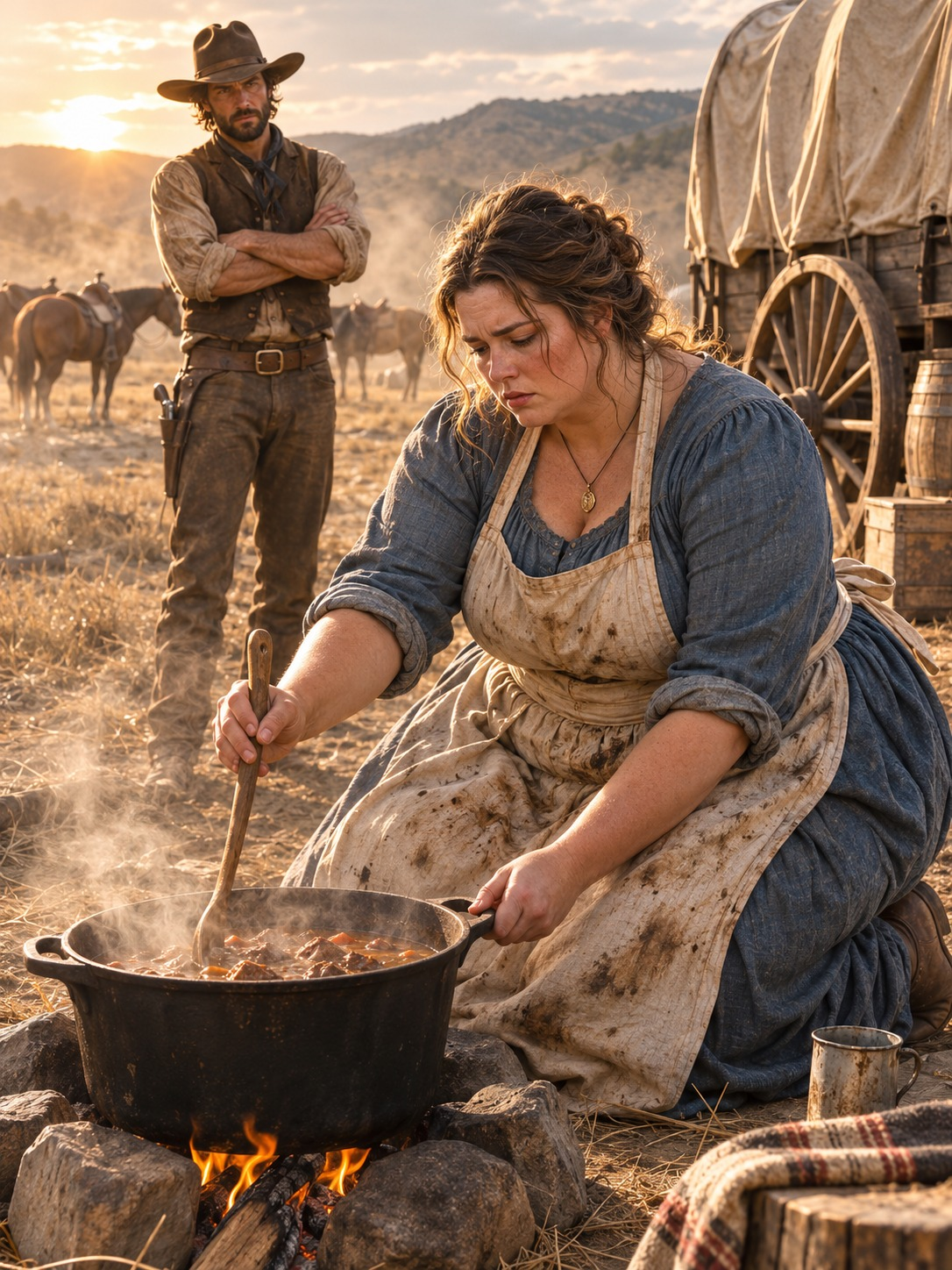
"Who are you?" Cora Bell whispered through the locked door.
The man outside did not answer immediately.
Then he said, "My name is Thomas Reed. I worked with your husband before he died."
Cora tightened her grip on Samuel's notebook.
"I don't know you."
"No, ma'am. But Samuel knew me."
"Then why have you come here in the middle of the night?"
"Because I heard Amos Vick was looking for his papers."
The words made her blood run cold.
She glanced toward the window.
A lantern moved beyond the kitchen wall, its light briefly illuminating the dusty yard.
"How do you know about the papers?"
Thomas lowered his voice.
"Because Samuel asked me to help him copy them."
Cora stared at the door.
She had spent eleven months believing that Samuel's final days held no secrets. He had been sick, frightened, and exhausted. She had cared for him until the fever took him.
Now a stranger was telling her that her husband had been investigating ranch accounts before his death.
And that Nell Foster had hidden evidence.
"Where is the second ledger?" Cora asked.
"That's why I need to speak with you."
"Then speak."
"Not through a door where anyone might hear."
Cora hesitated.
She wanted answers.
But she remembered Amos testing her door handle.
She remembered his warning that owners came and went while men like him remained.
And she remembered Everett telling her not to show Samuel's papers to anyone.
"Come back tomorrow," she said.
"Mrs. Bell—"
"Speak to Mr. Shaw first. If you know something about my husband, you can tell him."
Thomas fell silent.
Then he said, "Samuel always said you were sensible."
Cora closed her eyes.
The words hurt more than she expected.
"Please," Thomas continued. "Tell Nell that I came. Tell her the papers aren't safe where she left them."
Cora opened her eyes.
"What does that mean?"
But the stranger was already moving away.
His footsteps faded across the yard.
Cora remained beside the door, listening until she could hear only the wind.
Then she placed Samuel's notebook beneath her pillow and sat on the edge of her bed.
She did not sleep.
At dawn, Everett Shaw found Cora waiting outside his office.
She was wearing her clean sage-green dress beneath a faded shawl. Her auburn hair had been braided neatly, but the shadows beneath her eyes betrayed the night she had endured.
Everett stopped.
"Mrs. Bell?"
"A man came to my room last night."
His expression changed.
"Who?"
"He called himself Thomas Reed."
Everett set down the leather satchel he was carrying.
"What did he want?"
"He said he worked with Samuel. He knew about the notebook. And he said Nell Foster had hidden a second ledger."
Everett remained silent for a moment.
Then he opened the office door.
"Come inside."
Cora followed him.
He pulled out a chair, but she remained standing.
"Did you let him in?"
"No."
"Good."
"He said I should tell Nell the papers weren't safe."
Everett crossed to the window.
Outside, the ranch hands were preparing their horses for the day's work.
"Do you know Thomas Reed?" Cora asked.
"I've heard the name."
Her heart quickened.
"Where?"
"Samuel Bell performed carpentry work for several businesses around Bellweather. Reed was a freight driver who sometimes helped transport materials."
Cora frowned.
"Samuel never mentioned him."
"That doesn't necessarily mean anything."
"But why would he come here now?"
Everett turned.
"That's what we need to establish."
He studied her face.
"Mrs. Bell, have you eaten?"
She shook her head.
"Not yet."
"Then have breakfast before you do anything else."
"Mr. Shaw—"
"The questions will still be here afterward."
His tone was gentle but firm.
Cora looked down.
She had become so accustomed to working through hunger and exhaustion that the suggestion seemed almost strange.
"I have bread to prepare."
"Your helper can begin the washing while you eat."
She hesitated.
Then nodded.
"Thank you."
Everett watched her leave.
When the door closed, he reached for his coat.
His planned trip to Bellweather had suddenly become more important.
By eight o'clock, Everett and Wes Talbot were traveling toward town.
The wagon wheels rattled over the dry road.
The morning sun had risen above the eastern plains, and a thin layer of dust followed the horses.
Wes held the reins.
Everett sat beside him, studying the papers Franklin Dobbins had delivered.
"You think Amos is involved in more than the kitchen?" Wes asked.
"I think the kitchen may have been one way money was taken from the ranch."
Wes glanced at him.
"How much?"
"I don't know yet."
"Enough to ruin us?"
Everett folded the papers.
"Not by itself."
"But?"
"But a dishonest manager rarely limits himself to one account."
Wes shook his head.
"I've worked beside Amos for years."
"So have I."
"I knew he was hard on people. I didn't know he was doing this."
Everett looked toward the distant hills.
"Neither did I."
For several miles, they rode in silence.
Then Wes asked, "What about Mrs. Bell?"
Everett turned.
"What about her?"
"She's frightened."
"I know."
"Amos has been telling her for months that she'll lose her room. Now strangers are coming to her door."
Everett's jaw tightened.
"I intend to put an end to that."
Wes considered him.
"She's a good worker."
"Yes."
"And she's been treated badly."
"Yes."
Wes glanced toward the road.
"Then I'm glad you came home."
Everett did not answer.
He had spent years believing that providing employment and paying wages were enough to make him a responsible owner.
Now he was beginning to understand how much could happen when a man stopped paying attention.
Bellweather was busy when they arrived.
Wagons crowded the main street. A blacksmith hammered at a horseshoe. Merchants stood outside their shops, discussing prices and deliveries.
Everett first visited the establishment that Franklin Dobbins had proposed to supply Briar Creek's meals.
It occupied the rear of a general store.
Inside, a narrow kitchen contained two stoves, a preparation table, and several covered containers.
The proprietor, Henry Dobbins, greeted Everett with an eager smile.
"Mr. Shaw. Franklin said you might come."
"I wanted to see how your operation works."
"Of course."
Henry showed him the cooking equipment.
He explained how meals could be packed into covered containers and transported by wagon.
Everett listened.
Then he asked, "How many customers do you serve daily?"
"Depends on the day. Thirty or forty, sometimes more."
"And how many workers prepare the food?"
"Three."
"Would you hire additional help for Briar Creek?"
Henry hesitated.
"Not immediately."
Everett looked at the containers.
"How would you keep twenty meals hot during an eight-mile journey?"
"We'd cover them properly."
"And if the road were blocked by snow?"
"We'd do our best."
"What if my men returned two hours later than expected?"
Henry rubbed his chin.
"Well, naturally, we'd have to coordinate."
Everett nodded.
"Would Briar Creek's meals take priority over your existing customers?"
Henry looked uncomfortable.
"I couldn't promise that."
"Then what could you promise?"
The proprietor spread his hands.
"We'd send the meals when we could spare them."
Everett said nothing.
Henry hurried to explain.
"Mr. Shaw, you must understand that a business has to serve its regular customers first."
"I do understand."
Everett looked around the cramped kitchen.
"And that is precisely why this arrangement won't work."
Henry's smile disappeared.
"But Franklin said the contract was nearly complete."
"Franklin was mistaken."
"Mr. Vick assured us—"
"Mr. Vick had no authority to assure you of anything."
Henry stared.
Everett continued.
"My men need dependable meals. This establishment cannot provide them under the conditions you've described."
He turned toward the door.
Henry followed him.
"Mr. Shaw, surely we can negotiate."
"Not today."
"But we've already invested time—"
"Then I suggest you discuss that with the man who encouraged you to proceed without my approval."
Everett stepped outside.
Wes was waiting beside the wagon.
"Well?"
"The kitchen stays open for now."
Wes nodded.
"Mrs. Bell will be pleased."
Everett looked back at the store.
"Perhaps. But we still need to learn why Amos was so determined to close it."
Back at Briar Creek, Cora was preparing the noon meal when Nell Foster arrived.
The older woman entered carrying a basket of clean linens.
"Morning, dear."
Cora turned.
"Nell, I need to speak with you."
Something in her voice made Nell stop.
"What is it?"
Cora looked toward the doorway.
The kitchen helper was washing dishes at the far end of the room.
"Could we step outside?"
Nell studied her.
Then nodded.
They walked behind the covered wagon, where the sound of the kitchen could no longer be heard clearly.
Cora faced her.
"Who is Thomas Reed?"
Nell's expression changed.
For one brief moment, the older woman looked genuinely frightened.
"Where did you hear that name?"
"He came to my room last night."
Nell gripped the handle of her basket.
"What did he say?"
"He said Samuel asked him to copy some papers."
Nell closed her eyes.
Cora continued.
"He said you hid a second ledger."
The older woman opened her eyes.
"Cora—"
"Is it true?"
Nell looked toward the kitchen.
Then back at Cora.
"Yes."
The answer struck harder than Cora expected.
"You knew?"
Nell nodded.
"Samuel came to me shortly before he became ill."
"Why didn't you tell me?"
"Because he asked me not to."
Cora stared.
"My husband asked you to keep something from me?"
"He said he didn't want you frightened until he understood what he'd found."
Cora felt tears gather.
"He's dead, Nell."
"I know."
"He's been dead almost a year."
Nell's face tightened.
"I know that too."
"Then why didn't you tell me afterward?"
The older woman looked down.
"Because I was afraid."
Cora stepped back.
"Of Amos?"
Nell nodded.
"And Franklin Dobbins."
For several seconds, neither spoke.
Then Nell reached into her basket and removed a folded piece of cloth.
"Samuel gave me a packet of papers. He said they showed payments that didn't match the work performed."
"Where are they?"
"Hidden in my house."
Cora's heart pounded.
"Are they safe?"
"I thought so."
"What changed?"
Nell looked toward the road.
"Two days ago, someone entered my home while I was away."
Cora went still.
"Was anything stolen?"
"Not that I could see."
"Then how do you know someone was there?"
Nell swallowed.
"The cupboard where I keep my sewing things had been opened. And the floorboards beneath it were scratched."
Cora remembered Thomas's warning.
The papers aren't safe where she left them.
"Nell, you must tell Mr. Shaw."
"I will."
"Today."
Nell nodded.
"Today."
Cora reached for her hand.
"Samuel trusted you."
The older woman's eyes filled.
"He did."
"Then please don't keep anything else from me."
Nell squeezed her fingers.
"I won't."
Everett returned from Bellweather shortly before supper.
Cora was waiting near the serving table.
She had prepared a list of supplies for the following week, but her mind was far from potatoes and flour.
"Mr. Shaw?"
He stopped.
"Mrs. Bell."
"Did you speak to the meal supplier?"
"Yes."
"And?"
"He cannot guarantee reliable service. I've decided the ranch kitchen will remain open for the winter crew, provided we settle workable terms."
Cora felt a wave of relief.
"Thank you."
Everett shook his head.
"Don't thank me yet. We still have to agree on the details."
"I'd like that."
He noticed her expression.
"Something else?"
She nodded.
"Nell told me about Samuel's papers."
Everett became still.
"She admitted having them?"
"Yes."
"And where are they?"
"At her house in Bellweather."
Everett looked toward Wes, who had just entered.
"Wes, I want two trustworthy men available tomorrow morning."
"For what?"
"We're going to collect some documents."
Cora stepped forward.
"Mr. Shaw, Nell said someone entered her home."
Everett's eyes narrowed.
"When?"
"Two days ago."
"Was she harmed?"
"No."
"Did she report it?"
"I don't think so."
Everett considered the information.
Then he turned back to Cora.
"Mrs. Bell, I want you to remain here tomorrow."
She stiffened.
"But those are Samuel's papers."
"I understand."
"Then I should be there."
Everett's expression softened.
"I'm not trying to exclude you."
"It feels that way."
He studied her.
Cora took a breath.
"I know I'm only the cook."
"You're not only anything."
She looked up.
Everett continued.
"You're Samuel Bell's widow. If those papers belong to him, you have every right to know what they contain."
"Then let me come."
He hesitated.
Finally, he nodded.
"All right. But we go together."
Cora felt relief.
"Thank you."
"And Mrs. Bell?"
"Yes?"
"Bring your notebook."
That evening, Amos Vick watched from the far side of the yard as Everett spoke with Cora.
The manager's expression was unreadable.
He had spent six years running Briar Creek's daily operations.
He knew which men could be trusted, which suppliers would wait for payment, and which accounts Everett rarely examined.
For years, that knowledge had given him power.
Now Everett was asking questions.
And the young widow was answering them.
Amos turned toward the equipment shed.
Inside, Franklin Dobbins waited beside a stack of feed sacks.
"Well?" Franklin demanded.
Amos closed the door.
"Shaw inspected your brother-in-law's kitchen."
Franklin cursed.
"What did he say?"
"The contract is finished."
Franklin stared.
"Finished?"
"He's keeping the ranch kitchen open."
"Then what happens to the money?"
Amos stepped closer.
"Keep your voice down."
Franklin lowered it.
"You told me the arrangement was certain."
"It would have been if Shaw hadn't returned early."
"That's not my problem."
Amos's face darkened.
"It becomes your problem if those old receipts turn up."
Franklin went still.
"What receipts?"
"Samuel Bell's."
The businessman looked away.
Amos noticed.
"You told me everything had been destroyed."
"Everything I had."
"What does that mean?"
Franklin hesitated.
"Thomas Reed may have kept copies."
Amos stared.
"Reed?"
"He helped Samuel with some deliveries."
"Where is he?"
"I don't know."
Amos stepped closer.
"Find out."
Franklin swallowed.
"And the widow?"
Amos looked toward the kitchen.
Through the window, Cora could be seen placing bread on the serving table.
"She's becoming inconvenient."
Franklin's expression tightened.
"Don't do anything foolish."
Amos smiled without warmth.
"Then make sure those papers never reach Everett Shaw."
The following morning, Cora rode to Bellweather with Everett and Wes.
She sat in the wagon beside a small wooden chest containing Samuel's notebook and the forged receipt.
The road was dry, but the wind carried a warning of colder weather ahead.
Everett had brought a heavy coat.
He offered it when Cora shivered.
She hesitated.
"I have my shawl."
"I can see that."
He held out the coat.
"The wind doesn't seem impressed."
Despite herself, she smiled.
"Thank you."
She accepted it.
The coat was warm and smelled faintly of leather and cedar.
For several miles, they rode in silence.
Then Everett asked, "Did Samuel enjoy carpentry?"
Cora looked at him.
"Very much."
"What kind of work did he prefer?"
"Furniture. Especially tables."
Everett nodded.
"He sounds like a careful man."
"He was."
She looked toward the distant hills.
"He wanted to build us a house someday."
Everett said nothing.
Cora continued.
"Nothing grand. Just a little place with a porch and enough room for a garden."
Her voice softened.
"He used to draw plans on scraps of paper."
"Do you still have them?"
"One."
She touched the small pendant at her throat.
"I kept it folded inside my Bible."
Everett glanced at her.
"Then you still have something of the future he imagined."
Cora looked down.
"I suppose I do."
He did not press her to say more.
And she was grateful.
Nell Foster's house stood near the edge of Bellweather.
It was a modest whitewashed building with a narrow porch and a small garden behind it.
Nell was waiting outside when they arrived.
She looked relieved to see Everett.
"Mr. Shaw."
"Mrs. Foster."
She glanced at Cora.
"Come inside."
They entered the front parlor.
The room smelled of soap, dried lavender, and freshly ironed linen.
Nell closed the door.
"I haven't touched the papers since Samuel left them."
Everett nodded.
"Show us where they are."
Nell led them into the back room.
A wooden cupboard stood against the wall.
She opened it and removed a stack of folded linens.
Then she knelt and lifted a loose floorboard.
Cora watched anxiously.
Nell reached into the narrow space.
Her hand moved beneath the boards.
Then stopped.
She frowned.
"That's strange."
Everett stepped closer.
"What is it?"
Nell reached farther.
Her face drained of color.
"They're gone."
Cora felt her stomach drop.
"What?"
"The packet. It was wrapped in brown cloth."
Nell searched again.
Nothing.
Everett crouched beside her.
"Are you certain this is where you left it?"
"Absolutely."
Wes examined the floorboard.
"There are fresh marks here."
Everett looked at him.
"Someone forced it open."
Nell covered her mouth.
"Oh, Lord."
Cora stared at the empty space.
Samuel had tried to preserve evidence.
Nell had hidden it.
And now someone had taken it.
Everett stood.
"Nobody leaves until we understand what's happened."
Wes moved toward the front door.
Cora looked around the room.
Something felt wrong.
Not merely the missing papers.
The cupboard.
The folded linens.
The small sewing basket beside the chair.
She remembered Nell saying that someone had opened the cupboard but apparently taken nothing.
"Wait," Cora whispered.
Everett turned.
"What is it?"
Cora stepped toward the cupboard.
She noticed a small wooden box on the lowest shelf.
Its lid was slightly crooked.
"Nell, what's in that box?"
"Buttons and sewing needles."
"May I?"
Nell nodded.
Cora lifted the lid.
Inside were ordinary sewing supplies.
But beneath them lay a folded scrap of paper.
She pulled it free.
The handwriting was Samuel's.
Her breath caught.
She unfolded it.
Only one sentence was written there.
If the first packet disappears, look where the wages were counted.
Cora stared.
Everett stepped beside her.
"What does it say?"
She handed him the note.
He read it carefully.
Then looked toward Nell.
"Where were the wages counted?"
Nell frowned.
"At the ranch office, I suppose."
Cora shook her head.
"No."
Everyone turned toward her.
She remembered Samuel sitting at their little walnut table, counting coins after finishing a job.
She remembered the drawer where he kept receipts.
And she remembered selling that table after his death.
"Samuel counted his wages at home," she whispered.
Everett studied her.
"Where is the table now?"
Cora felt her heart pound.
"I sold it."
"To whom?"
She closed her eyes, searching her memory.
A furniture dealer.
A man who bought used household goods.
He had paid her three dollars for the table and two chairs.
Then she remembered his name.
"Mr. Harlan. He owns the secondhand shop near the blacksmith."
Everett turned toward Wes.
"Let's go."
The shop stood two streets away.
Its windows were crowded with old lamps, chairs, clocks, and household goods.
A small bell rang when they entered.
An elderly man appeared from behind a stack of crates.
"Can I help you?"
Cora stepped forward.
"Mr. Harlan, do you remember buying a walnut table from me last winter?"
The man studied her.
"Mrs. Bell?"
"Yes."
"Of course. Fine little table. Your husband made it, didn't he?"
She nodded.
"Do you still have it?"
Harlan hesitated.
"I don't believe so."
Cora's heart sank.
"Who bought it?"
The dealer scratched his chin.
"Let me think."
Everett stepped forward.
"We'd appreciate it if you could check your records."
Harlan nodded.
"Certainly."
He disappeared behind the counter and returned with a ledger.
He turned several pages.
"Walnut table. Two chairs. Purchased December seventh."
Cora leaned closer.
"Yes."
Harlan ran his finger down the page.
"Sold January twelfth."
"To whom?" Everett asked.
The dealer looked up.
"Amos Vick."
Silence filled the shop.
Cora stared.
"Amos bought my table?"
Harlan nodded.
"Paid cash."
Everett's expression hardened.
"Do you know where he took it?"
"Couldn't say."
Cora looked toward the window.
For months, Amos had controlled her work, threatened her room, and humiliated her.
Now she learned that he had purchased the table Samuel had built for their home.
The table with the drawer where Samuel had kept his records.
Everett closed the ledger.
"Thank you, Mr. Harlan."
They stepped outside.
Wes looked toward Everett.
"That table could be anywhere."
Everett nodded.
"Yes."
Cora gripped Samuel's notebook.
"But Amos bought it for a reason."
Everett looked at her.
"I believe he did."
They returned to the wagon.
Cora climbed aboard, her thoughts racing.
Samuel's forged signature.
The missing kitchen supplies.
The failed meal contract.
The stolen ledger.
And now the table.
Every answer seemed to lead back to Amos Vick.
But one question remained.
Why had Samuel been involved at all?
They reached Briar Creek shortly before sunset.
The ranch yard was unusually quiet.
Wes noticed it first.
"Where are the men?"
Everett looked toward the bunkhouse.
Several horses stood saddled near the corral.
A wagon had been moved beside the equipment shed.
Something was wrong.
Hugh hurried toward them.
"Mr. Shaw!"
Everett stepped down.
"What happened?"
Hugh was breathing hard.
"Amos sent two men into town this afternoon."
"Why?"
"He said they were collecting supplies."
Everett glanced toward the shed.
"Which supplies?"
Hugh hesitated.
"I don't know, sir. But he had them load a wooden table onto the wagon."
Cora froze.
"A table?"
Hugh nodded.
"Small walnut one. Looked old."
Everett turned sharply toward Wes.
"Find Amos."
Wes hurried away.
Cora stepped down from the wagon.
Her legs felt unsteady.
"Mr. Shaw, that could be Samuel's table."
"I know."
Hugh looked between them.
"There's something else."
Everett turned.
"What?"
"Amos told the men not to open the drawer."
Cora felt a chill.
"Why?"
Hugh swallowed.
"He said it was locked."
Everett looked toward the road.
"Which direction did the wagon go?"
"North."
Wes returned at a run.
"Mr. Shaw, Amos isn't in his quarters."
Everett's jaw tightened.
"Where is he?"
"Nobody knows."
Cora looked toward the equipment shed.
The door stood partly open.
A faint light flickered inside.
She took a step forward.
Then stopped.
On the ground near the doorway lay a small brass key.
She recognized it immediately.
Samuel had carried it on a leather cord.
It opened the drawer of their walnut table.
Cora bent and picked it up.
Her hands trembled.
"Mr. Shaw."
Everett turned.
She held out the key.
"This belonged to my husband."
He stared at it.
"Are you certain?"
"Yes."
Everett looked toward the shed.
Then back at Cora.
"Stay here."
But Cora was already moving.
She crossed the yard toward the open doorway.
The light inside shifted.
Someone was there.
She heard a chair scrape across the wooden floor.
Then a familiar voice spoke from the darkness.
"Don't come any closer, Cora."
She stopped.
Her heart hammered.
The voice belonged to Nell Foster.
Cora stared into the shed.
"Nell?"
A long silence followed.
Then the older woman whispered, "Samuel didn't die without telling me what he found."
Cora took another step.
"What did he find?"
Nell's voice broke.
"He discovered why Amos needed the kitchen closed."
Cora reached for the door.
Before she could pull it open, another voice spoke from inside.
A man's voice.
Low.
Cold.
And unmistakably furious.
"Tell her the rest, Nell."
Cora froze.
Amos Vick was standing on the other side.
And in his hand was Samuel Bell's missing ledger.






Comments 0