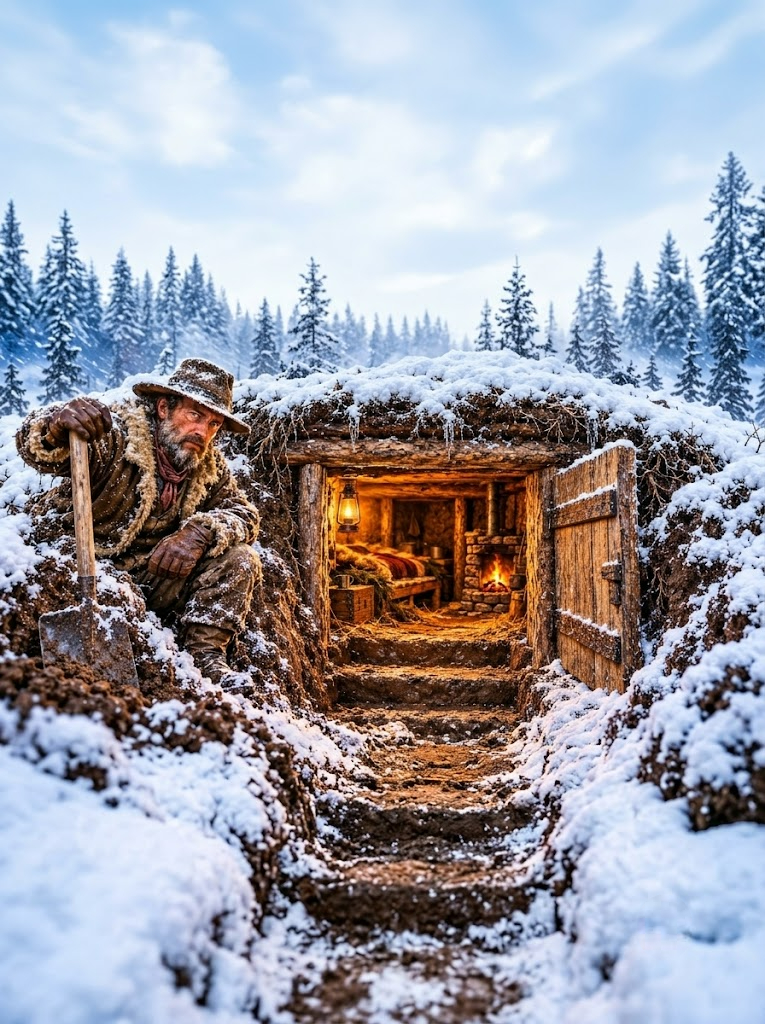
“Don't open that door!” the stranger shouted.
Jacob Mercer froze with one hand gripping the wooden latch.
On the other side of the buried entrance, the man's voice broke beneath the roar of the blizzard.
“Your daughter isn't alone!”
Nora's fingers tightened around Jacob's arm.
“What does that mean?”
Jacob pressed his face toward the narrow opening.
“Who are you?”
The answer came through chattering teeth.
“Caleb. Caleb Whitcomb.”
Jacob knew the name.
Miss Whitcomb's older brother.
The young man who occasionally delivered coal and firewood to the schoolhouse.
Jacob had met him twice at the general store, where Caleb had struck him as a quiet fellow with broad shoulders and a habit of looking at the ground when he spoke.
But why was he outside their home?
And where was Elsie?
“Where's my daughter?” Jacob demanded.
Caleb coughed.
“She's—”
A violent gust swallowed the rest of his words.
Something heavy struck the door.
Jacob pushed against the wood.
It moved another inch.
Through the opening, he saw a gloved hand gripping the frame.
Then a face appeared.
Caleb Whitcomb was barely recognizable.
His eyebrows were white with ice. Frozen snow covered his scarf, and one side of his face had turned an alarming shade of gray.
His lips trembled uncontrollably.
Jacob grabbed his coat.
“Where is she?”
Caleb tried to speak.
Instead, his knees buckled.
Jacob caught him before he disappeared into the snow.
“Nora! Help me!”
Together, they pulled the young man through the narrow entrance.
The storm fought them.
Wind drove snow into the room, scattering white powder across the wooden floor.
The lantern flickered.
Peter screamed.
Jacob dragged Caleb backward while Nora pushed the door with all her strength.
At last, the heavy wood slammed shut.
The sudden silence was almost shocking.
Only the muffled roar of the storm remained.
Caleb collapsed beside the table.
His body shook violently.
Jacob knelt over him.
“Where's Elsie?”
Caleb's eyes opened.
“She stayed…”
“Stayed where?”
“With the others.”
Jacob grabbed his shoulders.
“What others?”
Nora caught Jacob's wrist.
“Stop. He's freezing.”
“He knows where she is!”
“And he won't tell you anything if he dies on our floor.”
Jacob released him.
Nora removed Caleb's frozen gloves and wrapped a blanket around his shoulders.
His fingers were pale and stiff.
She rubbed them gently between her hands.
“Caleb, can you hear me?”
He nodded.
“Your sister,” Nora said. “Is she with the children?”
Caleb swallowed.
“Yes.”
Jacob felt his chest loosen.
“Then Elsie's at the schoolhouse?”
Caleb shook his head.
The relief vanished.
“No,” he whispered. “They left.”
Jacob stared.
“Left?”
“The schoolhouse…”
Caleb's breathing became ragged.
“The stove pipe broke. Smoke filled the room. Margaret couldn't keep the children there.”
Nora looked toward their own smoking stove.
For one terrible moment, the two dangers seemed to mirror each other.
“Where did they go?” she asked.
Caleb closed his eyes.
“To the Peterson place.”
Jacob knew the farm.
A mile beyond the schoolhouse.
Farther from their own homestead.
“Why would they go there?”
“Stone cellar. Margaret thought…”
He coughed.
“She thought they'd be safer.”
Jacob rose.
“Then I'm going.”
Nora stood between him and the door.
“No.”
“Nora, you heard him.”
“I heard that Elsie is with her teacher.”
“And you heard that they left the schoolhouse!”
“Caleb made it here. Let him tell us what happened before you walk into that storm.”
Jacob looked down.
Caleb was trembling beneath the blanket.
His eyes were barely open.
The young man had survived something terrible to reach them.
Jacob forced himself to kneel again.
“Caleb. Why did you come here?”
Caleb opened his mouth.
A faint sound escaped.
“Elsie…”
Jacob leaned closer.
“What about her?”
“She told me…”
Caleb's eyes rolled upward.
His body went limp.
Nora immediately pressed two fingers against his neck.
“He's breathing.”
Jacob remained motionless.
The wooden board lay beside the door.
Three letters had been scratched into it.
E. M. P.
He picked it up.
The carving was crude but unmistakable.
He had seen those letters before.
Elsie Mercer.
Peter.
His daughter had marked the wooden horse she made for her little brother with their initials.
But why had she marked this board?
And how had Caleb brought it to their door?
Jacob turned it over.
On the back was a shallow groove.
A single straight line.
Beneath it, another.
Then a third.
They looked almost like a child's attempt at counting.
Nora came beside him.
“What is it?”
“I don't know.”
She studied the markings.
“Elsie made those?”
“I think so.”
“Then she wanted you to recognize it.”
Jacob looked toward the door.
Somewhere beyond the frozen hillside, his daughter had left him a message.
And he had no idea what it meant.
Eight months earlier, Jacob Mercer had stood in the middle of one hundred sixty acres of Nebraska prairie and believed himself the luckiest man alive.
“Look at it, Nora.”
He spread his arms toward the open land.
“All ours.”
The wagon stood behind him.
Two exhausted horses lowered their heads toward the grass.
Elsie climbed down from the wagon and immediately began collecting wildflowers.
Five-year-old Peter remained seated among the blankets, clutching the wooden horse his father had carved during their journey west.
Nora stepped beside her husband.
She studied the land.
Rolling hills.
Tall grass.
A shallow ravine.
An endless sky.
There was not a single building in sight.
No barn.
No fence.
No house.
Not even a tree large enough to provide dependable shade.
Jacob smiled.
“One hundred sixty acres.”
Nora nodded.
“That's a great deal of land.”
“Enough for wheat. Corn, too, once we get the ground ready.”
“And a garden.”
“A big one.”
“And chickens.”
“As many as you want.”
She looked toward the horizon.
“Where will we live?”
Jacob's smile faltered.
He had expected excitement.
Perhaps gratitude.
Certainly admiration for the future he had brought them toward.
Instead, Nora had asked the one question he had spent the entire journey avoiding.
“I'll build us a house.”
“With what?”
“Lumber.”
“From where?”
“The dealer in town.”
“How much?”
Jacob adjusted his hat.
“We'll find out.”
Nora looked at him.
He knew that look.
She had worn it when he announced they were leaving Ohio.
She had worn it when he bought their second horse.
And she had worn it when he insisted they could make the journey west before summer.
It was not distrust.
It was arithmetic.
Nora believed in dreams.
She simply insisted on counting their cost.
“Jacob,” she said quietly, “how much money do we have left?”
He reached into his coat.
From an inside pocket, he removed a small leather pouch.
Inside were their remaining savings.
Eighty-six dollars.
Every coin represented something they had surrendered.
Their rented house in Ohio.
The furniture they could not afford to transport.
The sewing machine Nora had received from her mother.
Jacob's collection of carpentry tools, reduced to what could fit in a single wooden chest.
They had sold almost everything.
Eighty-six dollars remained between their family and hunger.
“Enough,” Jacob said.
Nora raised an eyebrow.
“Enough for what?”
“A beginning.”
She looked across the empty prairie.
“Then we'd better make it a careful one.”
The nearest settlement was a half-day's journey by wagon.
Jacob went there the following morning.
He returned after sunset with a sack of flour, a box of nails, and an expression Nora recognized immediately.
The lumber was too expensive.
“How much?” she asked.
He climbed down from the wagon.
“More than I expected.”
“How much, Jacob?”
“Forty-two dollars for what we'd need to start a small frame house. More if we want a proper roof and glass.”
Nora stared.
“Forty-two?”
“That's what he said.”
“Nearly half our money.”
“I can build the rest myself.”
“You can't build boards out of grass.”
Jacob said nothing.
Nora folded her arms.
“We need seed.”
“I know.”
“Food.”
“I know.”
“Winter clothes for the children.”
“Nora—”
“And if one of the horses gets sick?”
He turned away.
“I said I know.”
She fell silent.
Jacob hated the sharpness in his own voice.
His wife had followed him across hundreds of miles because she believed they could build something better.
Now, on their second evening in Nebraska, he was already snapping at her for asking sensible questions.
He removed his hat.
“I'm sorry.”
Nora softened.
“I know you can build a house.”
“Then what's the problem?”
“We can't afford the materials.”
He stared toward the hills.
For several minutes, neither spoke.
Then Nora said something that changed their lives.
“What if we didn't need so much lumber?”
Jacob turned.
“What?”
She pointed toward the nearest hillside.
“That slope faces away from the strongest wind.”
“So?”
“So the earth could be three of our walls.”
He stared.
“You want to live in a hole?”
“I want the children to have a roof.”
“Nora.”
“Think about it.”
“I have thought about it.”
“No. You've decided it's beneath you.”
The words stung.
Jacob looked at her sharply.
She did not retreat.
“We have two children,” she continued. “We have eighty-six dollars. We have land, tools, and two strong hands each. What we don't have is enough money to build the kind of house you want.”
“A dugout isn't a house.”
“Then make it one.”
He laughed bitterly.
“You want me to dig into a hill like a prairie dog?”
“If prairie dogs can survive these winters, perhaps we ought to learn something from them.”
Jacob shook his head.
He had built respectable homes in Ohio.
Two-story houses.
Barns with proper foundations.
Church additions.
He knew how to set rafters, frame walls, and fit doors.
And now his wife wanted him to carve a room into the dirt.
“What will people say?” he asked.
Nora looked at him for a long moment.
Then she answered quietly.
“Will their opinions keep Peter warm?”
Jacob had no reply.
That night, they slept beneath the wagon canvas.
The prairie wind rose after midnight.
It pushed against the wagon so hard that the wooden wheels creaked.
Peter woke crying.
Elsie curled closer to her mother.
Jacob lay awake listening to the gusts.
He had known wind in Ohio.
But this was different.
There were no forests to break its force.
No hills close enough to shelter the wagon.
Nothing between the family and miles of moving air.
He watched Nora pull the blanket higher around Peter.
Then he looked toward the dark outline of the hillside.
For the first time, he imagined what it might be like to live beneath the earth.
A place where the wind passed overhead.
Where the walls did not rattle.
Where the temperature changed slowly.
Where his children could sleep without the canvas snapping around them.
The idea was not entirely foolish.
That realization irritated him.
The following morning, he took his shovel and walked to the hill.
Nora followed.
He examined the slope.
The soil was firm.
The drainage appeared reasonable.
A shallow rise would protect the entrance from the worst of the prevailing winds.
He pushed the shovel into the ground.
The blade sank easily.
Nora watched him.
“Well?”
Jacob lifted a heavy clump of sod.
“Three days,” he said.
She frowned.
“What?”
“Give me three days. We'll have somewhere to sleep.”
Nora smiled.
Not because she had won an argument.
Because her children would have a home.
The first day nearly broke him.
Jacob cut through the sod and began excavating the hillside.
The soil was heavier beneath the surface than he expected.
Every shovelful had to be carried away.
Every root resisted.
Every hour exposed another problem.
By noon, his back ached.
By evening, his palms were blistered.
Nora worked beside him.
She carried soil in buckets and stacked cut sod into neat piles.
Elsie gathered small stones.
Peter collected sticks and proudly announced that he was helping build the walls.
At sunset, the hole was barely deep enough for Jacob to stand inside.
He climbed out, exhausted.
“This is madness.”
Nora handed him water.
“Perhaps.”
“We could be sleeping in a proper house.”
“With what money?”
He drank.
She sat beside him.
“Jacob, I don't need a fine house.”
He looked at her.
“I know.”
“I need a home where our children are safe.”
He stared toward the unfinished excavation.
“That's what I'm trying to give you.”
“I know that, too.”
She rested her hand over his.
For a while, they watched Elsie and Peter chase each other through the grass.
Then Nora said, “One day, when we have enough money, you can build the finest house in the county.”
Jacob smiled faintly.
“And until then?”
She squeezed his hand.
“Until then, we'll make this one worth coming home to.”
On the second day, Jacob began shaping the walls.
He cut the rear of the room deeper into the hillside and reinforced the exposed earth with rough timber supports.
He had brought enough lumber from Ohio to build a wagon repair frame and several storage boxes.
Now he used much of it for the roof.
It was not ideal.
The beams were uneven.
Some were older than he liked.
But Jacob knew wood.
He selected the strongest pieces for the main supports.
He placed the largest beam across the center of the excavation.
Then he built the roof frame above it.
Nora watched from below.
“Will it hold?”
“It'll hold.”
“How much earth goes on top?”
“Enough to keep the weather out.”
“And the snow?”
Jacob paused.
He looked toward the enormous blue sky.
“It'll hold,” he repeated.
He believed it.
Mostly.
That afternoon, a neighbor rode past on horseback.
His name was Walter Briggs.
He owned land several miles east and had already built a small frame house.
Briggs stopped when he saw Jacob working in the hillside.
“Well, I'll be damned.”
Jacob climbed out.
“Afternoon.”
Briggs looked into the excavation.
“You digging a cellar?”
“A house.”
Briggs laughed.
“A house?”
“Temporary.”
The neighbor leaned forward in his saddle.
“You planning to raise your family underground?”
Jacob felt heat rise into his face.
“Until we can afford something better.”
Briggs shook his head.
“Never thought I'd see a carpenter build himself a burrow.”
Elsie, who had been carrying a bucket of soil, stopped beside her father.
“It isn't a burrow,” she said.
Briggs grinned.
“No?”
“It's our secret house.”
The man laughed again.
Jacob's embarrassment deepened.
But Elsie continued.
“Papa says the earth will keep us warm in winter.”
Briggs looked at Jacob.
“Let's hope the hill doesn't come down on your heads.”
He rode away still chuckling.
Jacob stood motionless.
Nora approached.
“Don't listen to him.”
“He has a proper house.”
“He also has debts.”
Jacob looked at her.
She shrugged.
“I heard him complaining at the store.”
Elsie took her father's hand.
“I like our house.”
“It isn't finished yet.”
“I know.”
She smiled.
“But when it is, nobody will have one like it.”
Jacob looked down at his daughter.
He wanted to tell her that being different was not always a blessing.
That people could be cruel.
That a man who could not provide what others considered respectable would spend years hearing about it.
Instead, he squeezed her hand.
“Then we'd better finish it.”
By the third evening, the shelter had a roof.
Jacob laid timber across the excavation, covered it with brush and sod, and packed earth over the top.
He reinforced the entrance with rough boards and fitted a heavy wooden door.
He installed a small window to admit daylight.
Then he carried in their iron stove.
The chimney was the most difficult part.
The pipe had to pass through the roof without setting the surrounding material alight.
Jacob used a metal collar and carefully packed the opening with nonflammable material.
He tested the stove with a small fire.
Smoke rose through the pipe.
The draft worked.
He stood back, satisfied.
Nora entered carrying a lantern.
She looked around.
The walls were rough.
The ceiling was low.
The floor was unfinished.
But the wind was silent.
For the first time since arriving in Nebraska, their children could sleep behind a closed door.
Peter climbed onto the bed.
Elsie stood beside the stove.
“It's warm,” she said.
Jacob nodded.
“That's the idea.”
Nora placed the lantern on the table.
Its golden light filled the room.
She turned slowly.
Then she looked at her husband.
“It's beautiful.”
Jacob laughed.
“Beautiful?”
“Yes.”
“It's a hole in a hill.”
“No,” Nora said. “It's ours.”
Something moved inside his chest.
He looked at the children.
Peter was already curled beneath a blanket.
Elsie was arranging her few possessions on a wooden shelf.
Nora stood beside the lantern, smiling at him.
For the first time in years, Jacob felt that perhaps he had done enough.
Not everything.
But enough for one day.
He crossed the room and kissed his wife.
“Three days,” he whispered.
She rested her forehead against his.
“Three days and a shovel.”
The months that followed were harder than Jacob expected.
Summer brought relentless heat.
The first crop struggled.
A horse developed a swollen leg.
A wagon wheel broke.
Money disappeared faster than it came in.
But the underground home endured.
During the hottest afternoons, its interior remained cooler than the prairie outside.
When autumn winds began sweeping across the grassland, the thick earthen walls softened their force.
Neighbors who had laughed at the dugout occasionally admitted that it was comfortable.
Briggs never did.
But one cold November evening, he visited and stood beside the stove longer than necessary.
“Warm enough in here,” he muttered.
Jacob smiled.
“Warm enough.”
The children loved the place.
Peter called it the hill house.
Elsie drew pictures of it whenever she had paper.
She drew the wooden door.
The little window.
The stove.
The table.
And the roof covered with grass.
She always drew smoke rising from the chimney.
Straight upward.
Like a promise.
One evening, Jacob found her sitting at the table carving letters into a small piece of wood.
“What are you making?”
“A present for Peter.”
He examined the wooden horse.
She had scratched three letters beneath its belly.
E. M. P.
“What do they mean?” he asked.
“Elsie Mercer. Peter.”
Jacob raised an eyebrow.
“That's not how initials work.”
Elsie grinned.
“I know.”
“Then why put them there?”
“So he remembers who made it.”
Jacob chuckled.
“You think he'll forget his sister?”
She shook her head.
“No. But when he's grown, he might forget how little we were when we lived here.”
Jacob looked around the room.
He had never considered that possibility.
To him, the dugout was temporary.
A place to escape as soon as money allowed.
To Elsie, it was already a memory worth preserving.
He kissed the top of her head.
“Finish your horse, sweetheart.”
She returned to carving.
He watched her for another moment.
Then he went outside to split firewood.
By December, winter had arrived.
The prairie changed.
Grass disappeared beneath frost.
Water froze in buckets.
The horses huddled against the wind.
Jacob worked to prepare the shelter.
He packed gaps around the door.
He stored firewood.
He reinforced the roof supports.
He examined the chimney.
The pipe extended above the roof, but not as high as he wanted.
He had planned to purchase another section.
Then the money ran short.
Again.
Nora noticed him studying the pipe one afternoon.
“Is something wrong?”
“No.”
“Jacob.”
He sighed.
“I'd like it a little taller.”
“Why?”
“Snowdrifts.”
She looked toward the roof.
“Can we fix it?”
“After I get more pipe.”
“How much?”
“Not much.”
“Then buy it.”
He shook his head.
“Peter needs boots. Elsie's coat is wearing thin. We have enough to worry about.”
Nora frowned.
“The chimney matters.”
“I know.”
“Then promise me you'll fix it before the worst weather comes.”
Jacob looked at the clear sky.
“I promise.”
He meant it.
But promises were easy to make when the sun was shining.
Now, eight months later, the chimney was filling their underground home with smoke.
Jacob stared at the metal pipe.
The memory of his promise struck him with such force that he nearly staggered.
He had known.
He had known the pipe needed extending.
He had known snow could accumulate around it.
He had known that an underground home depended on proper ventilation.
And he had delayed.
Not because he was careless.
Because there had always been something else his family needed.
But the reason no longer mattered.
Peter was coughing.
Caleb Whitcomb lay unconscious beside the table.
Nora was struggling to keep the smoke away from the boy.
And Elsie was somewhere outside.
Jacob grabbed the water bucket.
He opened the stove door just enough to pour water onto the burning wood.
Steam hissed.
Smoke surged outward.
He slammed the door and stepped back.
The fire weakened.
He repeated the process carefully until the flames were extinguished.
Then he closed the stove.
The smoke stopped increasing.
But the room was already hazy.
Nora covered Peter's mouth with a damp cloth.
Jacob moved toward the small window.
He scraped away the frost.
A thick wall of snow pressed against the glass.
He tried opening the frame.
It would not move.
He looked at the door.
The narrow gap they had cleared was filling again.
They needed fresh air.
He took the shovel.
“I'm going to clear the entrance.”
Nora looked at him.
“Don't go outside.”
“I won't.”
He knelt and began scraping snow away from the threshold.
Each shovelful went into a bucket.
Nora carried the buckets to the far corner of the room.
It was exhausting work.
The snow was packed hard by the wind.
Jacob's shoulders burned.
His hands trembled.
But slowly, a narrow opening appeared.
Cold air entered.
The smoke began thinning.
Peter's coughing eased.
Caleb stirred beneath the blanket.
Nora knelt beside him.
“Caleb?”
His eyes opened.
“Where…”
“You're safe.”
He looked around.
Then his face changed.
“Elsie.”
Jacob dropped the shovel.
He hurried across the room.
“What about her?”
Caleb struggled to sit.
Nora supported him.
“Don't move too quickly.”
Caleb shook his head.
“You don't understand.”
Jacob crouched.
“Then tell me.”
Caleb's eyes filled with tears.
“The children left the schoolhouse. Margaret took them toward Peterson's cellar.”
“Yes. You told us.”
“But the storm got worse.”
“How much worse?”
Caleb swallowed.
“We couldn't see the fence posts anymore. Margaret tied the children together with rope.”
Jacob's stomach tightened.
“Elsie was with them?”
“Yes.”
“Was she hurt?”
“No.”
“Then where is she?”
Caleb looked toward the door.
His expression was haunted.
“She wouldn't leave him.”
Jacob went still.
“Leave who?”
Caleb closed his eyes.
“One of the younger boys fell. His boot came off in the snow. He couldn't walk.”
Nora pressed a hand over her mouth.
“Elsie stayed behind to help him,” Caleb whispered.
Jacob stared.
“Where?”
“Near the old creek crossing.”
Jacob knew the place.
A shallow depression in the prairie where water ran during spring.
In winter, it was little more than a frozen ditch.
But in a blizzard, it could become a trap.
“Why didn't you bring them?” Jacob demanded.
“I tried.”
Caleb's voice broke.
“I went back. I swear I went back.”
Jacob grabbed his coat.
“Where are they?”
“I couldn't find them.”
The words seemed to empty the room of air.
Jacob stared at the young man.
Caleb began crying.
“I heard her calling. I followed her voice. But the wind kept changing. I found that board in the snow.”
He pointed toward the piece of wood.
“Elsie had scratched those letters into it. She said her father would know.”
Jacob looked down.
The board lay beside the stove.
Three letters.
E. M. P.
He turned it over again.
Three shallow lines.
Caleb wiped his face.
“She told me something before we got separated.”
Jacob leaned forward.
“What?”
Caleb looked at him.
“She said if the storm took the road, she knew another way home.”
Jacob's heart pounded.
“What way?”
Caleb shook his head.
“I don't know.”
Nora reached for the board.
She studied the three lines.
Then her expression changed.
“Jacob.”
He turned.
“What?”
“These aren't counting marks.”
She held the wood closer to the lantern.
Jacob stared.
The lines were not equal.
One was long.
One was shorter.
The third bent slightly at the end.
Nora traced them with her finger.
“Remember when Elsie drew the land around our house?”
Jacob frowned.
“She draws everything.”
“No. The little map she made in October. The one you helped her with.”
He remembered.
Elsie had wanted to understand the boundaries of their homestead.
He had shown her the wagon road, the creek, and the low ridge behind the hill.
She had copied the shapes onto paper.
Then she had drawn a line from the schoolhouse toward home.
Jacob looked at the board.
The three marks suddenly made sense.
“The creek,” he whispered.
Nora nodded.
“And the ridge.”
Jacob pointed toward the bent line.
“The old wagon cut.”
Caleb stared at them.
“What does that mean?”
Jacob rose.
“It means she was trying to tell us where she went.”
He crossed to the wall and took down a coil of rope.
Nora watched him.
“Jacob.”
“I know what you're going to say.”
“No, you don't.”
He turned.
She stood beside Peter.
Their son was wrapped in a blanket, his eyes heavy with exhaustion.
Caleb sat against the wall, barely able to remain upright.
The stove was dark.
The shelter was growing colder.
Nora looked at the rope.
Then at the wooden board.
“If you go,” she said, “you won't be able to follow those marks in this storm.”
“I have to try.”
“You'll die.”
“Maybe.”
“And then what happens to us?”
Jacob looked at Peter.
The boy reached toward him.
“Papa?”
Jacob crossed the room.
He knelt and held his son.
For a moment, he could not speak.
He wanted to promise everything would be all right.
But the words would have been a lie.
Instead, he kissed Peter's forehead.
“I love you, son.”
Peter wrapped his arms around his neck.
“Bring Elsie home.”
Jacob closed his eyes.
“I'll do everything I can.”
He stood.
Nora moved toward him.
For one brief moment, he thought she would stop him again.
Instead, she placed something in his hand.
A small brass compass.
The one he had carried from Ohio.
He stared at it.
“I thought we lost this.”
“I found it in the wagon chest.”
She closed his fingers around it.
“Don't trust your eyes out there. Trust what you know.”
Jacob looked at her.
There were tears on her cheeks.
But her voice did not shake.
“And Jacob?”
“Yes?”
“If you cannot reach her, come back.”
He swallowed.
“Nora—”
“Promise me.”
He stared at his wife.
Then he nodded.
“I promise.”
He took the shovel and approached the door.
The wind howled beyond the buried entrance.
He began clearing the snow.
Behind him, Nora helped Caleb settle beside the bed.
Peter watched silently.
Jacob worked until his arms ached.
At last, the door opened wide enough for him to crawl through.
A blast of frozen air struck his face.
He lowered himself into the narrow opening.
The snow outside was deeper than his waist.
He pushed forward.
Then stopped.
Something lay beneath the drift.
A dark shape.
Not wood.
Not stone.
Fabric.
Jacob reached down and pulled.
A small wool mitten emerged from the snow.
Mustard-yellow yarn was stitched around the wrist.
His breath caught.
Elsie's mitten.
Nora saw it from the doorway.
“Jacob?”
He turned the mitten over.
Inside, tucked against the lining, was a folded piece of paper.
His fingers trembled as he opened it.
The writing was small.
Uneven.
But unmistakably Elsie's.
Papa, if you find this, don't follow the road.
Below those words was another sentence.
Jacob brought the paper closer to the lantern light spilling through the doorway.
He read it once.
Then again.
His face drained of color.
Nora reached toward him.
“What does it say?”
Jacob looked up.
His voice was barely audible.
“She's not trying to get home.”
Nora stared.
“Then where is she going?”
Jacob turned the paper toward the light.
Beneath Elsie's message was a name.
A name Jacob had not spoken aloud since the day they arrived in Nebraska.
And beside it were four words that made his blood run cold.
He knows where we live.
Jacob looked toward the darkness beyond the snow.
Then he heard footsteps.
Slow.
Heavy.
Coming from the other side of the hill.
Someone was approaching their buried home.
And whoever it was had begun calling Jacob's name.






Comments 0