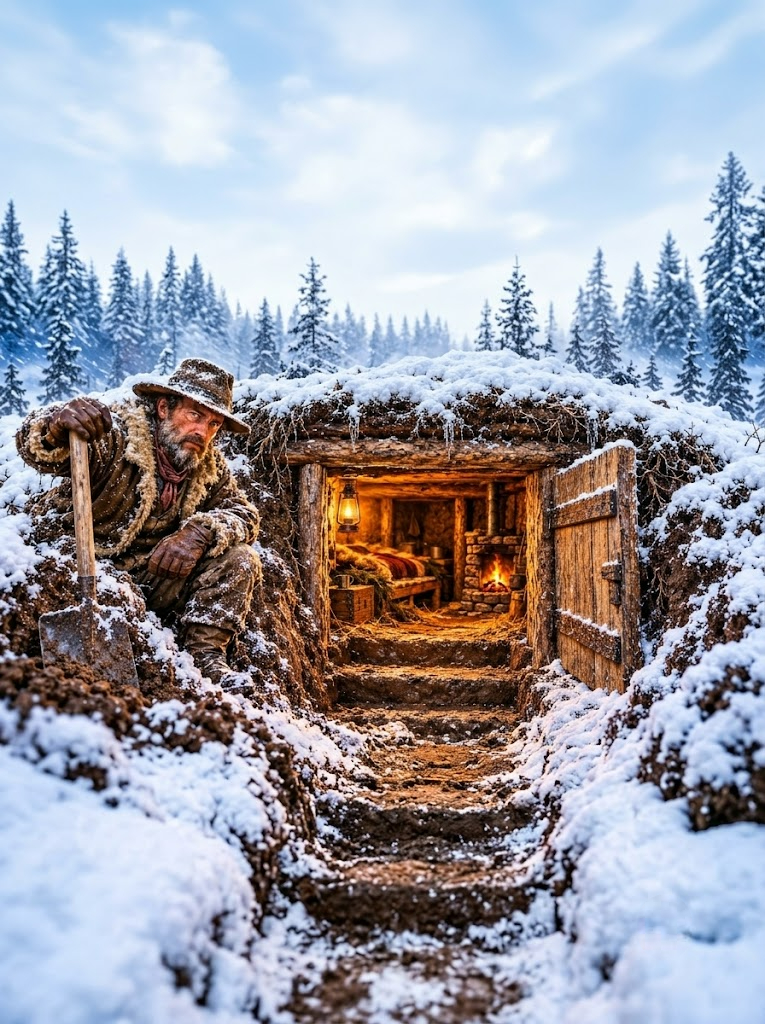
“Papa, don't let him open the door!”
Elsie's terrified voice rose from beneath the frozen wooden hatch.
Jacob Mercer dropped to his knees, gripping the iron handle while the blizzard tore across his back.
“Elsie! It's me! I'm here!”
The hatch shifted again.
A man's voice answered from below.
“I know who you are, Mercer.”
Jacob froze.
He recognized something in that voice.
Not the words.
Not the accent.
The confidence.
It was the voice of a man who believed he had been waiting long enough.
Walter Briggs stumbled forward through the snow.
“Jacob, get away from there!”
But Jacob had already pulled the hatch open another inch.
A pale hand appeared in the darkness.
Then a face.
A man with hollow cheeks, a frost-covered beard, and eyes that seemed almost black beneath the shadow of his hat.
Jacob stared.
For a moment, the storm disappeared.
“Thomas?”
The stranger smiled faintly.
“Hello, little brother.”
Jacob's fingers went numb.
Thomas Mercer.
His older brother.
The man he had not seen in nearly fifteen years.
The man Jacob had believed was dead.
For several seconds, Jacob could not move.
His brother's face was older, thinner, and marked by a deep scar that ran from his left eyebrow toward his cheek.
But the eyes were unmistakable.
Thomas had always possessed those eyes.
Sharp.
Restless.
Always searching for something that belonged to somebody else.
Jacob remembered them from childhood.
From the Ohio farmhouse where they had grown up.
From the day their father died.
And from the final argument that had torn their family apart.
“Thomas?” he whispered again.
His brother gave a humorless laugh.
“You look surprised.”
Jacob stared into the opening.
“You're supposed to be dead.”
“That's what people kept telling me.”
A sudden gust drove snow into Jacob's face.
He lowered his head.
Behind Thomas, a small figure moved.
“Papa!”
Elsie appeared in the dim light below.
Her chestnut braids hung stiff with frost. Her green coat was dusted with snow, and one side of her face was red from the cold.
Jacob's heart lurched.
“Elsie!”
She reached toward him.
He leaned into the opening and caught her hands.
Her fingers were painfully cold.
“Sweetheart, are you hurt?”
She shook her head.
“I'm all right.”
“Where's Samuel?”
Elsie's expression changed.
She looked behind her.
“He's here.”
Jacob saw a smaller boy sitting against an earthen wall.
His face was pale.
One foot was wrapped in a strip of cloth.
Thomas glanced toward the child.
“Neither of them would have lasted much longer outside.”
Jacob looked at his brother.
“What are you doing here?”
Thomas's smile disappeared.
“Saving your daughter, apparently.”
Walter Briggs leaned over the opening.
“Mercer, we need to get those children out.”
Jacob nodded.
He reached down.
“Elsie, give me your hands.”
She hesitated.
“Papa, Samuel can't walk.”
“I'll carry him.”
“And Thomas—”
Jacob's face hardened.
“Your uncle can take care of himself.”
Thomas looked up sharply.
“Still angry after all these years?”
Jacob ignored him.
He pulled Elsie toward the opening.
The girl cried out as the cold wind struck her face.
Jacob wrapped one arm around her waist and lifted.
Briggs caught her shoulders.
Together, they pulled her into the storm.
Jacob held his daughter against his chest.
For one brief moment, nothing else mattered.
Not the blizzard.
Not the buried house.
Not the smoke.
Not even the impossible appearance of his brother.
Elsie was alive.
She was breathing.
She was in his arms.
He pressed his face against her frozen hair.
“Oh, sweetheart.”
Her small hands gripped his coat.
“I knew you'd come.”
Jacob closed his eyes.
He had imagined those words a hundred times since the storm began.
Now that he heard them, they nearly broke him.
“I've got you,” he whispered.
But Elsie pulled away.
“Papa, Samuel!”
Jacob looked toward the hatch.
Thomas had lifted the younger boy beneath his arms.
The child was barely conscious.
Jacob reached down.
“Give him to me.”
Thomas hesitated.
Their eyes met.
For a moment, the old hostility returned.
Then Thomas lifted Samuel toward the opening.
Jacob caught the boy.
Briggs helped pull him free.
Samuel's injured foot hung loosely.
His lips were pale.
He made a faint whimpering sound.
Jacob wrapped the boy in his coat.
“We need to get them home.”
Briggs looked toward the hillside.
“The storm's getting worse.”
Thomas climbed through the hatch.
He moved stiffly, favoring his right leg.
When he reached the surface, he stood beside Jacob.
The brothers faced each other for the first time in fifteen years.
Thomas looked toward the distant outline of the Mercer hillside.
“So,” he said, “you finally got yourself some land.”
Jacob stared.
“How did you find us?”
Thomas's expression became unreadable.
“I've been looking for you.”
“Why?”
Thomas glanced toward Elsie.
“Not here.”
Jacob stepped closer.
“You don't get to appear out of nowhere and tell me when I can ask questions.”
Briggs caught Jacob's shoulder.
“Both of you, stop it.”
The wind roared.
Snow struck their faces.
Briggs pointed toward the faint depression leading back to Jacob's home.
“Those children won't survive another argument.”
Jacob looked down at Samuel.
The boy was shivering violently.
Elsie clung to Briggs's arm.
Jacob swallowed his anger.
“Fine.”
He turned toward the hillside.
“Stay close.”
Thomas looked at him.
“Jacob—”
“Not another word.”
They began moving through the snow.
The journey back was worse than Jacob expected.
The wind had shifted.
The tracks they had made only minutes earlier were already disappearing beneath fresh drifts.
Briggs led with the rope.
Jacob carried Samuel against his chest.
Elsie walked between them, holding tightly to her father's coat.
Thomas followed behind.
Every few steps, Jacob looked back to make certain his brother was still there.
He did not trust Thomas.
He had never trusted him.
But he could not leave a man outside in a storm like this.
Not even a man who had once destroyed everything their family possessed.
“Papa?”
Elsie's voice was barely audible.
Jacob bent toward her.
“What is it?”
“Are you angry?”
He stared.
“Angry?”
“With me.”
His heart twisted.
“Why would I be angry with you?”
“Because I didn't come straight home.”
Jacob stopped.
He crouched as much as Samuel's weight allowed.
“Elsie, look at me.”
She lifted her face.
Her eyelashes were white with frost.
“You stayed with Samuel because he needed help.”
She nodded.
“You did the right thing.”
“But I made you worry.”
Jacob swallowed.
“Sweetheart, worrying is part of being your father.”
Her lower lip trembled.
“I thought we were going to die.”
Jacob pulled her closer.
“I know.”
“I kept thinking about Mama and Peter.”
“I know.”
“And I remembered the old shelter Mr. Briggs showed us.”
Jacob glanced toward Briggs.
The older man looked away.
Elsie continued.
“I thought if I could get Samuel inside, we could wait until someone found us.”
Jacob looked toward the hidden hatch behind them.
“Did you know Thomas was there?”
She shook her head.
“No.”
“Then how did you find him?”
Elsie hesitated.
“He was already inside.”
Jacob felt his stomach tighten.
“Inside the shelter?”
“Yes.”
“Did he tell you who he was?”
She nodded.
“He said he was your brother.”
Jacob looked back.
Thomas was struggling through the snow.
His face was lowered against the wind.
“Did he hurt you?”
Elsie shook her head quickly.
“No, Papa. He helped Samuel. He gave us blankets.”
Jacob looked at his daughter.
“Then why did you tell me not to open the hatch?”
Her expression changed.
She glanced toward Thomas.
Then she whispered, “Because he said someone was following him.”
Jacob felt cold spread through his chest.
“Who?”
Elsie shook her head.
“I don't know.”
“Did he tell you?”
“He said we had to stay quiet.”
Jacob stared toward the white wilderness.
Thomas had not simply been hiding from the storm.
He had been hiding from someone.
And somehow, he had ended up in the same underground shelter where Elsie had sought refuge.
Jacob looked back at his brother.
Thomas raised his head.
Their eyes met.
Then Thomas glanced away.
Jacob said nothing.
Not yet.
Eight months earlier, the first person to laugh at Jacob's underground home had been Walter Briggs.
But he had not been the last.
By the time the Mercers finished their dugout, word had spread across the surrounding farms.
A carpenter from Ohio had brought his family west and built himself a hole in the ground.
Some neighbors were curious.
Others were amused.
A few were openly cruel.
One afternoon, a wagon stopped near the hillside.
Three men climbed down.
Jacob was repairing the entrance door when they approached.
One of them, a farmer named Daniel Harker, looked at the earth-covered roof.
“Well, Mercer, where's the house?”
Jacob straightened.
“You're looking at it.”
Harker laughed.
“I thought that was a root cellar.”
The other men chuckled.
Jacob felt heat rise into his face.
He had spent three days digging.
Three days hauling soil.
Three days cutting timber and reinforcing the roof.
His hands were still blistered.
His back ached every morning.
And these men were laughing at the only shelter he could afford.
“It's temporary,” Jacob said.
Harker walked toward the entrance.
He looked down the narrow steps.
“You keep your family down there?”
Jacob's jaw tightened.
“Yes.”
“Must be like living in a grave.”
One of the other men laughed.
Jacob took a step forward.
Before he could speak, Nora appeared in the doorway.
She carried a basket of laundry.
“Good afternoon, gentlemen.”
Harker tipped his hat.
“Afternoon, Mrs. Mercer.”
She looked at their wagon.
“Beautiful horses.”
“Thank you.”
“Do they have a barn?”
Harker frowned.
“Of course.”
“With a roof?”
He stared.
“Yes.”
“Then I imagine they appreciate having shelter.”
The men exchanged glances.
Nora continued calmly.
“My children do, too.”
Harker opened his mouth.
Nothing came out.
Nora smiled politely.
“Would you care for some water?”
The men declined.
A few minutes later, their wagon disappeared down the road.
Jacob watched them go.
Then he turned toward his wife.
“You didn't have to do that.”
Nora adjusted the laundry basket.
“Do what?”
“Embarrass them.”
She raised an eyebrow.
“They seemed quite comfortable embarrassing us.”
Jacob laughed despite himself.
Nora looked toward the underground entrance.
“Let them laugh.”
He shook his head.
“You don't understand.”
“What don't I understand?”
“I spent twenty years learning to build houses. Real houses. And now I'm living in a hole.”
Nora studied him.
“Jacob, did you build this place?”
“Yes.”
“Does it have a roof?”
“Yes.”
“Walls?”
“Yes.”
“A door that closes?”
“Yes.”
“Does it keep our children warm?”
He hesitated.
“Yes.”
She nodded.
“Then perhaps you should stop calling it a hole.”
Jacob looked toward the entrance.
For the first time, he saw the shelter through her eyes.
Not as proof of failure.
But as something he had created with his own hands.
A place that belonged to them.
A place nobody could take away because the rent was overdue.
A place where their children could sleep without hearing a landlord threaten eviction.
He looked at Nora.
“You really think it's a home?”
She stepped closer.
“I think a home is where people are loved.”
Then she touched his cheek.
“And there's plenty of that down there.”
The memory returned to Jacob as he struggled through the blizzard with Samuel in his arms.
He had spent months resenting the dugout.
Now every step toward it felt like a step toward salvation.
Briggs shouted ahead.
“There's the ridge!”
Jacob lifted his head.
Through the blowing snow, he saw the faint outline of their hillside.
The entrance was almost completely buried.
Only a narrow dark opening remained.
A weak amber glow flickered beyond it.
Nora's lantern.
Jacob nearly wept.
“Elsie, we're home!”
His daughter stumbled forward.
“Mama!”
The door opened.
Nora appeared in the entrance.
For a moment, she simply stared.
Then she saw Elsie.
Her hands flew to her mouth.
“Elsie?”
The girl ran toward her.
“Mama!”
Nora dropped to her knees in the snow.
She caught her daughter and pulled her close.
Neither spoke.
They held each other while the wind screamed around them.
Jacob stood nearby, still carrying Samuel.
He watched his wife bury her face in Elsie's hair.
He had seen Nora cry only a handful of times in their marriage.
When their first baby died.
When her father passed away.
When the lumber mill closed.
And now.
But these tears were different.
They were tears of a mother who had been forced to imagine burying her child and had suddenly been given that child back.
Jacob looked away.
His own eyes were burning.
Briggs touched his shoulder.
“Get the boy inside.”
Jacob nodded.
They carried Samuel down the narrow steps.
The shelter was warm again.
The stove burned steadily.
Peter sat on the bed beside Caleb Whitcomb.
When he saw Elsie enter, he jumped to his feet.
“Elsie!”
She ran to him.
The children collided in the middle of the room.
Peter wrapped both arms around his sister.
“You came back!”
Elsie hugged him tightly.
“I told you I would.”
Peter began crying.
Elsie kissed his forehead.
“Don't cry.”
“I thought you were gone.”
She held him closer.
“I'm here.”
Jacob watched them.
For a moment, the terrible day seemed to loosen its grip.
His daughter was alive.
His son was breathing easier.
His wife was smiling through tears.
The stove was working.
The roof still stood.
They had survived the first part of the storm.
Then Thomas Mercer stepped through the doorway.
And the warmth vanished from Jacob's face.
Nora turned.
She stared at the stranger.
Thomas removed his hat.
His dark hair was streaked with gray.
A long scar marked his cheek.
He looked older than Jacob remembered.
Much older.
Nora's eyes widened.
“Thomas?”
He nodded.
“Hello, Nora.”
She took a step backward.
Jacob moved between them.
“Don't.”
Thomas looked at him.
“I wasn't going to touch her.”
“You've done enough.”
Nora stared at her husband.
“Jacob, what's happening?”
He looked toward the children.
Elsie was helping Peter back onto the bed.
Samuel lay wrapped in blankets beside the stove.
Caleb watched silently.
Briggs stood near the door.
Jacob lowered his voice.
“Thomas was in the old shelter.”
Nora looked at his brother.
“I thought you were dead.”
Thomas gave a faint smile.
“Apparently, that story traveled farther than I did.”
Jacob's fists tightened.
“Don't make jokes.”
Thomas's expression hardened.
“I'm not.”
Nora looked between them.
“Why are you here?”
Thomas glanced toward the door.
“Because I had nowhere else to go.”
Jacob laughed bitterly.
“That's familiar.”
Thomas looked at him.
“You haven't changed.”
“Neither have you.”
Briggs stepped forward.
“Gentlemen, whatever happened between you, it can wait.”
Jacob turned sharply.
“You don't know what happened.”
Briggs held his gaze.
“No. But I know there's a blizzard outside, two children nearly froze to death, and this family needs peace more than another fight.”
Jacob looked toward Elsie.
She was watching him.
Her face was pale.
He forced his hands to relax.
“Fine.”
Thomas moved toward the stove.
Jacob blocked him.
“Stay where I can see you.”
Thomas stopped.
For a moment, something dangerous flashed in his eyes.
Then he nodded.
“As you wish.”
Nora led the children toward the bed.
She gave Samuel warm water in small sips and examined his injured foot.
His toes were painfully cold, but he could move them.
She wrapped the foot in dry cloth and tucked him beneath blankets.
Peter sat beside Elsie, refusing to release her hand.
Caleb leaned against the wall.
Briggs removed his wet coat.
And Thomas stood silently near the door.
Jacob watched him.
Fifteen years.
Fifteen years since the last time they had stood in the same room.
Fifteen years since Thomas had disappeared with money that did not belong to him.
Money their father had intended to divide between his sons.
Money Jacob had needed to begin his own business.
Thomas had taken it.
Every dollar.
Then vanished.
Their mother had died believing her eldest son would someday return.
Jacob had spent years trying to forgive him.
He had never succeeded.
Now Thomas stood inside the only home Jacob owned.
And somehow, the storm had brought him there.
“Tell me why you're here,” Jacob said.
Thomas looked toward the children.
“Not in front of them.”
Jacob stepped closer.
“You don't get to make demands.”
“I'm not making demands.”
“Then answer.”
Thomas rubbed his hands together.
His fingers were swollen from the cold.
“I came west three months ago.”
“Why?”
“Work.”
Jacob laughed.
“You expect me to believe that?”
Thomas looked at him.
“I worked on the railroad.”
“Doing what?”
“Whatever they paid me to do.”
Jacob studied his brother.
Thomas had always been clever.
Too clever.
He could talk a man into buying a broken wagon and convince him he had made a bargain.
He could borrow money without intending to repay it.
He could smile while lying.
Jacob knew those talents better than anyone.
“What happened to the money?” he asked.
Thomas's face changed.
Nora looked up.
“Jacob.”
“No. I want to know.”
Thomas stared at him.
“It's gone.”
“All of it?”
“Yes.”
Jacob shook his head.
“Of course it is.”
Thomas lowered his eyes.
“I made mistakes.”
“You stole from our family.”
“I know.”
“You left Mother waiting for you.”
Thomas flinched.
Jacob stepped closer.
“She died asking whether you'd come home.”
Thomas's face drained of color.
“Jacob—”
“You weren't there.”
“I know.”
“You didn't write.”
“I know.”
“You didn't even send word that you were alive.”
Thomas closed his eyes.
For several seconds, nobody spoke.
Then he whispered, “I know.”
Jacob stared.
He had imagined this confrontation for years.
He had imagined shouting.
Demanding repayment.
Forcing Thomas to admit what he had done.
But now that the moment had arrived, the anger felt strangely empty.
Thomas looked exhausted.
Broken.
Older than his years.
And Jacob could not forget that his brother had helped keep Elsie and Samuel alive.
That fact complicated everything.
Nora approached.
She placed a hand on Jacob's arm.
“Enough for tonight.”
He looked at her.
She nodded toward the children.
Elsie was watching.
Peter looked frightened.
Jacob stepped back.
Thomas lowered himself onto a wooden chair.
For the first time, he seemed to have no words left.
The storm continued into evening.
The wind never stopped.
Snow pressed against the door.
The small window disappeared completely beneath the drift.
Jacob checked the roof supports every hour.
The main beam groaned occasionally.
But it held.
Briggs helped him reinforce the entrance with spare boards.
Caleb recovered enough strength to sit upright and drink broth.
Samuel's shivering gradually eased.
Nora kept the stove burning carefully, watching the chimney draft and opening the door's ventilation holes whenever smoke began to linger.
The underground home was crowded.
Seven people and two exhausted children shared a space originally built for four.
Blankets covered the floor.
Wet coats hung near the stove.
The air smelled of wood smoke, damp wool, and hot broth.
But everyone was alive.
Jacob looked around the room.
Eight months earlier, he had worried that neighbors would laugh at his family for living underground.
Now those same neighbors had helped save his daughter.
And his small dugout had become a refuge for people who might otherwise have died in the storm.
He looked toward Briggs.
The older man sat beside the door, rubbing warmth into his hands.
Jacob approached.
“Walter.”
Briggs looked up.
“Yes?”
“Thank you.”
The older man nodded.
“No need.”
“There is.”
Briggs studied him.
Then he smiled faintly.
“Your little girl has more courage than most grown men I've met.”
Jacob looked toward Elsie.
She was helping Peter arrange his wooden animals beside the bed.
“Yes,” he said quietly. “She does.”
Briggs glanced around the shelter.
“Good house you've built.”
Jacob looked at him.
Briggs continued.
“I mean it.”
Jacob remembered the laughter.
The jokes.
The humiliation.
He almost smiled.
“Took three days.”
Briggs nodded.
“Three days well spent.”
For a moment, the two men sat in companionable silence.
Then Briggs leaned closer.
“Jacob, there's something you ought to know about Thomas.”
Jacob's expression hardened.
“What?”
Briggs glanced toward the far wall.
Thomas was sitting alone, staring into the stove.
“I saw him before today.”
Jacob frowned.
“When?”
“Two weeks ago.”
“Where?”
“At the general store.”
Jacob stared.
“He was here two weeks ago?”
Briggs nodded.
“He asked about you.”
Jacob felt anger rise.
“And you didn't tell me?”
“I didn't know who he was.”
“What did he ask?”
Briggs hesitated.
“He wanted to know whether you still had the papers from your father's estate.”
Jacob went still.
The estate papers.
He had carried them west in a small tin box.
They were among the few possessions he refused to sell.
Not because they had monetary value.
But because they were all that remained of his father's handwriting.
Jacob looked toward Thomas.
His brother was staring at the stove.
Briggs continued quietly.
“He also asked whether you had received a letter.”
Jacob frowned.
“What letter?”
Briggs shook his head.
“He wouldn't say.”
Jacob stood.
He crossed the room.
“Thomas.”
His brother looked up.
“What?”
“Why were you asking about Father's papers?”
Thomas's face changed.
For the first time since entering the dugout, he looked genuinely afraid.
“Who told you that?”
“Walter.”
Thomas glanced toward Briggs.
Then back at Jacob.
“It's complicated.”
Jacob stepped closer.
“Make it simple.”
Thomas looked toward Nora.
Then toward the children.
His hands began trembling.
“Jacob, I didn't come here for money.”
“Then why?”
Thomas swallowed.
“Because there's something you never knew about Father's death.”
Jacob felt the room grow cold.
Their father had died after a fall from a barn roof.
A terrible accident.
That was what everyone had believed.
That was what the doctor had written.
That was what Thomas had told the family.
Jacob stared at his brother.
“What are you saying?”
Thomas looked down.
“I should have told you years ago.”
“About what?”
Thomas's eyes filled with tears.
“The fall wasn't an accident.”
Jacob stopped breathing.
Nora stepped forward.
“Thomas…”
He shook his head.
“I can't keep lying.”
Jacob's voice became dangerously quiet.
“What happened to Father?”
Thomas looked at him.
Then toward the door.
The wind screamed outside.
A heavy thump echoed overhead.
The roof beam shifted.
Everyone looked up.
A small shower of earth fell onto the table.
Jacob grabbed the support post.
Another groan traveled through the ceiling.
Longer this time.
Deeper.
Briggs rose.
“Mercer, that beam's moving.”
Jacob looked toward the roof.
The central timber had begun to bend.
A thin crack appeared along its underside.
Nora pulled the children away from the stove.
“Jacob!”
He seized a spare wooden post.
Briggs rushed to help.
Together, they wedged it beneath the sagging beam.
The wood groaned.
The roof settled.
For one terrible second, Jacob thought the entire hillside would collapse.
Then the movement stopped.
Silence.
Everyone stood motionless.
Jacob stared at the ceiling.
The beam had held.
Barely.
He looked toward Thomas.
His brother was still sitting beside the stove.
But something had changed.
Thomas was staring at the floor beneath the hearthstone.
His face was white.
Jacob followed his gaze.
The large flat stone.
The one Nora had discovered during the first days of digging.
A narrow crack had appeared along its edge.
Jacob frowned.
He had never seen that crack before.
Thomas slowly stood.
“Jacob.”
His voice trembled.
Jacob turned.
“What?”
Thomas pointed toward the stone.
“Where did you get that?”
Jacob stared.
“It was already here.”
Thomas took a step backward.
“No.”
Jacob frowned.
“What?”
Thomas shook his head.
“No, no, no…”
Nora looked between them.
“Thomas, what's wrong?”
Thomas's eyes filled with terror.
“That stone…”
He swallowed.
“I've seen it before.”
Jacob stared.
“Where?”
Thomas looked toward the cracked hearthstone.
Then toward the ceiling.
His lips trembled.
“Jacob, you need to get everyone away from that floor.”
Jacob's heart began pounding.
“Why?”
Thomas did not answer.
Instead, he knelt beside the stone.
He brushed away the soot.
Beneath the dark surface, something had been carved into the rock.
Three letters.
And a date.
Jacob leaned closer.
His breath caught.
The letters were his father's initials.
The date was the day his father died.
Thomas reached toward the crack.
“Jacob,” he whispered, “there's something underneath.”
Jacob grabbed the iron pry bar.
He slid its tip beneath the stone.
Thomas caught his wrist.
“Wait.”
Jacob stared.
“What now?”
Thomas looked up at him.
His face was wet with tears.
“If you lift that stone, everything you believe about our family is going to change.”
Jacob tightened his grip.
Then he pulled.
The heavy hearthstone shifted.
A dark opening appeared beneath it.
Cold air rose from the earth.
And somewhere deep below the floor, a metal object began ringing.
Three times.
Slow.
Deliberate.
Jacob froze.
Thomas staggered backward.
Nora covered her mouth.
The ringing stopped.
Then a voice came from beneath the stone.
A man's voice.
Weak.
Terrified.
“Thomas Mercer?”
Jacob stared into the darkness.
The voice spoke again.
“Tell your brother I'm still alive.”






Comments 0