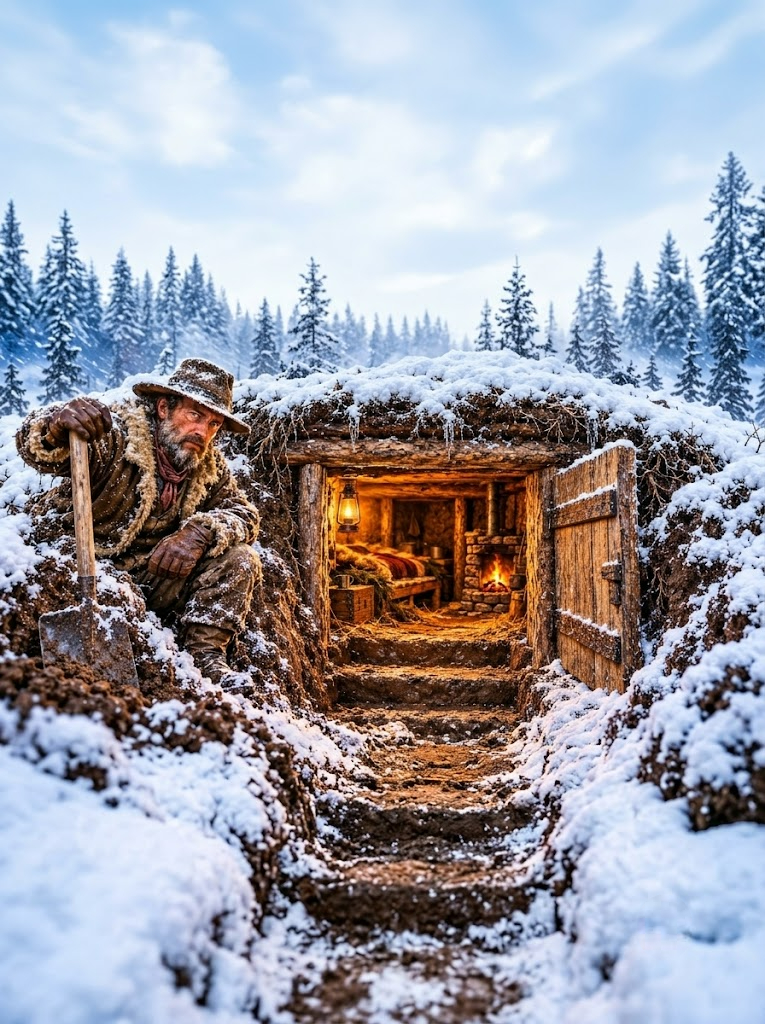
“Papa! Don't open it!”
Five-year-old Peter Mercer grabbed his father's coat as Jacob reached for the wooden door.
Jacob, the strongest man in the family, stopped when he noticed the little wooden horse trembling in his son's hands.
Three letters were carved beneath its belly.
E. M. P.
Elsie had carved them herself.
Jacob suddenly understood that the storm had already taken something from his family.
And he was about to risk everything to get it back.
“Let go, Peter.”
The boy shook his head.
“Please, Papa.”
Jacob crouched in front of his son. His thick beard was damp with sweat despite the cold air leaking around the doorframe.
“Your sister's out there, son.”
Peter's lower lip trembled.
“Is she coming home?”
Jacob opened his mouth.
Nothing came out.
He had spent his entire adult life believing that a father should always have an answer. When a roof leaked, he fixed it. When a horse went lame, he found a way to keep the wagon moving. When money ran short, he worked longer hours.
But standing inside a hole in a Nebraska hillside on January 12, 1888, Jacob Mercer had encountered something his hands could not repair.
His eleven-year-old daughter was somewhere beyond that door.
And the world outside had disappeared.
“Jacob.”
Nora's voice came from behind him.
He turned.
His wife stood beside the small cast-iron stove, one hand gripping the back of a wooden chair. Her blonde hair was pinned into a tight braid, although several strands had escaped around her temples.
She wore the same navy-blue wool dress she had put on before sunrise.
Her face was pale.
“Don't,” she said.
Jacob stood.
“Nora, we've been over this.”
“And you haven't listened.”
“Elsie left for school before the weather turned. She'll be trying to get home.”
“Then she'll need you alive when she gets here.”
He stared at her.
Outside, something struck the wooden entrance door hard enough to make its iron hinges rattle.
Peter flinched.
The underground home was barely larger than the kitchen in the house Jacob had once rented in Ohio. Its walls were packed earth, its ceiling supported by rough timber beams, and its floor covered with uneven wooden planks near the stove.
A narrow bed stood against the far wall.
Two wooden chairs surrounded a small table.
A shelf held tin cups, flour, dried beans, and the last of Nora's carefully preserved summer vegetables.
There was no luxury.
No spare room.
No proper front porch.
Only earth, timber, and the stubborn determination of two people who had refused to surrender their dream.
Eight months earlier, Jacob had been ashamed of this place.
Now he would have given every dollar he owned to know that Elsie was safely inside it.
“She's eleven,” he said.
“I know how old our daughter is.”
“The schoolhouse is nearly two miles away.”
“I know that, too.”
“Then how can you stand there and tell me not to go?”
Nora's expression changed.
Not into anger.
Something worse.
Hurt.
“Do you think standing here is easy for me?”
Jacob looked away.
He knew it wasn't.
Elsie was Nora's first living child. Their daughter had arrived after a pregnancy that nearly killed her mother, and after the loss of a baby boy whose grave remained hundreds of miles away in Ohio.
Nora had spent eleven years protecting Elsie from everything she could see.
Now the danger was something neither parent could see at all.
Jacob pulled his gloves tighter.
“I'll follow the fence line toward the road.”
“There is no fence line to follow.”
“I know where the road is.”
“You knew where it was this morning. You can't see ten feet outside now.”
“I'll take a rope.”
“Fasten it to what? We don't have two miles of rope.”
His jaw tightened.
She was right.
And he hated that she was right.
Not because he resented her intelligence.
Because every sensible argument she made felt like another minute stolen from their daughter.
He reached toward the latch.
Nora moved faster than he expected.
Her hand closed around his wrist.
“Jacob, look at me.”
He didn't.
“Look at me.”
Finally, he turned.
Her eyes were wet, but her voice remained steady.
“If you open that door, the wind could fill this entrance with snow before you take three steps.”
“I can handle the cold.”
“This isn't ordinary cold.”
“I've worked through Ohio winters.”
“This isn't Ohio.”
Her words struck harder than she intended.
For months, Jacob had insisted that hard work and common sense would carry them through anything the prairie could throw at them.
He had said it when their first crop struggled.
He had said it when the grasshoppers arrived.
He had said it when their well nearly dried up in August.
And he had said it when Nora warned him that the prairie wind was different from anything they had known back east.
He had always been able to answer her.
Until now.
A deep, hollow groan came from overhead.
Both adults froze.
The sound traveled slowly across the ceiling, beginning above the bed and ending somewhere near the entrance.
Jacob lifted his head.
The largest roof beam had moved.
Not much.
Perhaps a fraction of an inch.
But he had built the shelter himself.
He knew every joint.
Every knot.
Every place where the wood had been cut a little too short or fitted a little too tightly.
And he knew that sound.
“Jacob?” Nora whispered.
He raised one hand.
“Quiet.”
Another groan.
A sprinkle of dry earth fell from the ceiling and landed on the table.
Peter began crying.
“Papa, is the hill falling on us?”
Jacob crossed the room and placed a hand against the main support post.
The timber was solid beneath his palm.
He leaned his weight against it.
Nothing shifted.
But above them lay several feet of packed earth, sod, and now an increasing burden of snow.
He had designed the roof to carry the weight of the hillside.
He had not imagined a storm that could bury the entrance in a single afternoon.
“It's settling,” he said.
Nora watched him carefully.
“Are you sure?”
He looked at the beam.
“No.”
The honesty frightened her more than reassurance would have.
Jacob took a breath.
“I need to check the entrance.”
“From inside?”
“Yes.”
He moved toward the door.
The bottom was already packed with snow where the wind had forced powder through the narrow gaps.
He crouched and pressed his gloved fingers against the wood.
Cold radiated through it.
A thin line of white had formed beneath the threshold.
He tried lifting the latch.
It moved.
He pushed gently.
The door opened less than an inch.
Something heavy resisted from outside.
Jacob pushed harder.
The gap widened slightly.
A violent blast of frozen air swept into the shelter.
The lantern flame bent sideways.
Peter screamed.
Nora grabbed the edge of the table.
“Close it!”
Jacob forced the door shut.
Snow scattered across his boots.
For several seconds, nobody spoke.
Then Nora said quietly, “It's already burying us.”
Jacob stared at the door.
He had built the entrance on the sheltered side of the hill.
He had believed the slope would break the worst of the wind.
Instead, the storm was piling snow directly against it.
He looked toward the narrow window.
Only a pale rectangle remained visible behind the frost.
Beyond it, nothing moved except white.
“Elsie knows the way home,” he said.
Nora didn't answer.
“She knows the road.”
Still nothing.
“She knows to keep the wind at her back.”
“Jacob.”
“She knows—”
“Stop.”
He turned.
Nora's face crumpled for one brief moment.
Then she gathered herself.
“She also knows to listen to her teacher. If the storm came while she was in school, perhaps they stayed inside.”
Jacob clung to the possibility.
The schoolhouse was a small wooden building on higher ground, with a coal stove and enough room for twenty children.
Miss Whitcomb, the teacher, was young but sensible.
Surely she would not send children into a storm like this.
Surely she would keep them together.
Surely—
Peter coughed.
The sound interrupted Jacob's thoughts.
It was a small, dry cough.
Nora turned immediately.
“Come here, sweetheart.”
Peter crossed to her, dragging his wooden horse by one leg.
She knelt and straightened his sweater.
“Does your throat hurt?”
He shook his head.
“It's scratchy.”
“From crying?”
He nodded.
But then he coughed again.
Jacob barely noticed.
He was examining the doorframe, trying to calculate how much snow had accumulated outside.
If he could clear the entrance and attach a rope to the interior support post, perhaps he could reach the top of the hill.
From there, he might see the road.
It was a foolish plan.
He knew that.
But doing nothing felt even more foolish.
“I'm going to fetch the shovel,” he said.
Nora looked up sharply.
“Jacob.”
“I'm not leaving yet.”
He crossed to the wall where his tools hung from wooden pegs.
A short-handled spade.
A hammer.
A handsaw.
An iron pry bar.
The same tools that had helped build their home.
He took the spade down.
The wooden handle was smooth from years of use.
He remembered the first day he had pushed its blade into the hillside.
The prairie had been green then.
The sun had been warm.
And Nora had stood beside him, holding Peter on one hip while Elsie watched with enormous curiosity.
“Are we really going to live underground?” Elsie had asked.
“Only until I build you a proper house,” Jacob had promised.
Nora had smiled.
“A warm house is a proper house.”
He had laughed at her.
Not cruelly.
But with the confidence of a man who believed he understood the world better than his wife.
A house belonged above the ground.
A man who could build barns and frame houses had no business raising his children in a hole.
He had argued that point for nearly a week.
Then he had counted their money.
Eighty-six dollars when they arrived.
Less than seventy after purchasing seed, supplies, and feed.
A proper wooden house would have swallowed almost everything.
Nora had suggested the hillside.
Three days later, they had a roof over their heads.
Jacob remembered how proud Elsie had been when they carried the first bed inside.
She had called it their secret house.
A place where the wind couldn't find them.
He swallowed.
The wind had found them now.
“Papa?”
Peter stood beside the stove.
“What is it, son?”
“Elsie said she'd bring me something.”
Jacob turned.
“What?”
“A picture.”
“What kind of picture?”
“Of our house.”
Peter rubbed his eyes.
“She said Miss Whitcomb was teaching them to draw buildings. She wanted to draw ours because nobody else had one like it.”
Jacob felt something tighten in his chest.
Elsie had never been ashamed of the dugout.
Not once.
When other children laughed at her family's underground home, she had told them it was the safest house on the prairie.
When a neighbor joked that the Mercers lived like prairie dogs, Elsie had answered that prairie dogs were clever enough to survive winter.
Jacob had been embarrassed.
His daughter had been proud.
He looked down at the shovel.
The irony was almost unbearable.
He had spent months dreaming of the day he could replace this shelter with a respectable wooden house.
Now the wooden schoolhouse might be the only thing keeping his daughter alive.
And the underground home he had once despised might be the only reason his wife and son were not freezing.
Peter coughed again.
This time, the sound was deeper.
Nora turned toward the stove.
Jacob noticed the movement.
“What is it?”
She didn't answer immediately.
Her eyes were fixed on the black iron stovepipe.
A thin gray thread drifted from the seam where the pipe entered the stove.
It curled upward.
Then spread beneath the ceiling.
Nora frowned.
“Jacob, did you close the damper?”
“No.”
“Are you certain?”
“I checked it after breakfast.”
She stood.
“Then why is there smoke?”
Jacob set the shovel aside.
He crossed the room.
The stove was hot.
A small orange glow showed through the firebox opening.
He examined the damper handle.
Open.
He checked the stove door.
Closed.
The fire was burning, but not strongly.
He leaned closer.
A faint smell of wood smoke reached him.
That was not unusual in a frontier home.
Sometimes smoke escaped when fresh logs were added.
Sometimes a gust of wind pushed air down the chimney.
But this was different.
The smoke was not disappearing.
It was gathering.
Peter coughed again.
Nora pulled him away from the stove.
“Jacob?”
He followed the stovepipe upward.
It rose through the low ceiling and continued through the earth-covered roof.
Outside, the chimney opening should have stood well above the surface.
Should have.
Jacob remembered the wind direction.
He remembered the growing snowdrift at the entrance.
And he remembered how low he had left the stovepipe when they first finished the roof.
He had intended to extend it before winter.
There had been other expenses.
Other emergencies.
Always something more urgent.
A sick horse.
A broken wagon wheel.
Seed for spring.
A new pair of boots for Elsie.
The chimney extension had remained unfinished.
He stared at the ceiling.
“Nora.”
She heard the change in his voice.
“What?”
“Take Peter to the far wall.”
“Why?”
“Just do it.”
She lifted the boy and carried him toward the bed.
Jacob crouched beside the stove.
He adjusted the damper.
No improvement.
He opened the firebox door a fraction.
Smoke immediately rolled into his face.
He slammed it shut.
His heart began beating faster.
The chimney was not drawing.
The fire had nowhere to send its smoke.
He looked at the door.
Blocked by snow.
He looked at the window.
Nearly buried.
Then he looked at his wife and son.
Nora had wrapped a blanket around Peter's shoulders.
The boy's cheeks were flushed.
He coughed again.
“Jacob,” she said, “tell me what's happening.”
He swallowed.
“The chimney may be blocked.”
“With snow?”
“Yes.”
“Can you clear it?”
He looked upward.
The chimney opening was above the roof.
Above several feet of earth.
And possibly beneath a growing drift of snow.
He could not reach it from inside without dismantling part of the pipe.
Even if he managed that, the blocked flue would still need clearing.
He could put out the fire.
That would stop the smoke.
But the temperature outside was falling rapidly, and their underground shelter would eventually grow dangerously cold.
He could open the door for ventilation.
But the storm might fill the entrance with snow.
He could attempt to reach the chimney from outside.
But Elsie was already missing.
And every minute spent fighting the stove was another minute she remained somewhere in the white wilderness.
For the first time in his life, Jacob understood what it meant to have no good choice.
He took the iron pry bar from the wall.
Nora watched him.
“What are you doing?”
“Checking the pipe.”
“Will that help?”
“I don't know.”
He loosened the metal collar near the ceiling.
A small puff of soot fell onto his sleeve.
The pipe was hot.
He wrapped a thick cloth around his hand and touched the joint.
Then he stopped.
A sound had come from inside the chimney.
Not the ordinary ticking of heated iron.
Not the crackle of burning wood.
Something heavier.
A muffled movement.
Jacob tilted his head.
He listened.
The sound came again.
A soft scraping.
As though something above them had shifted against the metal.
Nora noticed his expression.
“What did you hear?”
He held up one finger.
Silence.
Then another scrape.
Jacob's stomach tightened.
He had heard snow sliding across roofs before.
He had heard ice breaking from gutters.
But this sound seemed to come from directly inside the pipe.
He placed his ear near the metal, careful not to touch it.
There was a faint hollow vibration.
Then a sudden thump.
The stovepipe shook.
Peter began coughing harder.
Nora pressed a cloth over the boy's mouth and nose.
“Jacob, we have to do something!”
He stepped back.
Smoke now drifted in visible layers beneath the ceiling.
The lantern flame flickered.
The room smelled increasingly of burning wood.
Jacob looked at the entrance.
The door was their only practical way out.
He could dig through the snow.
Perhaps.
If the drift wasn't too deep.
But if he opened it, the wind could drive more snow inside than he could remove.
And if he extinguished the stove, he might leave Nora and Peter without enough heat to survive the night.
He thought of Elsie.
He imagined her small figure somewhere beyond the hill, struggling through snow taller than her boots.
He imagined her calling for him.
He imagined her believing that her father would come.
He had promised his children that he would always protect them.
Now he might have to choose which promise to break.
Nora approached him.
Her face was pale, but her eyes were steady.
“Listen to me.”
Jacob turned.
“We can put the fire out,” she said.
“And freeze?”
“We have blankets. The earth will hold some warmth.”
“For how long?”
“Long enough to think.”
He looked toward the stove.
The smoke was thickening.
She was right.
Again.
And this time, pride had no place in the decision.
“Get the water bucket,” he said.
Nora moved immediately.
Jacob reached for the stove door.
He stopped.
A new sound had come from the entrance.
Three distinct knocks.
Not from the wind.
Not from shifting timber.
Three knocks.
Slow.
Deliberate.
Jacob turned.
Nora froze with the water bucket in her hands.
Peter stopped crying.
For a moment, even the storm seemed quieter.
Then came another knock.
Jacob's heart slammed against his ribs.
“Elsie?”
He rushed toward the door.
Nora followed.
“Jacob, wait!”
He pressed his ear against the wood.
Something moved on the other side.
He could hear it.
A faint scraping against the buried entrance.
Then a sound that might have been a voice.
He grabbed the latch.
Nora caught his arm.
“Don't open it all at once.”
Jacob nodded.
He lowered himself and pressed his shoulder against the heavy door.
The wood resisted.
Snow packed against the outside.
He pushed harder.
A narrow gap opened.
Freezing air rushed inside.
The lantern flickered wildly.
Jacob called into the darkness.
“Elsie! Is that you?”
No answer.
Only the roar of the blizzard.
Then something struck the door again.
Closer this time.
Jacob dropped to his knees.
He dug at the snow with his bare hands, pulling frozen powder through the opening.
Nora knelt beside him.
Together they cleared enough space to widen the gap.
Jacob reached into the darkness.
His fingers touched something hard.
Wood.
He pulled.
A small object came free from the snow.
He held it beneath the lantern.
It was a wooden board.
Roughly cut.
No longer than his forearm.
Across its surface, someone had scratched three letters.
E. M. P.
Jacob stopped breathing.
The same letters were carved beneath Peter's wooden horse.
Elsie had made the markings.
Nora stared at the board.
“Jacob,” she whispered, “where did that come from?”
He looked toward the opening.
The wind pushed snow against his face.
Something moved beyond the narrow gap.
A shadow.
Low to the ground.
Then came a small voice.
So faint he almost missed it.
“Papa?”
Jacob lunged toward the door.
But before he could pull it wider, a second voice rose from the darkness.
A man's voice.
Weak.
Terrified.
“Don't open it! There's something you need to know about your daughter—”






Comments 0