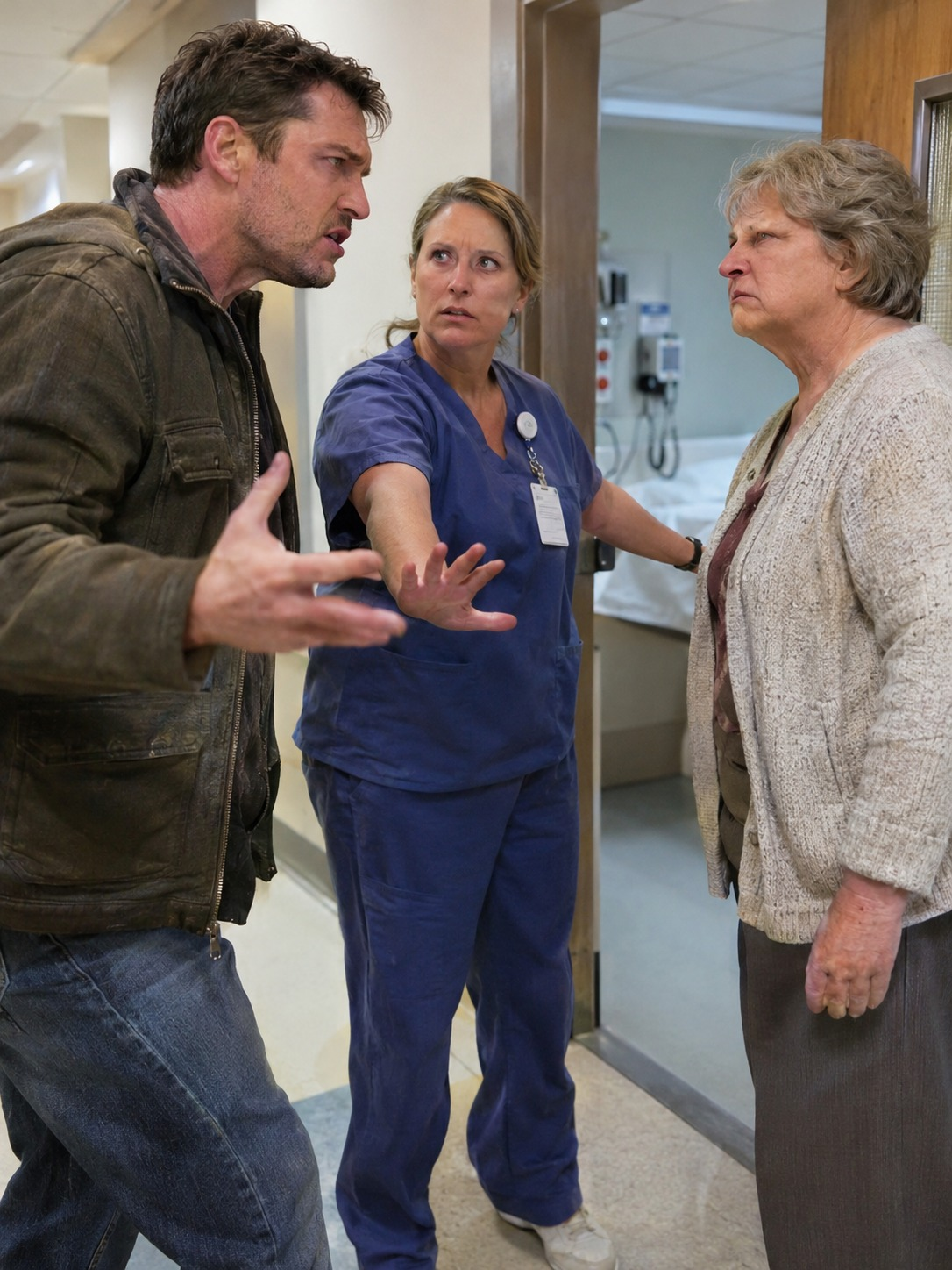
"Grandma, please! You're hurting me!"
My thirteen-year-old son was falling from his hospital bed when I reached room 412.
Charge nurse Kimberly Mitchell arrived holding his medical chart.
A red warning on the first page read: ASSISTED MOVEMENT ONLY.
My mother had been told.
And she had pulled him out of bed anyway.
I remember the sound of his knees striking the floor more clearly than anything else that morning.
Not my mother's shouting. Not the paper coffee cup bursting against the tile. Not even my own voice when I finally found it.
It was that awful, solid sound, followed by my son's cry.
Max had undergone emergency surgery for a ruptured appendix forty-eight hours earlier. He had a drain in his abdomen, stitches that needed protecting, and strict instructions not to stand without medical assistance.
And there he was, on his knees beside the hospital bed, one hand clutching his surgical dressing while my sixty-eight-year-old mother stood over him.
"Get up," she snapped. "You're thirteen years old. Stop acting like a baby."
"Grandma, please," he whispered. "It hurts."
She slapped him.
I had seen my mother angry hundreds of times. I had heard her say cruel things and watched her humiliate people with a single sentence.
But I had never seen her strike my child.
For one terrible second, my mind refused to accept what my eyes were showing me.
Then she raised her hand again.
"Ma'am! Step away from that child right now!"
The voice came from behind me.
Kimberly Mitchell, the charge nurse on the pediatric day shift, was already moving toward the doorway.
I reached my mother first.
I caught her wrist before she could deliver another blow.
"Don't touch him again."
My voice sounded strange. Low. Unsteady.
Mom stared at my hand around her wrist.
"Jeffrey, let go of me."
I didn't.
"He's recovering from surgery."
"He's pretending! Somebody needs to teach that boy—"
"He's recovering from surgery!"
I had never shouted at my mother like that.
Not when I was eight and she made me finish baseball practice with a swollen ankle.
Not when I was sixteen and she told me that crying at my father's hospital bedside was embarrassing.
Not when I was thirty-eight and she accused me of raising a weak son because Max had cried during a movie about a dog.
But I shouted now.
Because my son was on the floor.
And because I finally understood what all those years of keeping the peace had cost us.
Kimberly slipped past us and knelt beside Max.
"Sweetheart, don't try to stand."
Max's breathing was short and uneven.
"My stomach," he whispered.
"I know. We're going to help you."
She pressed the call button attached to her badge.
"Rapid response, room 412. Postoperative abdominal patient on the floor. Possible surgical-site injury."
My mother pulled against my grip.
"This is ridiculous."
I released her wrist once she lowered her hand.
She immediately straightened her cardigan.
That detail still bothers me.
My son was crying on the hospital floor, and my mother was worried about how her clothes looked.
"Jeffrey," she said, lowering her voice into the tone she used when she wanted to remind me who was in charge, "you're making a spectacle of this family."
I looked at her.
Then at Max.
His face was pale. His eyes were wet. His hand was pressed against the lower right side of his abdomen.
He wasn't looking at the nurse.
He wasn't looking at me.
He was watching his grandmother.
Waiting to see whether she was still angry.
Something inside me broke.
"Mom," I said, "get away from him."
Her mouth tightened.
"You don't speak to me that way."
"Then stop giving me reasons to."
She blinked.
For the first time that morning, she looked uncertain.
But that uncertainty lasted only a moment.
"You've let that boy manipulate you for years," she said. "He knows exactly how to get attention."
I turned away from her.
There was nothing I could say that would make her understand what she had done.
And my son needed me more than she needed another argument.
Two orderlies entered with a resident and a security officer.
Kimberly explained what had happened without raising her voice.
"Patient was forcibly removed from bed. Witnessed physical assault. Recent abdominal surgery. Complaining of increased pain."
The resident knelt beside Max.
"Max, I'm Dr. Ellis. Can you tell me where it hurts?"
Max pointed weakly toward his dressing.
"Right here."
"Did you fall onto your stomach?"
He shook his head.
"My knees."
"Did somebody pull you?"
Max hesitated.
His eyes moved toward the doorway.
Toward my mother.
I knew that look.
I had worn it myself when I was a child.
It was the look of someone trying to decide whether telling the truth would make things worse.
I crouched beside him.
"Max."
He looked at me.
"You can tell the doctor exactly what happened."
His bottom lip trembled.
"Grandma said I had to get up."
The room went quiet.
"She said I was pretending."
Kimberly placed a reassuring hand near his shoulder.
"You did the right thing by telling us."
My mother made a disgusted sound.
"Oh, for heaven's sake."
The security officer stepped between her and the bed.
"Ma'am, I'm going to need you to wait outside."
"This is my grandson."
"And right now, the medical team needs space."
She looked at me.
"Jeffrey. Tell him."
For forty-three years, those two words had been enough.
Tell him.
Tell your father I didn't mean it.
Tell your sister she's overreacting.
Tell the teacher you misunderstood.
Tell the neighbors everything is fine.
My mother had built an entire family around the assumption that I would explain away whatever she did.
But this time I said nothing.
The security officer escorted her into the hallway.
She turned at the doorway.
"You'll regret humiliating me like this."
I watched her leave.
Then I went back to my son.
The medical team moved Max onto a transfer sheet and carefully lifted him back onto the mattress.
He cried when they adjusted his position.
I wanted to take the pain away.
I wanted to go back twenty minutes and refuse to leave him alone.
I wanted to go back twenty years and learn how to say no to my mother before my child had to pay for my silence.
But none of those things were possible.
So I stood beside the bed and held his hand.
"I'm here," I told him.
Max looked at me.
"Is Grandma mad?"
The question nearly brought me to my knees.
He had just been dragged from a hospital bed.
He had been slapped.
His surgical wound might have been damaged.
And he was worried about whether the person who hurt him was upset.
"Listen to me," I said. "You didn't do anything wrong."
His eyes searched mine.
"Really?"
"Really."
He swallowed.
"She said I was embarrassing you."
I felt my throat tighten.
"You're not embarrassing me, buddy."
He looked down.
"I'm sorry I cried."
I squeezed his hand.
"Don't apologize for being hurt."
His face crumpled.
And for the first time since I had walked through the doorway, he cried without trying to hide it.
I stayed beside him while the doctors examined his incision.
One of the sutures had pulled.
The drain had shifted.
Dr. Patel, the surgeon who had operated on him, was called back to assess the damage.
The next hour passed in fragments.
A nurse checking Max's blood pressure.
A resident examining the dressing.
A new pain medication order.
The sound of wheels moving along the corridor.
The security officer speaking quietly outside.
And my mother, somewhere beyond that door, probably telling herself that everyone had overreacted.
At one point, Kimberly approached me.
"Mr. Owens, I need to ask you a few questions."
I nodded.
"Did you witness the incident?"
"Yes."
"Did you see your mother physically strike Max?"
"Yes."
"How many times?"
I looked toward my son.
He had finally closed his eyes.
"I saw one slap," I said. "I heard what may have been another before I reached the door. I stopped her when she raised her hand again."
Kimberly wrote everything down.
"Thank you for being specific."
"Is he going to be okay?"
"We're monitoring him closely. Dr. Patel will explain the surgical concerns."
I rubbed my face.
"I should never have left him with her."
Kimberly paused.
Then she said something I would remember for years.
"Right now, the most important thing is that he knows you're going to protect him."
I nodded.
But the truth was, I wasn't sure Max believed that yet.
And I couldn't blame him.
Because this hadn't started that morning.
It hadn't started with his appendix.
It hadn't even started when he was nine and my mother dismissed a fractured wrist as a little bump.
It had started long before Max was born.
In the house where I grew up.
In the kitchen where my mother taught us that obedience mattered more than pain.
In the living room where my father would lower his newspaper rather than challenge her.
And in the countless moments when I learned that silence was easier than confrontation.
My name is Jeffrey Owens.
At the time, I was forty-three years old and worked in purchasing at More Supply outside Dayton, Ohio.
I wasn't wealthy.
I wasn't powerful.
I was a divorced father trying to keep a job, pay a mortgage, and raise a boy who deserved more stability than life had given him.
Max's mother, Carrie, had left when he was five.
She moved to Arizona with a man she had known for four months.
At first, she sent birthday cards.
Then Christmas cards.
Then nothing.
I had spent years telling Max that her leaving wasn't his fault.
I had worked hard to make sure he never felt unwanted.
And somehow, while trying to protect him from one absent parent, I had allowed another adult to teach him that love had to be earned through obedience.
My mother watched him three afternoons a week when he was younger.
She made dinners.
She helped when I worked late.
She saved me almost eight hundred dollars a month in childcare.
I had called that support.
I had called it family.
I had called it love.
Now I was standing beside a hospital bed wondering whether I had been wrong about all three.
Kimberly returned with a clipboard.
"Mr. Owens, hospital security has taken an initial statement. We'd also like the patient advocate involved."
"Yes," I said immediately.
"And there will be a formal incident report."
"Good."
She studied me for a moment.
"Your mother is asking to speak with you."
"She can wait."
Kimberly nodded.
Then she glanced toward Max.
"There's something else."
I looked up.
"What?"
She lowered her voice.
"When I checked his chart, I noticed a note from yesterday's afternoon shift."
I frowned.
"What kind of note?"
"Something a nurse documented after speaking with your son."
A cold feeling settled in my stomach.
"What did he say?"
Kimberly looked toward the closed door.
Then back at me.
"I think you need to read it yourself."
She handed me the chart.
A yellow marker highlighted an entry beneath the previous day's date.
I looked down.
The first line was about Max refusing pain medication.
The second mentioned his grandmother.
But it was the third line that made my hands go cold.
Because the nurse had recorded Max's exact words.
And the sentence began:
"Please don't tell my dad that Grandma..."






Comments 0