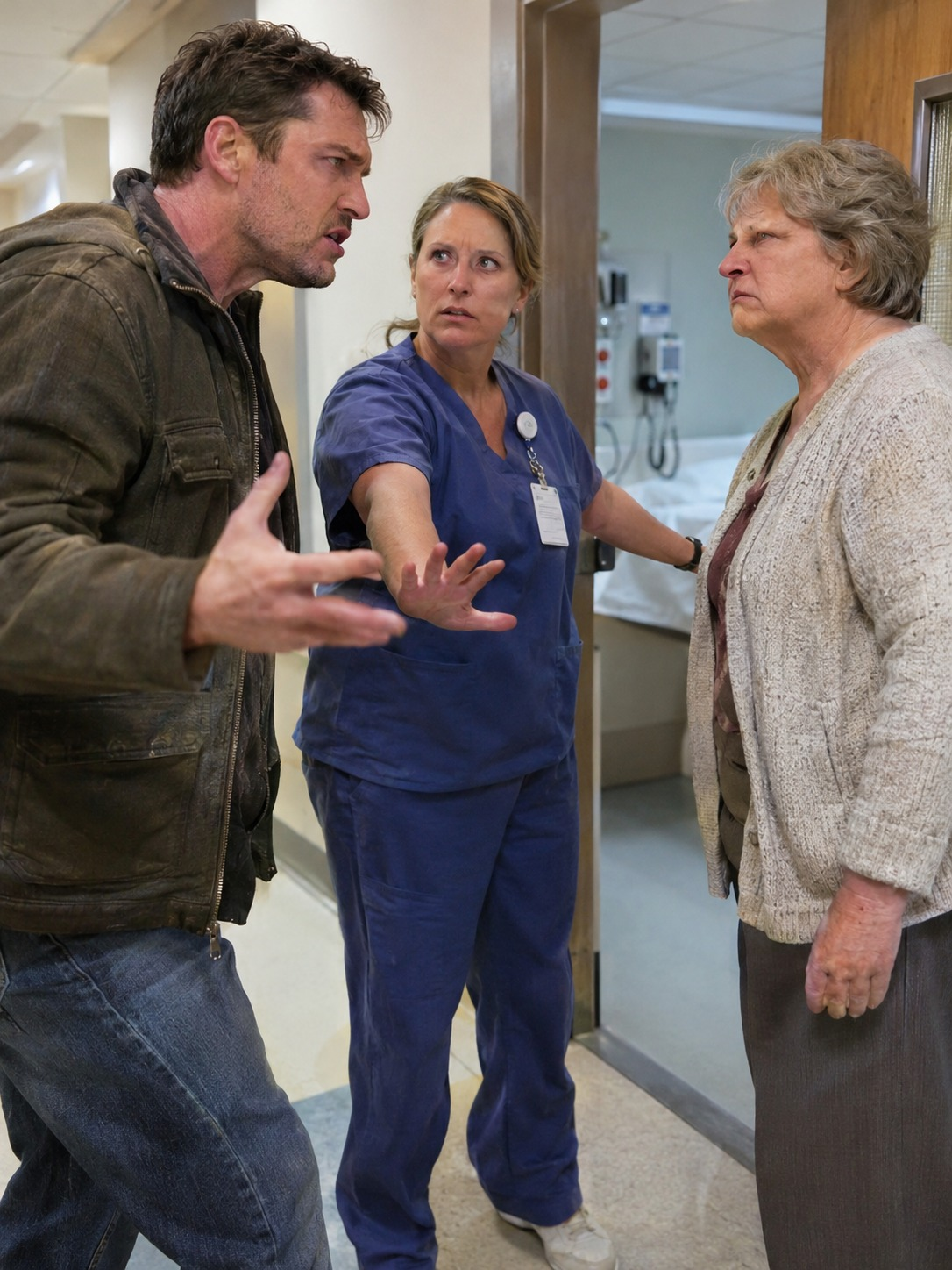
"The child was found crying behind the locked basement door."
I read the first sentence twice.
Then I looked at the name printed beneath it.
Daniel Michael Owens.
My older brother.
The same brother who had left our family home at eighteen and spent the next twenty-five years finding reasons not to come back.
I had always believed Daniel left because he hated our mother's rules.
Now I was holding a report that suggested something much worse.
Across the table, Rebecca wiped her eyes with a tissue.
"Jeff, before you read the rest, there's something you need to understand."
I didn't look up.
"Then tell me."
"Dad didn't write that report. Someone else did."
The document was dated March 14, 1989.
Daniel had been fourteen.
I was seven.
Rebecca was eleven.
At the top of the page was the name of a county family services office, followed by a reference number and the words Preliminary Family Assessment.
I remembered that year.
Not clearly.
Just pieces.
Dad working overtime at the tire plant.
Mom complaining about bills.
Daniel getting quieter.
And one afternoon when our neighbor, Mrs. Hensley, came over with a casserole and stayed in the kitchen for nearly an hour.
I hadn't thought about Mrs. Hensley in decades.
Now her name appeared in the second paragraph.
Reporting party: Margaret Hensley, neighboring resident.
I swallowed.
"What did Daniel do?"
Rebecca shook her head.
"Nothing."
"Then why was he locked in the basement?"
Her face crumpled.
"Because Mom thought he was pretending to be sick."
I stared at her.
The words were so familiar that for a moment I couldn't breathe.
Pretending.
Faking.
Being dramatic.
Seeking attention.
The same accusations my mother had thrown at Max while he lay on a hospital floor recovering from surgery.
I returned to the document.
According to the report, Daniel had complained of severe abdominal pain and nausea before school.
Mom believed he was trying to avoid a mathematics test.
She ordered him to get dressed.
He refused because he could barely stand.
An argument followed.
The report described allegations that Mom had confined Daniel in the basement after he continued complaining.
Mrs. Hensley heard him crying through a small basement window while taking out her trash.
She called Dad at work.
When he arrived home, Daniel was still downstairs.
The report stated that Dad took him to an emergency department later that afternoon.
I stopped reading.
"What happened to him?"
Rebecca stared at the table.
"He had a kidney infection."
I felt sick.
"How bad?"
"Bad enough that they admitted him."
I looked at the page again.
There it was.
A hospital admission.
An infection.
A child accused of faking pain.
And a mother who believed discipline mattered more than medical care.
Thirty-seven years later, she had done the same thing to my son.
Only this time, I had walked through the door before she could finish.
"Why didn't I know about this?" I asked.
"You were seven."
"I remember Daniel being sick."
"Mom told us he had the flu."
I shook my head.
"She said he was staying with Aunt Helen."
Rebecca nodded.
"He was in the hospital for four days."
I stared at her.
"Four days?"
"Yes."
"And nobody told me?"
"Dad thought you were too young."
I looked at the photograph clipped to the letter.
Seven-year-old me sat at the kitchen table with my arm in a sling.
I remembered that sling.
Or rather, I remembered the story Mom told about it.
She said I'd fallen off the porch because I was careless.
She said I cried so much that the neighbors thought something terrible had happened.
She made that story into a family joke.
Every Thanksgiving, she would remind everyone how dramatic I had been.
I turned the photograph over.
There was a note in Dad's handwriting.
Jeffrey, June 1989. Left arm. Medical follow-up completed.
I frowned.
"Why did Dad keep this?"
Rebecca took a breath.
"Read his letter."
I unfolded the pages again.
Dad's handwriting was uneven.
He had written slowly, pressing hard enough that the pen left marks on the paper beneath.
To my children,
There are things I should have said when you were young. I told myself I was protecting you by keeping our family together. I told myself your mother was strict because she was afraid of raising children who couldn't survive a difficult world.
I was wrong about what silence could accomplish.
I stopped.
For a moment, I could almost hear Dad speaking.
He had never been good at saying difficult things aloud.
He would clear his throat, look down at his hands, and search for words that wouldn't start an argument.
I remembered him sitting in the driveway after work, sometimes for ten or fifteen minutes before coming inside.
I used to think he was listening to the radio.
Now I wondered whether he was gathering the courage to walk through the front door.
I kept reading.
Daniel's illness should have changed everything. I promised myself it would. I spoke with the social worker. I agreed to a plan for making sure the children received medical care when they needed it. I believed your mother understood how serious the situation had become.
For a while, things improved.
Then the old rules returned.
I looked up.
"Rebecca, did Dad ever tell you about the social worker?"
She nodded.
"Only once."
"When?"
"About six months before he died."
I leaned back.
Dad had died of a heart attack at fifty-nine.
It happened on a Tuesday morning.
He had been getting ready for work when he collapsed in the bathroom.
By the time the ambulance arrived, he was unconscious.
I had spent eleven years wishing I'd called him the night before.
Now I was discovering that he'd carried secrets I never knew existed.
"What did he say?" I asked.
Rebecca folded her tissue.
"He told me he had spent too much of his life confusing peace with safety."
I looked down.
The sentence sounded like something I might have said that morning.
"He said Mom didn't always understand the difference between obedience and fear," Rebecca continued.
"Did you believe him?"
She hesitated.
"I wanted to."
"That's not what I asked."
Her eyes filled.
"No," she whispered. "Not completely."
I felt anger rise inside me.
Not because Rebecca was lying.
Because I understood her answer too well.
We had both spent our lives finding explanations for our mother's behavior.
She was tired.
She was worried.
She had a difficult childhood.
She raised three children while Dad worked long shifts.
She meant well.
Every excuse sounded reasonable until you placed it beside a frightened child.
Then it became something else.
I returned to Dad's letter.
If Wanda ever treats your children the way she sometimes treated you, do not make the mistake I made. Do not wait for another incident. Do not assume that love will prevent harm.
My throat tightened.
Protect the children first. Deal with the family afterward.
I lowered the paper.
For a long time, neither Rebecca nor I spoke.
The consultation room was quiet except for the ventilation system humming overhead.
Finally, I asked, "Why did Dad give this to you instead of me?"
Rebecca stared at her hands.
"Because you were the one Mom could always convince."
I looked at her.
"What?"
"Jeff, you were her favorite."
I almost laughed.
"Favorite?"
"Not because she treated you better. Because you always came back."
I thought about the afternoons I spent repairing things at Mom's house.
The grocery trips.
The doctor appointments.
The holidays I organized.
The way I defended her whenever Daniel refused to visit.
Rebecca continued.
"Daniel fought her. I avoided her. But you kept trying to make her happy."
I looked toward the door.
"And Dad knew that?"
"He worried about it."
I swallowed.
"Why didn't he tell me?"
"He tried."
I shook my head.
"No."
"Jeff, remember the Christmas before he died? When he asked you to stop leaving Max alone with Mom?"
I went still.
I remembered.
Max had been two years old.
We were sitting in Dad's garage.
He was helping me replace a broken headlight on my truck.
He asked whether Mom still watched Max when I worked late.
I told him she did.
Dad became quiet.
Then he said, "Just make sure the boy can always tell you when something's wrong."
I thought he was criticizing my parenting.
I got defensive.
I told him Mom had raised three children and knew what she was doing.
He didn't argue.
He just nodded.
I hadn't thought about that conversation in years.
Now I wanted to go back and listen.
"God," I whispered.
Rebecca reached across the table.
"Jeff—"
I pulled my hand away.
"Don't."
She froze.
"I'm not angry because you showed me this," I said. "I'm angry because you waited until Max got hurt."
She nodded slowly.
"I know."
"You saw Mom forcing him to stand yesterday."
"I tried to stop her."
"And then you left."
Her face tightened.
"Yes."
"Why?"
Rebecca looked toward the window.
"Because she said something that made me feel eleven years old again."
I waited.
"She told me I was turning against my own mother. She said Dad had spent years filling our heads with lies about her."
I stared at her.
"Did she know about the envelope?"
Rebecca shook her head.
"I don't think so."
"Then why bring up Dad?"
"Because she always does when she wants me to feel guilty."
I leaned forward.
"Rebecca, we are not children anymore."
"I know."
"Max is."
She covered her mouth.
And that was when I finally saw something I had been too angry to recognize.
My sister wasn't defending what Mom had done.
She was frightened of confronting her.
There was a difference.
It didn't excuse her silence.
But it explained why breaking that silence had taken so long.
I looked at Dad's letter again.
There were two more pages.
One described Daniel's decision to leave home.
Dad wrote that Daniel had stopped trusting the adults around him after the basement incident.
He had become angry.
He challenged Mom constantly.
He refused to apologize when she accused him of disrespect.
Eventually, he moved out.
For years, Mom told everyone Daniel was ungrateful.
She said he had abandoned the family.
She said he was selfish.
I believed her.
I remembered calling Daniel on his twenty-fifth birthday and asking why he couldn't forgive Mom.
He told me to stop acting like her messenger.
I hung up angry.
Now I understood why.
"Does Daniel know about this letter?" I asked.
Rebecca shook her head.
"No."
"Why not?"
"Dad asked me to share it if something happened that made it necessary."
I stared at her.
"Something happened thirty-seven years ago."
She lowered her eyes.
"I know."
I picked up my phone.
Daniel's number was still saved.
We hadn't spoken in eight months.
Our last conversation ended badly after I suggested he visit Mom for Mother's Day.
He told me he had no intention of spending another holiday pretending our childhood had been normal.
I accused him of holding grudges.
He told me I would understand someday.
Then he hung up.
I stared at his contact information.
Rebecca watched me.
"Are you going to call him?"
"Yes."
"Now?"
"Yes."
She looked frightened.
"Jeff, maybe we should wait until Max is better."
I turned toward her.
"That's exactly what we've been doing our entire lives."
She didn't answer.
I pressed the call button.
It rang four times.
Then voicemail.
I left a message.
"Daniel, it's Jeff. Something happened to Max. He's in the hospital, and Mom hurt him. I found Dad's letter. I know about the basement. I need to talk to you."
I paused.
Then added, "I'm sorry I didn't listen before."
I ended the call.
Rebecca was crying again.
I didn't have the energy to comfort her.
I gathered the papers and placed them carefully inside the envelope.
"Can I keep these?"
She nodded.
"Dad wanted you to have them if you needed them."
I looked at the handwriting on the front.
If the children ever need protecting.
My father had been afraid that the pattern would continue.
And he had been right.
At eight thirty, I returned to the fourth floor.
Kimberly was standing outside Max's room.
"How is he?" I asked.
"Resting. His pain is better controlled."
I released a breath.
"Thank you."
She noticed the envelope in my hand.
"Everything okay?"
I considered telling her about Dad's letter.
About Daniel.
About the report from 1989.
But Max's current medical care had to come first.
"I found some family records that may be relevant to the situation," I said.
Kimberly nodded.
"You can discuss them with the patient advocate. She can help determine what information belongs in the hospital's documentation."
"I will."
I stepped into Max's room.
He was awake.
His sketchbook lay open on the blanket.
"Dad?"
"Hey, buddy."
"Did you talk to Aunt Rebecca?"
"Yes."
"Is she okay?"
I sat beside him.
"She's upset."
Max looked worried.
"Because of me?"
"No."
He studied my face.
"Are you sure?"
I reached for his hand.
"Max, I need you to understand something. Adults are responsible for their own choices. You're not responsible for fixing their feelings."
He looked down.
"Grandma says families shouldn't tell strangers their problems."
I felt my chest tighten.
"Sometimes telling someone outside the family is exactly how you get help."
He considered that.
Then he asked, "Did Grandpa ever get mad at Grandma?"
I blinked.
"Sometimes."
"Did he yell?"
"Not much."
Max stared at the ceiling.
"I think he would've helped me."
My throat tightened.
"I think so too."
He turned toward me.
"Do you miss him?"
"Every day."
I thought about Dad's letter.
About the things he'd wanted to say.
About how much I wished he were still alive.
"Sometimes," I admitted, "I miss him more now than I did when he first died."
Max nodded as though he understood.
Then he closed his eyes.
I stayed beside him until his breathing became steady.
At nine fifteen, Angela Brooks returned to the room.
She asked whether we could speak in the hallway.
I followed her.
"The hospital has completed its initial safety review," she said. "Your mother's visitor restriction remains in place."
"Good."
"We've also confirmed that yesterday's incident was documented by Nurse Bennett and that a family member provided a witness statement."
"My sister."
"Yes."
I nodded.
"I spoke with her."
Angela continued.
"Security is preserving the relevant records, including the incident documentation and available camera footage from the corridor."
I looked up.
"Camera footage?"
"From the hallway. There are no cameras inside Max's room."
"Would it show what happened this morning?"
"It may show activity around the doorway. The appropriate staff will review it."
I thought about the coffee hitting the floor.
Kimberly running toward the room.
Mom being escorted out.
Everything that happened in those terrible seconds.
"Can I see it?"
"Requests for footage have to go through the proper process."
I nodded.
"Okay."
Angela hesitated.
"Mr. Owens, there's another matter."
My stomach tightened.
"What?"
"Your mother has been contacting hospital administration repeatedly."
"That doesn't surprise me."
"She's also made an allegation concerning your ability to care for Max."
I stared at her.
"What kind of allegation?"
Angela's expression remained professional.
"She claims you have neglected his medical needs and that she intervened because you weren't ensuring he received appropriate care."
For a moment, I couldn't speak.
Then I laughed.
Not because anything was funny.
Because the accusation was so outrageous that my mind had nowhere else to go.
"She dragged him out of bed."
"I understand."
"She slapped him."
"That has been documented."
"And now she's saying I'm neglecting him?"
Angela nodded.
"That's the allegation she made."
I rubbed my forehead.
"She told Max someone might take him away from me."
Angela looked concerned.
"Did he tell you that directly?"
"Yes."
"Please make sure that's included when you speak with the appropriate investigator."
I nodded.
The room seemed suddenly smaller.
Mom wasn't just trying to avoid responsibility.
She was trying to turn the situation around.
To make herself the protector.
To make me the problem.
It was what she had always done when someone challenged her.
But this time there were witnesses.
Medical records.
A nurse's report.
And my son's injuries.
"Will her accusation affect Max?" I asked.
"Any concerns raised will be assessed through the appropriate process. What matters is that the facts are documented accurately."
I nodded.
But I was frightened.
Not because I believed Mom.
Because I knew how convincing she could sound.
She had spent decades telling stories in which she was always the responsible one.
The one who made sacrifices.
The one who kept the family together.
And I had spent decades helping her tell those stories.
I thanked Angela and returned to Max.
He was sleeping.
I sat in the chair beside him and opened Dad's letter again.
I read the final paragraph.
Jeffrey, if you ever have to choose between keeping your mother happy and keeping your child safe, choose your child. Even if she never forgives you.
I folded the paper.
Then my phone vibrated.
Daniel.
I answered immediately.
"Dan?"
His voice sounded older than I remembered.
"Jeff. Is Max okay?"
"He's stable. They're watching his incision."
"What happened?"
I told him.
Not everything.
Just enough.
The surgery.
Mom forcing Max out of bed.
The slaps.
The nurse intervening.
The hospital report.
Daniel didn't interrupt.
When I finished, there was a long silence.
Then he said, "She did it again."
My throat tightened.
"Dan, I found Dad's letter."
"I figured you would eventually."
"You knew?"
"Some of it."
"Why didn't you tell me?"
He exhaled.
"Jeff, I tried. For years."
I closed my eyes.
He was right.
I had never wanted to hear it.
"There's something I need to ask you," I said.
"Go ahead."
"Was Mom always like this?"
Daniel was quiet.
Then he said, "No."
I frowned.
"What do you mean?"
"She got worse after certain things happened. But she was always capable of being cruel when she thought she was right."
I looked at Max.
"Why did Dad stay?"
Daniel took a long breath.
"Because he thought leaving would make things worse for us."
I stared at the floor.
"Did it?"
"Staying didn't protect us the way he hoped."
I swallowed.
"Dan, I'm sorry."
"For what?"
"For defending her. For telling you to forgive her. For making you feel like you were the problem."
He didn't answer immediately.
Then he said, "I appreciate that."
My eyes burned.
"I should've listened."
"Yeah," he said quietly. "You should have."
There was no cruelty in his voice.
Just truth.
And somehow that hurt more.
"Can you come to the hospital?" I asked.
"I can be there tomorrow morning."
"Max would like that."
"I'd like to see him."
I hesitated.
"Dan, there's something else."
"What?"
"Mom's telling hospital administration that I neglected Max."
Daniel went silent.
Then his voice changed.
"Jeff, listen carefully."
I straightened.
"What?"
"Don't argue with her. Don't meet her alone. Keep every message she sends you."
"I am."
"And don't let her convince you to settle this privately."
"I won't."
He paused.
"There's something about Mom you need to know."
I felt my stomach tighten.
"What?"
"After I left home, she made a report about me."
"A report?"
"To the police."
I stared at the wall.
"Why?"
"She claimed I'd stolen money from her."
"Did you?"
"No."
"Then why would she—"
"Because I told her I was going to speak publicly about what happened in that house."
I felt cold.
"What happened to the report?"
"Nothing came of it. But she used it to threaten me for years."
I looked toward Max.
My son was sleeping peacefully for the first time all day.
And I suddenly understood how far my mother might go to protect her version of the truth.
"Dan," I whispered, "what am I supposed to do?"
"Protect your son. Tell the truth. Let the professionals do their jobs."
I nodded.
Then he added, "And Jeff?"
"Yeah?"
"Don't assume she's finished."
The call ended a few minutes later.
I sat motionless.
At ten twenty, a hospital security officer appeared at Max's doorway.
It was Ray, the same officer who had escorted Mom away that morning.
"Mr. Owens?"
I stood.
"Yes?"
"Could I speak with you outside?"
I followed him into the corridor.
He looked uncomfortable.
"Your mother has left the hospital property."
I released a breath.
"Okay."
"But before she left, she delivered something to the front desk."
My stomach tightened.
"What?"
Ray held out a sealed white envelope.
My name was written across the front.
Underneath it were four words in my mother's handwriting.
You need to remember.
I stared at the envelope.
Ray continued.
"She insisted it be given directly to you."
I took it.
The paper felt unusually thick.
Inside was a folded sheet and a photograph.
I pulled out the photograph first.
It showed Max standing in my mother's kitchen.
He looked younger.
Maybe ten.
His face was pale.
One hand was pressed against his stomach.
I had never seen the picture before.
On the back was a date from three years earlier.
And beneath the date, Mom had written a sentence.
This is when it started.
I unfolded the sheet.
It wasn't a letter.
It was a printed copy of an email.
The sender's address had been partially blacked out.
The subject line read:
Concerns Regarding Jeffrey Owens and Minor Child
I stared at the date.
The email had been sent three years earlier.
Long before Max's appendix ruptured.
Long before the hospital incident.
Long before I realized my mother was capable of turning against me.
At the bottom was a short message.
If Jeffrey refuses to cooperate, the original documentation will be provided to the appropriate authorities.
I looked up at Ray.
"Did my mother say anything else?"
He hesitated.
"She said you'd understand once you saw who sent it."
I looked back at the email.
There was a name beneath the signature.
A name hidden by a strip of black ink.
But when I held the paper toward the light, I could make out the first few letters.
And then I realized the sender wasn't a stranger.
It was someone who had once lived in my house.
Someone who knew Max.
Someone I hadn't heard from in years.
I reached for my phone.
Before I could dial, a new message appeared.
The sender's name filled the screen.
Carrie Owens.
Max's mother.
The woman who had disappeared from his life eight years earlier.
Her message contained only six words.
Jeffrey, your mother contacted me today.
A second message appeared.
There's something you need to see.
Then a photograph began downloading.
I watched the progress bar move.
Ten percent.
Forty percent.
Ninety percent.
The image opened.
And standing beside my mother in the photograph was—






Comments 0