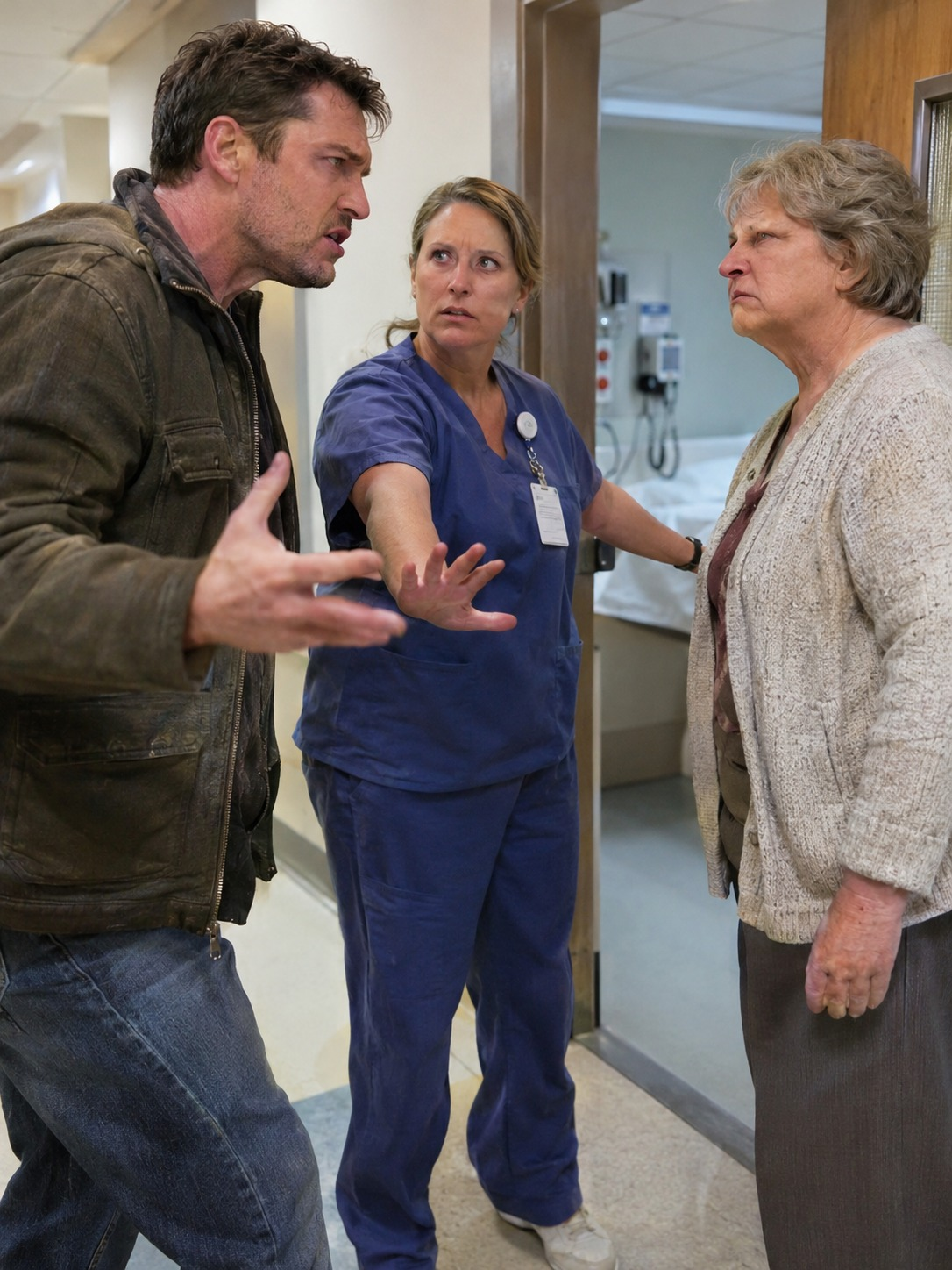
The bathroom door opened.
A woman stepped out.
She was wearing a hospital visitor badge, a gray sweater, and an expression I would remember for the rest of my life.
For one terrible second, I thought she was my mother.
Not because she looked exactly like Wanda.
She didn't.
But because she had the same rigid posture, the same habit of keeping her chin raised, and the same way of looking at a room as though she expected everyone inside it to obey her.
Then she stepped into the light.
And I saw her face.
She looked like me.
The same brown eyes.
The same narrow nose.
The same small scar above her left eyebrow, though hers was on the opposite side.
I stopped in the doorway.
Max was sitting upright in bed, clutching his blanket.
"Dad!"
I moved toward him immediately.
"I'm here."
He reached for my hand.
I took it.
Then I looked at the two women standing beside his bed.
"Who are you?"
The younger woman lowered the photograph.
"My name is Laura."
The older woman near the bathroom door swallowed.
"And I'm Margaret."
I stared at her.
"Margaret Hensley?"
She nodded.
I couldn't speak.
The woman who had saved Daniel from the basement in 1989.
The woman whose name appeared on the old family services report.
The woman connected to my birth.
She was standing in my son's hospital room.
And the younger woman beside her looked enough like me to make my stomach turn.
"Get away from his bed," I said.
Laura stepped back immediately.
Margaret raised both hands.
"We're not here to hurt him."
"Then why are you here?"
Margaret looked at Max.
"Your son asked us to come inside."
I turned toward him.
"Buddy?"
He nodded nervously.
"The lady said she knew Grandpa Edward."
I closed my eyes.
Of course.
That name.
The one name Max trusted almost as much as mine.
I looked back at Margaret.
"You should have asked me first."
"You're right," she said.
There was no argument.
No explanation about good intentions.
Just those two words.
For some reason, that made me angrier.
"Please leave the room."
Margaret nodded.
"Of course."
Laura followed her into the hallway.
I waited until they were gone.
Then I sat beside Max.
He was trembling.
"Are you okay?"
He nodded.
"Why were they here?"
"I don't know everything yet."
He looked toward the door.
"The younger lady said she was your sister."
I felt cold.
I stared at him.
"What?"
Max nodded.
"She said she was your twin."
I couldn't move.
The hospital bracelets.
The photograph of two babies.
Richard Hale's words.
Ask her what happened to the other baby.
I looked at my son.
He seemed frightened by my expression.
"Dad?"
I forced myself to breathe.
"I'm okay."
He studied my face.
"Are you sure?"
I nodded.
Then I took his hand.
"Max, I need you to know something."
"What?"
"Whatever those people say, nothing changes between you and me."
He frowned.
"Why would it?"
My throat tightened.
I looked at him.
He was thirteen.
He had spent days in pain.
He had been frightened by adults who treated him like something they could claim.
And still, when I told him our family might be changing, his first question was why it would change us.
I squeezed his hand.
"You're right."
He nodded.
Then he whispered, "Can we go home soon?"
I looked at the IV line beside his bed.
The surgical dressing.
The drain that Dr. Patel was still monitoring.
"Soon, buddy. As soon as the doctor says it's safe."
He nodded.
"Okay."
I stayed beside him until Kimberly arrived.
She checked his vital signs and reassured me that the sudden excitement hadn't caused any obvious medical problem.
Then I asked her to make sure no unexpected visitors entered the room.
She nodded.
"Already arranged."
I looked at her.
"Thank you."
She smiled gently.
"He's doing better, Mr. Owens."
I looked at Max.
He had already picked up his pencil.
He was drawing another horse.
"Yeah," I whispered.
"He is."
I stepped into the hallway.
Daniel was waiting.
So were Helen, Margaret, Laura, and Richard Hale.
Michael Voss was nowhere in sight.
Ray stood near the elevators.
I looked at the group.
For forty-three years, these people had known pieces of my life that I didn't.
Now they were standing together outside my son's hospital room.
And I was finished allowing them to decide what I deserved to know.
"Nobody goes near Max again without my permission," I said.
Margaret nodded.
"Understood."
Laura looked ashamed.
"I'm sorry. I shouldn't have gone in."
I studied her face.
The resemblance was unmistakable.
But resemblance wasn't proof.
I had learned that much.
I turned toward Richard.
"You said there were two babies."
He nodded.
"Yes."
I looked at Margaret.
"Tell me what happened."
She took a breath.
"Not here."
I almost laughed.
"That's what everyone keeps saying."
Margaret looked at me.
"Then let me say it differently. You deserve the truth, and your son deserves a quiet room. We can sit somewhere private and tell you everything."
I looked at Daniel.
He nodded.
"I'll stay with Max."
I swallowed.
"Okay."
We went to the family consultation room.
Sarah Whitcomb joined us by phone.
I wanted someone there who would ask questions instead of accepting explanations.
Margaret sat across from me.
Laura sat beside her.
Richard remained near the door.
Helen took a chair by the window.
I looked at Margaret.
"Start at the beginning."
She nodded.
"Forty-three years ago, I gave birth to twins."
My heart stopped.
She continued.
"A boy and a girl."
I looked at Laura.
Her eyes filled.
"Us?" I whispered.
Margaret nodded.
"Yes."
I stared at her.
For a moment, I couldn't speak.
Then I asked, "Why didn't you raise us?"
Margaret lowered her eyes.
"I was nineteen. I had very little money. I was frightened. And I was being pressured by people who convinced me I couldn't care for either of you."
I looked toward Richard.
He said nothing.
Margaret continued.
"Michael Voss was involved in the situation. He had helped me find work and housing, and I depended on him more than I should have."
I felt cold.
"Was he our father?"
She shook her head.
"No."
I released a breath I hadn't realized I was holding.
"Then who was?"
Margaret looked at Laura.
Then back at me.
"His name was Samuel Price. He was a young mechanic. We were together briefly. He died in an accident before you were born."
I stared at her.
The name meant nothing to me.
And yet it was part of me.
Margaret continued.
"Edward Owens knew Samuel. They worked together at the tire plant for a short time."
My throat tightened.
"Dad knew him?"
She nodded.
"Yes."
I looked down.
Of course Dad had known.
He'd been there from the beginning.
Margaret continued.
"When I became pregnant, Edward offered to help. He and Wanda had been hoping for another child. Daniel was already part of their family."
I frowned.
"Then why did you keep Laura?"
Margaret looked at her daughter.
"Because I couldn't bear to give up both of you."
Laura wiped her eyes.
Margaret continued.
"I agreed to let Edward and Wanda raise you. I kept Laura. I told myself I would explain everything when you were older."
I stared at her.
"Did you?"
She shook her head.
"No."
"Why?"
"Because Michael threatened to expose the arrangement in a way that would hurt everyone involved. He said the paperwork wasn't properly completed. He said Edward could lose you."
I looked at Richard.
He nodded slowly.
"That's what Edward feared."
I turned back to Margaret.
"Was there a legal adoption?"
She swallowed.
"There were guardianship papers and later court proceedings. Edward told me the legal arrangements were completed, but I never received every document."
Sarah's voice came through the phone.
"We'll need to obtain certified records before making any legal conclusions."
Margaret nodded.
"Of course."
I looked at her.
"Did Wanda know you were my mother?"
"Yes."
"Did she know about Laura?"
"Yes."
I closed my eyes.
My mother had known.
All those years.
Every birthday.
Every Christmas.
Every time she told me I owed her for raising me.
She had known I had a twin sister somewhere.
And she had never said a word.
I looked at Margaret.
"Why did you move next door to us?"
Her eyes filled.
"Because I wanted to know you."
I stared at her.
"You were our neighbor."
She nodded.
"For several years."
"You watched me grow up."
"Yes."
"And you never told me?"
She began crying.
"I was afraid."
I looked away.
That word again.
Afraid.
It had shaped nearly every decision in my family.
But Margaret continued.
"I also saw how Wanda treated Daniel. I saw things I couldn't ignore."
I looked back.
"The basement."
She nodded.
"That night, I heard him crying. I called Edward. When I realized what had happened, I gave a statement."
I swallowed.
"Why didn't you tell anyone about me then?"
"Because I thought exposing the old arrangement might make things worse for you."
I stared at her.
"You were wrong."
She nodded.
"I know."
There was no defense in her voice.
No attempt to make herself the victim.
She looked at me and accepted it.
"I was wrong," she repeated.
I sat back.
For a long time, nobody spoke.
Then I looked at Laura.
"Did you know about me?"
She nodded.
"Since I was sixteen."
I stared at her.
"Why didn't you contact me?"
She wiped her eyes.
"I tried once."
My stomach tightened.
"When?"
"About ten years ago."
I frowned.
"What happened?"
"I sent a letter to your mother's house."
I closed my eyes.
Of course.
"Did she answer?"
Laura nodded.
"She called me."
My heart pounded.
"What did she say?"
Laura swallowed.
"She told me you knew about me and didn't want contact."
I stared at her.
"I never knew you existed."
She began crying.
"I know that now."
I looked down.
For ten years, my sister had believed I rejected her.
And for forty-three years, I'd lived without knowing she was there.
I wanted to be angry.
I was angry.
But when I looked at Laura, I saw something else.
A woman who had been lied to.
Just like me.
I took a breath.
"Do you have children?"
She smiled through her tears.
"Two daughters."
I stared at her.
"How old?"
"Nine and eleven."
I felt something shift inside me.
Max had cousins.
Two little girls he'd never met.
I looked at Laura.
"Do they know about me?"
She nodded.
"They know I have a brother."
My throat tightened.
"What do they think?"
She laughed softly.
"They think you're probably very tall."
I almost smiled.
"I'm not that tall."
She looked at me.
"You're taller than me."
For the first time that evening, I laughed.
It surprised both of us.
Then Laura reached across the table.
She stopped before touching my hand.
"Jeffrey, I don't expect you to trust me immediately."
I looked at her.
"I don't know what I feel."
She nodded.
"That's okay."
"But I'd like to get to know you."
Her face changed.
She began crying again.
"So would I."
I looked at Margaret.
"And you."
She covered her mouth.
I continued.
"But slowly. And only if everyone tells the truth from now on."
Margaret nodded.
"Whatever you need."
I looked toward Richard.
"That includes you."
He lowered his eyes.
"Yes."
Then I asked the question that had been waiting in my chest.
"What happened to Dad?"
The room went quiet.
Richard took a breath.
"Edward had heart disease."
I nodded.
"Did Mom know?"
"Yes."
"Did she discourage him from getting treatment?"
Richard hesitated.
"Edward told me she dismissed his symptoms. But I can't tell you what happened in every conversation between them."
I looked at Margaret.
She nodded sadly.
"He called me a few weeks before he died. He said he was tired all the time."
I swallowed.
"Did he say he was afraid?"
"Yes."
"Of Mom?"
Margaret hesitated.
"Of what would happen to you if he wasn't there."
My eyes filled.
I looked down.
Sarah spoke gently.
"Jeffrey, we can request the medical records that are available. But nothing you've heard today proves that someone deliberately caused his death."
I nodded.
I knew.
And I didn't want grief to become another story built on assumptions.
Dad had died of a heart attack.
He'd experienced warning symptoms.
He should have received medical attention sooner.
And the people around him had failed to take his pain seriously.
That was terrible enough.
I didn't need to invent something worse.
I looked at Richard.
"Why did you keep the storage unit active?"
He took a breath.
"Because Edward asked me to preserve the records."
"And why did you keep them from me?"
Richard lowered his eyes.
"Because I convinced myself I was honoring his wishes."
I stared at him.
"Were you?"
He shook his head.
"Not anymore."
I nodded slowly.
"Then I want everything."
"Of course."
"All the original records. The correspondence. The payment history. Everything you have."
Richard nodded.
"I'll cooperate with Sarah and provide the materials through the proper process."
I looked at Helen.
"And Michael?"
Her expression darkened.
"He knew about the arrangement. He used it to pressure Edward for money."
I felt sick.
"And after Dad died?"
"He continued pressuring Wanda."
I stared at her.
"Then why did she work with him?"
Helen looked down.
"Because they discovered they could use each other."
I thought about the caregiver authorization.
The school letters.
The custody petition.
The photograph of Max.
My mother had wanted control.
Michael had wanted money.
And both had been willing to use my son.
I looked at Sarah's phone on the table.
"Can any of this help us Monday?"
Sarah answered carefully.
"The most relevant evidence will concern Max's safety, your parenting, and the authenticity of the documents submitted in the custody case. The older family history may provide context, but we need to keep the issues separate."
I nodded.
"Then that's what we'll do."
I stood.
For the first time, I wasn't desperate to hear another secret.
I had heard enough.
Now I needed to protect my son.
Monday morning arrived cold and gray.
Max remained in the hospital.
Dr. Patel had explained that his recovery was progressing, but he still needed monitoring and antibiotics.
Daniel stayed with him.
Rebecca sat beside his bed.
Kimberly checked on him before I left.
I wore the only dark suit I owned.
The same one I'd worn to Dad's funeral.
I hadn't planned that.
But when I saw myself in the mirror, I thought of him.
I thought of the letter he'd left.
You were wanted. You were loved.
I folded the copy and placed it in my pocket.
Then I went to court.
Sarah met me outside the courtroom.
She carried a folder filled with documents.
Hospital records.
Witness statements.
Copies of the disputed authorization.
Messages from Carrie.
The school letter.
And evidence showing the differences between the original pickup authorization and the document my mother had submitted.
I looked at her.
"Are we ready?"
She nodded.
"We're prepared to present what we have and address the court's questions."
I swallowed.
"Okay."
Then I saw Mom.
She stood near the far wall.
She wore a dark blue dress and carried a handbag.
Her hair was perfectly arranged.
She looked calm.
Almost pleased.
When she saw me, she smiled.
"Jeffrey."
I stopped.
Sarah stepped beside me.
"Mrs. Owens, any legal communication should go through counsel."
Mom ignored her.
"You're making a terrible mistake."
I stared at her.
For years, those words would have frightened me.
Now they sounded tired.
Predictable.
I looked at Mom.
"No."
Her smile disappeared.
I continued.
"The mistake was letting you convince Max that being afraid meant he was weak."
Her face tightened.
"You've turned him against me."
I shook my head.
"No. You frightened him."
She looked toward Sarah.
"This is ridiculous."
I didn't argue.
I didn't raise my voice.
I simply walked past her.
Inside the courtroom, I sat beside Sarah.
Mom sat across from us with her new attorney.
The hearing began.
The judge reviewed the emergency petition and the responses.
Mom's attorney argued that she had provided substantial care for Max and believed I was overwhelmed by work.
Sarah responded with the hospital documentation and evidence of my involvement in Max's medical care.
She explained that I had taken him for emergency treatment, remained involved in his recovery, and acted promptly when the hospital incident occurred.
Then she addressed the caregiver authorization.
The judge examined the documents.
The original school form.
The broader caregiver document.
The signatures.
The dates.
Sarah explained that authenticity was disputed and that the copied signature required further examination.
Mom's attorney argued that she had believed the authorization was valid.
The judge did not resolve the authenticity question that morning.
But the judge made something very clear.
A disputed document and unsupported allegations did not establish that Max should be removed from my care.
Then the hospital evidence was discussed.
Kimberly's statement.
Rachel Bennett's notes.
The security report.
Dr. Patel's medical observations.
The judge listened carefully.
Mom sat rigidly.
She didn't look at me.
When the judge asked whether she disputed physically removing Max from his hospital bed, Mom hesitated.
Then she said, "I was trying to teach him to be strong."
I felt my chest tighten.
Sarah placed a hand lightly on my arm.
The judge asked whether she understood that Max had just undergone abdominal surgery.
Mom answered, "He was exaggerating his pain."
The courtroom became very quiet.
I looked down.
I had heard those words my entire life.
Daniel was exaggerating.
Dad was exaggerating.
I was exaggerating.
Max was exaggerating.
But this time, the person listening wasn't a frightened child.
It was a judge.
And my mother's words had consequences.
After reviewing the evidence presented, the judge denied the emergency request for temporary custody.
The court did not grant Mom decision-making authority over Max.
The judge also directed that the disputed documents and allegations be addressed through appropriate further proceedings if either party wished to pursue them.
Sarah leaned toward me.
"Jeffrey, the emergency motion is denied."
I stared at her.
I had heard the words.
But they didn't seem real.
"He's staying with me?"
"Yes."
I closed my eyes.
For a moment, I couldn't breathe.
Then I felt tears running down my face.
I wiped them away.
Across the room, Mom stood abruptly.
"This isn't right."
Her attorney touched her arm.
She pulled away.
"I raised that boy."
I looked at her.
She meant me.
Not Max.
I knew because of the way she was staring.
As though the years she'd spent raising me entitled her to control everything I loved.
The judge reminded her that the hearing was concluded.
Mom sat down.
I didn't look at her again.
Outside the courtroom, Sarah explained the next steps.
The emergency motion was denied, but the underlying custody dispute could still require formal resolution.
We would preserve the evidence.
We would cooperate with the child services investigation.
And we would make sure Max had appropriate support.
I nodded.
"Thank you."
Sarah smiled.
"You're welcome."
Then she said, "Jeffrey, there's something else."
My stomach tightened.
"What?"
"Carrie contacted me this morning."
I looked at her.
"Why?"
"She provided a written statement."
I swallowed.
"About three years ago?"
Sarah nodded.
"She acknowledges grabbing Max's arm. She confirms that he was injured and that she should have contacted you immediately."
I closed my eyes.
Sarah continued.
"She also provided messages concerning Michael Voss and the caregiver document."
I looked at her.
"Does she want custody?"
"No. She has not asked for that."
I released a breath.
"Then what does she want?"
Sarah looked at me.
"She says she wants to take responsibility for what happened."
I nodded slowly.
For years, Carrie had been a wound I tried not to touch.
Now I understood that avoiding the truth had never helped Max.
I would not force him to see her.
But I would not lie to him about her either.
Whatever happened next would have to begin with honesty.
And with his safety.
The child services investigation continued after the hearing.
Melissa Grant spoke with the hospital staff, reviewed the records, and arranged for Max to be interviewed by a trained professional when his medical condition allowed.
I cooperated.
So did Daniel.
Rebecca gave a full account of what she'd witnessed.
Thomas Bennett provided his statement about the incident three years earlier.
Elaine Porter produced her original letter.
It did not contain the language praising my mother as Max's primary caregiver.
The statement submitted with the custody petition had been materially altered.
The original school authorization also differed from the broader caregiver document.
Further examination established that my signature image had been copied into the disputed form.
The evidence was referred to the appropriate authorities.
Michael Voss's role was investigated as well.
Richard produced emails showing that Michael had helped assemble documents for Wanda and had received payments from her.
Those records did not make every question simple.
But they gave investigators something real.
Dates.
Files.
Messages.
People willing to testify.
Eventually, the court proceedings concerning Mom's custody petition were dismissed after her attorney withdrew the unsupported claims and Mom abandoned her request.
The disputed documents were no longer treated as valid authorizations.
Separate investigations into their preparation continued through the proper channels.
I didn't need to know every consequence immediately.
I needed to know Max was safe.
And he was.
The hospital maintained its visitor restrictions until he was discharged.
At home, I changed the locks.
I updated his school records.
I removed Mom from the emergency contact list.
I made sure the school knew who was authorized to collect him.
I also arranged counseling for Max.
Not because something was wrong with him.
Because too much had happened to him, and he deserved someone trained to help him understand it.
I attended sessions when invited.
Sometimes he wanted to talk.
Sometimes he wanted to draw.
Sometimes he just wanted to sit beside me and say nothing.
I learned not to rush him.
I learned that silence could be safe when nobody was using it to hide the truth.
And I learned to listen when my son said he was uncomfortable.
Even when I didn't immediately understand why.
Especially then.
Three weeks after the hearing, Max came home from the hospital.
He walked slowly.
He still tired easily.
But his infection had resolved, his surgical wounds were healing, and Dr. Patel was pleased with his progress.
When we reached our front door, Max stopped.
I looked at him.
"Everything okay?"
He nodded.
Then asked, "Grandma isn't inside?"
I felt my chest tighten.
"No."
"Promise?"
I took out my keys.
"Promise."
He looked at the new lock.
Then at me.
"You changed it."
"Yes."
He smiled.
A small smile.
But real.
I opened the door.
Max stepped inside.
He looked around.
The living room was exactly as he'd left it.
His sneakers by the couch.
His drawings on the refrigerator.
The blanket he liked folded over the armchair.
He stood there for a moment.
Then whispered, "Home."
I swallowed.
"Yeah, buddy."
He turned toward me.
"Can we order pizza?"
I laughed.
"After the doctor clears your regular diet completely, we can celebrate with whatever you want."
He considered this.
"Pepperoni."
"Deal."
He smiled.
Then he hugged me.
Carefully.
Because his abdomen was still tender.
I held him just as carefully.
And for the first time in days, I felt something other than fear.
I felt relief.
Not because everything was fixed.
But because we were home.
Together.
The records from unit seventeen arrived several weeks later.
Sarah helped arrange access through the proper documentation.
Richard cooperated fully.
Inside the unit were boxes of medical records, correspondence, photographs, and handwritten notes.
Dad had kept more than I imagined.
There were records about Daniel's hospitalization in 1989.
Copies of letters concerning my childhood.
Notes about arguments with Mom.
And documents connected to my birth.
The certified records eventually confirmed what Margaret had told me.
Laura and I were twins.
Margaret Hensley was our biological mother.
Samuel Price was identified as our biological father.
Edward and Wanda had legally adopted me after a complicated early guardianship arrangement.
The adoption itself had been valid.
Michael Voss had no legal parental authority over me.
He had exploited uncertainty and secrecy surrounding the early paperwork to pressure the adults involved.
My father had spent years trying to keep him away.
I sat at my kitchen table reading the records.
Daniel sat beside me.
Laura was across from us.
Margaret stood near the window.
For a long time, nobody spoke.
Then I looked at the adoption order.
Edward Michael Owens.
My father.
The man who had chosen to raise me.
The man who taught me how to ride a bicycle.
The man who waited outside my classroom.
The man who held Max when he was born.
I traced his name with my finger.
Then I looked at Laura.
"I wish he'd told me."
She nodded.
"I know."
I swallowed.
"But I'm glad he was my dad."
Laura smiled through her tears.
"He sounds like a good man."
I looked at Daniel.
My brother's eyes were wet.
"He was," Daniel said.
Then he took a breath.
"And he made mistakes."
I nodded.
"Yeah."
Daniel looked at me.
"But he loved us."
I smiled sadly.
"He did."
For years, I had believed loving someone meant protecting them from painful truths.
Now I understood that Dad's secrecy had hurt us too.
He had loved me.
He had also been afraid.
Both things could be true.
I could honor him without pretending he'd been perfect.
And I could forgive him without repeating his mistakes.
That mattered more than I could explain.
I saw Mom one final time before deciding how much contact, if any, I wanted in the future.
We met in a supervised conference room at Sarah's office.
I didn't bring Max.
I didn't bring Daniel.
I went because there were things I needed to say.
Mom sat across from me.
She looked older.
Her hair was still perfectly arranged.
Her handbag rested on her lap.
But the confidence I'd known all my life seemed diminished.
"Jeffrey," she said.
I nodded.
"Mom."
She looked at me.
"I never wanted to lose you."
I took a breath.
"You didn't lose me because I found out about my birth."
Her eyes filled.
I continued.
"You lost my trust because you lied to me. Because you hurt Max. Because you tried to use documents to take him away."
She looked down.
"I thought I was helping."
I shook my head.
"No."
She looked up.
I kept my voice steady.
"You were trying to control us."
Her mouth tightened.
"I raised you."
"I know."
"I fed you. I clothed you. I took care of you."
"I know."
She leaned forward.
"Doesn't that mean anything?"
I looked at her.
"Yes."
For a moment, she seemed relieved.
Then I continued.
"But it doesn't mean you own me."
Her face changed.
I swallowed.
"And it doesn't mean you own Max."
She stared at me.
For once, she had no answer.
I took a breath.
"Max won't be seeing you. Not now."
Her eyes filled.
"Jeffrey—"
"He's afraid of you."
She looked away.
I continued.
"If you want to change, that's your responsibility. You can get help. You can take responsibility for what happened. But you can't demand that Max forgive you."
She began crying.
I watched her.
For most of my life, her tears had meant I needed to fix something.
I needed to apologize.
I needed to give in.
I needed to make her happy again.
This time, I stayed seated.
I let her cry.
And I didn't change my decision.
When the meeting ended, she asked one final question.
"Do you still love me?"
I looked at her.
The answer was complicated.
But I wasn't going to lie.
"Part of me always will."
She began crying harder.
I continued.
"But love doesn't mean I have to let you hurt us."
Then I stood.
I walked to the door.
And I left.
I didn't feel triumphant.
I felt sad.
But I also felt free to make my own decisions.
For the first time, that was enough.
Carrie met with me several months later.
We sat at a small café outside Dayton.
She looked nervous.
I was nervous too.
For years, I'd imagined what I would say if I ever saw her again.
Most of those imagined conversations ended with me shouting.
But when she sat across from me, I found that I didn't want to shout.
I wanted answers.
And I wanted to know whether she understood what she'd done.
Carrie folded her hands.
"Jeff, I'm sorry."
I looked at her.
"For leaving?"
She nodded.
"For leaving. For not calling. For coming back three years ago and handling everything so badly."
I waited.
She swallowed.
"I hurt Max."
I nodded.
"Yes."
"I didn't mean to."
"I believe that."
Her eyes filled.
"But you did hurt him."
She nodded.
"I know."
I looked down.
Then back at her.
"He spent years thinking you didn't want him."
Carrie began crying.
I continued.
"He waited for you on his birthday."
She covered her mouth.
"He thought if he got sick enough, you might come back."
Carrie broke down.
I sat quietly.
I didn't comfort her.
Not because I wanted to punish her.
Because this wasn't my pain to make easier.
When she finally looked up, she whispered, "Is there anything I can do?"
I took a breath.
"Yes."
She leaned forward.
"Anything."
"Tell the truth. Keep taking responsibility. And don't pressure him to see you."
She nodded immediately.
"I won't."
I looked at her.
"If Max ever wants contact, we'll handle it carefully and with professional guidance."
She nodded.
"I understand."
I studied her face.
I didn't know whether Max would ever want a relationship with her.
That wasn't a decision I could make for him.
But I could make sure he had accurate information.
And I could make sure he knew that the adults who failed him were responsible for their own choices.
Not him.
Carrie wiped her eyes.
"Thank you for meeting me."
I nodded.
"Take care of yourself."
Then I left.
There was no dramatic reconciliation.
No sudden forgiveness.
Just a truthful conversation.
For us, that was a beginning.
By spring, Max was back at school full-time.
He was growing stronger.
He laughed more.
He complained about homework.
He argued with me about bedtime.
He asked for second helpings at dinner.
Ordinary things.
Beautiful things.
One Saturday morning, Daniel came over with Rebecca.
Laura arrived with her two daughters.
Margaret brought homemade muffins.
The house was full of noise.
Max sat at the kitchen table showing his cousins how to draw horses.
Laura watched him with a smile.
I stood beside her.
"He's good," she said.
I nodded.
"He's always loved drawing."
She looked at me.
"Did you draw when you were little?"
I laughed.
"Terribly."
She smiled.
"Me too."
I looked at her.
There were still things we didn't know about each other.
Forty-three years couldn't be recovered in a few months.
But we were learning.
Slowly.
Honestly.
Without pretending the past hadn't happened.
Daniel walked into the kitchen carrying a plate of muffins.
"Jeff, your son has been telling me something."
I frowned.
"What?"
Max looked up.
"Dad, don't get mad."
I laughed.
"That's usually a terrible way to start a sentence."
He grinned.
"I want a dog."
I stared at him.
Daniel smiled.
Rebecca laughed.
Laura's daughters began cheering.
I looked around.
"You've all been planning this."
Max nodded proudly.
"Maybe."
I shook my head.
"Unbelievable."
He leaned forward.
"Please?"
I looked at him.
His face was bright.
His eyes were hopeful.
And for once, there was no fear behind the question.
He wasn't asking whether he was allowed to need something.
He was asking for something he wanted.
I smiled.
"We can look into it."
Max jumped out of his chair.
"Really?"
"Really. But a dog is a responsibility."
"I know!"
"Walking. Feeding. Cleaning up."
"I know!"
Daniel laughed.
"He's already got a name picked out."
I looked at Max.
"Of course he does."
Max grinned.
"Scout."
I smiled.
"Scout?"
He nodded.
"Because he can help us find adventures."
I laughed.
"All right. We'll see."
Two weeks later, we adopted a scruffy brown rescue dog from a local shelter.
He had one floppy ear.
A white patch on his chest.
And absolutely no understanding of personal space.
Max loved him immediately.
Scout followed him everywhere.
Into the kitchen.
Into the living room.
Down the hallway.
He slept beside Max's bed.
And whenever Max woke from a bad dream, Scout was there.
Sometimes I was too.
We didn't pretend the nightmares had disappeared.
We didn't pretend the past was gone.
But Max no longer had to face those moments alone.
On the first anniversary of his surgery, Max and I visited Dad's grave.
The sky was clear.
The grass was green.
Scout waited beside us on his leash.
Max carried a drawing.
It showed three people standing in a field.
A grandfather.
A father.
And a boy.
Beside them was a brown dog.
Max placed the drawing against the headstone.
I looked at him.
"What's that?"
He smiled.
"Grandpa Edward."
I swallowed.
"And who's the boy?"
"Me."
"And the other guy?"
Max looked at me as though I were being ridiculous.
"You, Dad."
I laughed softly.
"Right."
He stood beside me.
For a while, we looked at the headstone.
Then Max asked, "Do you think Grandpa would like Scout?"
I smiled.
"He would've loved him."
Max nodded.
"Yeah."
We stood quietly.
Then he looked up.
"Dad?"
"Yeah?"
"Are you happy?"
The question surprised me.
I looked at him.
At the boy who had been dragged from a hospital bed.
At the child who had spent years afraid to ask for help.
At the son who had somehow found the courage to tell the truth.
I thought about Daniel.
Rebecca.
Laura.
Margaret.
The family we'd lost.
The family we'd found.
The people who had hurt us.
And the people who had finally chosen to help.
I thought about Dad.
About his mistakes.
About his love.
About the letter he'd left me.
Then I looked at Max.
"Yeah, buddy."
I smiled.
"I am."
He grinned.
"Me too."
Scout barked.
Max laughed.
Then he reached for my hand.
"Can we go home?"
I looked at Dad's headstone one last time.
For years, I'd believed being a good son meant keeping everyone happy.
Even when it hurt.
Even when it meant ignoring my own fear.
Even when it meant teaching my child to ignore his.
Now I understood something Dad had tried to tell me before he died.
Love wasn't measured by how much pain you could endure.
It was measured by what you were willing to do to keep someone safe.
I took Max's hand.
"Yeah," I said.
"Let's go home."
We walked toward the car.
Scout trotted beside us.
Max talked about school.
About his drawings.
About the comic book he wanted to finish.
I listened.
Really listened.
And when he stopped halfway down the path, I stopped too.
"Dad?"
"Yeah?"
He looked at me.
"Thanks for believing me."
My throat tightened.
I knelt beside him.
"Always."
He hugged me.
I held him.
Then we walked the rest of the way together.
At home, the porch light was on.
Daniel had left a message saying he'd come over for dinner.
Rebecca was bringing dessert.
Laura and her girls were coming too.
Scout raced toward the front door.
Max laughed and hurried after him.
I stood on the porch for a moment.
The house was warm.
The windows glowed.
I could hear my son calling for the dog inside.
There were no secrets waiting behind the door.
No one demanding obedience.
No one telling Max that his pain wasn't real.
Just our home.
Our family.
And a future we were finally free to choose.
I stepped inside.
Max looked up from the living room.
"Dad, hurry! Scout stole my sock!"
I laughed.
"I'm coming."
And I closed the door behind me.






Comments 0